Abstract
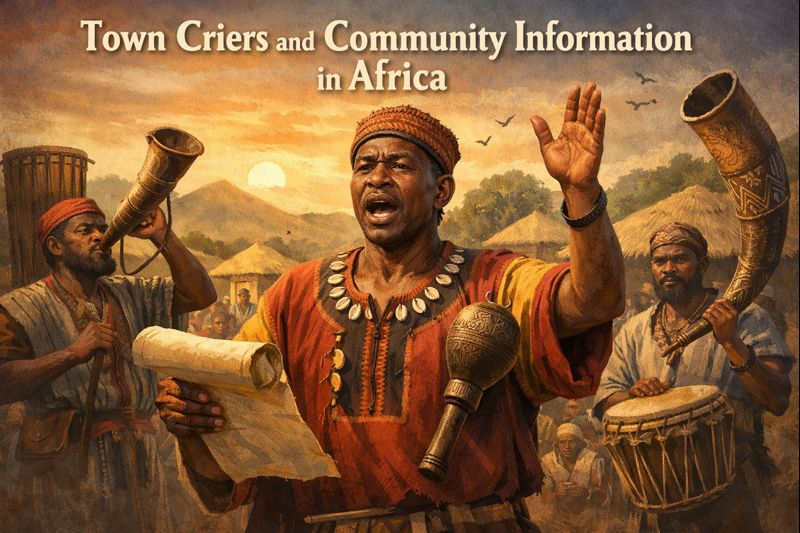
In pre-colonial African, societies, town criers played the role of a formal means of communication in that information flow between the kings, chiefs and councils to the rest of the community was accurate. Town criers were the people who spread knowledge on laws, rituals, emergencies and communal responsibilities and acted as dependable brokers of information that ensured a social order and unity existed. The paper investigates the institution of the town crier with a focus on the structural and functional aspects of its functions in the African governance and community life. This paper relies on historical, ethnographic, and modern sources, as well as previous studies of sound-based communication devices (Ibe, 2026) to showcase the ingenuity of technology and organization of the town crier system. The observations indicate that the role of town criers was to govern, be accountable to the society, resolve disputes, and transmit cultural knowledge.
Keywords: town crier, African communication, pre-colonial Africa, information community, indigenous governance.
1.0 Introduction
Communication has always been inherent towards social cohesion, governance and operation of communities. The pre-colonial African cultures developed complex structures that would guarantee the sharing of essential information within the villages and towns. In pre-colonial Africa, many tools were used as the instruments of mass communication, and human messengers were supplementing the systems, relaying the verbal messages directly to the communities (Nigerian Observer News, 2020).
The official proclamations, such as royal decrees, announcement of festivals, warnings of emergency, and communal duties, were left to the town criers. The position demanded that they should be familiar with the local oral traditions, the knowledge of the ritual procedures, and the ability to win the confidence of people. They were notably noteworthy in West African kingdoms like the Yoruba and Ashanti, Central African polities like the Kongo, and East African communities like the Shona, where human messengers had to be depended upon to cover large distances.
Town criers were still needed to interpret, explain, and enhance messages as far as drums and horns would go, making them accurate and understood socially. The presence of these shows the complexity of the pre-colonial African communication systems which integrated technological, human and social elements in a unified system. In the current paper, the author discusses the nature of the traditional African institution of the town crier and how it served structural, functional, and cultural purposes in ensuring the flow of effective communication channels and ensuring the bonding of communities.
2.0 Literature Review
The use of human and instrumental communication in African society is not new, its usage was recorded by scholars long ago. As Ibe (2026) points out, drums, gongs, and horns played a very important role in communicating with people over long distances. To supplement these tools, town criers operated as formalized human carriers of information, as in between the leaders and the community members, through the direct verbal communication.
Historical research indicates that towns criers were integrated into the governance system and they reported directly to kings, chiefs and council leaders (Okunna, 1999; Vansina, 1985). They were viewed as people with authority as their messages were authoritative and carried social and legal consequences. Nketia (1974), and Finnegan (2012) argue that effective communication in African societies depended on the trustworthiness and societal status of the messenger rather than the medium of transmission.
Specific examples are given by ethnographic studies. The Yoruba also used town criers or akogun to pass on royal announcements throughout their towns but would retain the rhythmic intonation to make the announcements easier to remember and hear. In the Ashanti Kingdom, announcements about taxes, labor contributions, and schedules of festivals were organized by criers (Vansina, 1985). The Kongo and Shona communities employed town criers as the main participants of conflict mediation and organization of the masses, which proves their versatile functions rather than just the delivery of messages.
The sources of the colonial period tended to misunderstand these systems, and the African communication was inaccessible as primitive or informal. Modern academics, however, have pointed to the formalization and procedural excellence of town criers (Osho, 2014). These researches point out that town criers were human tools of rule and social order, who worked in organized, culturally understandable networks, which brought about accountability and obedience.
3.0 Methodology
This paper takes a historical-ethnographic research design, gathering both primary and secondary data, such as oral documents, ethnographic observations, documents about the African communication system during the colonial times, and recent studies on African communication systems. The communities that use town criers are analyzed include those in the West, Central, and East Africa. Thematic analysis was used to find the trends in the role and duties and the social influence of town criers. The interaction between the human messengers and the communication systems of instruments, including drums and horns, was paid special attention (Ibe, 2026).
The theme analysis of data included repetitive themes in administration, emergency communication, ceremonial use, social legitimacy, apprenticeship, and cultural preservation. The historical records were used to illustrate various scenarios in which town criers worked in the ordinary and extraordinary conditions.
4.0 Findings and Discussion
4.1 Service in Community Organization
Town criers made sure that, all members of the community were informed even in remote households, market centers and sacred places. They used repetition, rhythmic cadence, and mnemonics frequently to improve the message retention (Nigerian Observer News, 2020). Town criers in certain cases used the services of drummers or horn players to further increase the reach of their message particularly when there was a need to get a message across urgently.
Discussion: The combination of human and instrumental media depicts a hybrid communication network. It was a system that guaranteed the safety of messages, their promptness and availability in different geographical location, and should be attributed to the technological and social creativity of African societies (Ibe, 2026). The town criers were also involved in a coordinating manner during the agricultural seasons telling of planting or harvesting times, distributing labor to community projects, and managing seasonal markets. The inter-village communication capability allowed them to share instructions and boost everyone’s output and consolidate social structure.
4.2 Emergency and Crisis Communication
The presence of town criers played a critical role with regard to informing people about urgent information. They alerted communities to incoming raids or conflicts, fires and natural disasters, epidemics or health crises, and the requests to perform collective resistance or labor activism.
Discussion: Town criers’ dependency on their understanding of code, projection and community reliance on them in the event of an emergency. Their mobilizing community action shows the strategic relevance of human intermediaries to African communication networks. In certain Ashanti towns, such as, criers would pass on information to the neighboring villages of approaching enemies and they would also coordinate with horn signals to make up a regional alert system. The coastal settlements of East Africa had town criers who announced the storms or pirates invasion, and directed fishermen and traders to shelter.
4.3 Ceremony and Ritual Functions
Other than operating in administration, town criers were instrumental in ceremonies and rituals. They proclaimed the coming of a royalty or dignitaries, marked the beginning of parties and holidays, gave commands to ritual participants, and taught sequences and offerings of rituals.
Discussion: The roles of town criers in these rituals show that cultural continuity featured town criers. This strengthened communal identity and social cohesion by capitalizing on functional announcements and connotative representation (Vansina, 1985; Ibe, 2026). Their tonal quality, volume, and cadence of the voices were also adjusted to suit various audiences to be easily understandable and very serious during rituals. In other instances, the town crier read histories or eulogistic poetry prior to the actual event thereby enforcing oral history and memory.
4.4 Association with Sound-Based Communication
The town criers used to operate in consortium with the drums, gongs and the horns. These instruments relied on tonal or rhythmic cues over long distances as Ibe (2026) explains. These messages were interpreted or amplified at the grassroots through the town criers so that information was available, true and culturally readable.
Discussion: The interaction between human intermediaries and instrumental communication shows the hybrid system of the technological ingenuity and the social intelligence. In other areas, the town crier used to decipher the meaning of drum signals and pass them in a standard form of language that everyone in the village could comprehend. This guaranteed the information fidelity and intelligibility. Also, criers occasionally organized messages of various adjacent villages, an early intercommunity form of networked communication.
4.5 Trust, Social Legitimacy and Training
Town criers had to be credible in order to be effective. The crier announcements were credible to the people in the community due to their formal position, societal acceptance as well as their uniform accuracy. Errors or misrepresentation may lead to social punishment or loss of office.
Discussion: The sustainability of the institution was based on trust and legitimacy. The town criers used to go through various apprenticeship programs as they had to be trained since they were young in memorizing, speaking in front of people, and following the ceremonies and projecting their voice. They were socialized to ethical and procedural norms and communication was always accurate and authoritative. There were also differences in gender roles where male criers dominated in some societies whereas female criers had great ceremonial or market related roles in others. This training, which was institutionalized, provided continuity and stability between generations.
4.6 Governance, Risk Management and Dispute Resolution
Town criers also contributed to the initial administration of law, as well as the resolution of civil conflicts. Through the spread of laws and policy decisions, they strengthened compliance and group responsibility. Town criers in times of conflict declared the community meetings and communicated decisions of the councils. Their proclamations contributed to the upholding of social order through the availability of an open and transparent access to the governing processes.
Discussion: The role of town criers in government reflects the dual aspect of town criers as communication devices and social controls, and this argument indicates that pre-colonial African societies possessed well-structured legal and administrative systems carrying the human communication systems.
5.0 Summary and Conclusion
This paper identifies the crucial status of town criers as official means of communication in the traditional African communities. Town criers spread laws, ceremonial announcements, emergency and instructions of community labor as immediate bridges between kings, chiefs, councils and community. They made sure that any information delivered was accurate, efficient and in a socially accepted way. Instead of working alone, town criers could use instruments like talking drums, gongs, and horns to make sure they reach as many people as possible and they do so precisely and this is an example of human-instrument communication network. Their purpose strengthened social unity, systems of governance, cultural sustainability, and conflict management, which was an African resourcefulness in arranging community information systems (Ibe, 2026).
Town criers were not just messengers but part and parcel of organized communication systems of pre-colonial African societies. They kept order in society, enforced the laws and social duty, society culture, and provided early legal systems. The example of the institution of the town crier shows that the African society created the effective communication channels that are effective, good, and based on human abilities, social power, and instruments. This paper, through the institution of the town crier, validates the fact that the traditional African society had formalized systems of community information distribution, refuting the old colonial notion of how Africans ruled and communicated. Town criers have a legacy that is still present in the modern African societies in terms of its influence on rural and governmental structures, performances at ceremonies, and educational processes.
References
Ibe, F. K. (2026). Drums, gongs, and horns: Sound as mass communication tools in pre-colonial Africa. Dutable. https://dutable.com/drums-gongs-and-horns-sound-as-mass-communication-tools-in-pre-colonial-africa/
Finnegan, R. (2012). Oral literature in Africa. Open Book Publishers.
Nigerian Observer News. (2020). The town crier. https://nigerianobservernews.com/the-town-crier/
Nketia, J. H. K. (1974). The music of Africa. W.W. Norton.
Okunna, C. (1999). Introduction to mass communication. New Generation Books.
Osho, S. (2014). African indigenous communication systems: Theoretical and practical perspectives. Studies in Media and Communication, 2(1), 100–109.
Vansina, J. (1985). Oral tradition as history. University of Wisconsin Press.