Abstract
The pre-colonial African societies had a complex communication structure founded on the extensive use of sound-making instruments such as drums, gongs, and horns. These were official channels of information dissemination, organization, publicity and maintenance of social order. These instruments were some of the earliest tools utilized as a medium of mass communication in pre-colonial Africa. This paper discusses the technological resourcefulness, cultural, and practical uses of these sound-based systems with reference to their contribution to governance, conflict management, social cohesion, and maintaining oral heritage. The findings made show that sound communication is a multifaceted indigenous body of knowledge in Africa and should not be mistaken for myths about pre-colonial technological and communicative abilities of Africans.
Keywords: Communication with drums, gongs, horns, talking, pre-colonial Africa, indigenous knowledge.
1. Introduction
Communication has always been the core of how societies function and their cohesiveness. Even before the advent of Western forms of media, African societies in pre-colonial times had devised sophisticated methods of communication (Finnegan, 2012). Some of the most effective systems were sound-based systems which involved the use of gongs, horns and drums. These instruments were used as tools of communicating structured messages as perceived by the larger community, and were major instruments of social organization, government and emergency warnings (Vansina, 1985).
The indigenous technology is an expression of these tools. African communities developed proper channels of distributing information using the codes of linguistic aspects, tonality, rhythmic patterns, etc. They helped in passing political orders, cultural regulations, cautions and mobilization messages both over distances and space. In the paper, the roles, mechanisms, and significance of these instruments as functional mass communication tools are explored, particularly, their technological ingenuity, influence in society, and value to culture.
2. Literature Review
Indigenous African communication systems have been widely documented by ethnomusicologists, anthropologists and historians. Vansina (1985) highlighted the importance of oral traditions in Africa in the discussion of sophisticated systems of historical and social information. According to Nketia (1974), the tonal patterns of African languages are recreated by talking drums. Carrington (1949) and Akpabot (1998) pointed out that drums, gongs, and horns were multifunctional in the organization of communities, imposing social norms and storing cultural knowledge.
The latest studies challenge the colonialist myth which posits that African cultures lacked sophisticated written or structured communication (Finnegan, 2012; Osho, 2014). The mass communication technologies domestically created were African, and they could transmit the particular information, organize masses, and sustain the governance systems. These studies suggest that African sound instruments were not only practical, but also technologically superior and effective in mass communication in the early years.
3. Methodology
The paper is a historical-ethnographic work which involves both primary and secondary sources including ethnomusicological analyses, oral histories, documentation of the colonial era, and contemporary research on the topic of African indigenous communication. The research aims at the selected populations of West, Central and Eastern Africa where the use of talking drums, gongs and horns has been documented. Patterns of communication, technological approaches, social functions and cultural meanings were established through the thematic analysis. It emphasized the aspects of structure and functionality of these tools as communication tools.
4. Findings/Discussion
4.1 Talking Drums: Structural and Linguistic Capacity
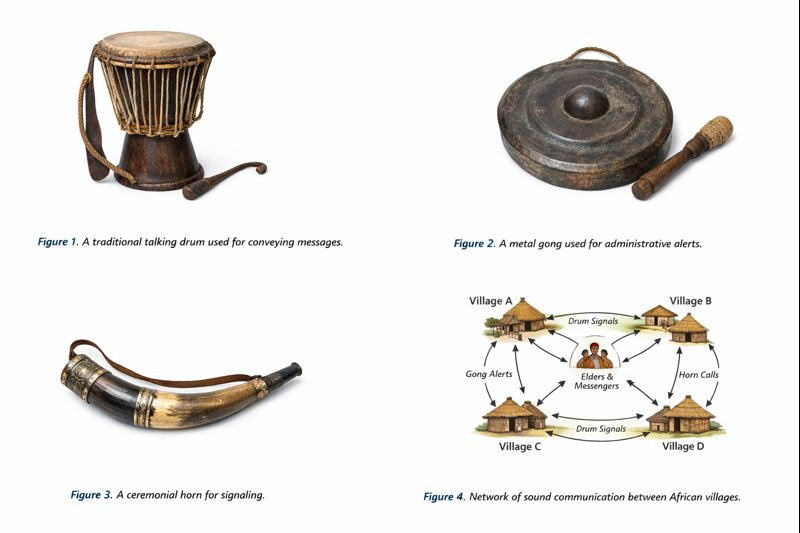
One of the most advanced instruments of mass communication tools in African history is the talking drums. The talking drums were mostly common among the Yoruba people of Nigeria, the Akan people of Ghana and other cultures of the Central African areas and these were designed to recreate the tonal and rhythmic attributes of spoken language (Nketia, 1974). The majority of the African languages are tonal and mean that a change in pitch will change the meaning. Drummers regulated the tension of their drums, the strategies, and beats to reproduce any meaningful linguistic message.
Extremely skilled drummers could pass names, proverbs, royal commands and general announcements. Drums were therefore used as musical instruments and codes of language transmission and decryption in systematic forms.
4.2 Long-Distance Communication
A key advantage of the talking drums was that communication over a very long distance was feasible with their help. The beats of the drums could go through forests, valleys and open savannahs. Neighbouring communities acted as a relay station in which messages were passed on to another village and this led to a networked form of communication (Akpabot, 1998).
Messages sent by drums included:
- Royal or chiefly issued political directions.
- Precautionary messages before a raid and natural disaster.
- Invoking community meetings.
- Festivals announcements and instructions.
The accuracy of the messages was based on how the drummer and the audience’s literacy to interpret the tonal patterns of the language.
4.3 Social and Cultural Functions
Talking drum, as one of the mass communication tools, supported socialization and collective memory. They preserved oral history, ancestry and cultural knowledge. Drums played significant roles in the ceremonies, gatherings, and rituals, serving both functional and symbolic roles. The union of technology and culture was manifested in the talking drums, bridging governance, ritual and communication (Carrington, 1949).
4.4 Gongs: Administrative, Governance, and Emergency Communication
Gongs, which could be metallic or wooden, were integral to administrative communication. Their sounds attracted communities to crucial messages, often delivered through town criers or elders (Okunna, 1999). Unlike talking drums, gongs were used to draw attention before verbal messages would be sent.
Common uses included:
- Publicity of new policies or legislation.
- Meetings or councils of the neighborhood.
- Trade notices and market scheduling.
- Work and Building project notifications.
Gongs were also significant in alerting the community the crucial occurrences or urgent events. Their sound was metallic, and it could be heard from a great distance, and it could also be distinguished from ordinary noises. Communities assigned specific rhythmic patterns to:
- Incoming attacks or raids
- Fire outbreaks
- Floods and natural disasters.
- Arranged local self-defense.
4.5 Horns: Ceremonial, Strategic, and Symbolic Communication
Horns were associated with leadership, spirituality, and status. They were crafted with tusks of the elephant, horns of animals or carved wood to give deep tones that demanded respect and attention (Nketia, 1974). Horns passed messages which presented physical and symbolic presence which favored social structure.
The arrival of royalty, the start of celebrations or the ceremonial events were announced using horns. They were also used in the declarations of war or peace, combining practical and symbolic communication functions (Vansina, 1985). Their multidimensional communicative ability is shown by the role the horn plays in rituals, which infused communities into the spiritual and cultural worlds.
Horns were used in the declaration of war and hunting. Blasts represented a certain order, like attack, retreat, or assembly points. Their success depended on familiarity with coded signals, highlighting the complexity of indigenous communication systems.
4.6 Comparison of Drums, Gongs, and Horns
| Instrument | Primary Function | Range | Social Applicature | Symbolic Applicature |
| Talking Drum | Encoding language, relaying a message | 1-10 km | Governance, emergency alerts, community mobilization | Oral history, praise poetry |
| Gong | Attention signaling, message initiation | 0.5-3 km | Administration, law enforcement | Authority, formal communication |
| Horn | Ceremonial and tactical signaling | 2-8 km | Military, ceremonies, public events | Royalty, leadership, presence of a deity |
Drums were complex linguistically, gongs served formal communication, and horns were symbols of authority, also organizing strategic or ceremonial action.
4.7 Technological Ingenuity and Cultural Integration
Knowledge in acoustics and the science of materials was needed in the production of the drums, gongs, and horns. Drum makers used wood density, skin tension and cavity design as the key to maximum resonance. Horn and gong makers used the knowledge of airflow, metallurgy, and vibration. Apprenticeships ensured the transfer of knowledge across generations. (Finnegan, 2012).
Sound encoding was systematic. The communities were educated to learn the interpretation of the messages of the drum, gong, and horn from childhood. The linguistic or symbolic sense was matched by the rhythmic patterns, which made the communication accurate and integrated into the culture.
Sound communication incorporated broader social networks such as elders, town criers, and ritual specialists. This ensured reliability, reinforced authority, and standardized interpretation across communities (Osho, 2014).
5. Implications for Social Cohesion and Governance
Group identity, authority and accountability in society were maintained by sound communication tools. They encouraged group work, mediation and resolution of conflicts. They also had oral histories and knowledge of their culture, and continuity across generations was preserved. These instruments symbolize local African creativity in establishing systematic, dependable, and social communication systems in trying to integrate technology, governance, and culture.
6. Conclusion, Summary
This paper has highlighted the use of drums, gongs and horns as instruments in mass communication in pre-colonial Africa which demonstrates the level of technology and its influence on the culture. Talking drums, as one of the mass communication tools, were used to transmit linguistic messages over large distances, gongs were used to pass messages on the administrative scale and in case of an emergency, and horns were used in ceremonial, symbolic, and strategic functions. Not only did these tools centralized political and social actions, but they also produced the oral history and strengthened social solidarity. In the analysis, it is observed that indigenous ingenuity, governance and cultural continuity may be experienced through the fact that African societies developed extremely effective sound-based communication networks.
To sum up, drums, gongs and horns were not only musical instruments or just ordinary mass communication tools, but they were also communication technologies that were used to work in pre-colonial African societies. They passed complex messages, planned political and social movements, maintained cultural memory and organized communities living in various landscapes. They are technologically advanced and culturally diverse in their construction and use. By examining these instruments, the misconceptions of colonialism are dismantled, and the brilliance, order, and creativity of the African pre-colonial communication system are highlighted. Sound-oriented instruments remain the testimony of the resourcefulness, resilience, and cohesion of African cultures.
References
Akpabot, S. E. (1998). Foundation of Nigerian traditional music. Spectrum Books.
Carrington, J. F. (1949). The talking drums of Africa. Carey Press.
Finnegan, R. (2012). Oral literature in Africa. Open Book Publishers.
Nketia, J. H. K. (1974). The music of Africa. W.W. Norton.
Okunna, C. (1999). Introduction to mass communication. New Generation Books.
Osho, S. (2014). African indigenous communication systems: Theoretical and practical perspectives. Studies in Media and Communication, 2(1), 100–109.
Vansina, J. (1985). Oral tradition as history. University of Wisconsin Press.