Introduction
Mobile trading has revolutionized the way that people engage with the financial markets. Rather than relying on a desktop computer, phone or a physical financial institution, investors can research prices, charts, view portfolio, and place orders via their smartphones and tablets. It’s an elegant facade of a complicated digital system, from mobile software and cloud to application programming interfaces (APIs), real-time data networks, and security systems, to name a few, and of course, to a specific backend trading system. Upon receiving a Buy or Sell order, the order could cycle through multiple interconnected systems before it reaches a venue that can facilitate the order. The knowledge of these technologies provides a key insight into how mobile investment platforms can provide financial information and trading capabilities that are fast, secure and reliable, expected in a financial services environment.
How Mobile Trading Apps Work
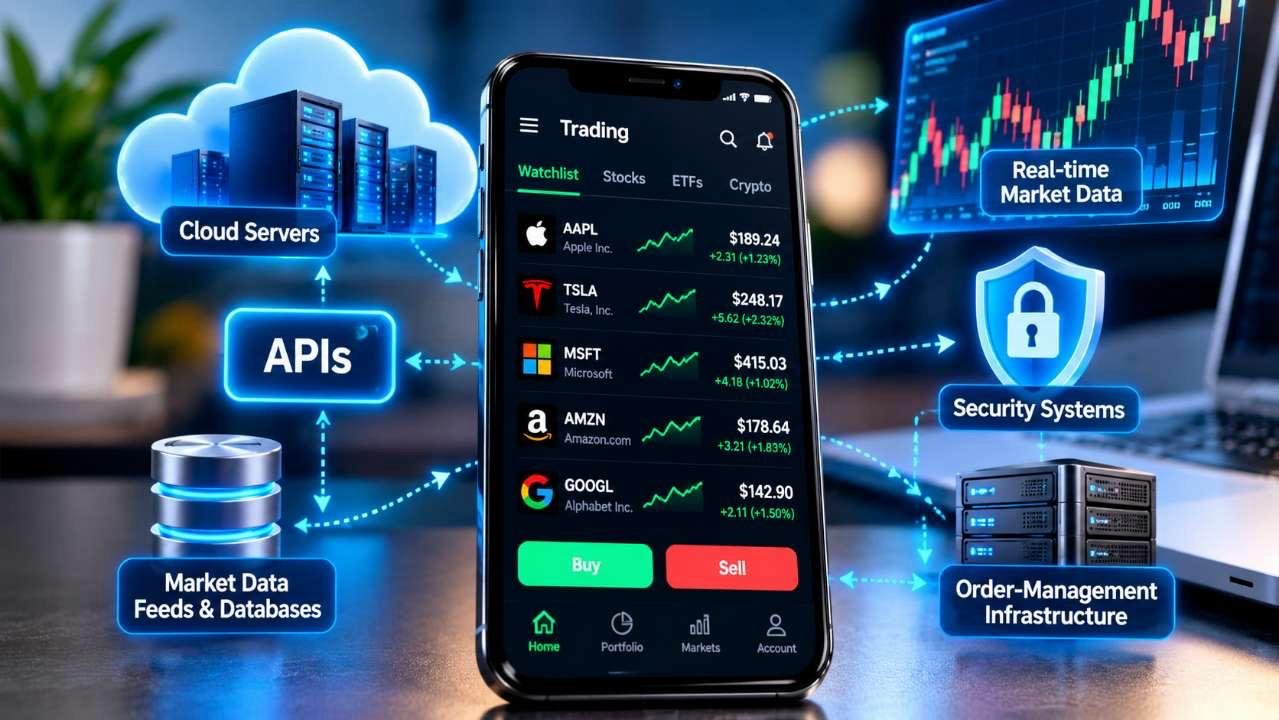
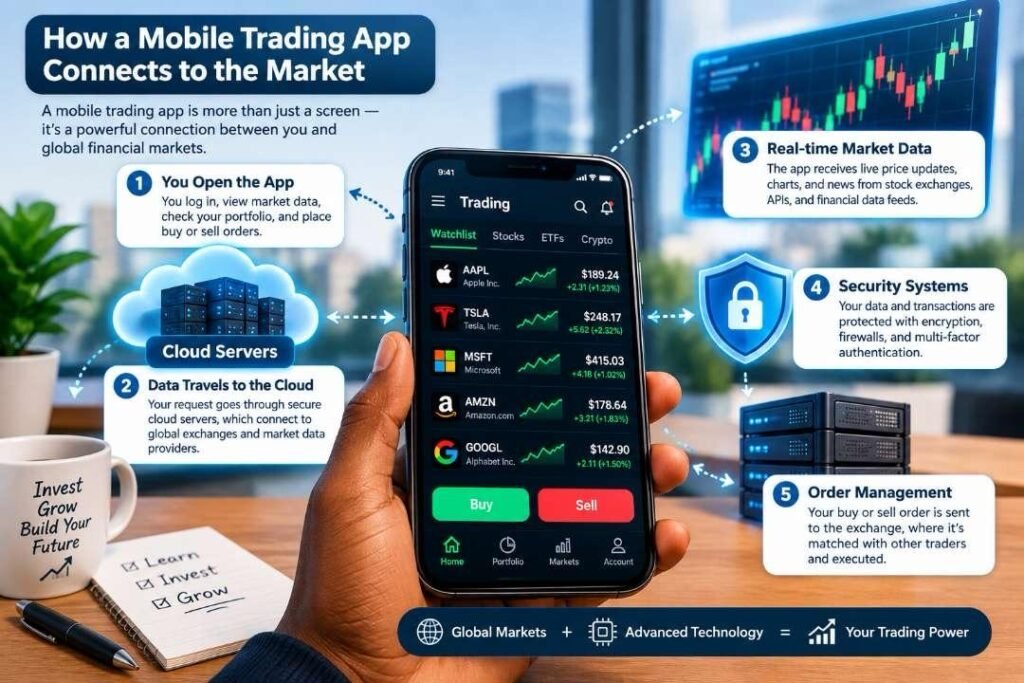
Mobile trading app is a software application which enables an individual to connect to a monetary system by using a mobile phone or tablet. It shows the balances of the accounts, market charts, places orders, provides transaction history and notifies alerts. But, generally all the information to do these functions is not present in the application installed in a device. It, on the other hand, sends requests to the remote servers, which process the requests and send the relevant information back. This architecture keeps the construction of the financial system out of the mobile device while enabling developers to update the market logic, security controls, and data services without having to deploy a new operating system to the entire financial system. The app thus serves as a handy entry point, with much of the sophisticated processing taking place in the back-end computers, set aside to handle multiple users at a time.
Cloud Computing and Scalable Infrastructure
Financial applications have to deal with varying levels of demand, which is why cloud computing is important. A platform may receive only a small amount of requests during quiet periods of a market but a lot of activity can occur during a big economic announcement, earning release, or when the market changes. Cloud infrastructure facilitates computing resources, storage, databases and networking capacity to grow and shrink based on operational needs. Platforms can spread workloads across a number of systems and locations, rather than relying on a single physical server. This can increase availability as a failure in one part of the service doesn’t need to cause failure in the rest of the service. Cloud can also enable investment platforms to scale up their automated monitoring, software deployment, data storage and disaster recovery capabilities in order to stay responsive in the face of increasing customer base and transaction volumes.
APIs: Interactions between Various Systems
APIs, stand for application programming interfaces, are defined rules and data formats that enable different software systems to communicate with each other. APIs can integrate an MVP into various systems, such as financial market data, account databases, portfolio systems, identity services, order-management systems, and other financial infrastructure. For instance, if a user logs in to a screen to open a portfolio, the application could make an authenticated request via an API and be able to receive data on holdings, prices, cash holdings, transactions, and so on. APIs also isolate the UI from the finance systems behind them, enabling the developers to enhance the mobile experience without having to re-develop all the finance services. With financial applications dealing with sensitive info, APIs must be authenticated and authorized, encrypted, validated, monitored and controlled for excessive and out-of-the-normal requests.
Real-Time Market Data
A key technology for a mobile trading app is its market-data system. Investors need prices, bid/ask data, volume, charts and other data to change rapidly. Platforms are connected to the market data feeds which are receiving the information from the exchanges, liquidity venues, data providers etc. from a financial source. The data are then processed and conveyed to applications via low latency communications systems. There might only be a swirling number on a mobile screen and a small chart, but the screen is only used to show information that is being received, validated, organized and communicated with large streams of information behind the scenes. There could be varying data needs for different assets and markets, and some data might be subject to licensing or may be delayed. Therefore the efficient processing of the information is crucial to ensure that necessary information can be conveyed without overwhelming the device and network.
The Rights to Place Orders and Create Trading Backends.
An investor places an order via a cell phone app, and it goes via a series of background processes, not directly from the cell phone to the exchange. The platform must provide identification of the account, authorization checking, order information checking and the ability to pass the instruction through the proper trading systems. Before an order is brought to an execution venue, the backend can impose risk controls, account rules, order validation and routing logic. The instruction can be transmitted to an exchange, a market maker, a broker or any other liquidity provider depending on the product and provider. Execution information needs to then be backfed through the system, to update order status and portfolio. This is the back-end trading system that links the easy-to-use mobile trading platform with the intricate operations of financial trading.
Push Notifications and Real-Time Communication
Push notification enables investment platforms to notify about events even if the app is not being used. They can be used on a platform to inform investors about the currency price. They could also alert investors to order executions, movements in currency prices, account activity, and deposits and withdrawals, or even security events. There is a lot of services behind a simple notification, they detect an event, decide if an alert should be sent or not, send the notification via a notification service and present it to the device. Real-time communication technologies can also keep track of the order status or the information on the market, without having to refresh the information manually multiple times while an application is running. The abilities will enhance responsiveness, but design of notifications requires careful consideration. Too many notifications can be distracting, and too few can divulge information, if the device shows the notification preview.
Authentication and Account Security
Being authentic is essential as the trading account can grant access to financial assets as well as personal data. The most basic type of login includes a username and password and today’s platforms have the option of further security measures, such as biometric verification, one-time codes, device recognition, session control, and multi-factor authentication. These measures ensure that they are attempting to access someone’s account who they should be. Authentication is not the same as authorization; authentication is the process of proving one’s identity and authorization is the process of determining what you can do once you are authenticated. Even though a platform may be able to identify a customer correctly, there may still be extra checks performed before allowing some transactions. Security systems can track for strange login patterns, unfamiliar gadgets, unsuccessful logins, and questionable activity. To protect a mobile trading account, however, doesn’t depend upon a just password, but on a number of coordinated controls.
Encryption: Secure Data Transmission
Encryption: Is a system that secures information by converting plain text into a code that is not easily deciphered by unauthorized users. When transferring account information, authentication data, or transaction instructions to the remote servers, mobile investment platforms employ encryption to secure the data in between the app and the servers. Secure transport protocols help to ensure that any information being transported over networks is not able to be read by an attacker. The encryption can also help to secure data stored, which limits the extent of damage if there is any unauthorized access. Encryption is a component of a broader security approach, though. It is also important to have secure software development, access controls, vulnerability management, monitoring, device security and incident-response procedures. The idea is to establish several layers of defense so that if one of the controls fails, an investor’s account or financial information will not be compromised.
Utilize Databases, Portfolio Tracking and Digital Statements.
Databases and Data Processing systems back all of the information relating to an investor’s account and holdings, behind the screen that shows an investor’s balance and holdings. Such systems can retain transaction records, positions, cash balances, order records, fees, statements and other account information. On opening a user’s portfolio page the app requests the data that it needs and displays it in a readable format. Once a trade is done, there must be an update of the records to ensure that the application reflects the new position and available balance. Accurate transaction record and document generation processes are also crucial for digital statements. Data consistency is very critical especially if there is a difference in ownership, cash or transactions. To ensure that reliable records are maintained across interdependent systems, investment platforms employ various validation, reconciliation, backup, audit trail and controlled processes.
Reliability, Redundancy, and Performance.
Speed is not the only important thing in mobile investing – reliability is another. Applications that fail to present information on demand don’t have a lot of dependability. Financial platforms thus employ redundancy, load balancing, system monitoring, backup infrastructure, and even disaster-recovery plans to minimize impact from hardware failures, network delays, software glitches or sudden surges in demand. A number of servers can share the workload, or monitoring tools could spot unusual performance and technical issues. Smartphone and network also play a role: outdated cell phone and/or weak Wi-Fi signals can cause delays in the updates or updates aren’t available at all. It is just one of the many components in an architecture that connects the device, the network, the servers, the databases, the security applications, market data infrastructure and order processing applications.
The Role of Security, Monitoring, and Regulatory Controls
Financial and security needs also impact investment platforms, and affect their technology. Logging and monitoring systems can track and capture login events, application usage, orders, system performance and other events that are relevant. Audit trails can aid in the investigation of an incident and determine what occurred during an incident or security event. Automated controls can detect fraudulent activity, access and transactions that might need further investigation. The systems have operational procedures, restrictions on access to the systems, testing of the software used, a plan for managing vulnerabilities, and a plan for responding to incidents. Financial technology thus merges the ease of use with a wealth of controls that may not be apparent on the mobile app. Its goal is not just to streamline trading but to establish a controlled environment where financial data and transactions can flow without interruptions, and risks are constantly monitored.
Conclusion
Mobile trading is simple on the outside, but super sophisticated on the inside. A user can be shown a price chart, click an order button and within a few moments get a notification, but each step could be handled by software on a mobile device, APIs, cloud computing, databases, market-data feeds, authentication services, encryption, order-management systems, and other behind-the-scenes trading infrastructure. These different components have to communicate effectively, securely, accurately and available. Real-time data ensures that investors are always up-to-date, APIs enable integration and communication between various services, cloud infrastructure ensures scalability, and authentication and encryption guard against account and information theft. While the back-end systems provide order validation and order routing and update orders after processing, the front-end systems tend to do the same. The more you know about these technologies, the better able you are to see what’s going on behind the easy-to-use trading screen on your smartphone or tablet, as financial services grow increasingly digital.
Get more well researched information about Mobile trading apps here.