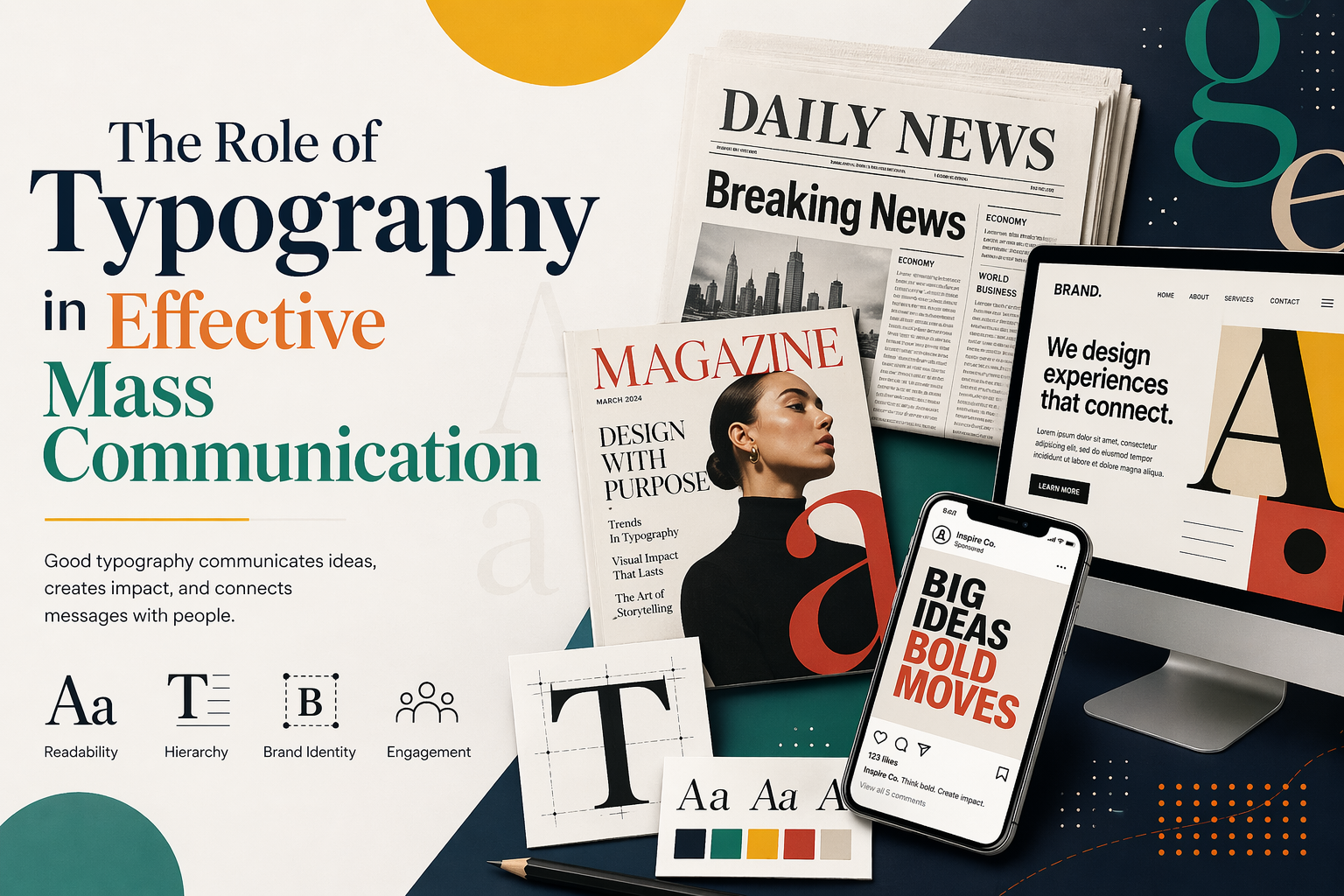
In the current information society, communication has ceased to be a mere issue of verbal or written communication. The visual presentation is a decisive factor in the effectiveness of a received, interpreted, and remembered message. Typography in mass communication is one of the most effective and powerful tools among the numerous visual elements that shape communication. It controls the text appearance, reading process, and the resonance of the text among people in different media platforms.
Typography is not about selecting pretty fonts, but a strategic communication tool that caters to both visual appeal and practical use. Typography is even more imperative in mass communication, which is the distribution of messages to large and diverse audiences. It makes information available, interesting, and convincing irrespective of the source, be it in newspapers, magazines, websites, or adverts.
In order to comprehend its significance, one must have the idea of typography and its role as a connector between information and readers. This article will discuss typography in mass communication, its main components, psychologically, and the practical uses of typography in various media.
Typography as an Element of Core Communication
Typography is an art and craft of organizing type in such a manner that it renders the written word readable, legible, and attractive. It entails various design choices such as the choice of font, font size, spacing, alignment, and layout. All these factors play a role in the perception of a message.
Typography has a number of important functions in mass communication:
It improves readability, making the information easy to understand.
It creates a visual hierarchy, which directs the readers through the material.
It evokes feeling and emotion, and shapes the perception of the audience.
It enhances branding and identity.
The tone and emphasis, unlike in verbal communication, where voice modulation is used to communicate such nuances, typography has to be able to convey these nuances in a visual way. An example is that bold text can be used to convey significance, and italics can be used to convey emphasis or nuance.
Typography is also a silent communicator. Readers make impressions of the text before they even start processing the text based on the appearance of the text. Clear, well-arranged design is an indicator of professionalism and credibility, and a messy or unbalanced typography can give the illusion of confusion or mistrust.
Basic Principles of Typography
Font Choice and Its Effect
One of the most significant features of typography is the font choice. Various fonts are associated with varied feelings and perceptions, and therefore are very effective in creating a perception of the audience.
Serif fonts are said to be linked with tradition, reliability, and authority. They are usually used in newspapers and scholarly journals.
Sans-serif fonts are used in digital media because they are modern, simple, and clear.
Display and decorative fonts are used for creative expression and should be used carefully to ensure readability.
The font used must be in accordance with the purpose of the message and the audience. A legal document should, as an example, use a formal and readable font, whereas a children’s advertisement can be a playful style.
Fonts Size and Readability
The font size has a direct relationship with the ease of reading. When dealing with mass communication where the audience may differ in terms of age, education, and visual skills, it is necessary to select the appropriate font size.
Headlines are normally written in large fonts to attract attention, and smaller fonts are used for detailed information. Nevertheless, when the font size is too small, it may deter reading, particularly on digital screens.
Similar elements (e.g., headings, subheadings, etc.) should have a consistent font size that ensures the structure and clarity.
Spacing: Kerning, Leading, Tracking
Space is important in visual comfort and readability.
- Kerning is used to adjust the space between single characters.
- Leading is used to control the vertical spacing between lines.
- Tracking influences the general spacing between text blocks.
Spacing is appropriate so that the text is not crammed or split. It enables readers to easily digest information without straining unnecessarily.
Alignment and Layout
Text alignment (left, right, center, or justified) influences the perception and reading of content. Texts aligned to the left are usually regarded as the easiest to read, particularly when the text is lengthy.
Layout, however, defines the way in which a text is organized on a page or a screen. A good layout will make the contents easily navigable to the reader, whereas a poor layout will confuse the reader.
Chain of Command and Information
Typography hierarchy is a critical element in mass communication since it categorizes information according to its significance. Through size, weight, and style variations, designers will be able to provide a definite direction for readers to be taken.
For example:
Headlines grab attention.
Subheadings provide structure.
Body text provides detailed information.
Lack of hierarchy may make content overwhelming, and readers may not be able to find the most important points.
Print Media Typography
Information Density in Newspapers
A classic example of typography used in mass communication is newspapers. They have to convey huge volumes of information in a small area and be readable.
In newspapers, typography focuses on:
Brief headlines to read at a glance.
Consistent column layouts.
Readable body text.
Serif fonts are not used by accident in newspapers but are designed to increase readability in print media.
Visual Creativity and Magazines
Typography is more interestingly employed in magazines to capture the attention of the readers. Designers will work with fonts, font size, and layouts to produce attractive images.
Typography contributes to bringing about:
Brand identity.
Reader engagement.
Storytelling.
To illustrate this, a fashion magazine would want to consider using beautiful and stylish fonts, whilst a sports magazine would want to use bold and dynamic fonts.
Typography in Digital Media
User Experience and Web Design
Typography in digital media is closely related to user experience (UX). The wrong typography can lead to high bounce rates since people cannot spend a long time on content that is not easily readable.
Good web typography is composed of:
Responsive font sizes.
Adequate line spacing.
High contrast between background and text.
Typography must also be capable of being scaled to the different screen sizes, such as smartphone and desktop screens.
Mobile Optimization
The use of a smaller screen size in the growing use of mobile devices should be used in typography. This includes:
Larger fonts so as to read it easily.
Simplified layouts.
Clear hierarchy.
Mobile typography is concerned with readability and usability.
Social Media Communication
Typography needs to be instantly attractive on social media. Posts in feeds that are highly trafficked often tussle up and must be appealing.
Good social media typography involves:
Big and bold fonts.
Minimal texts and with strong emphasis.
Clear visual hierarchy.
In this connection, typography is not only the issue of readability, but of interest and interchange.
Typography in Advertising And Branding
Building Brand Identity
Typography is one of the brand identity pillars. The familiarity and credibility among the audiences are achieved by using the same fonts.
For example:
The luxurious brands often use refined serif fonts.
Technology companies prefer clean sans-serif fonts.
Creative industries may experiment with authentic styles.
Brand values are communicated even without additional explanation through typography.
Emotional Appeal and Persuasion
Typography influences the feelings of a viewer about a message. The bold fonts may be applied to give a feeling of urgency and may be classy and reflect sophistication.
Advertisers use typography to:
Highlight key messages.
Create emotional connections.
Encourage action.
Due to this, a sale advertisement can have big and bold fonts to attract attention as opposed to an advertisement of a luxury product, which can contain small and elegant fonts.
Psychology of Typography
First Impressions Matter
Typography is an instant impression. Readers give judgment to the visual presentation and they do not need to engage with the work.
Well-designed typography signals:
Professionalism.
Credibility.
Trustworthiness.
Poor typography, on the other hand, is disheartening.
Readability and Cognitive Processing
Legible typography results in less mental work on the reader and therefore greater information is decoded accordingly.
The readability is affected by:
Font style.
Line length.
Spacing.
Contrast.
Typography optimization leads to increased opportunities to retain information and attract readers.
Emotional and Cultural Impact
Typography can be emotive and culture-conscious. The meaning of fonts in different cultures may be different.
It is on these that designers will have to consider when coming up with content to be shared by global audiences.
Challenges in Typographic Design
Striking A Balance Between Creativity And Functionality
One of the issues that designers have to face is balancing creativity and readability. Special typography may be employed to attract attention, but this should not come at the cost of clarity.
Cross-Platform Consistency
It can be difficult to get comparable typography in print and digital media. Designers should make sure that fonts and layouts are adaptable to be effectively used by designers.
Accessibility and Inclusivity
The typography must be such that it can be read by all, even those with visual deficiencies. This involves:
Using readable fonts.
Ensuring sufficient contrast.
Providing scalable text options.
Information Overload
Excessive writing and complex typography may be overwhelming to readers when applied in mass communication. The key to effective communication is simplicity.
Best Practices for Effective Typography
Simplicity And Clarity
The number of fonts and decorative styles should be kept to a minimum. Simplicity enhances readability.
Consistent Hierarchy
Have a nice structure including headings, subheadings, and body text.
Readability First
Choose fonts and spacing that give focus to readability.
Alignment and Spacing
Ensure that there is strong alignment and spacing to allow a clean layout.
Testing and Optimization
Test typography on different devices and platforms to be the same.
The Future of Typography In Mass Communication
Typography is still in flux with technological advancement. Such innovations as variable fonts and responsive design are changing the text display.
Interactive typography is becoming popular, in which the text responds to user input in digital media. This enhances communication and creates immersive experiences.
Artificial intelligence is also influencing typography by enabling customized content. Text can now be customized to meet user preferences to increase readability and user experience.
Conclusion
Typography should be a significant aspect of good mass communication. It affects the presentation, perception, and understanding of messages across platforms. Typography influences readability, interest, and trustworthiness, be it in print media or in digital interfaces and advertising.
Typographic principles can be applied by communicators to ensure the messages are more effective by mastering font choice, font size, font spacing, and font hierarchy. With little attention in the world, strategic typography can play an important role in a world where content can be easily identified and related to readers.
Lastly, typography is not only a component of design but a wonderful tool used in communication, which creates a distinction between knowledge and interpretation.