Geometric modeling is a key factor in the creation, experience, and interaction of virtual worlds in the fast developing computer graphics and animation field. Since the creation of realistic characters, to building virtual worlds, the geometric modeling is the core of the contemporary animation and interactive media.
Geometric modeling is a field that anyone in the computer graphics, animation, game development, or virtual reality (VR) field must understand. It gives the means to bring the imaginary into the clear digital shapes, letting the artists to create the visual masterpieces and the physical realism.
This paper will examine how character design, environment development, realistic graphics, and interactive experiences can be deeply rooted in geometric modeling as a process that is extremely important in immersive storytelling.
What Is Geometric Modeling?
The technique of digitally depicting the forms and skeletons of objects mathematically is called geometric modeling. In contrast to a plain drawing or sketch, the geometric models store mathematical data regarding the vertices, edges, surfaces, and volumes, which permit the objects to reside in the three dimensional space.
Geometric modeling also allows the designer to manipulate shapes at high-resolution, manipulating size, scale, orientation, and topology. This control plays a crucial role in making sure that characters, objects and environments act in a realistic manner when being animated or simulated in an interactive manner.
To have a deeper concept, geometric modeling extensively discusses the concept.
Basic Methodology of Geometric Modeling
The geometrical modeling has various methods based on project requirements. Every technique possesses its own advantages and uses in animation, plays, and virtual space.
Wireframe Modeling
Wireframe modeling is a modeling technique where the structure of a 3D object is created by creating points (vertices) that are connected by the means of lines (edges). Imagine it as the virtual framework of an object.
- Purpose: Wireframes enable animators and designers to grasp the shape and proportions as well as the underlying structure fast before proceeding with surface modeling in more detail.
- Use: It has been used in the early process of character, vehicle or building prototyping in animation or video game assets.
Wireframe models again are very malleable and can be iterated upon quickly thus becoming essential when it comes to collaborative creative effect.
Surface Modeling
Surface modeling is aimed at producing smooth continuous surfaces that characterize the visual appearance of an object. It brings realism to the wireframe skeleton by adding shape, texture and volume to the object.
- Techniques: Bezier curve, B-splines and Non-Uniform Rational B-Splines (NURBS) are typically used when doing surface modeling. These are mathematical tools that enable artists to manage continuity and curvature which are important in realistic animation.
- Applications: Surface modeling is applied in the design of the skin, clothing, vehicles, and organic forms, such as plants or animals.
Surface modeling gives the gap between abstract geometrical models and photorealistic image, so that the object appears to move and be lit in a way that is natural.
Solid Modeling
Solid modeling is a form of object representation as an entire volume, not as a surface or a structure. The method will enable an accurate determination of the physical properties (mass, density, and collisions).
- Uses: Solid modeling is necessary in CAD in mechanical simulations, interactive media in realistic physics, and animation in real-world interactions with other objects.
- Advantages: It is vital in immersive gaming and virtual reality because it is used as data used in physics engines, collision detection and environmental interaction.
Character Design: Geometric Modeling
The most important element of animation and interactive storytelling is characters. The geometric model allows perfect manipulation of form, motion, and expression that generates realistic computer personalities.
The definition of Shape and Proportions
The wireframe models are used to start the design process to define the skeletal structure of a character. Before proceeding to surface or solid modeling, artists change the position of joints, proportions of limbs, and general anatomy. This makes the moves and postures of the character to be realistic.
After the basic shape has been established surface modeling puts volume, muscles, skin folds and clothing details into the character giving them visual depth. Solid modeling makes sure that the character behaves properly to the surrounding, either pick things up or even hit the wall.
Motion and Rigging
Rigging is simply a procedure of attaching a digital skeleton to a character, and it is all based on the geometric information. The model has reacting vertices and joints to the movements and restrictions of the animation.
- Example: In a jumping scene, the joints of the knee should be bent at the right angles, the torso should move in a natural manner and the arms should be in place to support the body in a natural way.
- Importance: Moves will not look natural and smooth without accurate geometry, which will destroy the immersion of the audience.
Deformations and Expressions of the Face
More advanced geometry modeling enables minor facial expressions. As the manipulation of the vertex and surface geometry, a smile, a frown, eye movements, or complicated emotional reactions may be created by the animators.
- Case study: Pixar and Disney animation Pixar and Disney animation use a detailed geometry of facial muscles to express subtle emotions.
- Effect: When deformed correctly, it helps the story to be told better by making the characters relatable and personal.
The Process of Geometric Modeling Environment Creation
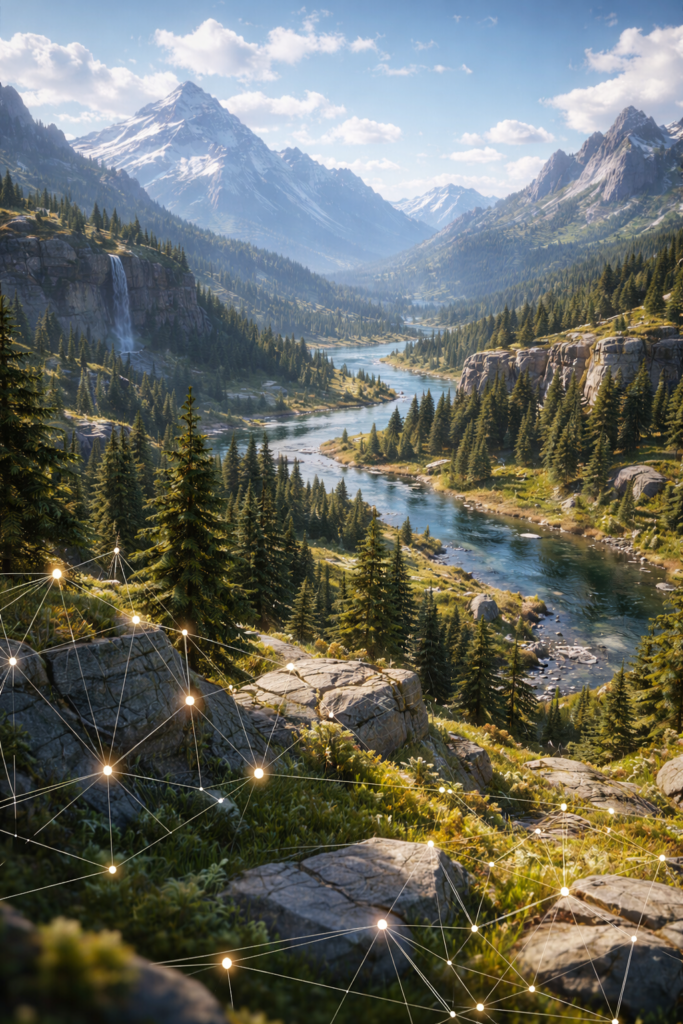
Virtual worlds are also dependent on the use of geometric modeling to bring about scale, depth and realism.
Terrain and Structures
Geometric data provides size, scale as well as perspective consistency. All buildings, mountains, rivers, streets have the exact vertices, edges and surfaces in order to be realistic.
- Application: Video games such as The Legend of Zelda: Breath of the Wild use geometry models to make huge, explorable environments that use the correct elevation and locations of structures.
Procedural and Parametric Modeling
Procedural modeling is an algorithmic method of generating repetitive or complex structure by algorithm. The parametric model enables the designers to establish object rules, which can be dynamically modified.
- Example: Procedurally, it is possible to generate a forest with hundreds of trees of different height and position and realistic spacing.
- Advantage: It decreases the number of manual interventions and has visual consistency and realism.
Interaction and Physics
Collisions, gravity and interaction between objects are simulated by solid geometric models. Bouncing characters and falling objects will depend on a right geometry.
- Example: In VR games, the objects can be picked by the player and react to the physical laws using the shape and weight information available in the geometrical model.
Geometric Modeling of Realistic Rendering
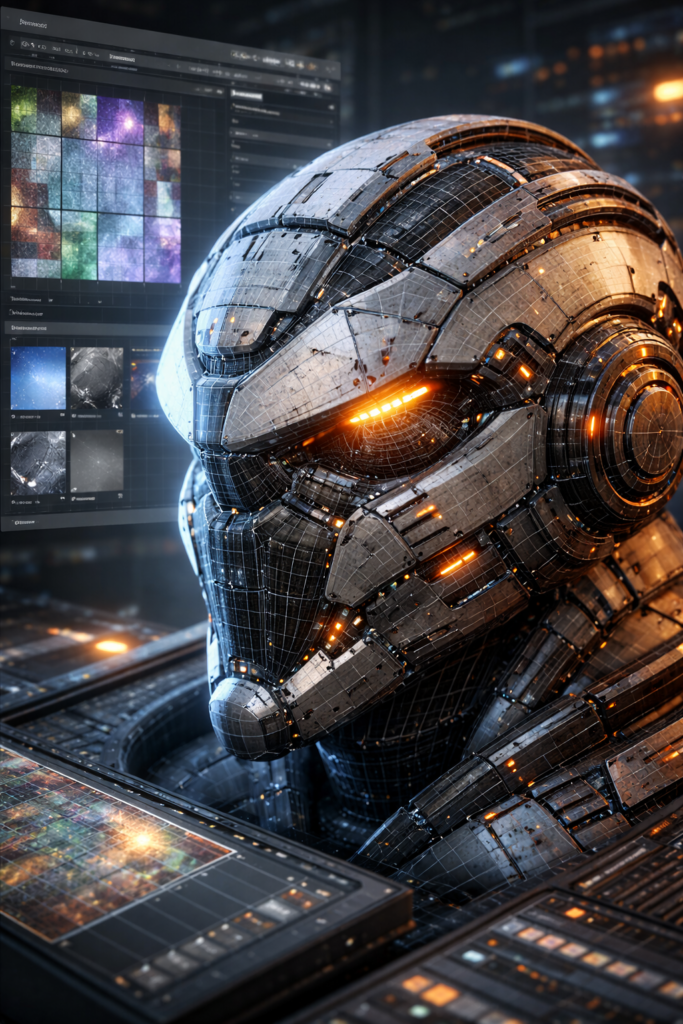
Transforming the geometric models into realistic images is done in the rendering process. The deeper the geometry the more realistic the end result.
Shading and Texture Mapping
Geometric models give coordinates used to map the texture (e.g. skin or fabric or metal) onto a surface. Correct UV mapping makes textures fit in the model, which give natural results in the dynamic lighting conditions.
- Methods: The use of normal mapping, displacement mapping and bump mapping require a high level of geometry accuracy to recreate surface detail without adding polygons.
High End Rendering Technology
Global illumination, ray tracing, and ambient occlusion rely on the use of geometric models. The processes compute the interaction of light with surfaces and volumes to give realistic effects of shadows, reflections and highlights.
- Example: Geometric data can be used to simulate the correct trajectory of light in order to produce photorealistic images in example: Ray tracing in modern games and films.
Interactive Media Geometric Modeling
Geometric modeling in interactive media is needed not just in appearances and graphics but also in the mechanics and ambiance of a game.
Real-Time Rendering
Interactive media (VR and video games) are required to recreate scenery in real time. Geometry models are made to minimize the computation load and preserve the visual quality.
- Techniques: Level of detail (LOD), mesh simplification and frustum culling are based on geometric accuracy.
- Impact: Provides stutter free frame rates and games.
Dynamic Interaction
Geometric models provide dynamical response of objects and environments. Examples are deformable terrain, walls that can be destroyed and fluid simulations that are realistic.
- Example: Minecraft In Minecraft, block geometry determines the interaction between players and the environment, which allows them to build, destroy and play games with physics.
Further Developments in Geometric Modeling
Geometric modeling is still being advanced with the change of technology.
Integration with AI
AI helps to create the models, optimize the meshes, and forecast the realistic movement and minimizes the human input. As an illustration, AI has the capability to automatically rig characters or create detailed urban environments.
Virtual Reality and Augmented Reality
Geometric modeling in VR and AR provides spatial accuracy where virtual objects can correspond to the real world. In order to have convincing immersion, accuracy of geometry is required.
Towards Photorealistic Immersion
With the increase in computing power, more and more detailed, photorealistic simulations can be aided by geometric modeling. Hyper-realistic animation, VR training software, as well as interactive movies, are based on a geometric accuracy to blur the boundary between the virtual and the real worlds.
Conclusion
Modern computer graphics and animation is based on geometric modeling. It allows creating characters, settings and interaction experiences with accuracy and reality. Since first wireframes to sophisticated solid designs, geometric data moves, interacts and offers visual consistency and allows creators to provide immersive storytelling.
It is important to know the geometric modeling in case of the animators, game developers as well as digital artists. Knowing these tricks, creators will be able to bring imagination to life and make the world interactive and lifelike and push the limits of what is achievable in the world of animation, games, and virtual reality.