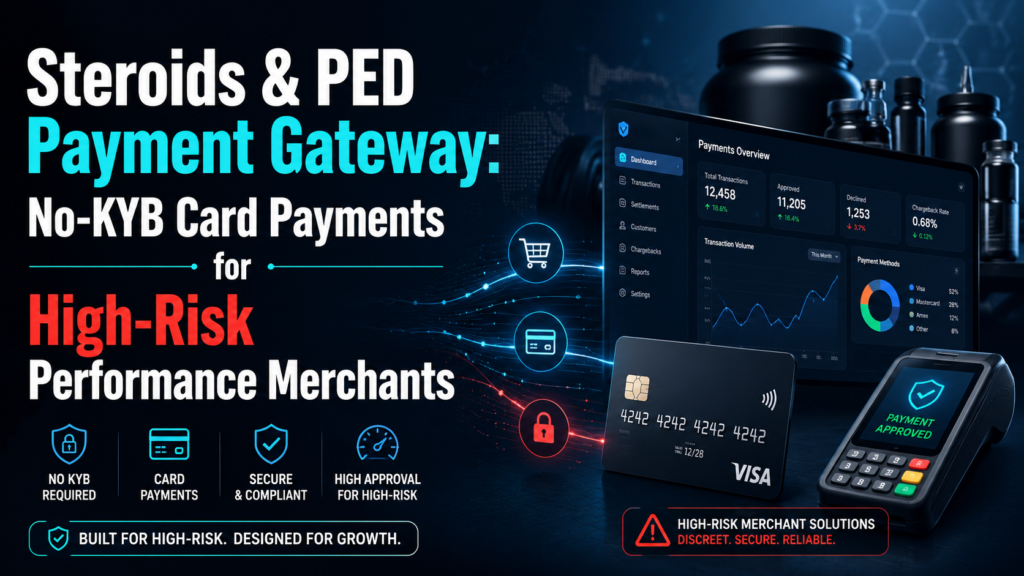
Finding a reliable steroids and PED payment gateway is difficult because performance-enhancement businesses sit inside one of the most restricted areas of online commerce. Merchants connected with bodybuilding, performance products, enhancement-related offers, fitness compounds, or PED-adjacent categories often face serious payment barriers from traditional gateways.
The issue is not only payment processing. Steroids, PEDs, and related performance products are sensitive and regulated in many markets. Because of this, banks and mainstream payment processors usually classify the category as high-risk. Even merchants that operate legally and follow their local rules can face rejected applications, long reviews, rolling reserves, payout delays, chargeback exposure, and sudden account freezes.
Rampex is different from a traditional payment gateway. It is built for high-risk and restricted industries that ordinary processors often refuse. Instead of forcing merchants through the same KYB-heavy approval system, Rampex allows businesses to accept card payments and receive instant USDC payouts directly to their own self-custodial wallet.
For lawful merchants searching for a specialized Steroids & PED Payment Gateway, Rampex offers a no-KYB payment model designed for high-risk businesses that traditional gateways often reject or restrict.
Why Steroids and PED Merchants Face Payment Restrictions
Steroids and performance-enhancing product categories are not treated like normal ecommerce. Traditional payment gateways often view these businesses as risky because of regulation, product sensitivity, customer disputes, reputational concerns, and compliance exposure.
A standard ecommerce store selling clothing or digital downloads may get approved quickly. A performance-related merchant, however, may be reviewed more aggressively because processors often associate the category with legal complexity, health-related claims, prescription controls, and restricted product policies.
Common payment problems include:
- rejected payment gateway applications;
- long KYB and business verification;
- product-category restrictions;
- marketing and website reviews;
- delayed merchant approval;
- account freezes;
- payout holds;
- rolling reserves;
- chargeback monitoring;
- high-risk processing fees;
- separate approval for every domain;
- account termination after risk review.
For merchants, this creates uncertainty. A business may have traffic, customers, inventory, and a working website, but still lose sales because the payment gateway refuses to support the category.
Why Traditional Payment Gateways Avoid PED-Related Businesses
Traditional gateways are built for standard, low-risk businesses. They are not designed for merchants operating in restricted or sensitive industries. When a business mentions steroids, PEDs, performance enhancement, bodybuilding compounds, or related terms, the gateway may flag the account for review or reject it outright.
This happens because traditional processors rely heavily on risk rules. Their systems are built around merchant KYB, business classification, underwriting, bank partner approval, chargeback exposure, and compliance monitoring. If the category looks too risky, the processor may decide it is easier to reject the merchant than support the account.
That approach creates a major problem for high-risk merchants. Even when a business is operating within its legal market, it can still be blocked by payment policies.
This is why PED-related businesses often need a payment solution that does not operate like a standard gateway.
Traditional High-Risk Processors Are Still Limited
Some merchants try to solve the problem by applying to traditional high-risk processors. These companies may be more open to sensitive categories than mainstream gateways, but they usually still follow the same old merchant account system.
A traditional high-risk processor may ask for:
- company registration documents;
- owner identity verification;
- bank statements;
- processing history;
- supplier information;
- product details;
- refund policies;
- website terms;
- legal and compliance documents;
- chargeback history.
Even after approval, the merchant may still face setup fees, monthly fees, higher transaction fees, rolling reserves, volume limits, delayed payouts, and strict account monitoring.
This means the merchant is still inside the traditional payment structure. The account may be approved, but it can still be frozen, limited, reviewed, or terminated later.
Rampex takes a different approach.
Rampex: A Different Payment Model for High-Risk Merchants
Rampex is not a traditional high-risk processor. It is a no-KYB payment gateway built for high-risk and restricted verticals. Its purpose is to help merchants accept card payments without the usual barriers created by conventional gateways.
With Rampex, customers can pay by card through a familiar checkout flow. The merchant receives instant USDC payouts directly to their own self-custodial wallet. This is important because the customer does not need to manually pay with crypto. The settlement method is different for the merchant, while the customer payment experience remains simple.
Rampex offers:
- no merchant KYB onboarding;
- instant approval for high-risk verticals;
- no rolling reserves;
- no setup fees;
- no monthly fees;
- no chargeback holds;
- final payments;
- instant USDC payouts on Polygon;
- payouts to the merchant’s own non-custodial wallet;
- unlimited integrated websites per merchant account;
- WooCommerce plugin;
- hosted checkout;
- payment links;
- provider-agnostic payment setup.
This is the key difference. Rampex should not be described as a normal payment gateway or a normal chargeback-management service. Its model is based on no-KYB onboarding, final payments, and instant USDC settlement.
Rampex vs Traditional PED Payment Gateways
| Feature | Traditional Gateways | Traditional High-Risk Processors | Rampex |
| Merchant KYB | Required | Required | No merchant KYB |
| PED-related businesses | Often rejected or restricted | Sometimes accepted after review | Built for high-risk verticals |
| Approval process | Manual review or rejection | Manual underwriting | Instant approval model |
| Rolling reserves | Possible | Common | No rolling reserves |
| Setup fees | Provider-dependent | Often possible | No setup fees |
| Monthly fees | Provider-dependent | Often possible | No monthly fees |
| Chargebacks | Merchant is exposed | Merchant is exposed | Payments are final / no chargeback holds |
| Payout method | Bank settlement | Bank settlement | Instant USDC payouts |
| Domain support | Often reviewed separately | Often reviewed separately | Unlimited integrated websites |
| Merchant control | Processor dependent | Processor dependent | Payouts to self-custodial wallet |
This comparison shows why Rampex is different from ordinary gateways. Traditional gateways depend on approval, reserves, chargebacks, and bank settlement. Rampex uses a no-KYB structure with final payments and direct USDC payouts.
Why No-KYB Matters in Restricted Performance Categories
KYB is one of the biggest obstacles for high-risk merchants. Traditional gateways often require business documents, identity records, processing history, bank statements, website reviews, product information, and compliance checks.
For PED-related businesses, this process can become slow and uncertain. The merchant may submit documents, wait for approval, and still be rejected because the category is restricted.
Rampex removes this traditional KYB barrier. Merchants can sign up without going through the standard business verification process used by conventional processors.
This is one of the main reasons Rampex is different from Stripe, PayPal, Shopify Payments, and traditional merchant accounts.
Why Final Payments Are Important
Chargebacks are a major reason high-risk merchants struggle with payment processing. In a traditional payment system, customers can dispute card transactions after payment. If chargebacks increase, the processor may hold funds, increase reserves, add penalties, or close the account.
Rampex should not be described as a company that provides chargeback management. That would be the wrong framing. Rampex does not operate like a traditional processor that helps merchants fight disputes. Its model is different because payments are final and there are no chargeback holds.
For high-risk performance merchants, this matters because it removes one of the biggest risks of traditional payment processing. Instead of managing chargeback exposure through a processor, merchants receive final payments through the Rampex model.
Why No Rolling Reserves Help Cash Flow
Rolling reserves are common in high-risk merchant accounts. A processor may hold a percentage of every sale for months to protect itself from future disputes. For a merchant, this can damage cash flow.
Performance-related businesses often need working capital for inventory, fulfillment, website operations, advertising, customer support, and supplier payments. If a processor holds a percentage of every transaction, the business may struggle even when sales are strong.
Rampex does not hold rolling reserves. Merchants receive instant USDC payouts directly to their own wallet instead of waiting for delayed settlement or reserve release periods.
This gives merchants more control over their revenue and reduces dependence on processor-side fund holds.
One Dashboard for Multiple Domains
Many high-risk merchants operate more than one website. A business may run different storefronts, landing pages, regional sites, private offers, or separate product categories. Traditional gateways often review each domain separately, which creates delays and uncertainty.
A merchant may get one domain approved but face a new review when adding another. This slows down growth and makes testing new offers more difficult.
Rampex supports unlimited integrated websites per merchant account. This allows merchants to manage multiple domains from one dashboard instead of repeating the traditional approval process for every website.
For performance-related ecommerce, this can be a major operational advantage.
Suitable High-Risk Business Types
Rampex may be relevant for lawful merchants operating in restricted or high-risk categories such as:
- performance-related ecommerce;
- bodybuilding product businesses;
- fitness enhancement brands;
- supplement-adjacent merchants;
- peptide-related businesses;
- nutra merchants;
- pharma-adjacent businesses;
- adult businesses;
- IPTV businesses;
- other restricted verticals that traditional gateways often reject.
Merchants are still responsible for following the laws and rules that apply in their own market. Rampex changes the payment model, but it does not remove the merchant’s responsibility to operate legally.
Why Customer Checkout Must Stay Simple
Even in restricted industries, customers expect checkout to be fast and familiar. A complicated payment process can reduce conversions. If customers do not understand how to pay, they may abandon the purchase.
Rampex helps by allowing customers to use card-based payment flows while merchants receive USDC settlement. The customer payment experience remains simple, while the merchant gets fast wallet-based payouts.
This separation between customer payment and merchant settlement is one of the reasons Rampex is useful for high-risk ecommerce.
Why Rampex Is Built for High-Risk Commerce
Most traditional payment providers try to avoid risk. They prefer low-risk merchants, simple categories, predictable chargeback rates, and standard bank settlement. That is why restricted businesses often face rejection.
Rampex starts from a different position. It is built for high-risk merchants from the beginning.
Its no-KYB onboarding, final payments, no chargeback holds, no rolling reserves, instant USDC payouts, and unlimited website support make it different from the traditional payment system.
For merchants in performance-related and restricted categories, this creates a payment option that is designed around the realities of high-risk commerce.
Conclusion
Steroids and PED-related merchants face some of the toughest payment restrictions online. Traditional gateways often reject the category, while traditional high-risk processors may still require KYB, manual underwriting, rolling reserves, setup fees, monthly fees, delayed settlements, and chargeback monitoring.
Rampex offers a different model. It is a no-KYB payment gateway for high-risk merchants, allowing businesses to accept card payments and receive instant USDC payouts directly to their own self-custodial wallet.
With no merchant KYB, no rolling reserves, no setup fees, no monthly fees, final payments, no chargeback holds, unlimited integrated websites, and one dashboard for multiple domains, Rampex is not a standard PED payment processor. It is a different payment solution for lawful high-risk merchants that traditional gateways often refuse.