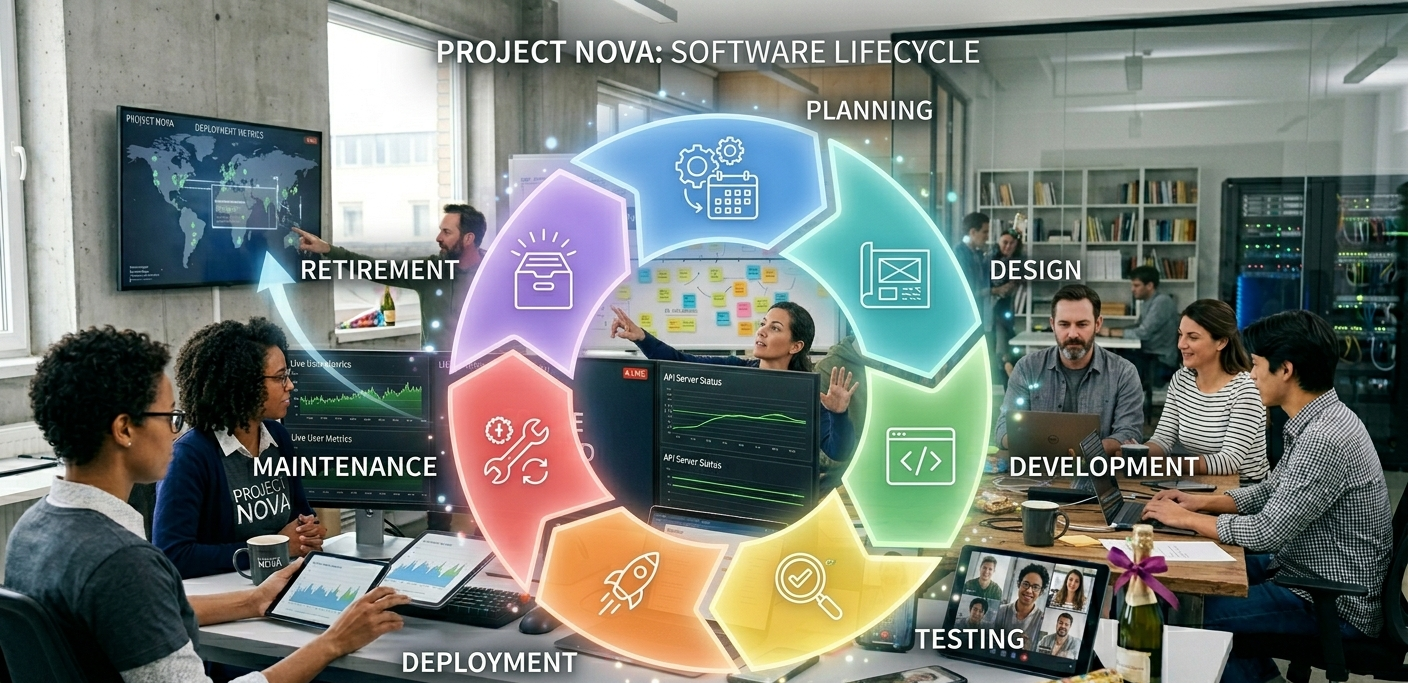
With the ever-changing digital environment, software is no longer merely a tool for supporting business operations, but the core of enterprise growth, innovation, and competitive advantage. The complex applications that organizations need to interface with customers, automate supply chains and analyze huge amounts of data have made the methodology used for building and maintaining these digital assets more paramount than ever. Now software lifecycle management—a systematic and end-to-end approach to manage a software application from its inception to development and deployment and finally to its retirement. A structured software life cycle can help mitigate risk, optimize resources, and guarantee that IT investments are delivered with predictable, quality results. If this is not organized, engineering teams often end up with priorities that never align with the rest of the organization, budgets that grow out of control, timelines that are constantly pushed back, and code bases that are unstable, ultimately jeopardizing operational stability.
Driving success for IT in the long term will involve moving from a reactive, “code-first” approach to a proactive, lifecycle approach. In this article, you will gain insights into each software lifecycle stage, the impact of a thorough management plan on software quality, security, and business continuity, and how to move forward with the software.
The Strategic Foundations: Planning and Requirement Analysis

All good software projects start well before any lines of code are written. Planning and requirement analysis is a crucial part of the software development lifecycle, laying the foundation for the project’s scope, purpose, and feasibility. In this stage, business analysts, project managers and lead architects work closely with end-users and executives to collect all in-depth functional and non-functional requirements. The procedure includes thorough feasibility analysis, financial budget planning, staffing, and identification of potential technical / operational risks. Having a clear, straightforward, and unambiguous idea about what the software should accomplish will help organizations avoid the dreaded “scope creep” which is a phenomenon in which features creep in over time, making timelines and budgets the proverbial sitting ducks.
In addition, efficient planning of the development project is linked to the overall strategic goals of the enterprise. It requires teams to consider important issues of scalability, compliance, and integration with existing legacy systems. These parameters are documented by the architects in a formal Software Requirement Specification (SRS) document that becomes the single source of truth for the rest of the life cycle. A detailed plan requires a certain amount of effort to be put into and helps to create a predictable path so that the downstream team, engineering, builds the correct product, correctly, the first time.
Architecture and Design: Blueprinting the Digital Ecosystem
After establishing requirements, the next stage is architecture and design; that is, transforming abstract business requirements to concrete technical blueprints. System architects decide on the application’s structural outline, choosing design patterns, data-flow trajectories, database models, and application programming interfaces (APIs) that are suitable for the system. This usually is divided into two parts: High-Level Design (HLD) and Low-Level Design (LLD). This is normally split into two parts: High-Level Design (HLD) and Low-Level Design (LLD). It is important that the software architecture is robust enough to accommodate the expected volume of users, adapts to large workloads and is robust to external cyber security attacks.
Paying attention to strong design, at the very least, pays off with respect to the maintainability and cost-effectiveness of the software asset over the long haul. Changes to architecture can be costly and time-intensive after coding or deployment, and may risk the entire project if the flaws aren’t detected before. The philosophy of modern software design is to make software modular, with individual parts being separated from one another with microservices or Service Oriented Architecture, so that each part can be updated, repaired, or replaced without disrupting the entire system. In the end, this stage ensures the structure for ongoing feature iteration and robust operational resiliency.
Implementation and Coding: Engineering Quality Assets
The implementation phase involves implementing the conceptual blueprints into functional software code. The developers implement the software components designed in the design phase using the selected programming languages, frameworks, integrated development environments (IDEs), and version control systems. Development teams must work to a consistent style of coding, documentation and architecture to keep velocity high and technical debt low. This phase is highly collaborative, using agile principles, short sprints, and daily stand up meetings to keep everyone synchronized and to openly discuss impediments and quickly add small slices of working code to a common repository. This is where they start to use the blueprint for their requirements, start designing the code in small modules, and then undergo peer review.
In order to maximize the quality of the software in the implementation, modern IT organizations have strict peer-review processes; in other words, code change must be reviewed by a secondary engineer before it can be integrated into the software. Along with the functional code, developers also create automated unit tests to verify that individual methods and modules work as expected. Development teams significantly reduce software bug injection, simplify the testing stage, and create an application asset which is extremely flexible to the changing requirements of the marketplace by focusing on clean code semantics and modular construction.
Rigorous Testing and Quality Assurance: Validating Performance

The key barrier between the development and production world is Quality Assurance (QA) and software testing. In this stage, committed QA engineers rigorously test the software application by employing various manual and automated testing techniques to uncover any potential loopholes, security flaws, and performance limitations. Such testing procedures are comprehensive and complex and encompass multiple testing layers:
Integration Testing: verifies that data flows and interactions work well between different modules and external third-party APIs.
Regression Testing: Ensures that new code changes/feature additions have not adversely affected the existing stable functionality.
Performance Testing: Analyzes how the system reacts to a heavy load of users to find its reaction, throughput, and stability at high stress.
Load Testing: Simulates extreme user traffic to measure system responsiveness, throughput and stability at peak stress.
User Acceptance Testing (UAT): Allows actual business end-users to interact with the software to confirm that it resolves actual business operational issues.
One of the main causes of software failure is to rush or skip the testing phase to meet the tight deadlines, resulting in expensive software patches, loss of reputation, and downtime for operations after the release. The integration of automated testing pipelines within the software lifecycle enables organizations to identify and address defects early, minimizing their costs and impact. This hard validation process ensures that the software shipped to production is stable, secure, fast and ready to generate business values.
Deployment and Release Management: Value to Production

The moment the software application is moved from the controlled stage environment to the actual production environment where users interact with it is referred to as deployment. Continuous Integration and Continuous Deployment (CI/CD) pipelines are widely used in modern release management, enabling automatic building, testing, and deployment of software to reduce latency in releases and prevent human error. For continuity of business, IT organizations have adopted several advanced deployment strategies, including “Blue-Green” deployments or “Canary” releases. A Blue-Green deployment also involves having two identical production environments, with one serving the live traffic and the other for the deployment of the new version for instant rollover without downtime.
On the other hand, a Canary release introduces the new software version to a smaller, tested pool of users prior to rolling it out to the rest of the infrastructure, where engineering teams can keep an eye on a few of the most important telemetry and identify any unforeseen software bugs. Good release management also requires having thorough rollback plans, so in the event of a major problem arising after deployment, the system can easily be returned to its previous stable condition. These deployment mechanisms are standardized and automated, greatly minimizing operational risks, maintaining high availability, and bringing value to end-users with minimal disruption.
Operations & Maintenance: Achieving long-term reliability

A software application launch is not the end of the software lifecycle, but rather the bulk of an application’s total cost of ownership (TCO) is realized during operations and maintenance. When software is placed into operation, it becomes part of a dynamic operating environment and must be continually monitored, optimized and patched to address the changing external environment. IT operations teams leverage state-of-the-art application performance monitoring (APM) tools to monitor the health and performance of their systems, server utilization, error rates, and user response times in real time. Generally, maintenance can be classified into four types:
Corrective Maintenance: Identify and repair hidden bugs found in production by customers.
Perfective Maintenance: Improving the performance of the system, optimizing code execution and polishing user interfaces to ensure maximum user satisfaction.
Preventative Maintenance: Refactoring code and keeping external components up-to-date to avoid future failures and security issues.
Adopting a proactive and structured maintenance plan can help mitigate the effects of technical debt, preventing it from building up over time. If you fail to take care of this step, software is prone to “software rot” – meaning that dependencies can become obsolete, security holes can proliferate, and performance can suffer. Regular maintenance provides the application with a steady level of reliability, security from emerging threats and consistent performance that can help it adapt to business needs.
Software Retirement and Decommissioning: End of Life
The last but often forgotten stage of the software lifecycle is retirement or decommissioning. At some stage, any software asset will eventually become too costly to sustain for a variety of reasons, including impractical technical debt, changing business directions, or the introduction of better software today. Legacy app retirement is a process that demands careful planning and execution to avoid operational disruption, data loss, or regulatory non-compliance. The decommissioning process includes archiving key historical information, canceling on-going subscriptions to infrastructure, revoking software licenses and moving vital workflows to another platform.
A lack of effective software retirement management poses a serious business risk. Legacy systems that are not monitored and maintained in the background are easy targets for hackers and do not get updated security patches. What’s more, when IT systems are stuck on outdated software, they consume valuable IT dollars in licensing, power and maintenance personnel. Creating a formalized decommissioning process allows companies to safely discontinue the use of legacy applications, safeguard corporate data integrity and recover precious funds to invest in the modern digital transformation.
Conclusion: Driving Business Success Through Lifecycle Governance
Systematic management of the software lifecycle is an essential part of any business looking to be operational, provide high software quality, and maintain a long-term business continuity. Whether it’s the initial concept and design or the rollout, day-to-day upkeep, or the eventual decommissioning, every aspect is fundamental to ensuring the organization’s digital investments are cherished and secure. A disciplined lifecycle management process can turn software development into a highly disciplined and predictable engineering science, instead of an unpredictable ad-hoc craft.
Comprehensive lifecycle governance creates a sense of continuous improvement in the organization, eliminates data silos between development and operations teams, and allows software assets to be resilient in changing market environments. By understanding and navigating the software lifecycle, companies in today’s digital age can reduce technical debt, streamline operational costs, ensure robust system uptime, and consistently provide high-quality digital experiences that can foster long-term business success.