Introduction
Fertilizers are a significant part of agriculture and gardening these days, as they provide plants with the nutrients they require to grow, produce better crops, and resist diseases. Choosing the right fertilizer for the right application is always a challenge for farmers and gardeners, particularly in the selection of an organic vs a chemical fertilizer. It is essential to know the difference between these two kinds of fertilizers because it influences soil health and fertility, crop quality and yield, environmental sustainability and long-term agricultural productivity. Due to the degradation of the soil, environmental pollution, and food safety concerns, sustainable farming practices are increasingly looked upon by people today. Thus, the use of organic and chemical fertilizers has gained greater attention than ever before.
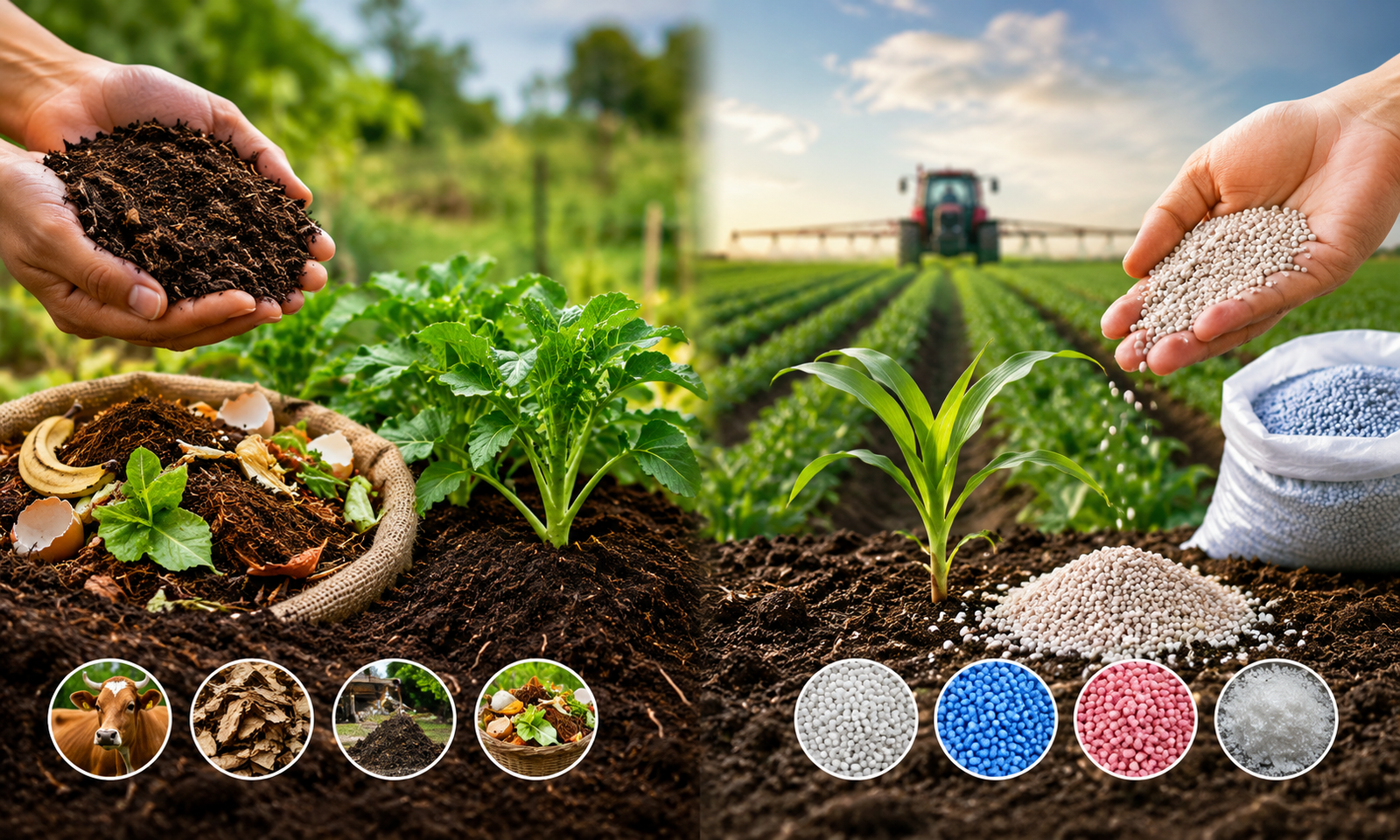
Organic fertilizers are made from natural sources like plants, animals, animal wastes, fish emulsion, compost, and bone meal. They gradually increase soil fertility through soil structure improvement and promotion of good microorganisms. Chemical fertilizers, however, are processed products that are made to supply nutrients rapidly and directly to plant life. Such fertilizers are popular due to being easy to use and the ability to bring rapid results, with the potential to boost the yield of crops within a short time. There are some advantages and disadvantages associated with each type of fertilizer, however, that should be considered by farmers before making a choice. Knowing the mechanism of action for each fertilizer application can improve crop performance without harming the environment and soil for future generations.
Principles of Organic and Chemical Fertilizers.
Organic fertilizers are any materials from naturally occurring sources containing nutrients that plants require. These fertilizers are released over time as micro-organisms decompose the organic material within the soil. Due to the slow release mechanism, organic fertilizers are able to enhance soil fertility over time, and also help retain soil moisture and nutrients. These include for example, seaweed extracts, green manure crops, poultry manure and cow dung or compost. Organic fertilizers are often linked to sustainable agriculture practices, as they minimize the use of synthetic chemicals and contribute to soil ecosystem diversity. Organic farmers tend to use these fertilizers extensively to sustainably produce healthy and productive farmland.
Chemical fertilizers (also referred to as inorganic or synthetic fertilizer) are produced industrially by a combination of essential nutrients including nitrogen, phosphorus and potassium. These foodstuffs are typically in concentrated form and are very effective in promoting quick growth of the plants. These include urea, ammonium nitrate, superphosphate and NPK fertilizers. Commercial farming is commonly practiced with the use of chemical fertilizers because they give quick and certain results. Fertilizer management will be simpler in large farming systems because farmers will be able to apply the exact amount of nutrients required for the crop. Although they are effective, over- or over-timed application of chemical fertilizers can create soil ills (acidification, water pollution, etc.) and reduced microbial activity in the soil.
Farmers and gardeners interested in a more detailed understanding of organic and chemical fertilizers can read more about functional aspects, and make comparisons, to gain understanding of how each type of fertilizer impacts crop productivity and soil health over time.
Basic Differences between use of Organic and Chemical Fertilisers.
There are certain differences between the use of organic and chemical fertilisers. The key difference between organic and chemical fertilizers is the source where they are obtained. Organic fertilisers are made from natural plant and animal sources and chemical fertilisers are produced using an industrial chemical process. This difference has an impact on the nutrient release in the soil. The slow decomposition of organic fertilizers results in a long-lasting nutrient supply and contributes to the long-term fertility of the soil. Chemical fertilizers release nutrients in quick succession and are immediately available to the plants for immediate growth and yield, which are comparatively high. Chemical fertilizers are particularly valuable when deficiencies in any of the nutrients are apparent and need to be corrected immediately.
Another key distinction is how they impact soil structure and microbial activity. Organic fertilizers add organic matter which can enhance the soil texture, aeration and water holding capacity. They promote the growth of beneficial microorganisms including bacteria, fungi and earthworms which are important in maintaining the health of soil ecosystems. The principal objectives of chemical fertilization are to provide plant nutrients directly to the plants and have little impact on soil structure. Without organic matter supplementation, soil quality can deteriorate in the long run. Also, organic fertilizers are usually made from lower nutrient concentration than chemical fertilizers, which requires more organic fertilizers to provide equivalent nutrient levels. Chemical fertilizers have a high concentration, are easy to transport and are more convenient for large-scale farming operations where a quick delivery of nutrients is required.
There are also differences between the two types of fertilizers due to cost and availability. Organic fertilisers can be costlier for farmers if they have access to livestock manures or compost in their proximity, but if they are not in their immediate vicinity, processing and transportation costs can be expensive. On the other hand, chemical fertilizers can be easily obtained in agricultural shops and can yield rapid economic benefits because of the increased yield of crops. But as the cost of fertilizers continues to increase, and industrial production becomes a reliance, it can become expensive for small farmers to use chemical fertilizers. Additionally, organic fertilizers are more environmentally friendly as they minimize chemical runoff and promote sustainable farming practices, whereas chemical fertilizers, if used improperly, can lead to pollution and harm to the environment.
Organic fertilizers are beneficial because they are natural and biodegradable. There are a number of long-term benefits associated with organic fertilizers and this is why they are extremely valuable in the context of sustainable farming. A major plus is that they have a natural ability to enhance the structure of the soil. Organic matter increases the porosity of the soil, improves water infiltration and moisture holding capacity, particularly in drought-prone areas. Over time, soils amended with organic fertilizers are made more fertile by creating an environment conducive to the proliferation of beneficial microorganisms that can break down nutrients into forms plants can readily absorb. This biological activity is beneficial to a healthier soil ecosystem and helps prevent nutrient depletion. Organic fertilizers are also useful in reducing soil erosion by enhancing soil stability and soil humus.
One other major advantage of organic fertilizers is that they are environmentally friendly. They are natural materials which minimize the build-up of harmful chemicals in the environment. Organic fertilizers help to minimise the leaching of nutrients into rivers, lakes and ground water, keeping water pollution to a minimum and protecting water ecosystems. They also reduce the chances of chemical burn to plants, since nutrients are slowly released, instead of all at once. Organic fertilizer users frequently observe better quality, flavor, and nutrient content of crops due to the balanced and healthy soil ecosystem. By the recycling of waste materials from agriculture, organic farming systems will also reduce the amount of greenhouse gases produced, rather than using industrial chemical production.
Organic fertilizers also help to promote sustainable agriculture, ensuring the long-term productivity of farmland. Long-term application without notable impact on environment and maintaining soil fertility. Composting, animal manure and crop residues, when part of a farming system, can lead to better biodiversity and resistance to pests and diseases for farmers. In the long run, if farmers make their own compost from waste products on the farm, the use of organic fertilizers can also help to lower farming costs. Organic fertilizers take a bit longer to show results than chemical fertilizers, but the long-term benefits of better soil health makes organic fertilizer a great option for environmentally aware farmers and gardeners.
Advantages of Chemical Fertilizers
Chemical fertilizers have a high value as a source of nutrients which are quickly and efficiently provided to the crops. Their greatest benefits include quick response after application by plants. Chemical fertilizers contain nutrients which are easily soluble in water and absorbed by plants practically at once. This quick response is useful if crops are defolienced which may impact growth and yield. Commercial farmers growing commercial crops are generally forced to use chemical fertilizers because it is easy to boost productivity and promote intensive farming. Chemical fertilizers have contributed greatly to increasing agricultural production and enhancing food security in areas with high food demands.
One of the other significant advantages is nutrient management. Chemical fertilizers have a specific nutrient ratio, which is tailored to the needs of various crops. The amount of nitrogen, phosphorus and potassium that can be applied to the plant can be determined by the growth stage in which it is found, and the exact amounts can be applied. This kind of control can facilitate efficient crop management and can maximize yields. Chemical fertilizers can also be simple to store, carry and apply through the use of modern farming equipment. They have a high nutrient concentration which allows for smaller amounts to be used than bulkier organic materials, which makes them easier to apply in larger scale agricultural applications where labour and transport costs are significant.
Chemical fertilisers are particularly beneficial for crops with high requirements which need nutrients to be available for optimum growth as soon as possible. Artificial fertilizers tend to yield quick growth and early maturity of crops such as maize, wheat, rice and vegetables. Chemical fertilizers can quickly replenish soil nutrients in cases of high levels of nutrient deficiency and prevent complete crop loss. They are also consistent in their composition, so that they can be predicted in commercial agriculture where productivity is a component of income. Chemical fertilizers, if applied with care according to the recommended guidelines, can play an important role in efficient agriculture and food production worldwide without effect on the environment.
Drawbacks and negative effects on the environment.
While there are numerous advantages with using organic fertilizers, there are also a number of drawbacks that must be taken into account. One disadvantage is that the nutrients are provided gradually and this may not meet the immediate nutrient needs of the fast-growing plants. Organic fertilizations may require some patience since they may not show the noticeable results in plant growth immediately after application. The nutrient content of organic fertilizers may also be reduced and require larger rates of application, which can increase labor and transportation costs. Poorly processed manure or compost may contain weed seed, bad bacteria or odours that pose management issues in some instances. Availability may also depend on the availability of organic matter in the area.
There are also a number of drawbacks and environmental issues associated with chemical fertilizers. Overuse can result in nutrient runoff into rivers and lakes, water pollution and harmful algal blooms. Over time soils can become acid when used improperly, and microbial activity can decrease, as well as soil fertility. The production and use of chemical fertilizers can also be a source of GHG emission. Synthetic fertilizer dependent farmers are often on a negative cycle as they are forced to invest more and more in production in order to keep their level of production, while at the same time making their production less sustainable. In addition, over-fertilizing can lead to fertilizer burn and if left unchecked, can impact food quality.
With these conditions, environmental sustainability is a topical issue and the responsible use of fertilizers is of great importance in today’s agricultural context. Organic fertilizers are generally considered to be more environmentally beneficial and less harmful than chemical fertilizers, which can lead to degradation of soil and pollution of the environment if not properly handled. In recent times, it is advocated that integrated nutrient management systems can be implemented involving the application of organic and chemical fertilizers. In this way, farmers will be able to experience the rapid release of nutrients, while maintaining soil fertility and environmental health in the long term. To sustain food security while maintaining natural resources, sustainable farming is the key.
Suitability to different crops and cropping systems.
Various crops may have different nutrient requirements, growing seasons and environments, so will respond differently to different fertilizers. Organic fertilisers are very appropriate if the crop is cultivated in a sustainable or organic farming system. Organic fertilizers for fruits, vegetables, herbs and leafy vegetables have yielded good results because the quality and microbiological activity of the soil has increased, which also has a positive impact on the quality of the crops grown. Organic fertilizers are also a good choice for home gardens where soil improvement is more important than high yields. Natural fertilizers are often a requirement for certification of organic premium crops and the demand for “green food” is increasing.
In large-scale farming for commercial production, use of chemical fertilizers would be preferred since the speed of growth and yield is required. Most crops require considerable levels of nutrients, particularly rice, maize, wheat and sugarcane, and these nutrients are often available at a cheaper cost through chemical fertiliser. Farmers are actually the ones who use agricultural chemicals in the intensive production system to achieve production goals and profit maximization. These fertilizers are particularly beneficial in areas where soils are low in nutrients, and crops need to be fertilized right away. In commercial farming a chemical fertilizer can be used in combination with organic matter to improve soil health, nutrient use efficiency and reduce its impacts on the environment.
Integrated farming with use of both organic and chemical fertilizers is becoming popular as it has the advantages of both the systems. Chemical fertilizers can supply the nutrients quickly in the critical growth stages, while organic fertilizers can improve the soil health and microbial activity. It is a blend that enables farmers to become productive and have soil fertility in the long run. To achieve sustainable agriculture, productive and environmental protection should be balanced. Understanding the pros and cons of both fertilizers will allow farmers and gardeners to make an informed decision for their crops, soil, and farming methods that will benefit their crops.
Conclusion
Both organic and chemical fertilizers are important and have been in discussion for the modern agricultural practices. Organic fertilizers can benefit soil fertility, enhance microorganisms and help to use soil sustainably. They play a role in soil health, decrease pollution threats and promote ecological equilibrium in cropland. Chemical fertilizers, however, provide a rapid supply of nutrients, large harvests and efficient food production to meet the world’s needs. They are easy and effective to use and can be valuable in commercial agriculture, especially when nutrients need to be readily available for the crop.
The fertilizer selection is related to crop type, soil condition, farming goals, environmental consideration and resources. They have to take into account both the advantages and disadvantages of the type of fertilizer that they are selecting for their farmers and gardeners. When using integrated nutrient management, the use of both organic and chemical fertilizers may yield the highest returns in many situations because it enhances soil health and productivity. Use of the fertilizer for sustainable agriculture is vital, harmonizing with the production of the crops and environmental protection. Farmers need to understand the difference between the two types of fertilizers, the benefits and drawbacks of each and how they can use them to keep the soil fertile for future crop production and growth.