
The operating system is responsible for coordinating software and hardware resources that make the computer usable. What lies behind common tasks like opening an application, saving a document, accessing the Internet, or printing a file is a set of system components that need to get the job done efficiently. The organization of these parts and the division of responsibility between kernel, device drivers, system services, applications and hardware constitute operating system architecture.
There are many different architectural approaches to creating different operating systems because there is no single technique that delivers the same level of performance, security, reliability, and maintainability across a variety of computing contexts. Many systems store all of the services in the kernel, but others separate critical services into other components. Once you understand these architectural decisions, you’ll be able to easily understand why different operating systems behave differently in performing similar tasks.
Operating System Architecture
Operating system architecture is the internal structure of an operating system and how its main components are related to each other. The kernel is at the heart of most operating systems and controls the use of vital resources like the processor, memory, storage, and input/output devices. The top layers above the kernel are system services and other software that supply functionality to applications. For instance, when a user starts a program, the program does not usually directly access physical memory or a storage controller. On the contrary, it is asking services from the operating system that follow predefined interfaces and the operating system is responsible for system and hardware resources. The architecture dictates where these functions operate, how components interact and what happens if a component fails or should be updated.
One good way to visualise operating system architecture is to visualise a large organisation made up of different departments with specific roles. In one design, lots of departments can be located in the identical central workplace and communicate very rapidly. In another, departments can be split into distinct offices that have distinct communication avenues. The first can give rapid interaction but can also create a problem in one department that can impact other areas. The second one gives more isolation, but could have some communication overhead. The trade-offs are the same for operating system architectures. Processors, memory, hardware portability, security, reliability, and maintainability are all factors that the designer must take into account when designing a system.
Monolithic Kernel Architecture
A monolithic kernel is an OS architecture where a number of fundamental OS services run in the privileged address space of the kernel. They may be responsible for process management, managing memory, file systems, networking, device drivers, and more. These components run in the kernel, and thus can communicate directly with each other without having to repeatedly jump across multiple protection domains. This can yield high performance since there is relatively direct communication between the parts of the kernel. The kernel of Linux is frequently referred to as a monolithic kernel with a modular design since the main services reside in the kernel, but many of the services can be loaded and unloaded as modules when necessary.
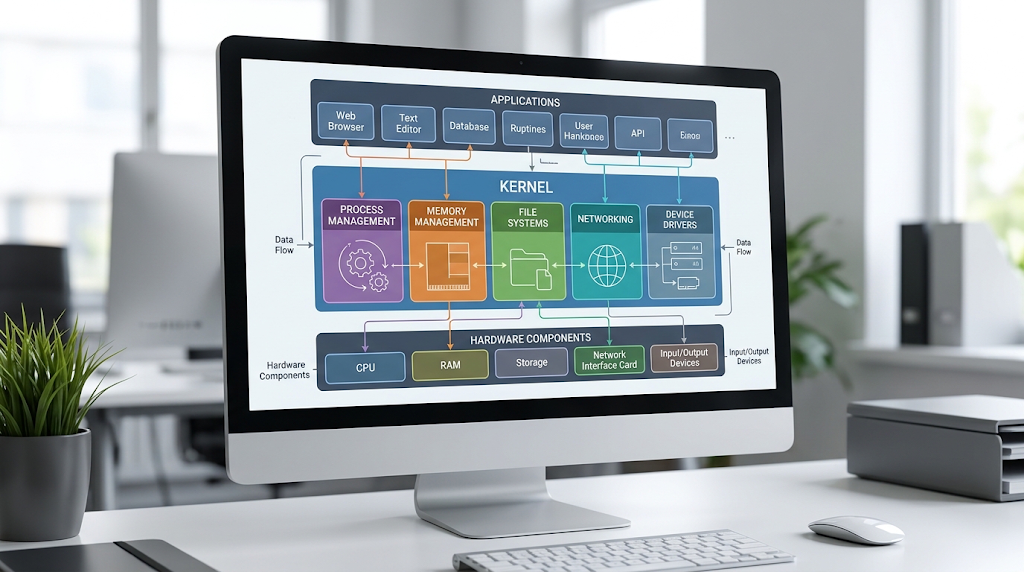
Performance is one of the key benefits of a monolithic approach. If an OS service is desired for a process, it can be satisfied using efficient mechanisms provided by the kernel; closely related OS services can communicate without incurring the time overhead of a lot of inter-process communication. Hardware interaction can also be very efficient as device drivers and other hardware related components can have direct access to kernel facilities. Many components in the same privileged environment, however, bring reliability and security risks. If a serious bug occurs in one of the kernel level components, like the device driver, it can have a negative impact on the whole operating system. As such, it is important for developers to test and maintain components running with high privileges.
As more features are added to the OS, it can become more complex in a monolithic architecture. A large kernel can include a large number of pieces of code that run on various hardware platforms, file systems, networking technologies and security mechanisms. Modifying one part might need to be considered relative to other kernel parts to ensure that it functions as intended. Some of these challenges may be addressed in a modular way with clear interfaces, testing and development tools in modern implementations. So, monolithic doesn’t imply that everything that is in the operating system is permanently fixed in one static block. It, on the other hand, is mainly the location of important operating service processes and the degree to which they are combined.
Microkernel Architecture
The microkernel, on the other hand, is designed to make the kernel as small as possible. Architectures usually rely on placing only the most critical mechanisms in the kernel, like inter-process communication, interrupt handling, scheduling, and low-level memory management.The architecture usually involves placing only the most critical mechanisms in the kernel – such as inter-process communication, interrupt handling and scheduling, low-level memory management. The kernel can be modularized and services like device drivers, file systems etc. can be run as separate processes or servers outside the kernel. This separation can help build clearer lines between components and possibly decrease the code being executed at the highest level of system privileges.

An important advantage of having a microkernel is increased isolation. A failure of a service running outside the kernel could result in the failure being isolated to that service instead of an immediate OS failure. This design can also help secure as less components would have access to critical kernel resources without restrictions. For example, a device driver can be separated from the rest of the kernel features. This separation can be very beneficial in systems that require reliability and predictable behavior. But the extra communication overhead between isolated components can be added. To communicate between services, they will have to do so in other ways, for example via IPC, which can be more complex than direct calls between components within a monolithic kernel.
The tradeoffs in microkernels are thus different between very high performance and high reliability/maintainability. The small kernel can be easier to analyse, test and protect and the kernel can be separated from services that can help to improve fault isolation. Meanwhile, designers need to make sure that there is efficient communication between components that can support the workload of the system. The performance and communication capabilities of processors have improved, and this has made microkernel approaches possible in various settings. The architecture is relevant especially considering the need for predictability of behaviour, secure boundaries, and reliability of the system over any need to minimise all communication overheads.
Hybrid Kernel Architecture
A hybrid kernel is a mix of the features of monolithic and microkernel. The goal is typically to keep the performance advantages of having critical services in an environment that is tightly coupled with the organization’s concepts derived from microkernels. In the real world, the word “hybrid” can be applied to a design with a relatively large kernel that still provides good internal isolation between components compared to a classic monolithic design. Hybrid or hybrid-like approaches are often mentioned in the context of Windows NT and Apple’s XNU kernel, and the terminology and architectural classification are dependent on how the system is analyzed.
Flexibility is the main drive for hybrid designs. A fully monolithic architecture may have efficient communication, but may have a lot of privileged code, and a strict microkernel may have a much greater degree of isolation but may need more communication between components. A hybrid design tries to locate those services whose performance is a critical concern where they can communicate efficiently, while keeping the architectural boundaries and abstractions in place for organization and maintainability. It can be helpful to use for general purpose operating systems that need to run a variety of applications and hardware. The resulting architecture is frequently complex since more than one architectural philosophy is involved.

Modular Architectures
Modular architectures break up the operating system into various parts which can be built, loaded, replaced, and managed separately from the rest of the OS, but still interact with a core kernel or framework. Modularity does not define if an operating system is monolithic, microkernel based or anything else; it refers to the way functionality is divided into modules. For instance, a system could contain a core system known as a kernel, and modules that could be loaded on the fly, such as device drivers, a file system, networking support, or other features. This is because other hardware or features can be added or upgraded to the operating system without all of the hardware being permanently integrated into the kernel of the operating system.
The idea of modular design can be extended to modular architectures which break down an existing system into its separate parts, and then link and control them using specified interfaces. In an operating system, this can make the code more maintainable as developers can make changes to just one part without having to make changes to other unrelated parts of the system. Another advantage of modules is that hardware support can be made more flexible: A driver or other piece of hardware may be added in as the hardware itself is required. But with modularity comes not just the elimination of security or reliability concerns, but no easy answers. Even components that are granted a lot of privileges require testing, access control, compatibility management and security updates.
Concept of a Layered Operating System Design.
A layered operating system has layers of functionality, and each layer services the layer on top of it and depends on services offered by lower layers. Lower levels typically deal with hardware and basic resource management; higher levels offer increasingly higher level services to applications. This can make for a tidy concept as every layer carries out a specific function. For example, lower-level layers of an application don’t need to know how the storage device behaves electrically since they have abstractions that remove lower-level details.

The greatest benefit of a layered design is organization. Having clearly defined boundaries can help make an OS easier to understand, test, troubleshoot and maintain, as it allows developers to see which layer is responsible for a specific function. Well-structured boundaries can also strengthen security as access to lower-level resources is controlled via defined interfaces. But when it comes to strict layering, there can be limitations. Some operations may have additional overhead or make certain optimizations more challenging, due to the need for interlayer communication. Real operating systems are, therefore, not necessarily strictly layered. They might, however, use layered principles and/or modules, direct communication paths or other architectural methods.
How the Components of an Operating System Work Together.
In either architecture, it is important that multiple components of the operating system are coordinated. The kernel handles basic resources, process management decides where to allocate processor time, memory management decides how to allocate RAM and virtual memory, components of the file system organize the information stored on information devices, and device drivers are the link between information devices and software. System calls and other interfaces are used to allow applications to request services from the operating system in a controlled manner. When a user opens a file, for example, the application can request the operating system to locate and read the file. The operating system in turn controls the file system, storage driver, memory subsystem, and hardware controller to get the information it needs and to present it to the app.
A special consideration for hardware interaction is that operating systems act as a mediator between applications and physical devices. The technical specification and communication needs of a keyboard, network adapter, graphics processor, SSD or printer is different. Device drivers convert OS requests into operations which are understood by specific hardware. In a monolithic system drivers can run directly in the kernel space. In a microkernel design, drivers can be separated off into individual services. In modular architectures, drivers can be added or removed as modules; in layered architectures, the operation of the driver may be at the lowest level of abstraction, whereas the higher level abstractions are hardware independent. These differences have an effect on the efficiency and safety of operating system communication with hardware.
Relationship between the Major Architectural Approaches.
Performance
Communication frequency between the components and the amount of work that needs to be done upon service requests is critical to performance. Many services run in a privileged environment, making monolithic designs an efficient way to communicate. Microkernels can cause extra communication overhead as services can be distributed to different processes.
Hybrid architectures try to get the best of both worlds, efficient communication and organization separation; modular and layered architectures can be designed in ways that maintain good performance. How fast a computer feels in everyday use depends on implementation quality, hardware, workload, compiler optimizations, drivers and many other things; architecture alone is not enough to determine the performance of a system.
Security
The quantity of privileged code and the level of isolation of components both have an effect on security. By limiting the number of services operating in the most privileged portion of the system, microkernels can help to minimize the impact of compromised or failing services. Monolithic kernels may be bigger, but if they are, their security can be significantly enhanced with the use of robust security mechanisms, careful development of drivers, access controls, and constant patching.
Depending on their implementation, modular and layered designs can offer helpful boundaries as well. Ultimately, choosing a specific kernel model is only one way to ensure that the system as a whole is secure, since there are vulnerabilities in applications, drivers, system services, configuration tools and hardware interfaces.
Reliability
Reliability is related to the ability of an operating system to remain operational under the occurrence of errors in components. Services are separated and fault isolation may become easier in a microkernel as a failed service can be restarted without the need to shut down the entire system. While monolithic systems may be more susceptible to system-wide consequences in the event of failure of privileged components, modern implementations feature many mechanisms to identify and recover from errors.
Controlled component updates can be supported with modular designs and layered structures can help define responsibilities for troubleshooting. For all architectures, reliability is built on testing, error detection and recovery, hardware reliability, and operating system maturity.
Maintainability
Maintainability refers to how accessible it is for the developers to change, update, debug, and extend an Operating System. It can be easier to do this with modular and layered designs, in which functionality is split into parts that are easy to understand. There is also a good conceptual separation between the microkernels as many of the services are independent from the central kernel.
While a large monolithic kernel might be more difficult to manage, due to the close interaction of many components, modular monolithic systems have some of the answers. Documentation, stable interfaces, automated testing, code review and version management are critical and important no matter what the architecture. Even with a rather complex architecture, a well-organized implementation can be maintainable.
What are the reasons for the different architectures of operating systems?
Computers are designed for a variety of purposes, thus no universal operating system architecture. A desktop operating system has to be able to support a wide variety of applications, graphics hardware, storage devices, networking equipment and peripherals. Scalability, availability and efficient use of resources may be priorities for a server. There is a need for embedded systems to be limited in memory and timing requirements, and for safety-critical computers to be predictable and well-isolated. These various needs impact on architectural considerations. Trade-offs between performance, security, reliability, compatibility of hardware components, development effort and future maintenance considerations are therefore evaluated when making design decisions that concern the organization of system components.
The architectural decisions also change over the course of the years. The OS developers don’t have to make a decision between all-or-none versions of monolithic design, microkernel design, hybrid design, modular design or layered design. In modern systems, the ideas of several approaches are integrated into one system to satisfy practical needs. A kernel could also be monolithic, with dynamically loaded modules and strong internal abstractions. Another system could be designed using microkernel ideas to isolate components whilst optimizing the communication methods to achieve a better performance. Modular components can exist in parallel with layered interfaces. This blend enables the developers to borrow from various architectural traditions without getting locked-in to any particular theoretical approach.
Conclusion
Architecture of an operating system defines the organization and interrelationship of the various components of a computer system. The monolithic kernels combine a lot of important services into a tightly coupled kernel-based environment which may have the advantage of efficient communications but needs to be carefully managed to ensure that privileged components are not inappropriately managed. Microkernels aim to isolate and contain faults by separating many services from the central kernel, making it smaller and simpler. Hybrid kernels: Sometimes a combination of approaches, and modular architectures group functionality into components that can be handled separately. Layered Designs provide levels of abstraction which make responsibilities easier to understand and control. These approaches do not present a binary choice between good and bad designs, but rather features some compromise.
Having an understanding of these architectures also allows you to understand how operating systems can behave differently in the same basic tasks. Many different parts of the operating system work together when the application interacts with a file, communicates over a network, or accesses a hardware device. The architecture dictates the containment of failures and security issues, the communication between those components, and where they run. Thus, architectural decisions are closely related to performance, security, reliability, maintainability and hardware interaction. These various methods will help readers learn about the engineering decisions made in designing the operating systems of today and how they may differ depending on the particular type of computing environment.