If you’ve ever had a tool wear out too fast, chip unexpectedly, or come out of heat treatment slightly off, you’ve probably asked yourself this question at some point:
Should I be using O1 steel, or is A2 steel a better choice?
It’s a common question, especially in stamping, cutting, and general tooling work. The confusing part is that both materials seem very similar at first glance. In reality, they behave quite differently once you start using them.
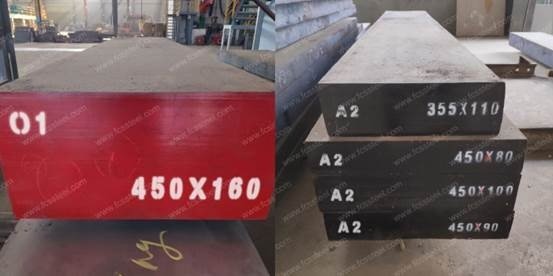
The Difference Is Not What Most People Think
Both O1 steel and A2 steel can reach similar hardness levels, usually somewhere around 58–62 HRC. So if you’re expecting a big difference in “how hard” they are, you won’t find it there.
The real difference shows up in how they behave.
O1 steel is easier to work with and more forgiving. It tolerates small variations in alignment or load without failing immediately.
A2 steel is more stable and wears more slowly, especially in repetitive production.
That’s really the core trade-off. Everything else comes from it.
What You’ll Notice in Daily Use
In a typical shop environment, the difference becomes obvious after a few thousand cycles.
With O1 steel, wear is usually gradual. In many stamping setups, edge rounding becomes noticeable somewhere around 3,000–8,000 hits. The tool keeps working, but performance drops and regrinding becomes necessary.
A2 steel behaves differently. The edge holds longer, and it’s common to see tool life improve by around 30–50% in similar conditions.
But when something goes wrong, A2 steel reacts faster. Instead of wearing down, it may chip at specific points. This often happens when clearance is tight or alignment is slightly off. The rest of the edge may still look fine, but the tool is already compromised.
When People Switch from O1 to A2

Most shops move to A2 steel when wear becomes the main limitation.
For example, in blanking operations, frequent regrinding with O1 steel increases downtime. Switching to A2 steel can extend maintenance intervals and improve consistency across longer runs.
However, the switch is not always smooth.
Some setups begin to show edge chipping after moving to A2 steel. This is usually not a material defect, but a sign that the process was already marginal. A2 steel simply exposes it earlier.
This is why material selection often needs to be combined with small process adjustments, not treated as a standalone fix.
Why Some Shops Still Prefer O1
Even with the advantages of A2 steel, O1 steel is still widely used.
The main reason is stability in less controlled environments. O1 steel is easier to heat treat and less sensitive to variation. It can handle small inconsistencies without failing suddenly.
In shorter production runs or in shops where conditions vary, this matters more than maximum tool life.
In those cases, a tool that wears predictably is often more valuable than one that lasts longer but fails without warning.
Heat Treatment Makes a Bigger Difference
One area where the difference becomes very clear is heat treatment.
O1 steel is oil-hardening, which means faster cooling and a higher risk of distortion. Complex parts often require additional finishing after hardening.
A2 steel is air-hardening, so cooling is more uniform. In practice, dimensional variation can be reduced by roughly 30–50%, which is why A2 is often preferred for precision tooling.
That said, A2 steel requires tighter control. If temperature or tempering cycles are inconsistent, results can vary more than expected.
This is also where supplier quality starts to matter. For example, some manufacturers such as FCS Tool Steel focus on tighter control of composition and heat treatment response, which helps reduce variation between batches — something that becomes more critical with steels like A2.
So Which One Should You Use?
There’s no single answer, but the decision usually becomes clear when you look at the actual problem.
If tools are wearing out too fast, A2 steel is often the better option.
If tools are chipping, cracking, or behaving unpredictably, O1 steel is usually safer.
If dimensional stability after heat treatment is critical, A2 steel has a clear advantage.
If your process is not very consistent, O1 steel will generally give you fewer surprises.
A Simple Way to Think About It
You don’t need to overcomplicate the decision.
O1 steel is easier to manage and more forgiving in real-world conditions.
A2 steel performs better when the process is stable and controlled.
Both are widely used for a reason. The key is matching the material to how your tools actually behave, not how they look on paper.
Final Thought
Most material choices aren’t about finding the “best” steel.
They’re about avoiding the problem that costs you the most time.
If your issue is wear, A2 steel usually helps.
If your issue is an unexpected failure, O1 steel is often the safer choice.
In practice, the difference often comes down to consistency — both in your process and in your material supply. Once those are aligned, the choice becomes much more straightforward.