Introduction
Maximize Tesla Range is essential because Tesla models are known for their long range, efficient electric engines, and very advanced energy management systems. That said the range reported on a Tesla’s spec sheet or which is displayed in the vehicle does not always match what a driver will see out on the road. This may come as a shock to new electric car owners that expect to hit the numbers put forth by the manufacturers with every charge. In fact, EV range is a variable that is affected by a great many factors which include temperature, speed of travel, altitude, tire pressure, use of climate control, traffic, load in the car, and driving style. By which we also mean that understanding these variables is key to reducing range anxiety and in turn making the Tesla a more predictable and efficient vehicle.
The good thing is that it is doable for the drivers to take a few practical actions which in turn will improve real world efficiency of the car without making every trip out of convenience or comfort. The solutions we put forward as solutions include pre conditioning the battery, use of regenerative braking to the max, keeping tire pressure at right levels, reducing that which is not needed in terms of energy use, and also changing up highway driving habits a bit. In cold weather we have a different set of strategies from what we would use in hot weather and also — we have the issue of aerodynamic drag which increases as speed goes up on the highway. By studying how these elements play a role in energy use we can better use what we have in the tank and leave the house with a greater buffer of range.
Tesla’s reported range varies from actual range which is what they report versus what you see in practice.
Tesla reports their range under controlled tests which do not include all variables of weather, traffic, speed, terrain, and driver behavior. Standardized tests are for the benefit of consumers which have a way to compare models, but in the real world that is a different story. A driver on a smooth flat surface in fair weather may see results that play out as the company reports, while another driver on a cold winter day at high speed with the heat on may see much different results. The displayed range is really a guess at performance rather than a concrete distance which the car will always log.
Tesla’s advertised range
Several variables which put in play the real world range above or beyond what is reported. Temperature is a key one as batteries perform best within a certain range. Very cold weather can raise energy use and also affect charging and regenerative braking. Very hot weather can increase the energy it takes for cooling the battery and passenger compartment. Also speed plays a role as aerodynamic drag increases with speed. To that we have steep hills, strong headwinds, low tire pressure, roof top equipment, heavy cargo, frequent acceleration and aggressive use of climate control which also see to increased electricity use. These variables which is what we see is that two Tesla drivers may get very different ranges out of the same model.
How Temperature Affects Tesla Range
Maximizing Range in Cold Weather
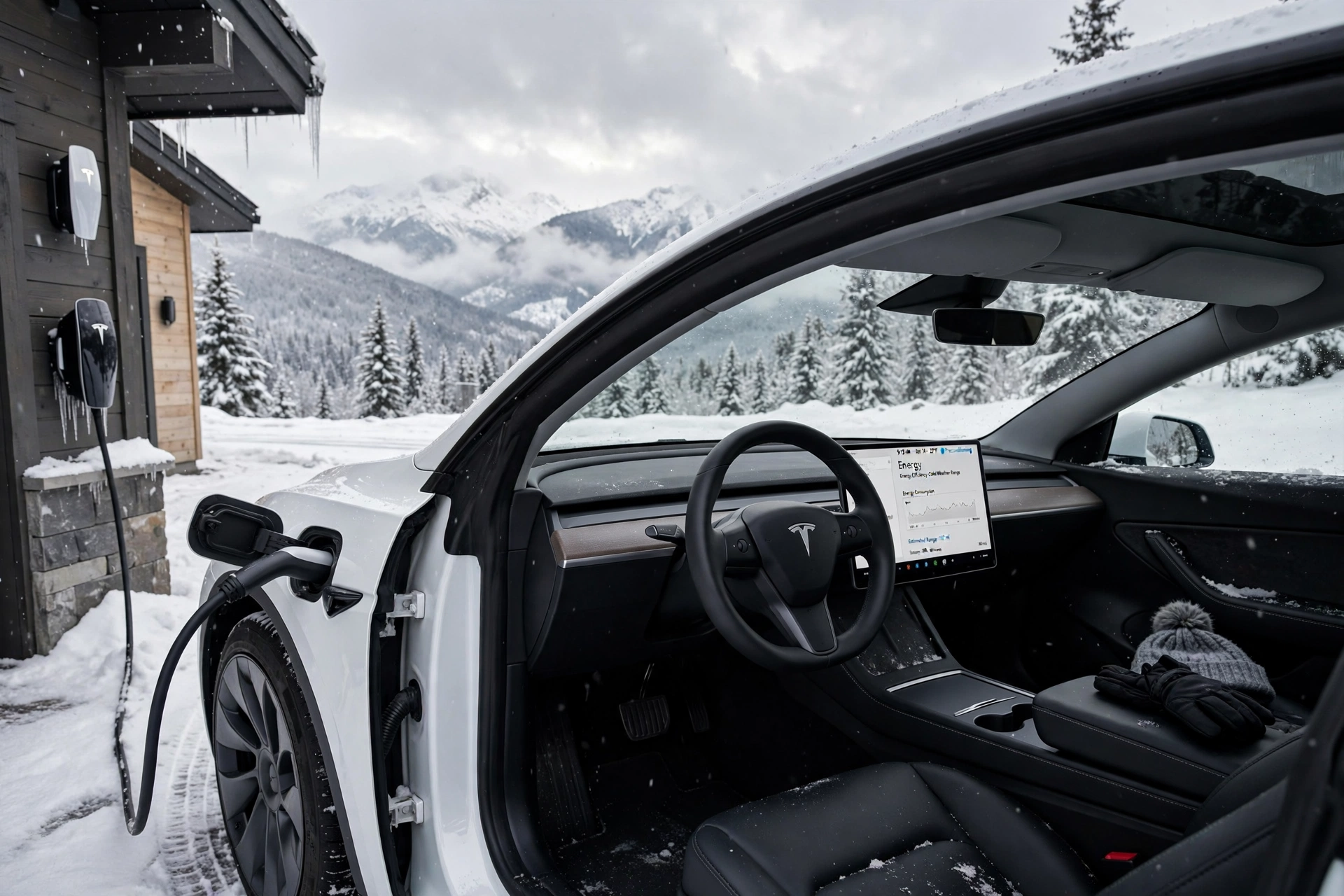
Cold, which is a few degrees below freezing, is a great issue for electric cars as the battery and other systems perform less efficiently at these low temperatures. At lower temperatures the battery may require more power to get to what we consider a usable operating temperature. Also the car may use up more electricity to heat the cabin, defog the windscreen, warm the seats and so on. Also in cold weather regen may be reduced which means the car doesn’t recover as much energy from braking until the battery warms up to an optimal temp. This all adds up to higher energy use in a Tesla during winter which is very noticeable in short trips out of a cold start.
Preconditioning is a very useful practice for cold weather performance. If the Tesla is plugged in while parked it can prewarm the battery and cabin which in turn uses external electricity as opposed to that which is stored in the battery for the initial heat up. Also drivers may reduce the need for cabin heating by using seat heaters when appropriate and setting a moderate temperature in the cabin. Also plan out longer trips so that the car has time to get to an optimal operating temp. We are not trying to do away with cabin heat at all but rather to use the car’s energy resources more smartly before and during the trip.
Maximizing Range in Hot Weather
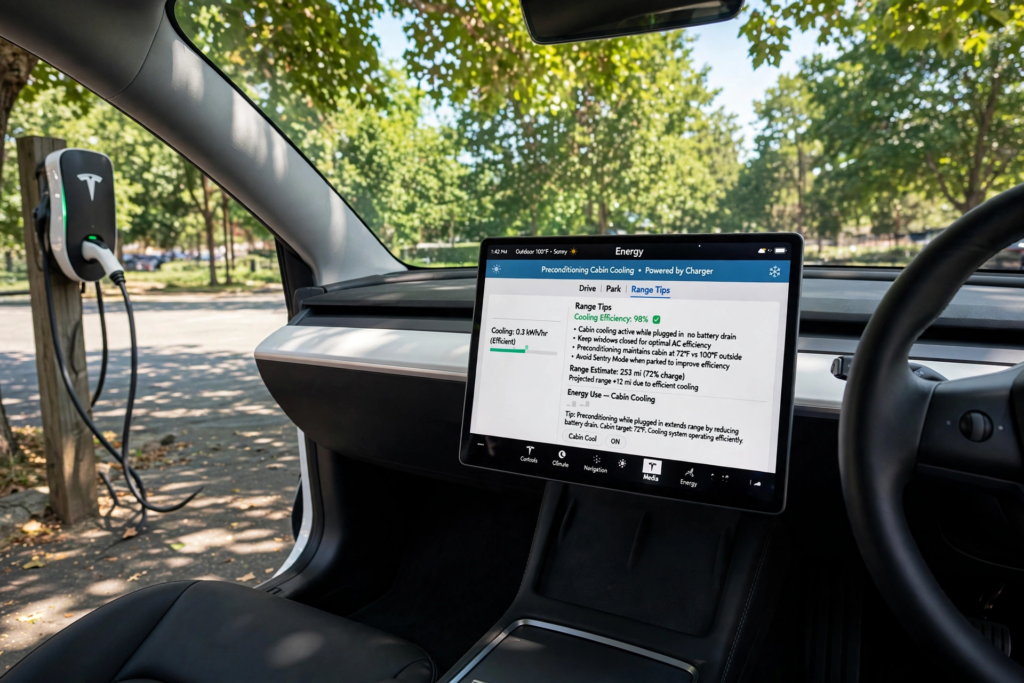
High in temperature we see different efficiency issues. In hot weather the Tesla will use more electricity to cool the passengers’ compartment and manage battery temperature. Air conditioning may become a big user of energy by the time the vehicle is left in the sun which in turn will heat the interior a great deal. The issue also exists of the battery requiring more energy for cooling during what is a very demanding performance which in turn also may be a hot time that may be while driving and also when charged up. Also a traveler in very hot weather may report less efficiency from the car compared to another at the same speed but on a cooler day.
One out of the simplest methods to cut down on unneeded energy use in hot weather is to pre-condition the car while it is plugged into a charger. Before you go, cool the interior which in turn reduces the amount of battery power used to bring the cabin back down to a more bearable temp after you start driving. Also park in the shade or use proper sun protection which will also reduce the initial cooling demand. While you should still use the climate control when you need it for comfort and safety, don’t think that the best practice is to drive in a dangerous or very hot setting. Efficient use of climate control is about waste reduction not totally doing away with what is a necessary element.
Use Preconditioning to Improve Efficiency
Pre condition which is very useful as it gets the Tesla ready for what it will see out on the road before you even hit the open road. When the car is hooked up to a charger we see use of energy to warm or cool the battery and passenger area coming from the grid and not the battery which in turn leaves more of the stored energy for when you are actually driving. Also pre-conditioning can do a great job when you are about to use a fast charger which in turn prepares the battery for better charging as the navigation and vehicle systems see fit.
Drivers can include preconditioning as a step in their regular routine when weather is very cold or very hot. Instead of jumping into a car that has been sitting in an extreme temperature for several hours and hitting full heat or full AC right away, take some time to precondition which in turn makes the trip more efficient. Also this practice may see the cabin reach a more comfortable temp from the start of the trip. The exact results may differ by temperature, trip distance, state of charge of the battery, and if the car is plugged in but in general preconditioning is the easy way to put Tesla’s energy management at your service.
Regenerative Braking and Efficient Driving
Regenerative braking is a key element in Tesla’s efficiency strategy. We see that instead of using traditional friction brakes at each instance of deceleration, regenerative braking which has the electric motors also function as generators at those times, renews some of the vehicle’s kinetic energy and puts it back into the battery. While it is true that not all of the energy used for acceleration is able to be recovered as energy conversion is not perfect, what we do see is that regenerative braking does in fact greatly improve efficiency in the case of frequent changes in speed which is very common in urban driving where vehicles report to stop and go often.
Drivers may see great results from regenerative braking if they look ahead and allow the car to slow gradually instead of aggressive acceleration and last minute braking. A steady pace which is free of the unexpected is better for energy use and also what the car is designed for. In traffic lights, intersection, and speed limit change filled roads do your best to see what is up ahead and avoid that extra acceleration. Regenerative breaking is a part of a whole efficient approach to driving, not a reason to change your normal safe driving practices. Smooth acceleration, early notice of what is ahead, and predictable speed changes are what you want to aim for instead of trying to max out the regeneration on each break.
Highway Driving: Greatest Range Challenge.
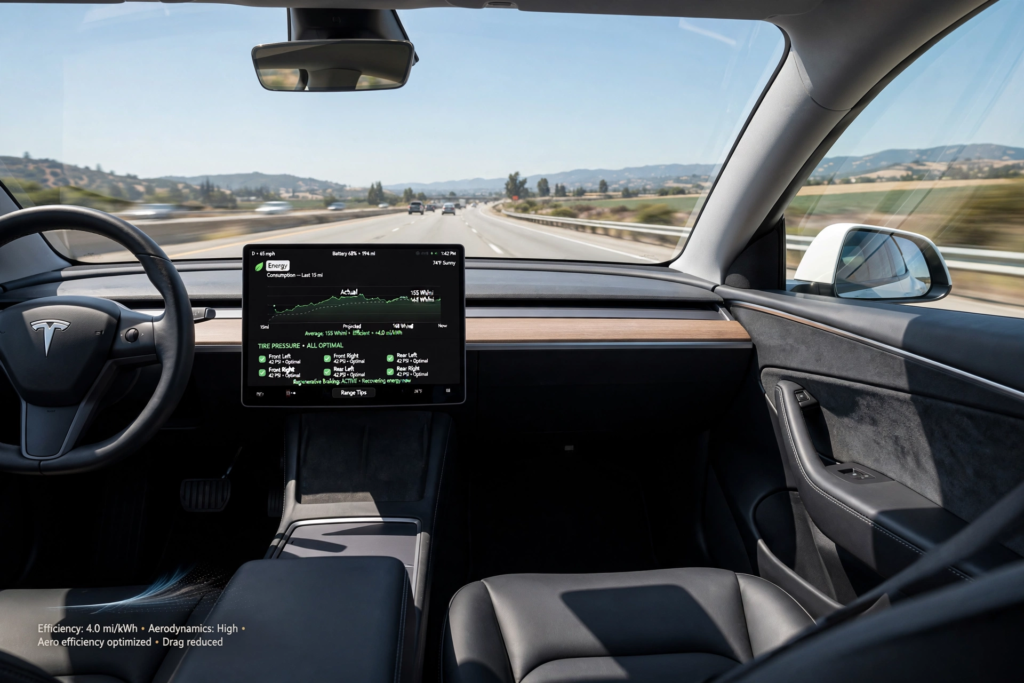
Highway travel reduces Tesla range more quickly then which many drivers think. At low to moderate speeds issues like rolling resistance and acceleration take the lead but as speed goes up aerodynamics play a greater role. Also a large increase in speed at higher rates doesn’t help the Tesla’s range as much as it does at lower speeds. What we see is a Tesla which at a constant moderate highway speed can use a great deal less energy than the same car going much faster, even when the distance traveled is the same.
The best approach for highway driving is to keep to a steady, moderate speed which you maintain as much as possible rather than fast accelerating and breaking. Fast acceleration uses up a lot of fuel which is wasted energy and very high speeds increase the issue of wind resistance. In the case of headwinds the issue is magnified as the car in effect is fighting a stronger wind. Also roof racks, cargo boxes, open windows and other changes to the car’s aerodynamics will increase fuel drag. For long highway trips it is best to focus on a constant speed, check tire pressure, reduce what causes extra drag and use navigation to plan for charging stops instead of trying to push the car as hard as you can between charges.
Maintain Tires and Reduce Unnecessary Weight
Tire health and pressure play a large role in electric vehicle performance. Under inflated tires increase rolling resistance and therefore put more strain on the battery as the car uses more energy trying to move the vehicle. As electric cars are able to react fast to these inefficiencies, keeping the pressure at the level which is suggested by the manufacturer is a quick way for drivers to improve performance. It is up to the driver to check tire pressure often and to use the information provided in the manual, not what may seem like an appropriate pressure just by look. Also of note is that the physical state of the tires’ tread has an impact on performance, which means that as they become worn or if they are of a poor quality that it also will in turn play a negative impact on the performance of the vehicle’s handling, breaking, and also over all drive.
Vehicle mass is a factor to look at as well, especially on long trips. While putting unneeded items in the trunk or cabin may not greatly affect fuel economy, extra weight does require more energy for the car to move and to climb hills. Thus out of date items which you are not using should be removed for improved efficiency over time. Also in highway driving aerodynamics play a large role which is often ignored. A roof mounted carrier which is left on when not in use may use up more energy for the full duration of a highway trip. By keeping your Tesla clean, well maintained, and without that extra external gear you can see better efficiency.
Plan Your Itinerary By Energy Use.
Good planning of your trip can reduce range anxiety which is an issue beyond your control due to weather and driving conditions. Instead of putting all your eggs in the basket of estimated miles left to do which is a variable factor, drivers should look at the total energy use for the whole trip. A route which has a lot of hills, high speed roads, is in heavy traffic, has extreme temps, or is affected by wind may use more energy than a route of the same distance in easier conditions. Nav systems and the car’s energy metrics are a great tool to see if a trip as planned is doable but drivers should still leave some buffer time as we can’t count on estimates to be exact.
Charging breaks must be included as a normal part instead of a symptom of a deficient range. For a long trip a regular pit stop for charging is a great way to break the monotony and at the same time reduce the travel stress. Also drivers should not plan to charge their dying batteries at the last moment which when possible we can do without. A comfortable margin in the battery’s charge level is useful for those unexpected changes like traffic issues, bad weather or a detour. What causes range anxiety is that which we don’t know, not that we can’t actually make it to our destination. With better trip planning we can turn that unknown into a predictable element of the trip.
Use Efficient Driving Habits Every Day
Driving which you do has a great impact on what you consume in terms of charge as you go. With hard acceleration you get that rush which many Tesla owners report as a plus point of their cars’ performance, but of which if you do a lot you will see an increase in your charge use. Also you don’t have to drive very slowly to drive efficiently; what you do is avoid large changes in speed and use the car’s kinetic energy well. What we see in most efficient driving is smooth acceleration into a steady speed which in turn is better for fuel economy than that of constant hard acceleration and braking. In heavy traffic give yourself room to brake early which in turn reduces the amount of extra acceleration and break which in total is more efficient.
Another which is a great practice is paying attention to the vehicle’s energy report. Tesla gives drivers info which allows them to see if actual energy use is more or less what was expected. As for when the displayed range goes down faster than the odometer reading, this isn’t a reason for concern. That said, a temporary rise in consumption during a hill climb, cold start, or high speed run doesn’t mean there is an issue with the car. What we put out for estimated range isn’t always the same as what we see on the energy consumption which is why it is important to understand the difference between the two. It will help you make better decisions and put to rest unnecessary worry.
Reduce your range anxiety with a practical buffer.
Range anxiety results from the fact that we tend to treat the reported range as a definite promise instead of the variable which it is according to the driving conditions. When a Tesla reports a certain range, that is not to say it is a guaranteed distance the car will travel, rather it is an estimate which may change with weather, speed, terrain, or traffic. A better strategy is to have a buffer and take into account the conditions you will be traveling in. For example a long trip on the highway in cold weather will require more preparation out of which a short urban journey in mild weather will be very different.
Drivers also put together a personal profile of their car by which they track energy use across many trips. After a while you notice how the Tesla does in the city, on the highway, in heat, and in cold which is beyond what the range spec says. The point is not to be constantly at the meter or to drive with anxiety. Instead the goal is to get to know your car well enough that charging and trip planning is second nature. With time most drivers are able to establish a buffer which at once is comfortable and which also doesn’t see waste in excessive charge breaks.
Best Tips for Improving Tesla Range at a Glance.
The best way to increase Tesla range is to implement many small efficiency improvements as a set rather than to rely on a single solution. Before driving, pre-condition the cabin and battery when time allows which is especially true for very hot or cold weather. Also maintain proper tire pressure which in turn will reduce rolling resistance and remove any extra weight from the vehicle like roof top boxes which will improve aerodynamics at high ways. Also smooth out your acceleration, expect predictable braking, to keep to moderate speeds on the highway and use regenerative braking when you do brake these actions in combination will see great results. Also these tips play well together so you don’t have to do one large scale change to see an improvement.
Weather and which you are to travel in is a factor that should play into your expectations. In cold weather the battery and cabin’s need to be heated which in turn uses more energy, in hot weather the car will require more to keep cool. Also at high way speeds, in strong winds, up steep hills, and with heavy loads you will see range drop off. Instead of trying to change everything which uses energy in the car, what drivers should do is pay attention to what they can actually control. A mix of preparing before you go, efficient driving, smart charging, and setting realistic expectations is by far the best approach to get the most out of your range.
Conclusion
Max out on Tesla range from a different perspective which is to study how an electric vehicle performs in the world around it and based on driver input. While official range numbers are a great point of comparison, what you see in the real world will play out differently based on temperature, speed, terrain, traffic, tire pressure, vehicle load, use of climate control, and driving style. Once you understand these variables range performance issues between what is advertised and what you get play out much more predictably. In cold weather pre-conditioning and thoughtful use of heat is key, in hot weather efficient cooling and staying in the shade pays off and on the highway steady speeds and reduced wind resistance will see you far.
In large part what you do is to get to know your Tesla’s real world energy use and go from there. Use regen brk well, keep tires maintained, do away with unnecessary aerodynamic add ons, pre-condition when you can, drive smoothly and leave a charge buffer for the trip. Thus with the right prep and setting your expectations properly long distance in a Tesla becomes a routine thing, almost a normal part of EV ownership which in the past was very much a worry.