Introduction
In today’s competitive business world managers require which is of great value to them as they make decisions on pricing, production, and profitability. To that end we see that marginal costing and contribution analysis is a very effective tool in management accounting. Also it is true that these may look very technical at first glance but in fact they become very simple once they are explained well. What is more important is that they give very valuable input into how companies determine their profitability at varying levels of output.
This article breaks down marginal cost techniques in an easy and practical way we see how contribution margins support better management decisions. Also you will see application of these principles in real life examples which also include break even analysis and profit planning.
What Is Marginal Costing?
In marginal costing only variable costs are applied to units of production and fixed costs are recognized as period costs which we fully write off from total contribution.
In other words marginal costing is a method which looks at the extra cost of producing that one extra unit. That cost is what we term the marginal cost. Also this method of costing separates out into two clearly defined categories of costs; Variable costs are those which fluctuate with production levels. Examples are raw materials, packaging, and direct labor. Fixed costs are the same no matter the level of output which includes rent, salaries, and insurance. Marginal cost analysis is in fact looking at which costs do what and how they in turn play a role in profit.
The Core Idea behind Marginal Costing
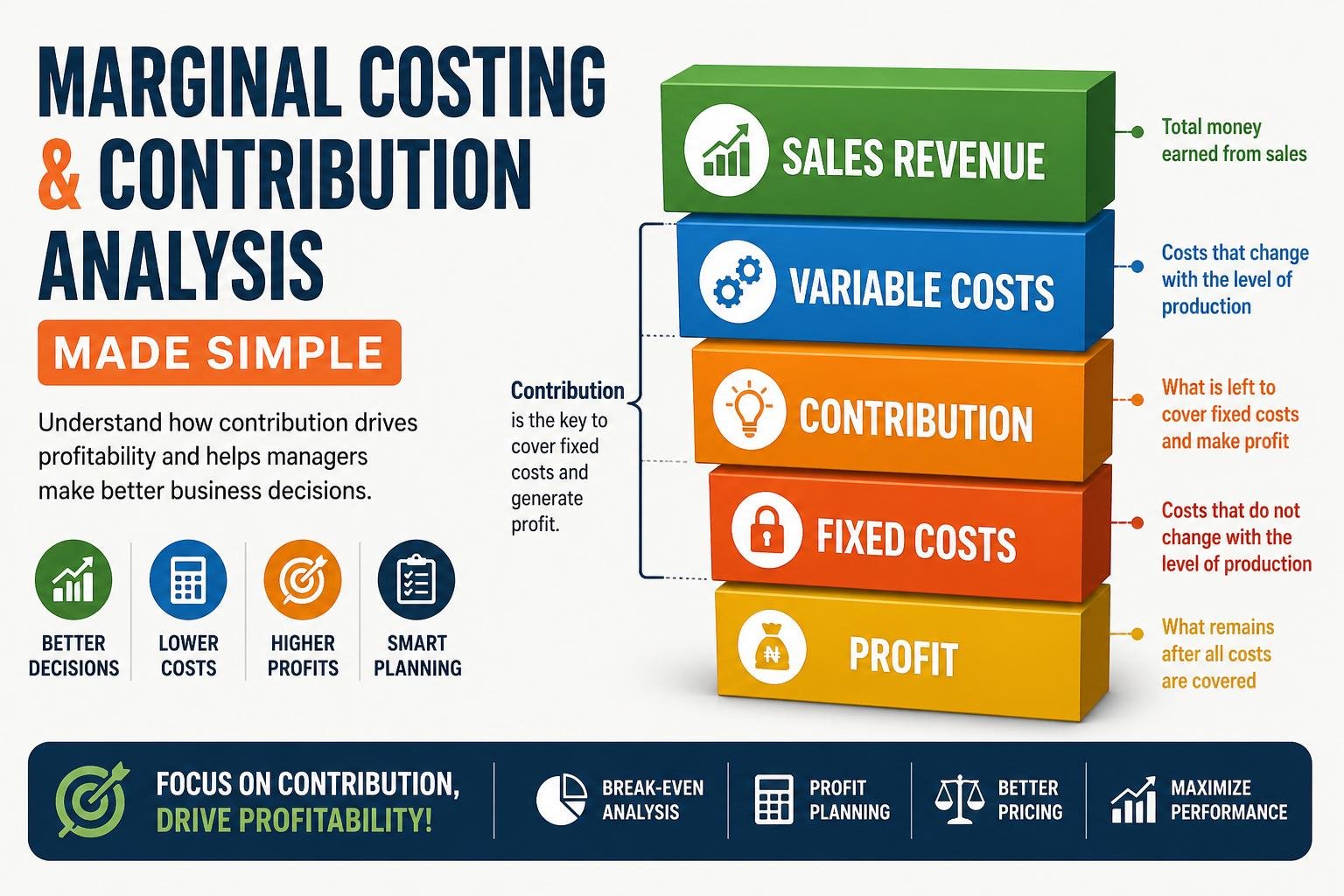
The basic principle of marginal costing is that profit results from the difference between sales revenue and variable costs. That which is left is called contribution. Instead of what one total cost per unit is concerned with, marginal costing is into how much each unit contributes to cover fixed costs and out of pocket expenses as well as profit. Also it is very useful for decision making.
Understanding Contribution Analysis
Contribution in the base of what marginal costing is. It is a measure of how much revenue remains after variable costs are paid. Contribution is determined by the difference between total sales revenue and total variable costs. Also on a per unit basis it is the sale price less the variable cost per unit.
This contribution fulfills two key functions. Also it covers fixed costs. Also once fixed costs are covered in full, any extra contribution is profit.
Why Contribution Is Important
Contribution also gives you a better picture of profitability which in turn allows managers to see how sales volume plays into profit and which in turn supports quick and efficient decisions. For instance, if a product has a high contribution margin what we see is the business earns more per unit sold which in turn helps to cover fixed costs better and produce profit.
Also we see which products or services are do well which we should put more of our resources into and which we may want to discontinue.
Practical Example of Marginal Costing
Take for example a small business which creates handbags. The unit price per bag is ₦6,000 which is what we see at the point of sale. Also we see that variable cost per bag is of the value of ₦3,500. In addition the company is looking at fixed costs of ₦250,000 per month.
First out of which we calculate the contribution per unit by taking the selling price and subtracting the variable cost which results in a contribution of ₦2,500 per bag.
If the business sells 100 bags it will see a total of ₦250,000 in contribution. This breaks even which in turn means the business is at a standstill, not making a profit or a loss.
If the business breaks even at 100 bags sold and goes under at less. Also if it sells over 100 bags it begins to turn a profit. If less, out go the dollars.
Break-Even Analysis Explained
Break even analysis is used to calculate the point at which a business is not making a profit or a loss. To determine the break-even point in units fixed costs are divided by contribution per unit. Using the grocery handbag study which found that at a sales volume of 250,000 bags we break even at 2,500 units. This means for the business to break even it must sell at 100 bags.
Break even analysis is very useful as it sets out a clear sales target for the business. Also it allows managers to see how changes in costs or pricing play into profitability.

Margin of Safety
The safety zone is the difference between actual sales and break-even point. It shows what level sales can drop to before the business begins to lose money. For example if the business has a total of 130 bags instead of 100, the overage of 30 units is the margin of safety. A larger cushion of safety means lower risk at the same time a small cushion points out that the business is at its break-even point which in turn may put it at loss.
Contribution Margin Ratio
The contribution margin ratio is a percentage of sales which is put toward fixed costs and profit. It indicates what each naira of sales does for fixed costs and profit. For instance if a product which goes for ₦6,000 has a contribution of ₦2,500 the contribution margin ratio is about 41.7 percent. This means that out of every naira of sales 42 kobo go to fixed costs and profit.
Profit Planning Using Marginal Costing
Marginal cost analysis is a useful tool for profit planning. Businesses may use it to determine the number of units which must be sold to reach a certain profit level. To achieve this you sum up fixed costs and target profit then divide by the contribution per unit. For instance, a handbag business that wants to see a profit of ₦150,000 has to cover fixed costs as well as the desired profit. This in turn means it has to generate a total contribution of ₦400,000. Dividing the revenue out by a unit contribution of ₦2,500 we see here that the company has to sell 160 bags in order to hit its target. This type of analysis enables managers to set realistic goals and plan operations effectively.
Pricing Decisions and Marginal Costing
Marginal analysis is very useful in determining prices. At times a company may get a special order at reduced price which is less than what they usually charge. What mainly matters is that the price covers variable costs and also puts something aside for fixed costs. If the price goes beyond the variable cost, taking the order in question may still improve total profit which in turn may be true if we have some unused production capacity.
For example when the handbag company gets an order at a price of ₦4,000 per bag and has a variable cost of ₦3,000, the contribution is at the rate of ₦500 per unit. Although this is a lower than the usual contribution we still see that it is a positive addition to the profit.
Make-or-Buy Decisions
Marginal cost analysis also is used by companies to determine which components to make in house or which to outsource. If which variable cost is less than the purchase price in house production is usually the better option.
In many cases the issue is complex which is when what is produced internally is using resources that could be put to more profitable use. Also in these situations opportunity cost must be taken into account.
Limiting Factor Analysis
In the real world companies are presented with issues like limited labor, materials, or machine time. Marginal costing and contribution analysis determines which product to put forward based on contribution in relation to the limiting factor. If one product has a greater contribution per labor hour than another it should be made a priority when labor is limited. This is that the business will at all times be maximizing profit.
Advantages of Marginal Costing
One of the great benefits of marginal costing is that it is a very simple tool. By looking at variable costs only it does away with the allocation of fixed costs to each unit. Also it brings out the variable costs which in turn make it easy to see which options are best at a quick glance. Another advantage of it is that it supports planning and forecasting. We see that managers are able to use it for which they put out profit estimates at various sales levels and also which is useful in preparing for changes in demand. Marginal analysis which in turn gives us a clear picture of cost volume profit relationships that is key to business success.
Limitations of Marginal Costing
Although it has its benefits, marginal costing also has some issues. One issue is that it leaves out fixed costs in pricing products. In the long term all costs should be covered which includes fixed costs. It also does not apply to external financial reporting which at times requires full cost allocation. Also we see that marginal costing presents a linear model which at times does not match real world. Also it is to report that which is of a short term nature and we do not see much look at long term strategies.
Real-Life Application Example
Picture a small bakery that produces loaves of bread. Each loaf goes for ₦1,500 and we have a variable cost of ₦900. Also we see that the bakery’s fixed costs are of the sum of ₦120,000 per month. At each loaf the bakery gets in at of ₦600 to break even they must sell 200 loaves. If at 250 loaves the bakery reports a total contribution of ₦150,000. After which variable costs are covered the profit is ₦30,000.
This example demonstrates how marginal costing allows business owners to see into the health of their finances and make better decisions.
Marginal Costing vs. Absorption Costing
Marginal costing and absorption costing differ in their treatment of fixed costs. In marginal costing fixed costs are treated as period costs and do not form part of the unit cost. In absorption costing fixed costs are applied to each unit produced. This varies in terms of how profits are reported out. We use marginal costing for internal decisions which absorption costing we use for external reports.
How Businesses Use Marginal Costing Today
Today’s companies use marginal costing for many purposes. Startups use it to determine their cost structure and set prices. Manufacturers use it to improve production levels and reduce waste. Service companies apply it to setting prices and profitability analysis. In digital companies we see that which customers or services are the most profitable.
Tips for Using Marginal Costing Effectively
In order to do well with marginal costing businesses must separate fixed and variable costs out. This is a very important element of accurate analysis. They may use contribution in the day to day decisions but also implement other methods for long term planning.
Regular it is that we review cost behavior which is a practice we must get into as costs do vary over time. Also managers should not put all their eggs in the marginal costing and contribution analysis basket and instead look at the full range of financial and strategic issues.
Conclusion
Marginal costing and contribution analysis are great tools which put large financial decisions into simple terms. In looking at the interaction between sales, variable costs, and fixed costs, what businesses find is that they are able to see profit generation very clearly.
Concepts of contribution margin, break even analysis, and profit planning which in turn enable managers to evaluate different what if scenarios and make informed decisions. In terms of setting prices, accepting special orders, or determining production levels marginal costing tools prove to be very useful.
In some what which may be very limited it is a key tool in the field of management accounting. When used in conjunction with other financial tools marginal costing and contribution analysis enables companies to do better controls, see in to greater efficiency, and achieve long term success.
Get more well researched information about Marginal Costing and Contribution Analysis here.