Introduction
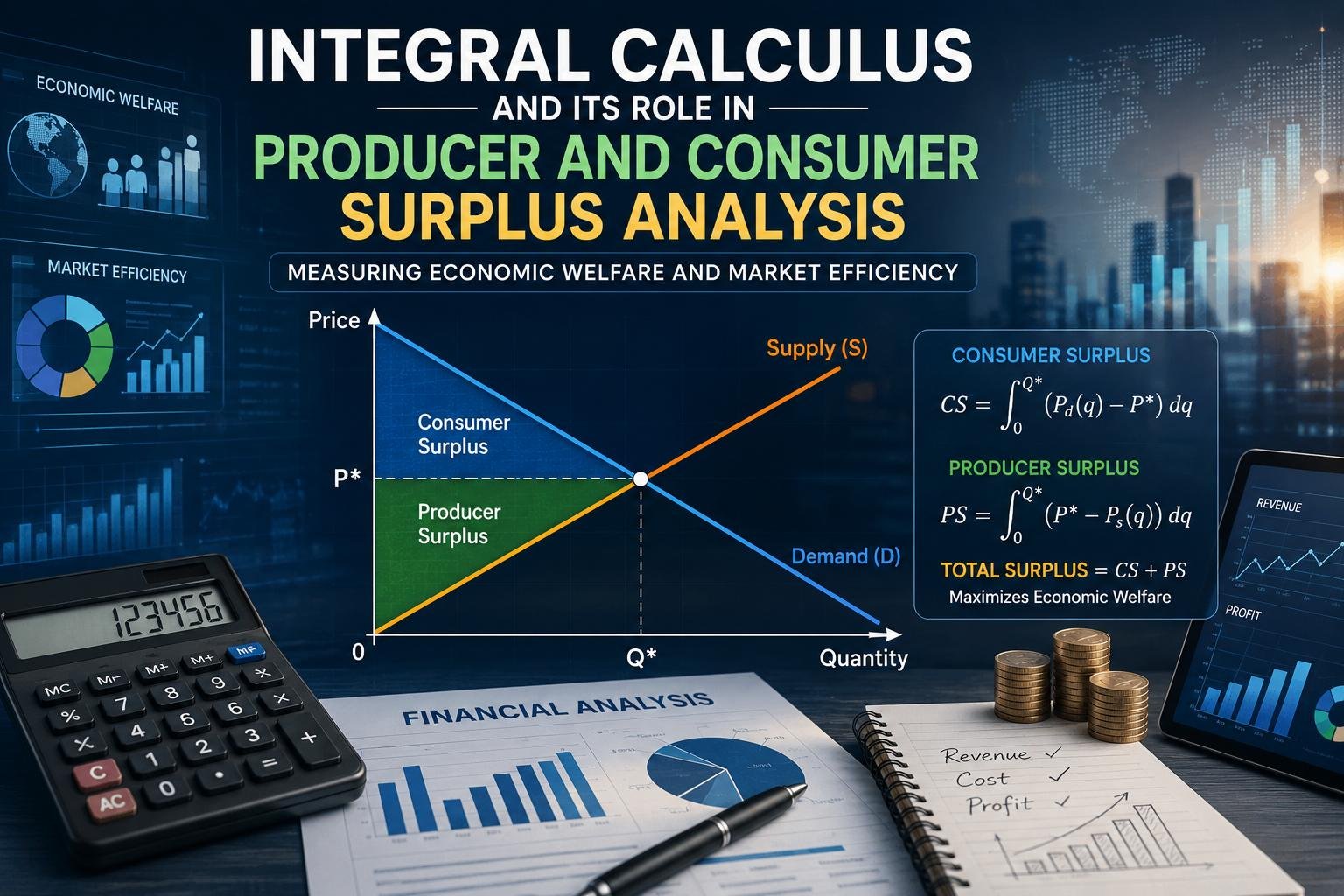
Integral Calculus in producer and consumer surplus analysis is a key component in today’s accounting and economics which in turn professional use it to determine total values over time. We see in businesses and economics that they are dealing with variable quantities like revenue, cost, production, demand and profit. While marginal analysis looks at small scale changes in these variables, integration is what is used for the total effect of those changes over a larger scale.
In economics we see that integration is a very useful tool for study of market efficiency and economic welfare. It is a tool which allows economists to determine consumer and producer surplus which in turn is important for assessment of how markets do or do not serve the interests of buyers and sellers. Also businesses use integration in looking at price decisions, forecasting long term profitability, and evaluating performance of operations.
As companies grow to be in more data intensive and competitive spaces they require better tools for analysis of financial and economic trends. We see how integration plays a role in the success of businesses and economists which in turn give us insight into how companies improve their decision making, allocate resources better, and evaluate total market performance.
In this article we look at how integral calculus in producer and consumer surplus analysis is used in accounting and economics which reports on it’s application in marginal and total functions, producer surplus, consumer surplus, pricing efficiency and economic welfare.
Understanding Integral Calculus in Economics
Integral calculus is a math tool for measuring accumulated values. In economics and accounting we see it used to turn marginal values into total values. Marginal values are for small changes which in turn total values represent the full picture of accumulation over a time frame or range.
Also for instance a company may know the extra cost which is added by that of a single additional unit of a product. In terms of integration it helps to determine the total production cost for all units which a company produces. Also in a similar fashion economists look at how individual purchase choices play out to affect the market as a whole.
The issue is that which we put forth is a very valuable concept because in the world of business we see constant change as opposed to stability. Prices are in a state of flux, consumer interest waxes and wanes, and production outputs are a function of the market at large. What we present is a framework which systematically looks at these changes and which also puts into perspective their financial impact.
In the fields of accounting and economics integral calculus supports:
- Revenue analysis
- Cost estimation
- Profit evaluation
- Demand forecasting
- Market efficiency studies
- Welfare analysis
- Pricing strategies
- Resource allocation decisions
Due to which they present themselves as such, integration has become a key analysis tool in business management and economic research.
Marginal Functions and Total Functions
In the field of integration a key application is that of the relationship between marginal and total functions. Marginal analysis is used to determine the change in economic variables. We see this in marginal cost, marginal revenue, and marginal utility. These functions tell us how a variable will shift with the production, sale, or consumption of one more units.
Also businesses tend to focus on overall results instead of individual changes. What managers require is total cost, total revenue, or total profit to make strategic decisions. Integration plays a role in turning that which is at the margin into the total picture.
For example as a company is aware of how production costs grow with each additional product unit they may use that info in integration which in turn allows accountants and analysts to do total production cost estimates for the whole production process. This also helps firms:
- Prepare financial budgets
- Determine pricing policies
- Forecast profitability
- Evaluate operational efficiency
- Plan expansion strategies
Also in that regard total revenue analysis is made easier for businesses which know how revenue grows with different sales levels. This issue of what is the relationship between marginal and total analysis is which integral calculus in producer and consumer surplus analysis is very much applied in managerial accounting and economics.
Integration’s Role in Cost Analysis.
Integration plays a large role in business decision making which is in the field of cost analysis. Companies report on many types of costs which include fixed, variable, and semi-variable. As production levels are always in flux, it is of great importance for companies to understand total cost behavior in order to maintain profitability. Marginal analysis of cost reports the cost of that extra unit. In terms of integration we see that which total cost of production for a range of units may be estimated.
This process is true of most businesses which report that they:
- Growing production costs as a result of resource scarcity.
- Reducing costs via scale.
- Changes in labor and material costs.
- Operational adjustments over time
Through analysis of total cost behavior companies are able to determine if production expansion is profitable. Manufacturers can also determine that which production level brings in the most profit via integrated cost analysis. In service based businesses we see that they put staff levels in relation to what is expected from customer demand. Also in retail we note that they look at inventory management costs to improve efficiency. In finance and accounting we see that integration also plays a role in which companies are able to determine long term spending trends and to improve the accuracy of their financial forecasts.
Revenue and Profit Evaluation
Revenue and profit analysis is a key element in business. As we look at marginal revenue which is the additional income from one more sales we also must study total revenue and over profit performance.
Integration also supports businesses in looking at total earnings across many sales levels. This which presents:
- Pricing decisions
- Sales forecasting
- Profitability analysis
- Investment planning
- Market expansion strategies
Companies may look at total costs and total revenues to see if present operations are sustainable. Also through integration we see how firms react to market competition and changing consumer demand. In the industries of transportation, technology, and energy that see great price fluctuation, we see that integrated revenue analysis helps businesses better adapt to market trends. Profit analysis is of great importance to businesses which aim to increase shareholder value and see out the long term.
Consumer Surplus and Economic Welfare
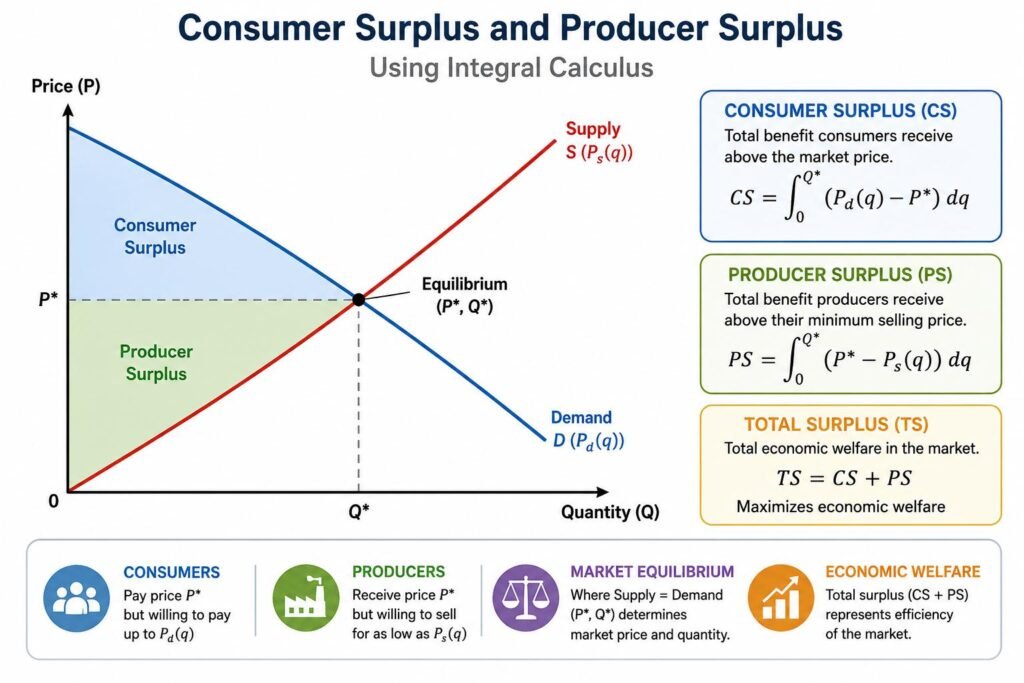
Consumer surplus is a fundamental element in welfare economics. It is the difference between what consumers are willing to pay for a product and what they do pay in the market. Integration is a tool which economists use to determine the total benefit that consumers get out of a market. Instead of looking at each purchase separately, we look at the total satisfaction or utility which consumers as a whole gain.
Consumer surplus indicates which economic factors play key roles in:
- Market affordability
- Consumer satisfaction
- Purchasing power
- Demand strength
- Pricing fairness
When there is high consumer surplus buyers get more out of the product than they pay for which in turn points to good pricing practices and high consumer welfare.
Governments and policy makers look at consumer surplus when evaluating:
- Tax policies
- Subsidies
- Price controls
- Public services
- Market regulations
In terms of business, we see that which companies which understand consumer surplus do better in terms of pricing strategies and customer retention. We find out that which put profit in balance with what customers value do better in terms of brand loyalty and long term market success.
Producer Surplus and Business Performance
Producer surplus is the benefit which sellers see when market price goes above the minimum they are willing to accept for their products or services. Integration also out to determine total producer gain at various levels of production which in turn gives us insight into issues of producer profitability, market incentives, and business sustainability.
Producer surplus is a result of:
- Production efficiency
- Resource availability
- Market demand
- Technological advancement
- Competition levels
When producer surplus grows firms in general see an increase in profitability and we also see that they have a greater incentive to increase production.
Businesses use of producer surplus analysis for:
- Market opportunities
- Pricing efficiency
- Competitive advantages
- Cost management strategies
- Investment decisions
Economists study which producers benefit from and how it affects industry performance and economic growth. For instance governments may look at what tax policies or trade regulations do to producer surplus in agriculture, manufacturing and energy sectors. That which we present is a report which in turn allows policy makers to put in place strategies which benefit both business and consumer.
Market Efficiency and Pricing Decisions
Integration plays a large role in market efficiency analysis. In efficient markets resources are allocated in a way that maximizes total economic welfare between consumers and producers. Consumer and producer surpluses add up to total market welfare. By looking at these surplus economists are able to determine if markets are working efficiently or if there is inefficiency.
Businesses also profit from which this analysis does as pricing decisions play a key role in demand, sales volume and profitability. Also for instance which companies set prices too high they reduce consumer surplus and lose customers. Also which prices set too low do to that which in turn weakens producer surplus and profitability.
Integrated market research which helps companies develops pricing strategies that balance:
- Customer satisfaction
- Competitive positioning
- Revenue generation
- Long-term profitability
In very competitive sectors which see great change in consumer preference.
Applications in Accounting and Financial Planning
Integral calculus is used in more than just theory of economics. Also it supports practical aspects of accounting and financial management.
Accounting professionals use integrated analysis for the determination of total financial values over time. This includes:
- Long-term revenue trends
- Expense accumulation
- Depreciation analysis
- Investment returns
- Financial forecasting
Businesses work in economic uncertainly which is a factor of unpredictable future results. Integration which includes constant analysis of financial reports is what allows accountants to put together more accurate projections.
Financial analysts may also employ models that integrate multiple elements when looking at:
- Cash flow patterns
- Business growth rates
- Cost behavior trends
- Capital investment performance
These present what we may term as issues for better budgeting, strategic planning and risk management. As data analysis and financial modeling play a larger role in accounting the issue of integration becomes more important.
Integration into Public Policy and Economic Planning
Governments and economic institutions also use integration in the assessment of public policies and national economic performance.
Consumer and in producer surplus analysis policy makers are able to see the results of:
- Taxes
- Subsidies
- Tariffs
- Minimum wage laws
- Environmental regulations
For instance a government may look at which ways a tax policy reduces total market welfare or which groups it unfairly affects. Integration also plays a role in infrastructure planning and public investment evaluation. Economists are able to determine the long term social benefits of transportation systems, health care programs, or educational initiatives.
In international trade we see that surplus analysis is a tool which governments use to determine the benefits and costs of imports, exports, and trade agreements. Due to what it measures in terms of economic results over time integration is still a very useful tool for public decision making.
Challenges in Applying Integral Calculus
Integration which is a great tool for analysis does at times present a challenge in real world business and economic settings.
Economic systems are affected by a great deal of what is unpredictable, including:
- Consumer behavior changes
- Inflation
- Technological disruptions
- Political instability
- Global market fluctuations
Thus integrated models may not always represent real market conditions. Another issue is data accuracy. For reliable surplus and cost analysis we require better market information, demand estimates and production data. Although there are issues with these, integration still provides a structure for analysis of in depth economic issues and better decision making. Today we see that modern tech and analytics tools have made it easier and more practical for businesses and economists to perform integrated analysis.
The Increasing Role of Integration in Modern Economics
In today’s business world data driven decisions are the norm. Companies are collecting large sets of financial and operational data which they use to improve efficiency and competitiveness.
Integration is growing in its importance to:
- Business analytics
- Economic forecasting
- Financial technology
- Market research
- Artificial intelligence systems
Economists in the present use of integrated models to look at consumer trends, also we see them use these tools to predict market movement and to evaluate economic policies. Also which we find is the application of that research by businesses which in turn use the info to better run their production, to do better pricing strategies and in effect increase their profitability. In the age of digital markets and global trade we see that which was once secondary is now of great importance that is to say that which relates to market behavior. Organizations which do well at integrated analysis are also the ones which better respond to market changes and see out the long term growth.
Conclusion
Integral to the fields of accounting and economics is the use of integral calculus in producer and consumer surplus analysis which we use to turn marginal data into total relevant values. In the field of economics we see that through integration businesses and also economists are able to do in depth analysis of costs, revenues, profits, consumer surplus, and producer surplus.
In many fields beyond pure math we see application of this in pricing strategies, financial planning, market efficiency analysis, and public policy evaluation. Also we see how through the measurement of large scale economic actions integration gives us in depth look at what is happening in the market and how resources are best put to use.
Consumer and producer surplus analysis also goes in to which economists assess total economic welfare and pricing fairness. Also businesses benefit from these insights which improve profitability, raise customer satisfaction, and inform strategic decision making.
As we see the growth and change in modern economies the role of integration in business analytics and in economic research is very present. Those organizations and policy makers which understand these issues are better equipped to maneuver through tough market conditions and to promote sustainable economic growth.
Get more well researched information about Integral Calculus in Producer and Consumer Surplus Analysis here.