The
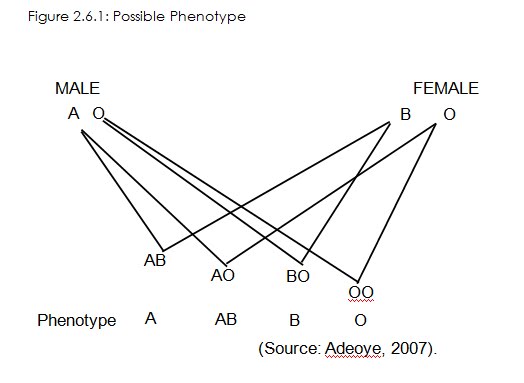
inheritance of ABO group is governed by three allelic genes, A, B and O. The A
and B are dominant while the O is recessive. The O gene is called anmorph
because it has no protein in the homozygous form.
inheritance of ABO group is governed by three allelic genes, A, B and O. The A
and B are dominant while the O is recessive. The O gene is called anmorph
because it has no protein in the homozygous form.
Laws of Inheritance of ABO Blood Group
An
offspring can possess antigen A, B or both if inherited from both parents. A
parent of blood group AB cannot produce an O offspring.
offspring can possess antigen A, B or both if inherited from both parents. A
parent of blood group AB cannot produce an O offspring.
Table
2.6.2: Possible phenotype of offspring resulting from the making of various ABO
blood group (Baker and Silverton, 2009).
2.6.2: Possible phenotype of offspring resulting from the making of various ABO
blood group (Baker and Silverton, 2009).
|
Phenotype of parent
|
Possible phenotype of offspring
|
|
O x O
|
O
|
|
O x A
|
O or A
|
|
O x B
|
O or B
|
|
O x AB
|
A or B
|
|
A x A
|
A or O
|
|
A x B
|
A, B, AB or O
|
|
A x AB
|
A, B or AB
|
|
B x B
|
B or O
|
|
A x AB
|
A, B or AB
|
|
AB x AB
|
A, B or AB
|
Serology
Individual
whose red cells lacks A, B or both antigens have the respective antibody on
their sera. This is Landsteiner’s rule. These antibodies are both present at
birth. Infants start producing them after 3 – 6 months of age. Anti-A and
Anti-B reach their peak level between 5 to 10 years are absent in infants.
Elderly persons and in pathological condition affect antibody production.
whose red cells lacks A, B or both antigens have the respective antibody on
their sera. This is Landsteiner’s rule. These antibodies are both present at
birth. Infants start producing them after 3 – 6 months of age. Anti-A and
Anti-B reach their peak level between 5 to 10 years are absent in infants.
Elderly persons and in pathological condition affect antibody production.
ABO
antibodies are most important of all other blood group antibodies. Transfusion
of an incompatible blood can cause a severe transfusion reaction. These
antibodies are potent haemolysis. The antibodies are of both IgM types and can
bind to complement.
antibodies are most important of all other blood group antibodies. Transfusion
of an incompatible blood can cause a severe transfusion reaction. These
antibodies are potent haemolysis. The antibodies are of both IgM types and can
bind to complement.
As
ABO antigens are also present on the tissue cell, their antibodies can cause rapid
organ rejection in the transplantation of highly vascularized organs. ABO IgG
antibodies can cross the placenta during pregnancy and may cause haemolytic
disease of the newborn (HDN) in an antigen positive foetus. However, HDN due to
ABO antibodies is rarely severe because the development of antigens in the
newborn is incomplete and the infant’s soluble antigens have a neutralizing
effect (Yamamalo, 2009).
ABO antigens are also present on the tissue cell, their antibodies can cause rapid
organ rejection in the transplantation of highly vascularized organs. ABO IgG
antibodies can cross the placenta during pregnancy and may cause haemolytic
disease of the newborn (HDN) in an antigen positive foetus. However, HDN due to
ABO antibodies is rarely severe because the development of antigens in the
newborn is incomplete and the infant’s soluble antigens have a neutralizing
effect (Yamamalo, 2009).