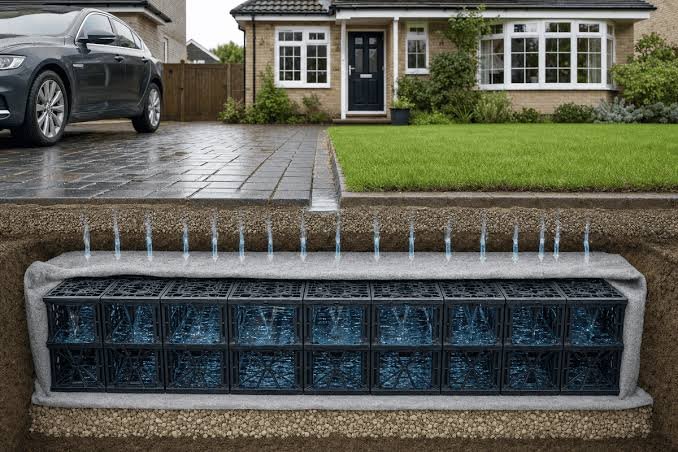
A project team may see two underground systems built from similar modular cells and assume they are different names for the same tank. They are not. Infiltration stores runoff temporarily and lets it enter suitable surrounding ground. Attenuation stores water behind a sealed envelope and releases it through a controlled outlet.
The distinction changes the evidence, geotextile wrap or geomembrane lining, connections, maintenance risks, and approval route. A StormTank module can form the storage core for either configuration, but the module does not decide where water should go.
Understanding the mechanism before product selection prevents the most expensive category error in modular drainage: building a system that stores water correctly but sends it to the wrong destination.
Follow the water after it enters storage
Storm Manage organizes its modular applications by runoff destination. A soakaway crate configuration uses a permeable envelope so water can move into the ground. An attenuation tank uses a sealed envelope and outlet control. Rainwater harvesting adds reuse, treatment, overflow, and operating duties.
This makes a useful teaching test: draw one arrow from the storage block to the final destination. If the arrow enters surrounding soil, the project is discussing infiltration. If it reaches a sewer, watercourse, or other accepted route through a control, the project is discussing attenuation or detention. If it reaches a non-potable demand, it is part of a harvesting system.
Real projects can combine functions, but the operating logic must be designed and documented. Similar crates do not make the routes interchangeable.
Let ground evidence decide whether infiltration is viable
Storm Manage’s selection guide asks whether testing shows the ground drains, whether groundwater is sufficiently below the base, whether an outfall exists, whether discharge is restricted, whether foundations or contamination constrain the site, and whether traffic passes above. Those questions help a project team decide whether stormmanage.com should configure a soakaway crate or attenuation tank.
Infiltration needs more than a general soil description. Testing should represent the proposed location and depth, while groundwater and contamination require professional interpretation. Nearby structures and property boundaries may constrain location. Poor ground is not fixed by adding more crates.
If infiltration is unsuitable, a lined system may provide controlled storage where an accepted outlet exists. That route needs its own evidence rather than being treated as the fallback a supplier can choose alone.
Match the envelope to the mechanism
A geotextile wrap separates the modular block from surrounding material while permitting water movement for infiltration. A geomembrane lining creates sealed containment for attenuation. Protection layers, corners, joints, penetrations, and inspection risers must support the selected mechanism.
Installing the wrong envelope defeats the concept. A plastic sheet around a soakaway prevents intended infiltration; a permeable wrap around an attenuation block cannot provide sealed storage. Product names on invoices are less important than the coordinated construction detail.
Responsibility should be explicit. Identify who designs the envelope, supplies materials, installs and inspects it, accepts repairs, and authorizes backfill. Stormmanage.com can provide compatible system information, but site-specific detailing remains part of project design.
Compare outlet and maintenance risks
Infiltration performance can decline when sediment reaches the storage interface or ground drains more slowly than expected. Attenuation performance can decline when a controlled outlet obstructs or its setting changes. Both configurations require pretreatment, access, observation, records, and a response to unusual retained water.
A soakaway is not a water-treatment device. Runoff quality and groundwater protection must be assessed. An attenuation tank also does not automatically treat water; it manages quantity and timing while the wider drainage train addresses pollutants.
Maintenance access should reach the inlet, pretreatment, storage observation points, outlet where present, and overflow. The finished surface must keep those routes usable.
Read common symptoms through the correct mechanism
The same observation can mean different things. Water remaining in a soakaway crate may signal slow ground response, high groundwater, sediment at the infiltration interface, or an event still draining. Water remaining in an attenuation tank may be expected until the controlled outlet releases it, or it may reveal blockage, a changed setting, downstream surcharge, or damaged pipework.
Diagnosis starts with the intended water path and recent conditions. Check upstream pretreatment, inspection access, water level, outlet where present, visible damage, and maintenance history. Do not dig into the StormTank module array merely because water is present; storage is its job. Escalate when behaviour differs from the accepted design or operating record.
Surface overflow also needs context. Infiltration may be overwhelmed or unable to drain between events. Attenuation may receive more inflow than modeled or lose downstream discharge. Both require an approved exceedance route that keeps risk away from buildings and critical access as far as the design allows.
This mechanism-based reading helps project teams write better maintenance instructions. Instead of saying “inspect the tank,” identify what to observe, what normal looks like, what evidence should be recorded, and who decides whether the issue belongs to ground, treatment, control, structure, or operation.
Use a water destination comparison
Water destination comparison
| Decision | Infiltration | Attenuation |
| Final route | Suitable surrounding ground | Accepted receiving system |
| Key evidence | Ground, groundwater, pollution, and location | Discharge, storage, outlet, and exceedance |
| Envelope | Permeable geotextile wrap | Sealed geomembrane lining |
| Operational focus | Protect infiltration and monitor drainage | Protect storage and controlled outlet |
England’s national standards place runoff destinations in a hierarchy and require evidence, water-quality protection, maintenance, structural integrity, and failure planning. The principles reinforce a general lesson: destination comes before the underground product, even though local requirements must guide each project.
Choose the system only after the route is defensible
The Storm Manage system selection guide can help teams frame the right supplier discussion. Provide accepted destination, site evidence, storage basis, structural envelope, access, and documentation needs. Storm Manage can then configure the StormTank module and related components.
Neither infiltration nor attenuation is universally better. Infiltration can keep runoff close to source where ground and pollution conditions allow it. Attenuation can control release where infiltration is unsuitable and a receiving route is accepted. The project succeeds when evidence, envelope, outlet, and maintenance all follow the chosen water path.