Introduction
Every business that is a success starts with a vision, but that’s not enough to sustain the growth of a business. The vision becomes a reality when it is turned into measurable, realistic goals that can be achieved in the long term, by making decisions and taking action. If the business doesn’t have a clear direction, it is easy to see that the business owner may be facing issues instead of planning for future issues. They can waste resources on doing things that don’t add value, not track progress easily, or get demoralized when progress doesn’t happen in a timely fashion.
Realistic business goals give direction, increase focus and enable entrepreneurs to allocate their time, money and energy to the right activities. They establish accountability on the team and highlight the opportunities for improvement. Most importantly, realistically setting goals allows businesses to build momentum by setting appropriate expectations that mirror the resources and market conditions. Goals that are too high can cause frustration and burnout, goals that is too low can restrict growth.
The key to long-term business success is having a balance between short-term needs and future goals. Having the right mindset and knowing how to set up goals, measure outcomes, and adapt as needed to ensure your business is sustainable and successful is a key to success. This article examines how to implement some of the practical strategies that ensure objectives are established to drive sustainable business growth, and maintain motivation, versatility and future business focus.
The Significance of Business Objectives
Business objectives are the basis for any strategic planning and decision making. They define an organization’s desired goals and offer a course of action, or roadmap for achieving them. When companies lack clear goals, they can suffer from inconsistencies, inefficiency and uncertainty over priorities and responsibility among employees.
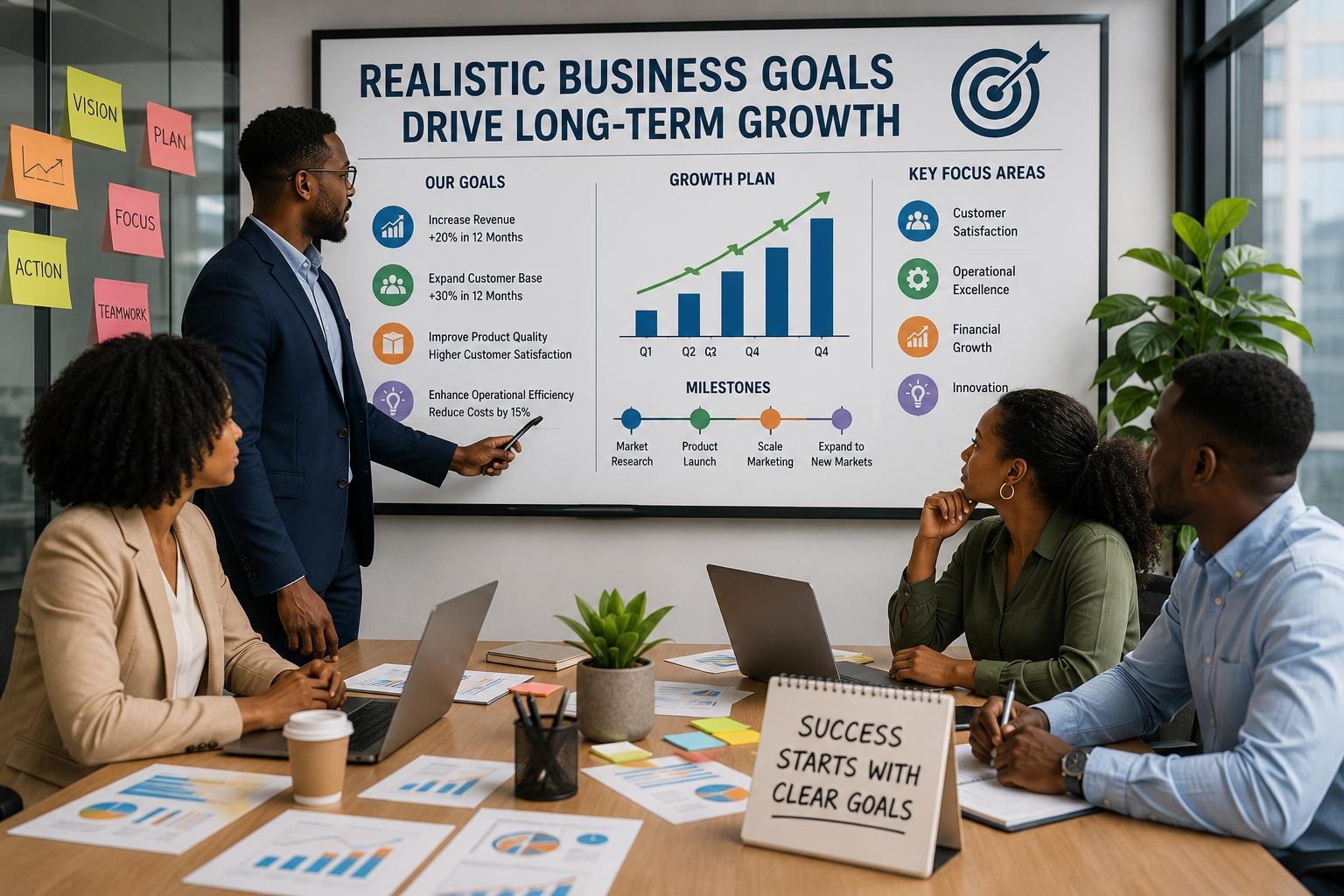
Goals assist business owners to focus on investments that need to be made and which activities make for the most growth. If, for instance, a business wants to boost revenue by 20% throughout the following year, it could concentrate on customer retention, product expansion or sales process enhancements. A lack of goals can cause initiatives to be fragmented and ineffective.
Goals are also crucial for motivation and accountability. Knowing how their individual work can help to achieve bigger goals increases employee performance. Taking measurements of progress towards targets helps to build a sense of achievement and keeps teams going. Furthermore, goals enable leaders to objectively assess performance and determine where further support and/or enhancement is needed.
More than anything else, business objectives establish stability when there is uncertainty. Businesses can easily become sidetracked from their mission with economic shifts, disruptions to the market and changing expectations from customers. Clear objectives serve as a benchmark for organizations to stay on track (and be flexible) when facing shifts.
1. Using Goal-Setting Frameworks for Better Results
Structured planning techniques are one of the best ways to set realistic goals. Companies that do not base their goals on any data, only on intuition, will end up with goals that are vague and hard to measure. Structured systems provide clarity and increase the potential of success at the outset with the establishment of expectations and performance indicators.
Adopting a sound goal-setting approach that delivers practical ways to prioritize goals, track progress, and connect personal actions with organizational focus can help businesses thrive. Such frameworks help to mitigate uncertainty and help employees know what steps to take to effectively translate their big dreams into action.
There are a number of popular frameworks that are widely used in all industries. The SMART principle is used to facilitate organizations in setting goals that are specific, measurable, achievable, relevant and time-bound. Rather than saying ‘increase sales’, a SMART goal would say, ‘increase monthly sales revenue by the 15th by improving customer retention strategies over the next six months.
Another popular formula is Objectives and Key Results (OKRs). This approach is based on clear goals with measurable outcomes that show progress. The structure fosters collaboration within departments and allows them to be flexible and innovative. OKRs are useful tools for businesses that are looking to grow quickly because they are transparent and promote accountability.
The selection of the framework depends on the size of the business, industry, resources, and growth phase. In either case, it is important to be consistent to obtain significant results.

2. Linking Goals to the Business Vision & Mission
The objectives of a business always should be in-line with the mission and vision of the organization. A business that does not take into account its true purpose but focuses only on short-term profit is likely to succeed initially but fail to keep customers and be relevant in the long run.
The vision is the destination of the business, and the mission is the purpose and targets of the business. Goals serve as connections in the journey from what is happening now to what is desired in the future. Each objective should be able to answer the question: How does this support the long term direction of the business?
A tech company looking to be a leader in customer service innovation might set goals on response time, product quality and customer satisfaction scores, as opposed to just revenue. These goals are aligned with the company’s identity and they bring competitive advantages that help in the sustainable growth of the company.
Engaging employees in goal setting is another way to increase employee engagement. An understanding of the “why” of what they do, and being able to see how what they do makes a difference, motivates staff. Companies that consistently are doing what they can to make their actions perform in congruence to their mission are more likely to create a stronger culture and a stronger brand.
3. Setting up Long-Term Goals by Dividing them into Manageable Steps
This can sometimes be too overwhelming for small businesses with limited resources, especially when they have long-term goals. If you are trying to achieve a long-term objective, it is easier to monitor and manage progress by breaking it down into smaller targets. Milestones provide opportunities for celebration, learning and adaptation on the journey.
Assume that a business would like to double its sales in 5 years. This goal is more attainable when broken down into smaller annual, quarterly and monthly goals. Year one could be devoted to expanding customer base, year two to increasing product lines and year three to new markets. Each phase has a contribution towards the overall objective, with a manageable level of expectations.
Milestone planning also enhances the allocation of resources. By identifying what investments are needed at each stage, businesses can make sure that they aren’t investing too much in initiatives that might not yield immediate rewards. Clarifies roles and timelines, minimizes confusion and enhances coordination.
Ongoing milestone checks are helpful to see performance trends. When performance doesn’t meet targets, the business owner can detect issues early and take necessary measures to prevent major issues from arising. This will minimize risk and boost the chances of meeting long-term objectives.
4. Achieving Goals that Fit the Timeframe
There is a need to balance the short term operational requirements and long term aspirations of the entrepreneurs. Only short term thinking can result in decisions that negatively impact long term growth, and only long-term thinking can result in cash-flow issues and inefficiencies.
Short-term goals give you momentum and stay you motivated. These can range from a rise in monthly sales, lowering costs, raising the ratings for customer service, to initiating a new marketing campaign. These goals lead to measurable results that help to create signs of progress and continue the journey.
Long term goals, however, are concerned with strategic development. These can be about expanding the market or positioning the brand, diversifying the product offering or new technology. These programs can be long-term and expensive to implement, and it may take time before they start to show any improvement.
Businesses that are successful combine both of these ideas into the business planning process. Goals for the short-term should not be in opposition to long-term goals. For instance, today’s higher customer satisfaction leads to higher customer loyalty and lifetime value in the future. A business that is able to keep this balance will be able to thrive and be resilient.
5. Establishing goals, Evaluating progress and Reporting results
Without regular measurement of progress goals are useless. Measurement of performance enables enterprises to see if strategies are effective or not and if resources are being utilized efficiently. Data is the only way to make decisions in a subjective and reactive manner.
Key Performance Indicators (KPIs) are measurable indicators to demonstrate progress. Financial KPIs could be revenue growth, profit margins, operating costs, and cash flow performance. Some of the metrics used for marketing can be customer acquisition costs, traffic to the website, conversion rates, and customer retention.
It depends on the goal being achieved which metric is used. Companies should not be obsessed with the number of numbers they are gathering, it can lead to confusion, not understanding. Instead, the emphasis should be kept on indicators that are closely related to the organization’s priority.
Frequent evaluations promote responsibility and ongoing improvement. Monthly and quarterly assessments are used to celebrate successes, troubleshoot and modify strategies as needed. Reporting can be streamlined and visibility can be enhanced across departments with technology tools and dashboards.
If staff knows how their work is being assessed and what will be achieved by their efforts, levels of engagement and productivity can often be greatly enhanced.
As Businesses Evolve, so do their Goals.
The business world is ever evolving. You have to deal with changing customer preferences, new innovations from the competition, changing regulations, and economic conditions. Realistic goals 6 months ago might not be realistic or relevant to the current situation.
Flexibility is a vital part of good goal setting. Businesses should constantly check and review objectives to keep them in-line with current business realities and the opportunities for the future. Changing the goals should not be considered as failures, but rather as responsible leadership and strategic thinking.
For instance, when the economy is down, companies that are considering making a physical expansion might hold off on the expansion and focus on efficiency or digitalization instead. In the same way, chances of unexpected growth opportunities may warrant forgoing any previously long-term goals.
Regular strategy reviews enable organizations to check if objectives are still relevant and attainable. Leaders and, as applicable, staff from various departments should be included in these conversations to bring in their insights from the work and see things from their point of view.
Flexibility can be a competitive advantage for an organization that changes course, as it can adapt to changes and remain focused on the end goal.
Common Mistakes to Avoid When Setting Business Goals
Not many businesses struggle as a result of the absence of goals, it’s actually because their goals are inadequately designed. It’s easy to set expectations that are too high and have too many resources and capabilities. Setting overly ambitious goals can generate excitement and enthusiasm, but may be followed by disappointment and a resulting drop in morale when they are not achieved.
One of the other errors is making goals without measurable outcomes. Objectives like “improve customer service” are not specific enough to give direction on what would constitute a measure of success. However, businesses should set quantitative goals, like cutting response times or boosting customer satisfaction scores.
But some organizations are too preoccupied with financial objectives and neglect their customers, their employees, and efficiency. For sustainable growth there is a need to take all aspects of business performance into account in a balanced approach.
Effective communication of goals can also be a factor affecting success when it is not done properly. People can’t affect the objectives if they don’t comprehend what they are. Leaders should make sure that expectations are clear and priorities are constantly emphasized by meeting, reporting and feedback sessions.
Lastly, many companies set goals, but never follow up. Goals should not be things that are put away following the annual planning process.
Achievement of Goals through the Development of Accountability
Accountability gets goals from intentions into action. If companies make goals “owned” by someone, they’re more likely to get done as that person has a clear responsibility to see them through. Individuals or teams should be identified to implement, monitor and report each goal.
Periodic assessments provide a chance to monitor progress and to solve problems before they get out of hand. The weekly meeting, monthly report and quarterly strategy meeting keeps everyone focused and committed to the organization.
There is also greater accountability when transparency is maintained. Open communication helps foster collaboration and inspires staff to give their best performance. Recognition programmers can help to further enhance engagement by recognizing milestones and rewarding outstanding performance.
Technology platforms can help to hold people accountable by automatically monitoring deadlines, tasking responsibilities and providing performance reports. These help to decrease the administration while maintaining visibility between teams and departments.
In turn, accountability can foster healthy business growth and help you reach longer-term goals on a regular basis when it becomes a part of the organizational culture.
Conclusion
One of the most important responsibilities of any business person or entrepreneur is to establish realistic goals for their business. Effective goals offer direction, enhance focus, add accountability and provide measurable steps to future success. Practical goals enable businesses to optimize their resources and remain resilient in the face of market fluctuations.
Goal setting is not just about having “wants; it needs to be done successfully. This includes choosing the right frameworks, mapping out goals and aligns them with the organizational vision, setting realistic benchmarks, tracking progress regularly, and being adaptable to change. Just as critical is the capacity to make decisions now that will support long-term growth, so that short-term decision making will continue to support the vision.
The business owners who adopt a disciplined approach to goal-setting put themselves in a position to grow and thrive in their business. They don’t pursue fast results without careful consideration, but take time to incrementally advance and make educated choices. The ongoing efforts build stronger businesses, stronger teams and more opportunities for continued success in competitive markets.
Get more well researched information about realistic business goals here.



Your explanation gave me an engaging overview from start to finish this morning and I look forward to reading more from you