Walk a retail floor with fresh eyes, and the difference between a well-considered display and a neglected one is immediate. Not because the neglected floor lacks product — it rarely does. Because the product has no context, no body, no suggestion of how it lives in the real world. Shop mannequins are the tool that provides that context, and the retailers who understand what they are actually doing with them consistently present clothing in a way that feels intentional rather than merely stocked.
The Hanger Gap Nobody Fixes
Clothing on a rail asks customers to do something cognitively demanding — to mentally reconstruct a three-dimensional garment from a two-dimensional hang and then project that reconstruction onto their own body. Most customers cannot do this reliably, and most will not attempt it for long before moving on. The problem is not the garment. It is the presentation. A tailored jacket on a hanger tells you the colour and roughly the cut. On a form with the right shoulder width and chest fill, it tells you whether it is something worth trying on. That distinction drives footfall into fitting rooms, and fitting room visits are where conversion actually happens.
Silent Salespeople at the Door
A dressed shop mannequin at the entrance to a section is doing something a rail cannot — it is making a specific, styled argument for a garment before any customer has consciously decided to engage. The customer approaching sees an outfit, reads it in roughly a second, and either feels something or does not. If they feel something, they walk toward it with intention rather than drifting. That shift from passive browsing to active consideration happens before any staff member has spoken, before any signage has been read, and before the customer has even consciously decided to look. The display made the first move. That is sales work, not decoration.
What Proportions Actually Communicate
This is where most retailers underinvest in thinking. The proportions of a display form are not neutral — they function as a reference point for every customer assessing whether a garment will work for them. A relaxed-fit shirt presented on a lean, elongated form reads as deliberately oversized and considered. The same shirt in a broader form reads as simply large. Neither reading is wrong, but only one is likely to sell the shirt to the customer the brand is trying to reach. Professional shop mannequins are designed around specific garment categories and customer profiles — and matching the form to the product rather than using whatever is available makes a measurable difference to how the clothing is perceived.
When Realism Works Against You
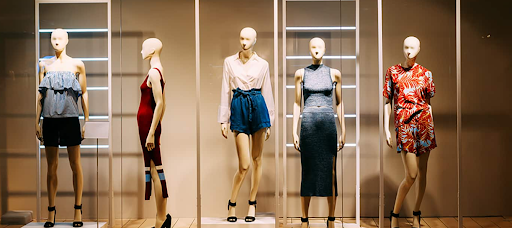
Highly realistic mannequins with detailed facial features and expressive posture seem like the obvious premium choice. In most retail contexts, they are not. A realistic face draws the eye upward and holds it there, which is precisely the wrong place for it to land when the goal is selling a garment. Abstract forms with minimal or no facial detail keep visual attention moving through the silhouette, into the fabric, towards the details that justify the purchase. This is not an aesthetic opinion. It reflects how visual attention actually moves through a retail environment, and the display designers who understand it choose abstraction deliberately rather than defaulting to realism because it feels more sophisticated.
Groupings Are Underused
Single-dressed forms work. Grouped forms work considerably harder. Two or three shop mannequins positioned with genuine spatial consideration – different but complementary poses, a natural eyeline between them, and outfits that suggest a shared occasion or aesthetic – produce something that reads as a scene rather than a display. Scenes create narrative. Narrative sells identity. For any brand whose customer is making a purchase that is partly about self-image rather than purely utility, that narrative function is not a secondary consideration — it is central to why the display either produces desire or simply produces awareness.
Conclusion
The floors that convert consistently are not necessarily the busiest or the best-stocked. They are the ones where the display work was done with intention rather than habit. Shop mannequins chosen for the right garment, positioned with spatial intelligence, and maintained to a standard that reflects the brand’s quality, do commercial work that compounds quietly over time. The customer never credits the form. They credit the shop, which is exactly the outcome a good display produces.