Introduction
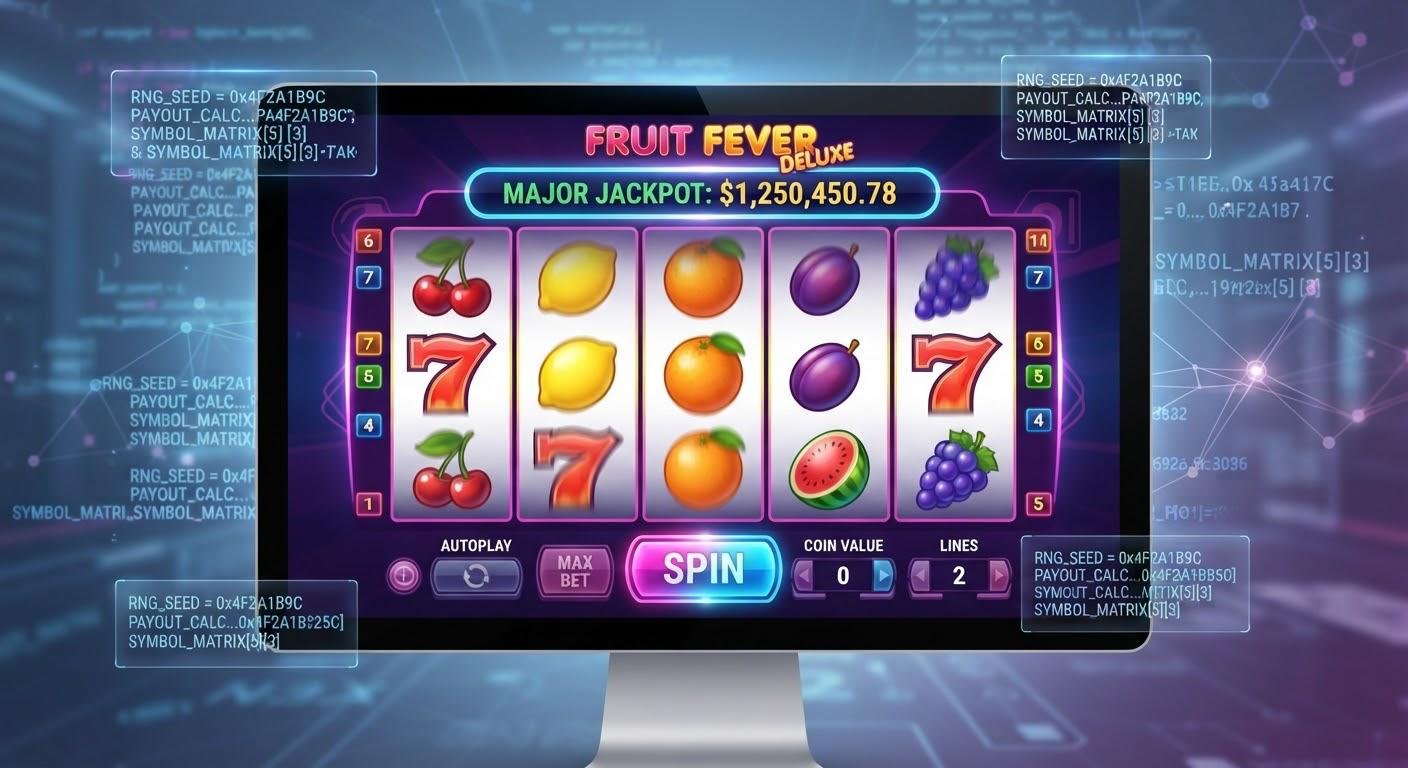
Alongside computer programming and mathematics, graphics and money processing facilities are incorporated into online slot games. Although they may resemble the physical slot machines that exist, online slots utilize computer programmes to determine both what symbols players receive and the resulting wins. Players will often believe that they can visually ascertain the factors that affect game outcomes; however, an understanding of key technologies and processes enables a person to recognize how online slot games actually operate. In particular, reels, paylines and symbols, along with random number generators and money processing technologies are integral in determining results. Within a game, these elements work together in accordance with mathematical guidelines. Technology thus allows online slot games to simultaneously adhere to clearly defined criteria and also offer seemingly random results. Recognizing relevant technologies and processes is key to differentiating factual information regarding online slot games from common misconceptions.
How Online Slots Operate
Digital Reels
As well as the graphics that are seen, online slot games feature ‘reels’ vertical areas that display a variety of symbols and which seem to move when a player requests a spin. Whilst traditional slot machines utilize actual physical reels, online slots use computerized graphics to emulate this effect, platforms such as 마이베스트플레이 . Three, five or even more reels can be present in a game. Within an online slot, there is a set list of where on a reel that each symbol can be shown. Following a player’s spin, the computer programme then identifies which of these locations should be displayed. Although the decelerating and halting of reels is animated, this is largely illustrative of an outcome, which has already been decided by the computer programme. Consequently, reel animation is not directly responsible for results. Computer programmes analyze data using mathematical guidance to decide on an outcome for a game and the animation is then utilized to convey this in a visually appealing manner.
Paylines
Paylines are lines or locations upon reels which are important in identifying whether or not a given set of symbols constitutes a winning combination. With conventional slot games, a payline usually lies in the Centre region of the reels. Contemporary digital slot games can utilize various types of paylines, which can extend in horizontal, vertical and even more intricate directions. Moreover, some games use different ways to recognize winning combinations – for example, some allow winnings to be attained if successive reels show identical symbols, irrespective of whether or not they lie on a payline. The number of active paylines and requirements for winning are dictated by a game’s guidelines. For instance, a game may stipulate that three identical symbols must be shown along a payline for a win to be awarded. It is therefore important to recognize these guidelines as, purely having a set of identical symbols will not always yield a win it must match a winning combination as identified by the game’s programme.
Symbols
Symbols are the images shown on reels and are analyzed to establish winning combinations. Numbers, fruit and letters are frequently encountered, as well as themed imagery and special symbols that can trigger extra functionality. Every symbol has a particular role and value that has been set within a game’s programme. Usually, symbols are involved in standard winning combinations. Special symbols can also have distinctive impacts. For example, wild symbols can act as substitutes for other symbols so as to facilitate winning combinations. Furthermore, scatter symbols can initiate bonus features or free spins, depending on where they are shown, again as dictated by a game’s guidelines. Certain slot games additionally utilize multiplier symbols which boost the value of applicable wins. Again, these additional functionalities are not universally present and will differ from game to game. Throughout the creation of a game, developers specify the likelihood of symbols being shown and their associated values in order to ensure that they appropriately fit within a game’s mathematical framework.

Random Number Generators
What are Random Number Generators (RNGs) are highly significant technologies employed by modern online slots. As their name suggests, these are computer programmes that generate random numbers which in turn affect game results. Typically, digital slots implement pseudo-random number generators (PRNGs). These utilize mathematical formulae along with an original number (known as a ‘seed’) to calculate a sequence of numbers. Although PRNGs utilize structured mathematical methods to determine numbers, expertly developed programmes will generate numbers that are sufficiently random for use in online slots. In addition, supplementary sources of ‘entropy’ may be integrated to further enhance randomness. Constantly, the programme is generating random numbers and, on a player requesting a spin, suitable numbers are analyzed and used to decide on the relevant reel locations or game result. Remarkably, this evaluation occurs swiftly and is often completed prior to the completion of a spin’s visual representation.
How Random Number Generators Determine Results
Computer programme mathematical guidelines are used to associate random numbers with reel locations. Subsequently, the programme translates these numbers into reel locations and the relevant symbols displayed in those locations. Whether or not a winning combination is achieved is then assessed. Developers can manipulate the mathematical programme and hence the distribution of symbols on reels to dictate the likelihood of different results being obtained. For instance, a symbol can be allocated a greater quantity of reel locations than another and so is statistically more likely to be shown. However, the volume of symbols that are visibly present on a game’s reels is not necessarily representative of their true likelihood of occurrence. Rather, it is the programme which determines how often different results can arise. Therefore, to comprehend how random number generators function, it is vital to consider the mathematical programme upon which a game is based.
Why Individual Spins are Independent within Correctly Operating Random Number Generator Games?
Many people wrongly believe that a slot game’s results are affected by previous results. Actually, within correctly operating random number generator driven slot games, the outcome of a given spin is unaffected by previous spins. Therefore, a player’s history of unsuccessful spins does not elevate the chance of a subsequent win and nor does a string of successful spins automatically raise the probability of further success. The random number generator adheres to its mathematical programme and does not alter the likelihood of results simply because a player has obtained particular outcomes. Even if a specific combination has a 1 in 100 chance of occurring, this does not strictly mean that it will only transpire after 100 spins. Rather, it may happen on numerous occasions within a short space of time or may not manifest itself for far longer. Individually, spins are analyzed and are not bound by past results.
This idea is tightly associated with the gambler’s fallacy. Essentially, the gambler’s fallacy is the erroneous assumption that random occurrences will self-correct within a limited timeframe. Someone may believe that, after a number of unsuccessful spins, they are now more likely to receive a winning combination. However, as previously mentioned, the probability of an upcoming result is still dictated by a game’s mathematical programme. Similarly, after a number of successful spins, this does not assure that a future spin will again be successful and does not suggest that a game is currently in a preferable phase. Although, in the long term, statistics are often able to approximate expected probabilities, there can be substantial variation between results. Consequently, it is not reliable to utilize short term trends and observations in an attempt to foresee future online slot game results.
Slot Game Payouts
1. Return to Player Rate
A game’s Return to Player (RTP) rate is a mathematical figure that demonstrates the proportion of money that a slot game is intended to pay back to players in the long term. For instance, a slot with a theoretical RTP of 96% is designed to return, in the long term, an average of 96 units for every 100 units that are staked. The difference between 100% and the theoretical RTP equates to the theoretical house advantage. Once more though, it must be noted that a player’s actual results may widely differ from the theoretical RTP over a short time frame. A game’s RTP is mathematically determined and is typically derived using probability and potential payout information. Although it is valuable information that shows someone how a game is theoretically likely to behave in terms of money related aspects, it should not be viewed as definitive of an individual’s results nor as a means of assuredly recouping money that has been lost.
2. Volatility and Hit Rate
Volatility also known as variance is used to characterize the nature of a slot game’s payout profile. Usually, low volatility games will tend to offer more regular but modest wins. Conversely, high volatility games may infrequently yield wins but can deliver larger payouts. Medium volatility games exhibit behavior that is intermediate between these two extremes. Hit rate is a complementary term which is concerned with the regularity with which a game delivers a winning result, again in accordance with its guidelines. However, a high hit rate does not always equate to a game providing a superior return. Frequently, winning combinations will be of lesser monetary value than the amount that was staked. Developers apply mathematical probability knowledge to analyze how a game’s hit rate, volatility and payout level interrelate. This assists in clarifying why, despite having similar RTP rates, two slot games can offer quite distinct experiences. Furthermore, it illustrates that neither a game’s hit rate nor its payout level alone can sufficiently describe its mathematical performance.
3. Progressive Jackpots and Bonuses
Aside from basic payout functionality, some online slots offer supplementary payout options. Progressive jackpots grow as money is added to a communal fund by players placing appropriate bets. Depending on the system, these may be associated with one, multiple or an entire network of machines. Software is used to determine the requirements that need to be fulfilled in order to claim a progressive jackpot. These can include particular symbol combinations and/or other criteria. Bonus features differ in that they further enrich a game by introducing further functionality, such as free spins, multipliers and interactive choices. Again, these are determined by a game’s mathematical programme. Although extra functionality can heighten the complexity of a game, it does not negate the continued importance of maths. Each progressive jackpot and bonus has its own criteria and payout determinants which must be embedded within a game’s mathematical programme by developers.
How Slot Games are Checked for Accuracy
It is fundamental that online slot games are accurately checked. Developers must confirm that their programmes are correctly applying mathematical principles and that random number generators are sufficiently random. Usually, examination of programmes, algorithms and probability data, as well as extensive simulation, are undertaken to analyze slot games. Statistical analyses can be carried out to investigate if numbers are sufficiently randomly distributed and to detect any irregularities. Moreover, independent testing institutes can also check computer programmes to ensure that they are in fact delivering results that are in-line with a game’s guidelines. Such assessments can pinpoint technological issues, irregularities and even avenues for tampering. Apart from random number generators, further areas of a game which can be analyzed for accuracy include: payout functionality; bonus features; instructions and appropriate application of other programme elements. Basically, these investigation techniques enable verification that a game is indeed functioning in line with its mathematical programme.
In regulated areas, alongside internal checks, organizations running and developing online slot games may also be required to have their games independently verified by recognized testing institutes before they can be made available to the general public. Bodies such as Gaming Laboratories International (GLI) carry out and provide verification for gambling technology. Within certain regions, regulatory bodies may impose additional requirements such as routine re-examination, provision of technical information, and evaluation of security procedures. These procedures are valuable as they promote responsibility by ensuring that computer programmes are conforming to appropriate technical criteria. Yet, the precise nature of and requirements for verification will differ from country to country and between regulatory bodies. Thus, a game which has been verified in one area may not necessarily have been similarly verified in another. As such, when investigating online slot gaming, it is important to appreciate the significance of licensing, independent verification and open policy procedures. Not all websites and slot games will necessarily comply with the same criteria.
Common Misconceptions
There are various misconceptions which impact people’s comprehension of online slot games. For example, some people think that slot machines are more likely to yield winning outcomes following a prolonged period of unsuccessful spins. People also frequently wrongly believe that the time of day at which a game is played, the level of a player’s stake and/or a repeated button pressing pattern can affect a random number generator. Within correctly working random number generator driven slot games, these factors will not impact on the chances of a given result occurring unless a game’s guidelines explicitly allocate differing probabilities to particular timings, stakes and/or button press sequences. Another widespread misconception is that if a player is close to obtaining a winning combination then they are likely soon to win a jackpot. Nevertheless, near miss visuals are merely representational and do not imply that a winning outcome is imminent. Further information relating to digital gaming can often be found on sites detailing 슬롯사이트 정보. Nonetheless, factual and independently verifiable information should be prioritized over unsubstantiated claims about winning tendencies or foolproof winning methods.
Conclusion
Online slot games incorporate computer programming, mathematical concepts, random number generators and money processing technologies. Visual constituents such as reels, paylines and symbols are also integral. Computer programmes use random number generators and their associated mathematical programme to determine game outcomes. Factors including Return to Player rates, volatility and jackpot functionality are all relevant in analyzing how and to what extent money is paid out. Crucially, within accurately operating random number generator slot games, individual spins are independent and so prior results are not a dependable predictor of forthcoming ones. Alongside independent verification and statistical analysis, regulatory verification is also used to further confirm that computer programmes are working in line with their mathematical programme. Appreciation of these facets permits individuals to better assess online slot games, whilst recognizing misconceptions and distinguishing between factual and deceptive information. Overall, an understanding of relevant technology is key to gaining a sounder comprehension of digital gaming, but does not imply that any technology can assuredly lead to wins.
Get more well researched information about How online slot games work here.