Introduction
Have you ever taken to the market with the same sum of money as last year and only to find out that you can now purchase a lot less? That experience clearly shows how inflation affects your money. Inflation silently decreases the worth of money in the long run, thereby making the daily living more costly.
Nowadays, in a turbulent economic situation, where prices appear to escalate more quickly than incomes, learning the principles of inflation has ceased to be a choice, but rather a necessity. Inflation will impact how you use your money whether you are a student, salary earner or business owner in one way or the other irrespective of you realizing it immediately. Its effects are far-reaching in terms of the cost of basic needs to long-term savings targets.
To make wise financial choices, it is vital to comprehend the notion of inflation. Once you understand the dynamics of inflation, you can make actions to guard your money and you can even increase it despite the increasing prices. The above description of the concept of inflation and how inflation affects your money in the long-term may seem complicated, but you can learn more about how this works in the real-life world by reading this detailed explanation.
Now in this article we are going to simplify down inflation, we will discuss how it has impacted on your purchasing power, how inflation affects your money and we will also give you a few practical tips on how you can remain financially stable even with the increase in prices.
What Is Inflation?
Inflation refers to the percentage change of the overall price of goods and services with the passing time. The purchasing power of money decreases with the increase in inflation. This implies that you can purchase less of goods and services with the same amount of money as you used to purchase.
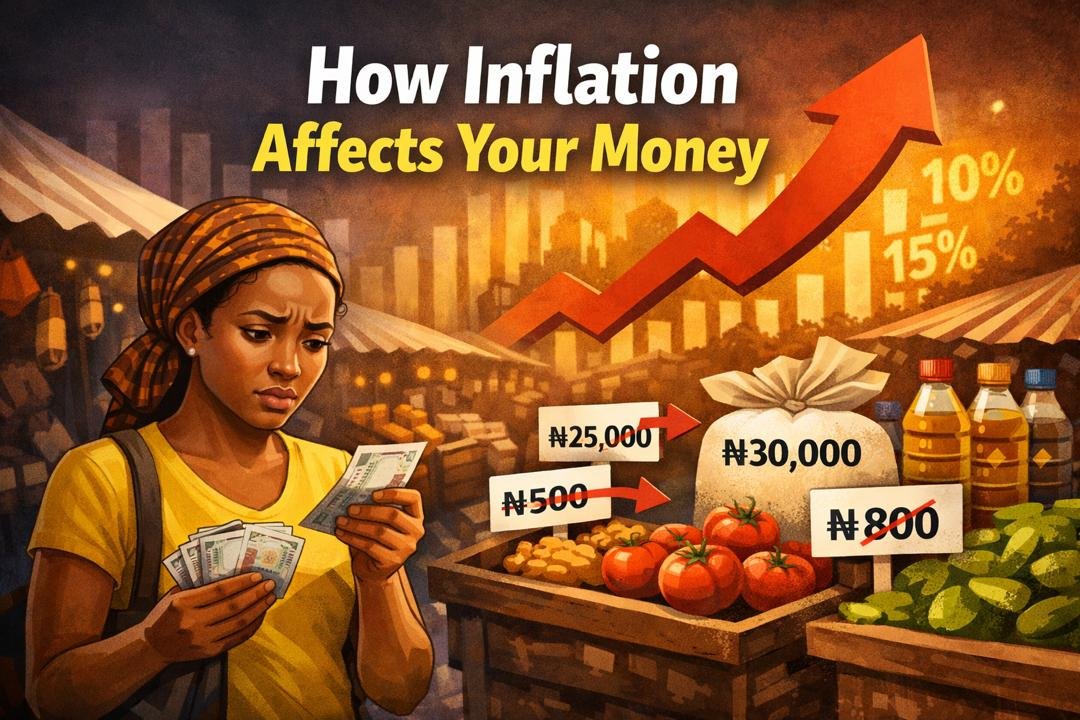
Using the example of a bag of rice which today costs ₦25,000, and then the price goes up to ₦30,000 the following year, it is the inflation that has brought about the change.
Most economies are used to inflation, which is normal but it may pose financial pressure on an individual and family when it is too high or unpredictable.
Types of Inflation
Knowing the various kinds of inflation assists you to note how and why prices change.
1. Demand-Pull Inflation
This is where demand of goods and services will be above supply. When the demand to purchase a product is higher than the supply, prices are increased.
2. Cost-Push Inflation
This occurs when the production cost goes up. As an example, the cost of transport may go up due to the increased fuel prices which further increase the cost of goods.
3. Built-In Inflation
It is an expectations-driven type. Employees seek increased wages to be able to meet the increased costs and business owners raise prices in order to meet their wages.
How Inflation Decreases Purchasing Power
Purchasing power is the amount of goods and services that you can purchase with your money. Over time this power is diminished by inflation and this is how inflation affects your money.
For instance:
- The same amount, 10000, can purchase groceries in a week.
- It may only take a couple of days in a couple of years.
That is why the inflation is commonly referred to as a silent thief. It takes away your monetary power bit by bit and you do not realize it instantly.

Effects of inflation on daily life
Inflation touches on almost all elements of your finances.
1. Increasing cost of living: The fundamental necessities such as food, housing, transport, and medical care have increased.
2. Savings Lose Value: Cash or low-interest savings lose their worth as time goes on unless it increases more rapidly than inflation.
3. Fixed Income is Risky: Former employees who have a fixed salary or pensions find it more difficult since their earnings do not go up as quickly as prices.
4. Business Challenges: Companies might have difficulties in increasing production rates and either increase pricing or minimize services.
Inflation and your savings
It is essential to save money, and you can lose your savings due to inflation.
For example:
- You save ₦500,000 today
- The inflation increases at 12 percent per year.
- A year later that money can just purchase what ₦440,000 was able to purchase before.
This demonstrates that merely saving is not sufficient- you must increase your money.
Inflation and Investments
Inflation may negatively and positively affect investors, according to their approach in managing money.
Positive Effects
- Real property, such as property, tends to appreciate.
- Stocks can increase when companies increase prices.
Negative Effects
- Fixed-income investments can decrease their values.
- Market uncertainty has the potential to make it more risky.
The trick is to select investments that are able to stay ahead of inflation.
How to safeguard your money against inflation
Inflation is inevitable but you can do something constructive in order to mitigate its effects.
1. Invest Wisely
One of the best methods of overcoming inflation is by investing. As opposed to having money lying around, invest in assets that will yield overtime.
Options include:
- Stocks
- Mutual funds
- Real estate
- Bonds
The idea is to make higher returns than the rate of inflation.
2. Develop Multiple Revenues.
It can be dangerous to depend on a single source of income. Consider:
- Freelancing
- Opening a side-business.
- Online income opportunities
Additional income will assist you to cope with the increasing costs.
3. Budget and Control Spending
Budgeting has never been more important than it is now due to inflation.
Tips include:
- Track your expenses
- Cut unnecessary costs
- Pay attention to the key expenditure.
- Plan ahead major purchases.
An organized spending lifestyle can make you remain financially stable.
4. Increase Your Skills
Among the most effective methods of combating inflation is to enhance your earning capacity.
You can:
- Learn new skills
- Take online courses
- Improve your qualifications
Better opportunities tend to be better-paid due to increased skills.
5. Invest in Real Assets
Real assets are more likely to do well in the case of inflation. These include:
- Land and property
- Commodities
- Businesses
They tend to appreciate with an increment in prices.
6. Do not Keep Excess Cash.
Keeping lots of cash may be dangerous in times of inflation as it will diminish in worth with time.
Instead:
- Store emergency money in the form of cash.
- Put the rest in expansion.
7. Test Your Financial Plan on a Regular basis.
Economic situations are evolving and your financial plan should as well.
Ask yourself:
- Am I increasing my investments?
- Can I afford to keep up with inflation?
- Is there a need to change my budget?
Periodic reviews aid in keeping you on schedule.
Inflation in Nigeria: A Real Concern
Inflation in some countries such as Nigeria may be more evident because of:
- Currency fluctuations
- Import dependence
- Rising fuel costs
This further pushes the need to be more aggressive towards financial management among individuals.
List of common errors
In working with inflation, do not commit the following typical mistakes:
- Having all your cash on hand.
- Ignoring investment opportunities
- Not monitoring expenditure.
- Depending on one source of income.
- Delaying financial planning
These are some of the errors that can be avoided and they can contribute to a big difference in your financial future.
The Long-Term View
Not only is inflation a short-term problem, it has long-term implications to the goals like:
- Buying a home
- Funding education
- Retirement planning
Without considering inflation, then you can be below the financial goals.
It is always better to plan, so that you do not lose value of your money.
Conclusion
Inflation is an inevitable aspect of the economy, but it does not necessarily have its way with your financial prospects. With knowledge of the term inflation, you will be in a position to take proactive measures to secure and increase wealth.
The most important things to learn are:
- Inflation decreases the purchasing power.
- Saving is not sufficient.
- It is necessary to invest and make more.
- Intelligent financial behavior is a big deal.
By using the appropriate approaches, including making the right investments, diversifying your income and controlling your expenditure, you can remain ahead of the inflation and guarantee your future in terms of finances. During these unpredictable economic conditions, the most valuable thing that you have is knowledge. The better you know about inflation the better you will be prepared to make a decision that will make your money work towards you and not against you.
In addition to these strategies, having the correct mindset is also crucial. A consistent, patient and adaptive approach is needed to achieve financial growth in an inflationary setting. Economic environment will keep on evolving and the more informed and active individuals are, the more they will be at an advantage to succeed.
In the future, inflation is probably going to continue being an important factor defining individual and global economies. This renders financial literacy to be more valuable than ever. The sooner you begin planning and do it, the more you will be ready to deal with future uncertainty.
Get more well researched information about how inflation affects your money here.