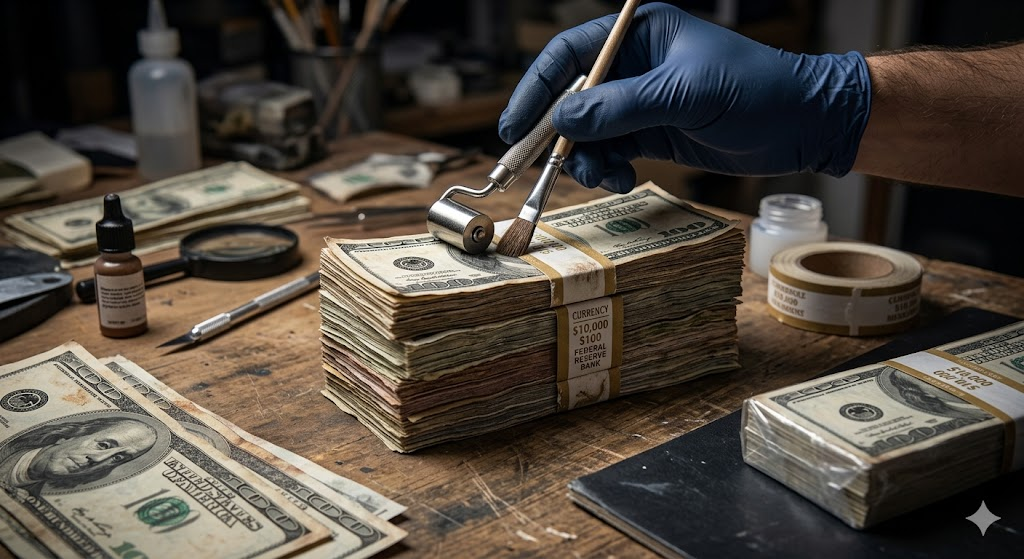
Visual realism became the most important factor for producing fake stacks of cash. You see these replicas in films, photos, and specials. Looking real is a must if you want to break the immersion. There is a lot of planning and attention to detail involved in the process. These must all help with their aged look, so the stacks seem real at first glance.
Purpose and Applications
Event planners frequently use fake money stacks as themed party props. The fake money stacks have a double purpose. They are primarily being used for visual storytelling. They are a necessity for film directors and photographers to make the scenes believable. Stage productions also require stacks that appear visually appealing from a distance. These realistic banknotes avoid legal trouble while maintaining the illusion of currency on screen. They serve as a protective layer, preventing productions from financial and legal consequences.
Material Selection
To make realistic stacks of cash, you need to prepare the materials first! The paper should be textured similarly to that of real banknotes. Faux money usually uses high-grade cotton or other fibers that can imitate the feel of real currency very closely. Avoid glossy paper to prevent glare from light, which can break the illusion. Material selection is no compromise between performance and an authentic feel.
Printing Techniques
How you print is a huge part of how realistic it looks. Using high-end printers, they reproduce intricate details and hues found on real bills. The ink must be right, because some colors can look similar to real banknotes. They meticulously observe even the smallest details, such as watermarks and serial numbers. Such components lend authenticity and realism to the final result.
Design and Artwork
However, accurate art is the backbone of any credible fake stack. Artists study actual notes to replicate complex designs and images. Sparse as they can get, they are matched with borders, portraits, and numerical values. Small adjustments are made to differentiate between copies and real money, which, in turn, keeps it legally compliant. The alterations ensure authenticity without violating anyone’s copyright.
Cutting and Assembly
A uniform look requires a sharp cut in the first place. Every single note must be the exact dimensions of official notes to avoid raising any suspicions. After printing, sheets are cut using sharp blades or machines. They keep the edges straight and avoid imperfections. After cutting, the notes are stacked, lined, and ready to go. In some cases, a band or wrapper is added to strengthen the illusion.
Aging and Finishing Touches
Stacks that are freshly pressed can appear too clean. In response to this, artists often apply negligible aging effects. Soft wrinkles, blurred areas, or subtle wear reproduce circulation. Those final touches make the stacks look like they have been through many hands. Since it will break the illusion, you want to make sure you are not going overboard with the effect.
Legal Considerations
There are stringent rules in place to produce replica currency. The designs of replica currency must be distinctly different from those of real money, either by varying their size or by omitting certain security features. These strategies eliminate confusion and keep said legal troubles at bay. Production companies stay informed about currency laws to prevent props from crossing the line into legal tender. These guidelines help ensure that both creators and users remain safe.
Quality Control and Testing
Each stack is fully inspected before delivery. Quality control teams regularly check color accuracy, texture, and alignment, and if anything is wrong, we will warn you and provide a new copy. And with any imperfection, even the smallest, the whole stack fails. Feedback from test audiences or production staff may lead to changes. The film sets, or photo studios, may see only the most convincing fakes.
Conclusion
There is a certain art combined with science in designing fake money stacks to be visually correct. Everything from the material to the printing process goes to bolster reality. The legalese safeguards them from ownership claims, while the final polish mitigates any damage to their public image. This process delivers a prop that is ideal for all film, photography, and stage productions. Focusing on detail and accuracy, these creators deliver replicas that engage viewers and keep the spirit of visual storytelling alive.