Introduction
The computer systems are at the center stage of nearly every facet of human life in the age of the new digital world. Online banking and mobile communication, healthcare management, and running any business across the globe are all processes that involve computers and storing, processing and transmitting large volumes of information within just a second. However, a lot of individuals continue to think that a computer system is a mere physical object like a laptop or a desktop. The reality has it that the actual computer system is a compilation of various interdependent parts, the hardware, software and humanware that are to operate in unison to ensure the system operates successfully.
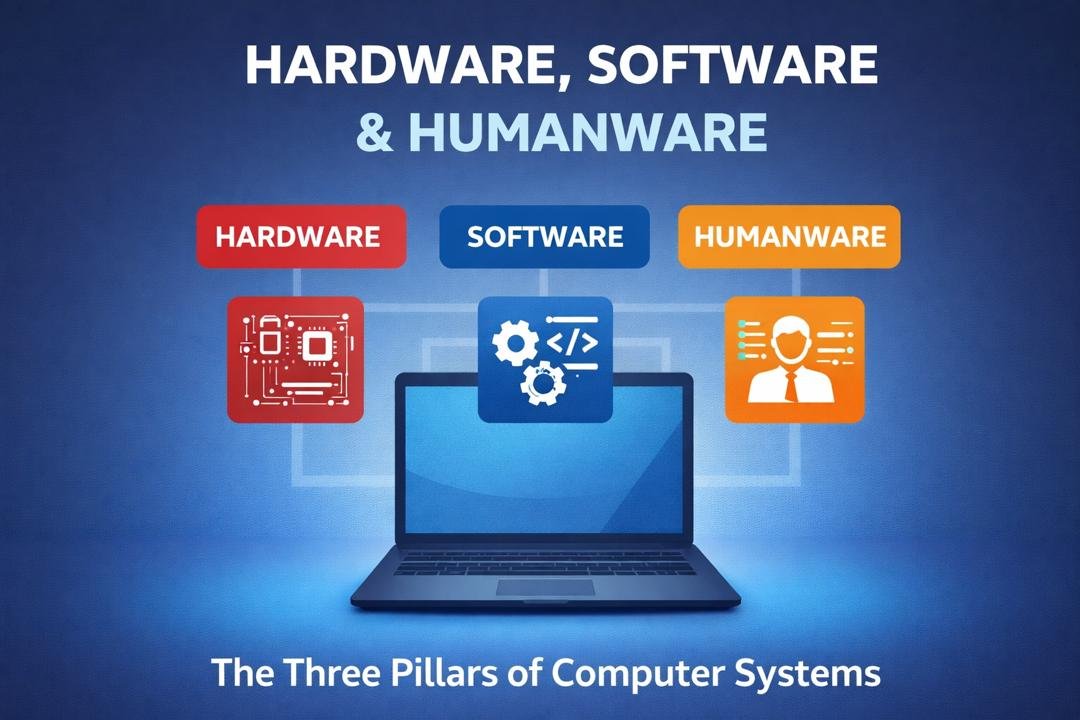
Computer system can best be described as a unit composed of three main components; hardware, software and humanware. These three aspects do not exist in isolation, rather, they rely on each other to accomplish significant tasks. Humanware is what makes a system used correctly and productively, software gives the instructions, and hardware is what gives the physical infrastructure. The absence of one of these elements will render the whole system useless. These three are commonly referred to as the basic building blocks of computer systems and they are the most important to the students, professionals, and the ordinary users.
This article gives the description of every component, their roles and how they work together to form an effective system of information processing. At the conclusion you will have a good principal knowledge of the way computer systems work as whole interdependent systems.
Computer System as an Integrated Unit
A computer system comprises of interrelated components that coexist to achieve data processing tasks. Such operations are on a continuous cycle called the information processing cycle that involves input, processing, storage, output and communication. All these phases of this cycle require hardware, software, and humanware.
As a case in point, when a learner is typing an assignment on the computer, the hardware (keyboard) receives the input, the software (word processor) arranges and formats text and the student (humanware) determines what to write and how to utilize the system. In case any of these elements is not present, the work cannot be finished.
The balance and collaboration of components of a computer system determines the success of the computer system. Such interdependence is what renders computers dependable, effective and strong instruments in the contemporary society.
Understanding Hardware
Definition of Hardware
Hardware is the material and physical components of a computer system. These are the elements which can be observed, touched and physically handled. Hardware is the backbone of any computer system since it gives the computer structure and the electronic circuitry that they have to operate.
Usual examples of hardware are:
- Central Processing Unit (CPU)
- Monitor
- Keyboard and mouse
- Printer
- Motherboard
- Random Access Memory (RAM)
- Solid state and hard disk drives.
Categories of Hardware
There are four broad categories of hardware according to functionality, these are:
- Input Devices
These gadgets enable one to input certain data and commands into the computer system.
Examples include:
- Keyboard
- Mouse
- Scanner
- Microphone
- Webcam
- Processing Devices
Instruction is performed by processing devices and system operations are conducted.
Examples include:
- CPU
- Motherboard
- RAM
- Storage Devices
These are gadgets that hold information and software on a temporary or permanent basis.
Examples include:
- Hard disk drive (HDD)
- Solid-state drive (SSD)
- USB flash drive
- Memory cards
- Output Devices
Output devices present or show the user processed data.
Examples include:
- Monitor
- Printer
- Speakers
- Projector
Role of Hardware
Hardware carries out all the physical functions which are required during data processing. It performs calculations, transfers data, stores information as well as displays results. However, hardware is passive. It will not be able to do anything by itself unless it gets the orders of software and commands of human users. This demonstrates that, hardware cannot be sole to make a working computer system.
Understanding Software
Definition of Software
Software is the programs, applications and data that give the hardware an instruction on what it should do. Software is exact, it cannot be touched physically but it can be installed, updated, and removed out of a computer system. In the absence of software, hardware would only be a meaningless machine.
Types of Software
Software is subdivided into two broad categories:
- System Software
System software manages computer hardware and it offers a platform on which application programs can be executed.
Examples include:
- Windows, MacOS, Linux and Android operating systems.
- Device drivers
- Utility softwares such as antivirus software and disk cleaners.
- Application Software
Application software assists the users to do certain tasks.
Examples include:
- Microsoft Word document program
- Excel for calculations
- Chrome, Firefox, Web browsers
- Media players
- Accounting software
Role of Software
Software requires being the linkage between the user and the hardware. It translates human commands into machine understandable commands which can be implemented by the hardware. The system resources also are managed with the help of software, which secures the system and enables the users to do their work effectively.
Understanding Humanware
Definition of Humanware
Humanware are those people who are using, managing, designing, and maintaining the computer systems. It also encompasses every person that interacts with computers both novices and highly professional.
Humanware examples are:
- End users
- Programmers
- System administrators
- IT technicians
- Network engineers
Role of Humanware
The smartest feature of the system is humanware. Human beings determine which activities the computer will perform, the software to be installed and how the data should be managed. They also fix issues, maintain systems and provide security. A computer system would be meaningless without humanware in terms of control, output and having a purpose.
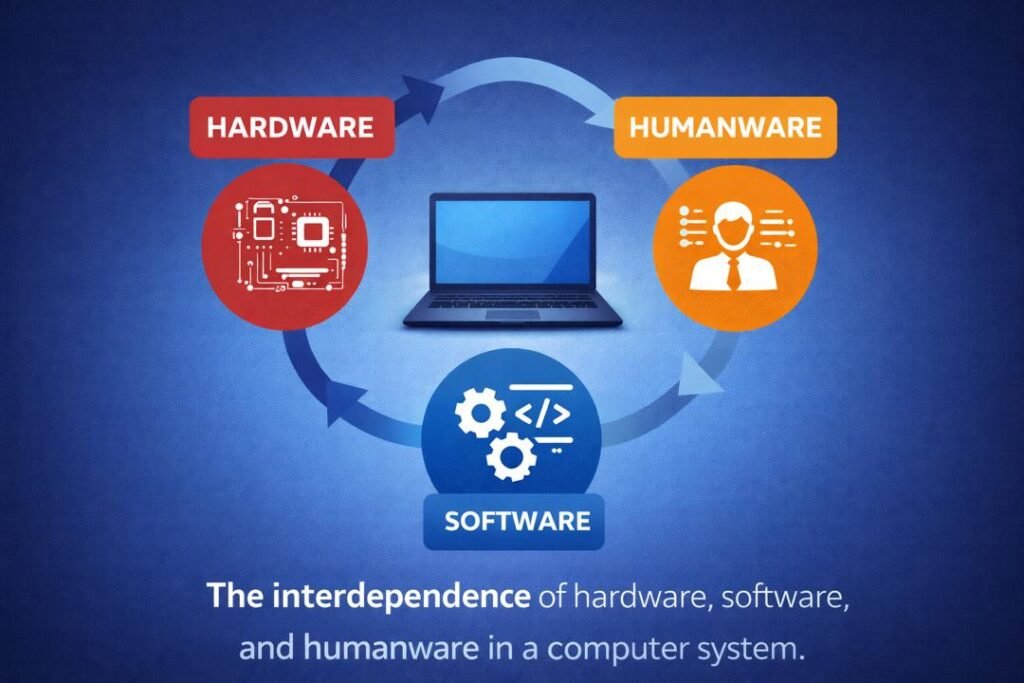
Hardware-software Interaction and Humanware Interaction
The three elements are interrelated in a cyclic interaction:
- Humanware is the one that gives inputs and commands.
- These instructions are converted into software.
- Instructions are implemented by hardware and output generated.
To illustrate, preparing lesson notes through a laptop requires the teacher (humanware) to type the information, the word processor (software) to format the text and the computer devices (hardware) to process and present the data.
Significance of the Interdependence between them
Without a single component in the computer system, the computer system cannot operate effectively:
- Hardware does not exist without software.
- Hardware cannot do anything without software.
- The system lacks a purpose without humanware.
Their collaboration provides information accuracy, efficiency, reliability and security in data processing.
Real-Life Applications
Computer systems pervade nearly all spheres of life of modernity, and their functionality is a resultant work of hardware, software, and humanware. Teachers in education make use of computers, projectors and learning platforms to work out lessons, present information, and evaluate students. These hardware and software are laptops and tablets, as well as interactive boards, and learning management systems, word processors, and online research applications. These systems are used by the humanware teachers, students and administrators to enhance teaching and learning.
Millions of transactions are being processed daily in computer systems in the banking and finance sector. Hardware used in automated teller machines (ATMs), mobile banking applications, and online payment systems include servers, card readers and network devices. The software will support customer information, monitor transactions and offer security. These systems are operated by bank staff and customers (humanware) who need to speedily and safely transfer money, check balances and pay bills.
Physicians and nurses adopt computer systems in the healthcare industry to store and manage the records of patients, to make appointments, analyze test results, and monitor the health condition of patients. These data are captured by hardware, such as computers, scanners, and medical devices, and then the information is organized and displayed with the help of special software. Humanware takes care of making sure that this data is decoded in the right way so that it could be used to make life-saving decisions.
Computers are used in business and offices to organize records, interact with customers, develop products and review performance. Desktops, printers and servers are hardware devices that are used together with the software like accounting packages, email systems and design tools. These systems enable the employees to enhance productivity and make quality business decisions.
Examples of ways in which computer systems are used in transportation include controlling of traffic lights, airline bookings, vehicle tracking and aiding in the navigation systems. Information is collected and transmitted by a type of hardware, which includes sensors, GPS units, and control panels. The information is processed with software and generates real-time updates, and the human operators oversee and control the systems.
Such applications indicate that computer systems cannot be limited to a single field. Rather, they contribute to almost all the activities within the society, which demonstrates the relevance of the collaboration between hardware, software and humanware in resolving the real life issues and enhancing the general lifestyle.
Conclusion
Every computer system is based on hardware, software and humanware. These are the basic parts of computer systems that are interrelated and should collaborate in order to get productive information processing. Being able to know their roles and relationships can be a powerful foundation to gain knowledge of information technology and apply digital tools to the current society.
Get more well researched information about the computer systems here.