
A Brief History of the Evolution from Local to Remote Computing
In the more primitive days of information technology, companies and individuals were just stuck with the local constraints of their computer hardware equipment. When a growing company needed more storage space or faster computing speed, they needed to spend so much money on costly physical servers, on-site climate controlled server rooms and highly specialized IT staff to maintain the systems. Today this local approach has been completely revolutionized by the emergence of cloud computing and an architectural paradigm shift that provides access to services, such as servers, storage, databases, networking services, software applications, and sophisticated analytics, all delivered directly over the internet.
Cloud computing has truly democratized enterprise-grade technology, allowing agile startups to rapidly expand to an international scale and individual consumers access to huge computing environments that were unimaginable to the average person.
What Is the Cloud?
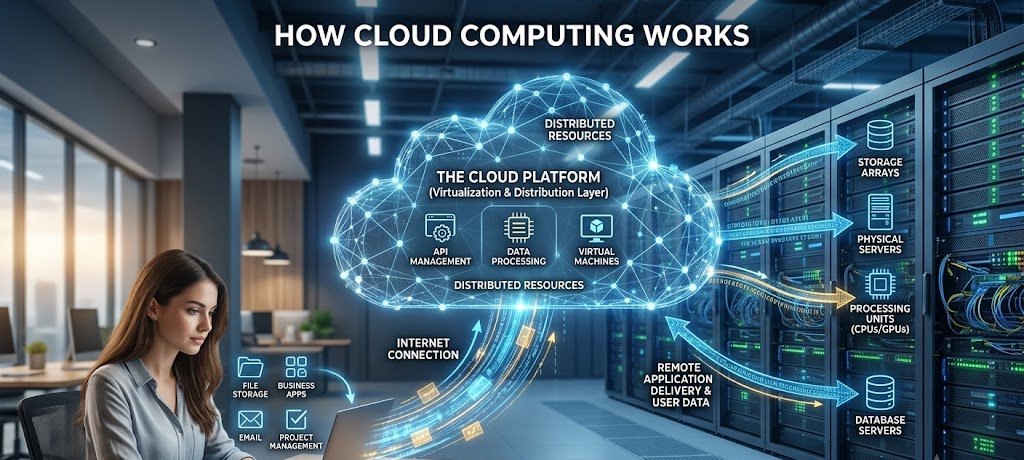
Before understanding how this modern digital platform works, it is important to delve into its structural elements that drive the provisioning of these distributed services. In essence, the cloud is based on a network of geographically distributed data centres with thousands of physical servers, connected together and managed by advanced hypervisors and virtualisation technology that enables the efficient sharing of resources. A grasp of the fundamentals of cloud computing enables users to appreciate how this vital virtualization layer abstracts physical hardware into software-based, flexible, and readily provisioned virtual resources.
A cloud user doesn’t interact with a single, fixed physical computer, but rather with a flexible pool of resources that automatically assigns processing power and storage according to shifting, real-time workload needs. This is a complicated technology trick that happens behind the scenes, allowing end-users to access their records instantly, securely and without hassle from any internet-connected device.
The Core Deployment Models of Cloud Computing
Public Cloud: Scalability and Accessibility for the Masses
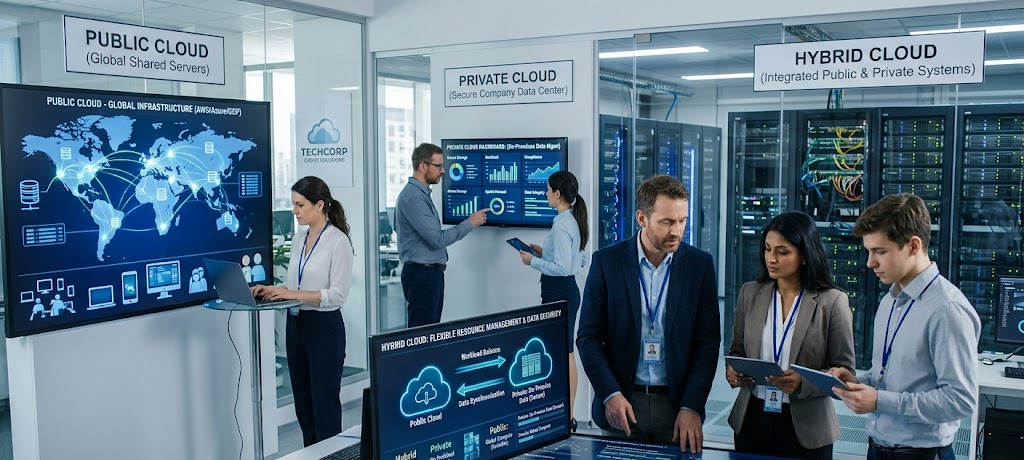
The public cloud model is the most familiar and commonly used architectural paradigm of this digital world, owned and managed by the large third party hyperscale service providers, Amazon Web Services (AWS), Microsoft Azure, Google Cloud Platform (GCP). With a public cloud, the service provider owns, operates and secures all the physical machines, networks, and huge data center buildings, and provides the computational resources to a number of different organizations and individual users through the public internet.
The multi-tenant architecture enables all different kinds of clients to be hosted on the same physical server infrastructure, while guaranteeing absolute data privacy and systemic security by providing logical isolation. The key benefit of the public cloud model is the huge economies of scale associated with eliminating up-front capital expenditure and the highly elastic, “pay as you go” pricing model that is particularly beneficial for organisations with extremely dynamic workloads.
Increased Security With All Dedicated Infrastructure Resources: Private Cloud
In contrast, the private cloud model provides a virtualized infrastructure that is used solely by one organization or enterprise customer, and where data and workloads are completely separated from other customers. A private cloud is either installed on premise at an organization’s data center or hosted by a third-party cloud provider specializing in cloud services for that specific organization, and providing the organization with dedicated, non-shared physical hardware assets. This highly isolated environment offers organizations an unparalleled level of control of operations, design flexibility and data security, making it a preferred deployment option for highly regulated industries such as international banking, healthcare systems, defense, etc.
The private cloud efficiently deals with a number of security issues raised by multi-tenancy and compliance risks, but there are significant up-front capital expenditures needed to build, set up, and keep up the cloud, at the same time a portion of the scalability advantages of public clouds is surrendered.
Hybrid Cloud: Strategically the Middle Ground
The solution in between these two extremes is the hybrid cloud, a complex architecture that brings together a public and private cloud environment and enables data and applications to flow freely between them. It allows modern enterprises the ability to take advantage of the ultra-secure, dedicated nature of a private cloud for sensitive workloads with the ability to scale up to the vast resources of the public cloud for less critical workloads.
For example, a large e-commerce company could use a private cloud for financial data that it has to keep secure, but a public cloud for its front-end website that it needs to manage with a large volume of traffic. The hybrid cloud provides organizations with unparalleled operational flexibility, enabling dynamic asset orchestration, seamless interoperability, and workload mobility, optimizing the digital infrastructure for security and cost-effectiveness.
Cloud Service Models: IaaS, PaaS, and SaaS
The IaaS, PaaS and SaaS service models are just three of these.
Infrastructure as a Service (IaaS)
In addition to these deployment models, cloud computing can be seen in terms of the structural layers, with the very base of the cloud hierarchy being Infrastructure as a Service (IaaS). IaaS offers users basic, raw computing resources—including virtual machines, physical or virtual storage blocks, networking, load balancers, firewalls and more—on a per-use basis, and lets system managers control these resources through web-based dashboards or through application programming interfaces (APIs). Renting virtualized server infrastructure from a cloud vendor, as an IaaS deployment does, allows organizations to take full control over the operating systems, middleware, applications and data runtime environments that are deployed on those virtual machines.
This particular layer is especially desirable for systems engineers and network architects who demand the highest degree of control over their system configuration without the associated operational burden of purchasing, racking and supporting physical hardware components.
Platform as a Service (PaaS)
A more abstract layer is Platform as a Service (PaaS), which is a more specialized version focusing on a simplified software development lifecycle where you will get an environment configured to build, test, deploy and manage software. With a PaaS approach, the cloud provider takes over the entire infrastructure, such as servers, storage, networking, operating systems, database management systems and runtime middleware, leaving the developer free from infrastructure management tasks. This approach lets software engineering teams channel all their creative talents into writing clean application code and improving user experiences, instead of having to deal with the complexities of configuring complicated backend servers or implementing operating system security updates.
The most favored PaaS solutions help modern development teams to speed up their time-to-market, build continuous integration and deployment pipelines, and automatically scale applications according to their fluctuating user demand curves.
Software as a Service (SaaS)
The most ubiquitous cloud experience is Software as a Service (SaaS), which provides full-featured and end-user applications directly from the Web browser or mobile device user interface. The cloud infrastructure provider is responsible for everything from the core data centre infrastructure to the application user interface, and everything in between, under the SaaS model. Users pay for these digital services generally on a monthly or yearly recurring basis, completely avoiding the time consuming, cumbersome process of buying software licenses, installing thick execution files locally, or manually updating them.
Whether it is Enterprise productivity platforms such as Microsoft 365 or Salesforce or Consumer entertainment platforms such as Netflix or Spotify, SaaS has transformed the way today’s society creates, consumes and interacts with digital media.
Why Cloud Computing Matters for Businesses and Individuals
The Objective Is to Reduce Costs and Capital Investment
Perhaps the most compelling business case for going cloud is the complete transformation of corporate financial modeling effected by the extraordinary decrease in upfront capital costs. With the traditional IT structure, companies would make huge investments in the initial stages of the project, basing the physical infrastructure on their best estimate of the future volume of calculations they would be carrying out. This often led to over-provisioning and then to an underutilization of the data centre for most of the time it was running.
The key to this structural inefficiency is to shift fixed capital spending (CapEx) to flexible operational spending (OpEx): pay only for the exact computational resources used on a minute-by-minute basis. The precise utility-billing model makes it attainable for SMEs to leverage top-tier data storage and processing without sacrificing their finances, thereby ensuring that the playing area is level throughout the world’s different industries.
Elastic Scalability and Business Agility Like Never Before
In tandem with economic efficiency is the concept of elastic scalability, which refers to a cloud ecosystem’s inherent capacity to dynamically increase and decrease resources based on real operational needs. Cloud instances can be provisioned and decommissioned automatically in a few seconds, while it takes weeks, if not months, to deploy and provision physical infrastructure needed to handle corporate growth. With this fluid responsiveness, an application can rapidly accommodate a sudden, massive influx of users – whether it’s a viral marketing campaign or the launch of a flash retail sale – and run without crashing, then scale back down virtually instantly when the traffic dies down to avoid squandered operational costs.
This new agility enables today’s enterprises to adapt quickly, rapidly test new digital service lines with little risk to the bottom line, and roll out web-based applications across the planet at once.
Transforming Collaboration and Data Storage at the Workplace
The cloud offers not only structural and infrastructural benefits, but it has also irrevocably changed the ways that modern workforces collaborate, and that they protect their valuable organizational data assets. The old ways of working were dependent on having various storage devices and the transmission of incomplete email attachments which often resulted in major version control issues and the siloing of data between different departments within the organization.
Productivity suites based on the cloud will eliminate these operational hurdles by providing a single source, real-time repository for simultaneous editing, commenting, and managing of documents by many distributed users, regardless of their geographic location. Moreover, cloud storage solutions offer very automated and geographically redundant data back-up methodologies that safeguard organizations against catastrophic data losses from local hardware failures, malicious ransomware attacks, or natural disasters at a physical company location.
Challenges and Considerations of Cloud Computing
For most organizations, cloud adoption is a complex process that presents a host of challenges.
Compliance With Data Security, Privacy, and Regulatory Requirements
The advantages of shifting to a cloud-based architecture are numerous, but the move also poses unique problems and complicated security risks that companies need to be aware of and navigate to prevent significant disruptions to their operations. Data security and compliance is one of the major concerns of cloud adoption – where sensitive intellectual property or customer information is stored on a remote third party server is the organization’s potential digital attack surface.
Cloud security is distributed, so the provider ensures physical security for the data centre, but the client is responsible for setting up identity access controls, encrypting data and managing client-facing application vulnerabilities. If these are not managed properly, they can lead to catastrophic data breaches, hefty fines and non-compliance with strict international laws like GDPR or HIPAA.
The Concept of Vendor Lock-In and Downtime Vulnerabilities
Another common challenge that companies often face is vendor lock-in where businesses become so tied up in a particular cloud provider’s products, databases, and platform designs that they are unable to switch. Moving large amounts of data and intricate application infrastructures between two prominent cloud service providers can be extremely time-consuming, complex and expensive, especially when they involve large data egress fees and different architectural approaches. Moreover, by its nature, cloud computing requires constant, high-speed internet connections to operate.
If a large cloud computing service provider experiences an outage or downtime in its data center, it could bring an entire business to a halt, leaving users without access to their mission-critical applications and putting them at a major financial loss. Thus, organisations need to invest deeply in building strong DR strategies, multi-cloud solutions, and comprehensive contingency plans to effectively combat these structural risks.
Cloud Computing in Action – Real World Applications
Everyday Consumer Impact
The ubiquity of cloud computing can be understood by simply observing how much it has infiltrated into everyday consumer life, away from the confines of the corporate boardroom. From streaming high definition films on smart TVs to syncing a photo library to a remote server to playing an interactive video game with other players worldwide, people are heavily dependent on cloud infrastructure. The mobile operating systems of today are tightly coupled to the cloud, and they routinely back up the settings, contact lists, and personal media files of devices in real-time without any attention being drawn to the process, so that data can be seamlessly recovered in the event of a device loss, theft, or upgrade.
This invisible integration has transformed the way people engage with digital material, raising the bar for consumer expectations to a new level and forever changing the notion of ownership to one of being available anytime, anywhere.
The AI Revolution, Big Data, and Enterprise
In the corporate and industrial world, cloud computing is the key driver of sophisticated digital transformation, predictive big data analytics and automated machine learning programs. For most organisations, it’s too expensive to build and run a tract of compute power capable of training more complex AI models or analysing multi-terabyte datasets on their own premises. Cloud platforms address this through the provisioning of huge networks of specialized graphical processing units (GPUs) on a flexible by-the-hour rental model, which allows researchers to process complex medical images, optimize global supply chains, and create predictive financial algorithms quickly and efficiently.
Within the medical field, particularly, the cloud-based eHR networks and telemedicine applications have revolutionized patient care by allowing physicians to securely communicate and gain immediate access to vital patient information from various medical centers.
Conclusion: Embracing the Cloud-First Future
To conclude, cloud computing has come a long way from its inception as a simple, remote data storage option to the backbone of today’s global digital economy. The cloud has transformed the way today’s businesses innovate, scale and compete today in complex, global markets by replacing complex physical hardware with flexible, digital services in public, private and hybrid deployments. Despite the many obstacles to cloud adoption, including data privacy, regulatory compliance, and dependence on vendors, the strategic benefits of operational agility, economic efficiency, and real-time collaboration across the globe are undeniable, making cloud adoption essential for organizational survival.
The future of cloud integration with emerging technologies is promising, and as these technologies continue to evolve—such as edge and quantum computing, and generative artificial intelligence—it will be a massive era of human productivity and technological advancement for decades to come.