Abstract
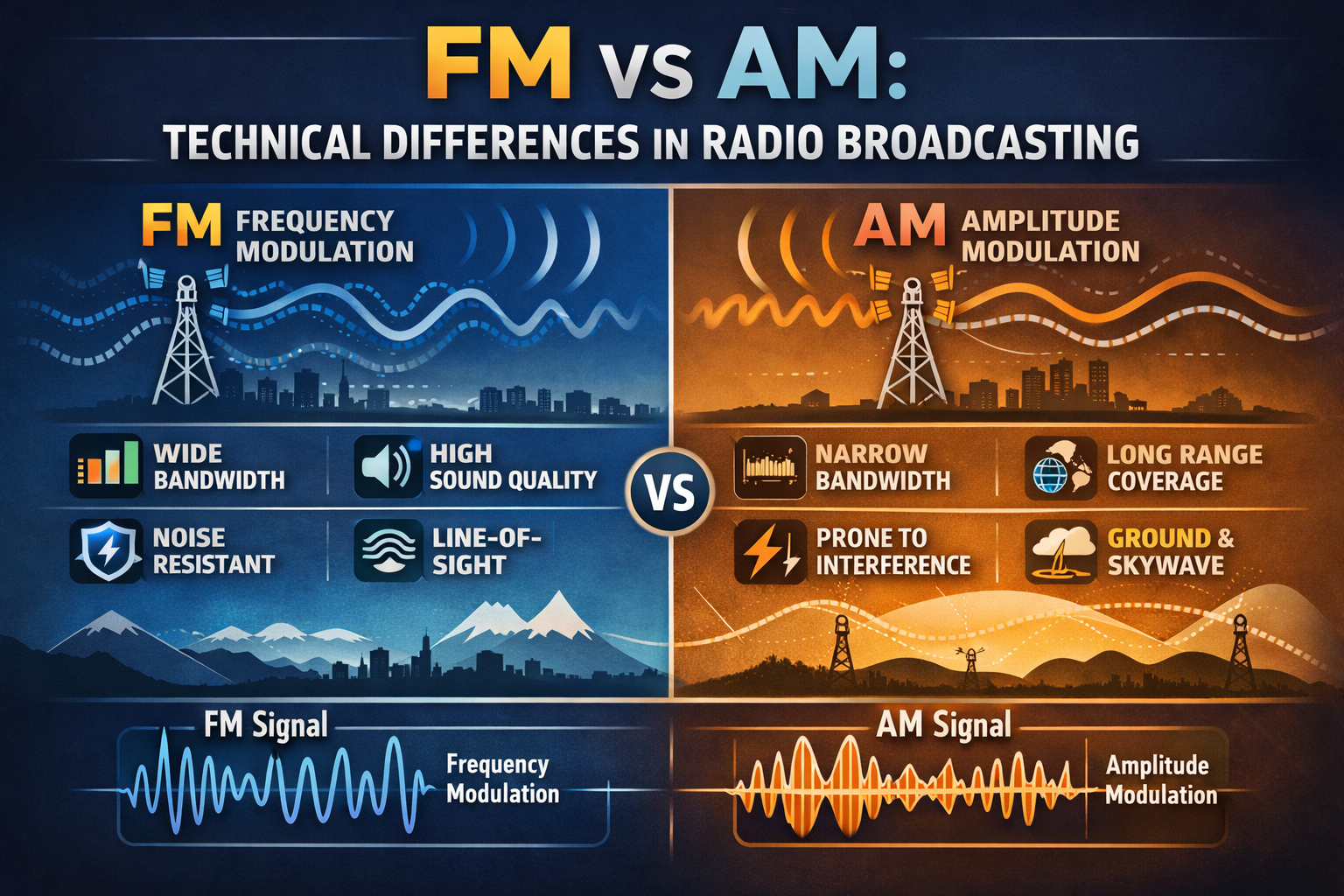
Radio broadcasting relies on the principle of modulation that allows the audio signals to be passed through electromagnetic waves in an efficient manner. Amplitude Modulation and Frequency Modulation (FM vs AM) are two basic methods involved in broadcast communication. This paper will look at the technical aspects of the differences between these two systems in signal structure, bandwidth needs, noise capacity, sound quality and geographical coverage. The research would use a qualitative analysis approach guided by the existing literature on communication engineering to give a reasoning on the effect of modulation methods on the performance of broadcasting and experience of the audience. The results show that FM broadcasting has a better sound and a higher interference-resistance capability because of an encoding of the signal in terms of frequencies, which is the reason why it is the most common in music broadcasting. On the other hand, AM broadcasting is significant in long-distance transmission due to the capability of propagating through long- distance transmission mechanisms that include the ground wave and skywave. The analysis comes up with a conclusion that despite the still dominance of FM over the entertainment broadcasting, AM still plays strategic roles in news, emergency communication, and broadcasting in rural areas. The knowledge on the differences between these systems is still significant to broadcast engineers, policymakers, and media scholars.
Keywords: frequency modulation, radio broadcasting, amplitude modulation, signal propagation, bandwidth.
1.0 Introduction
The radio broadcasting is one of the most prominent mass communication technologies within the contemporary society. Radio transmission has depended on the use of modulation to transmit the audio information in electromagnetic waves since the beginning of the twentieth century. The low-frequency sound signals are not able to penetrate space efficiently without modulation (Stremler, 2018).
Conventional radio broadcasting is dominated by two major modulation systems namely Amplitude Modulation (AM) and Frequency Modulation (FM). They work on the principle of an audio signal mixed with a high frequency carrier wave. They however vary in determining how the carrier wave gets altered by the information signal.
In AM broadcasting, the carrier wave is amplitude varied or reduced depending on the audio signal whereas the frequency is held constant. In FM broadcasting, the carrier wave frequency is adjusted in time with the audio signal with the amplitude being constant (Haykin, 2013).
Such technical distinctions result in significant signal performance differences, such as bandwidth, noise resistance, audio fidelity and transmission range. Consequently, various broadcasting systems employ varying modulation methods with reference to the purpose of communication.
It is important that broadcast engineers, communication scholars, and media practitioners understand these differences. An oversimplified comparison which can aid in comparing AM and FM broadcasting systems points out the underlying difference in modulation and application of modulation methods.
This paper therefore compare AM and FM broadcasting systems and why FM became the most important in the broadcasting of music, and AM is still used in long distance communication.
2.0 Literature Review
2.1 Evolution of Radio Broadcasting Technologies
The radio broadcasting is one of the earliest electronic mass communication systems that appeared in the early part of the twentieth century. Briggs and Burke (2017) reported that early radio communication was greatly dependent on amplitude modulation since it could be more easily enacted with the technologies at that time.
Amplitude modulation was popular in 1920s and 1930s and it formed the main system of early broadcasting stations in Europe and North America (Sterling & Kittross, 2002). But AM broadcasting had serious problems of interference due to atmospheric noise and electrical disturbance.
The technological breakthrough came with the development of frequency modulation by an engineer by the name Edwin Armstrong in the 1930s. Armstrong established that FM signals were much more immune to noise and could have more sound quality than AM broadcasting (Lewis, 1991).
2.2 The technical research on modulation systems
The structural differences between AM vs FM signals have been widely studied over time by communication engineering studies. According to Haykin (2013), AM signals represent information by modulations in amplitude, and thus, they are easily vulnerable to electrical noise since noise also changes signal amplitude.
Conversely, FM signals code messages by varying frequencies. FM broadcasting is more effective in terms of signal clarity and minimized distortion since most of the noise in the environment is not frequency noise but amplitude noise (Carlson and Crilly, 2010).
Moreover, Stremler (2018) observes that the FM signals occupy a broader bandwidth than the AM signals because the frequency deviation restricts the number of stations that can be broadcasted over a specific frequency range.
2.3 Broadcasting Applications
Various broadcasting services use various modulation technologies based on their purposes. Reproduction of high-fidelity sound is necessary in music broadcasting and that is why large numbers of FM radio have been used in broadcasting entertainment programs (Sterling & Kittross, 2002).
In contrast, AM broadcasting is still applicable in long-range communication since the signals can be reflected by the ionosphere and stations in the area can cover audience hundreds or even thousands of kilometers (Briggs and Burke, 2017).
3.0 Theoretical Review
3.1 Modulation Theory
Radio communications are based on modulation theory. The theory describes how a baseband message (audio message) may be conveyed over long distances where it is embedded on a high frequency carrier wave (Haykin, 2013).
The process entails three elements:
- Information signal
- Carrier signal
- Modulation mechanism
In amplitude modulation, the carrier signal amplitude changes in line with the message signal. In frequency modulation, the carrier wave frequency is modulated in response to the message signal.
3.2 Signal Propagation Theory
Signal propagation theory is the theory of the propagation of electromagnetic waves in the atmosphere. Carlson and Crilly (2010) argue that there are three key ways through which radio signals travel:
- Ground wave propagation
- Skywave propagation
- Line-of-sight propagation
The AM broadcasting depends mostly on the ground wave and skywave propagation, which permits long distances of signals travel. Line-of-sight propagation is the primary one used in FM broadcasting, and this limits the coverage to regional levels.
These theoretical concepts describe practical differences in the range of coverage of AM vs FM broadcasting system.
4.0 Methodology
This research paper discusses a qualitative analytical research design which has used secondary data as source of information. The analysis of scholarly literature, communication engineering textbooks, and broadcasting research discussing modulation techniques are the approaches of the methodology.
The paper is dedicated to the comparison of AM vs FM broadcast systems on the basis of five technical parameters:
- Signal structure
- Bandwidth requirements
- Noise resistance
- Audio quality
- Coverage range
There were academic materials that were reviewed to determine the weaknesses and strengths of each modulation system. The results are discussed analytically and compared using tables to bring a clear picture on the technical differences.
5.0 Findings
5.1 Signal Structure
Signal structure is the first important distinction between AM vs FM broadcasting.
In AM transmission, carrier amplitude varies with modulating wave whereas frequency is constant.
In the FM transmission, the carrier wave frequency changes but the amplitude does not change.
5.2 Bandwidth Requirements
The range of frequencies employed by a radio signal is called bandwidth. AM broadcasting does not need a significant amount of bandwidth since it has only two sidebands around the carrier frequency.
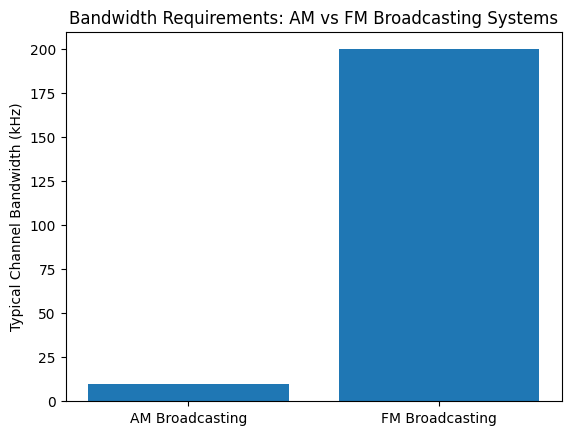
FM broadcasting involves much broader bandwidth since the frequency deviation, and multiple sidebands (Stremler, 2018).
5.3 Noise Resistance
One of the most significant issues in radio communication is environmental noise.
The AM signals are very susceptible to noise due to electrical interference with signal amplitude. AM encoding relies on the variation of the amplitude to convey the information and therefore, noise distorts the signal easily.
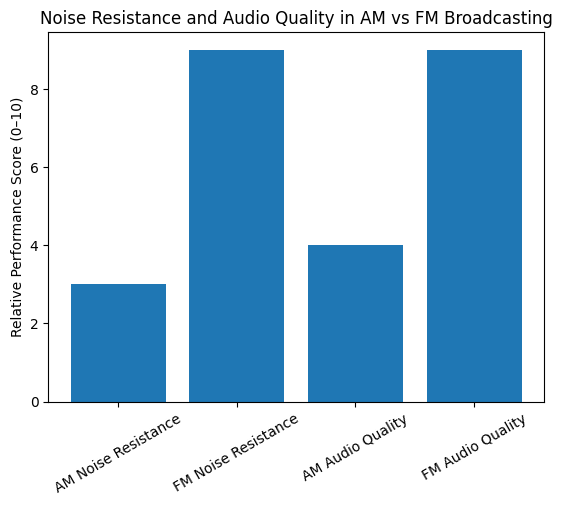
FM signals are less susceptible to noise since the signal is coded in frequency variations and not amplitude variations (Carlson & Crilly, 2010).
5.4 Audio Quality
Other important differences include sound reproduction.
FM broadcasting helps in providing a broader frequency response and stereo transmission that results to greater sound fidelity. The broadcasting quality of AM radio is low, and therefore it is more appropriate when speech is required as opposed to music.
5.5 Coverage Range
Through skywave propagation across the ionosphere, AM signals can be transmitted over long distances. This enables AM stations to cover a large audience way out of the location of transmitter.
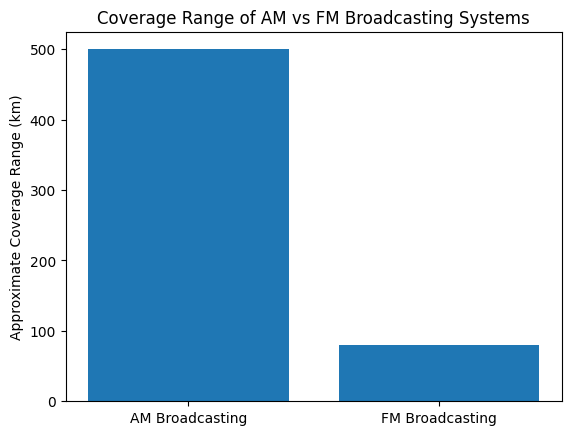
FM signals normally move in straight lines and are restricted by the curvature of the earth and hence limited to areas of coverage.
6.0 Discussion
The analysis has shown that AM and FM broadcasting systems have various technical weaknesses and strengths.
FM broadcasting has a high audio fidelity and is very resistant to electrical interference. The benefits render it the favorite in music broadcast and entertainment programmes. FM broadband enables a better sound quality and stereo emittance due to the expanded band-width.
Nevertheless the FM signals have shorter distances due to the fact that they are primarily based on line-of-sight propagation. This renders them unsuitable in long distance broadcasting.
On the contrary, AM broadcasting offers a wide coverage, owing to the propagation by skywave. This attribute renders AM radio useful in the international broadcasting, rural communication and in case of emergencies.
Although AM has low audio quality, it can still be used in talk radio, news broadcasting and in disaster communication systems.
These results state the reason why both technologies are currently frequently used together in modern broadcasting systems to satisfy various communication requirements.
7.0 Conclusion
This paper has compared AM vs FM broadcasting systems in regards to structure of the signal, bandwidth, resistance to noise, sound quality and the range.
The results prove that FM broadcasting is more effective in terms of sound quality and resistance to interference, which determines its supremacy in the music broadcasting. The overall bandwidth needs and the low range of coverage however limit its application in long-distance communication.
Technically old, AM broadcasting is still relevant due to its capability to transmit signals across huge geographical regions via ground wave and skywave propagation.
The co-existence of AM vs FM broadcasting is an indication of the various technical merits of both modulation systems. Although FM has overtaken AM in terms of dominance in the entertainment broadcasting, AM still has strategic communication roles of emergency broadcasting and rural information dissemination.
The digital broadcasting technologies of the future can change the radio transmission systems even more, yet the technical basis of AM and FM modulation is a must-have in communication engineering and media studies.
References
Briggs, A., & Burke, P. (2017). A social history of the media: From Gutenberg to the Internet (3rd ed.). Polity Press.
Carlson, A., & Crilly, P. (2010). Communication systems: An introduction to signals and noise in electrical communication (5th ed.). McGraw-Hill.
Haykin, S. (2013). Communication systems (5th ed.). Wiley.
Lewis, T. (1991). Empire of the air: The men who made radio. HarperCollins.
Sterling, C. H., & Kittross, J. M. (2002). Stay tuned: A history of American broadcasting (3rd ed.). Lawrence Erlbaum Associates.
Stremler, F. G. (2018). Introduction to communication systems (3rd ed.). Addison-Wesley.


Great article overall. I liked how the topic was broken down into clear sections, making it easy to follow. The writing doesn’t feel forced or artificial, which is something I value a lot when reading blog content.