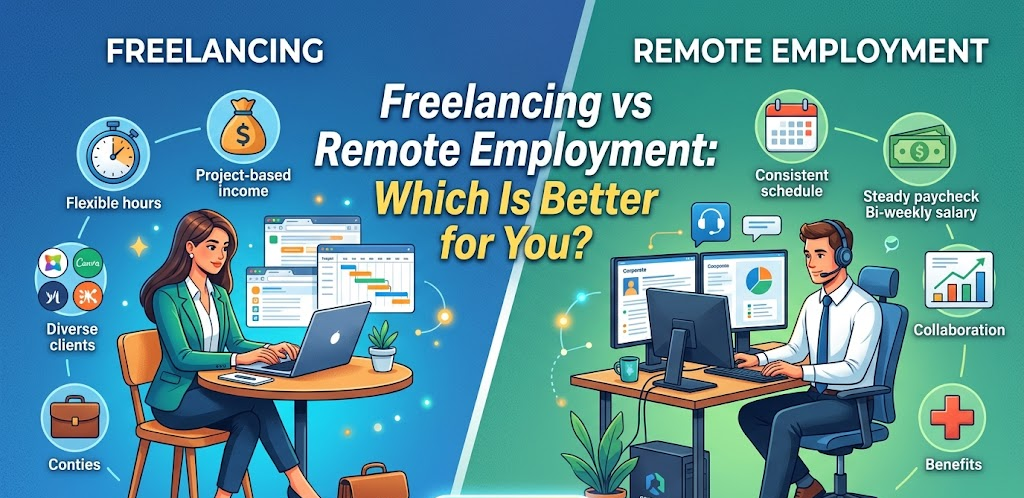
How people work has radically changed over the past 10 years. The use of technology, improved internet connectivity, and the shifting needs of the workplace have seen to it that millions of professionals are now able to work outside the office settings. Some of the current hot trends include freelancing and remote jobs.
Though both models may allow individuals to work anywhere, even at home, there is an extremely large divergence in the terms of structure, income trends, employment opportunities, and security in the long term. The choice between the two may not always be easy, especially for those individuals who are actually struggling to make ends meet and, in the process, live their own lives.
In this article, you will find a comprehensive and realistic comparative analysis of freelancing and traditional remote employment, to better comprehend their main differences and find out which one fits your objectives, personality, and way of life.
What is Freelancing/Remote Employment?
What Is Freelancing?
Freelancing is a form of self-employment whereby one offers his/her services to clients, whether on a project or contractual basis. The freelancers usually have multiple customers at the same time and take care of all the details of their work, including client acquisition, bargaining their fees, delivery of the services, and budgeting.
The most common spheres of freelance are:
- Creation of content and writing
- Graphic design
- Web development
- Digital marketing
- Video editing, animation
Freelancers are free and answerable, just as business owners who own their own businesses.
What is Remote Employment?
Remote employment is that work where one is employed in a company but does not necessarily have to be in a traditional office. Telecommuters are allowed to work full-time or part-time and are normally assigned some duties within an organizational structure.
They also receive a routine salary, they have bosses, and work in a team with the aid of digital tools such as video conferencing and project management tools.
In contrast to freelancers, remote workers belong to an organization and adhere to organizational policies, schedules, and expectations.
Stable Income and Earning Potential
One of the most crucial factors to be considered in the decision to freelance or accept an offer as a remote employee is income earning and management.
Freelancing Income
The freelancer is normally paid on a project, hourly, or per milestone basis. This means that the monthly revenue can be subject to variation due to alteration in workload and clientele. A few months can be very lucrative, whereas others can be sluggish.
However, when it comes to earning, there can be no boundaries to freelancing. Skilled freelancers who have a good reputation can charge a high price and respond to customers who spend a lot of money worldwide.
Remote Employment Income
Remote workers are given a stable income, which could be in the form of a monthly payment. This stability enables easy financial planning, settling of bills, and long-term payments. Bonuses, overtime, or performance incentives are even offered by other companies.
Nonetheless, the potential number of earnings may be restricted by the company policies and salary system.
Key Insight
Remote work is most applicable to individuals who feel comfortable with financial risks to make more, and freelancing is the appropriate option when one desires a steady income and no doubt about financial protection.
Balance and Flexibility at Work
Flexibility is one of the main reasons to quit conventional office working, but the flexibility of such a choice with regards to freelancing and working from home is varied.
Freelancing Flexibility
Freelancers are at liberty with their time. They can decide:
- When to work
- Where to work
- How much to work
With this flexibility, there is enhanced work-life integration. As an illustration, freelancers are able to take breaks in the day, travel whilst working, or set schedules that are compatible with their personal engagements.
Remote Employment Flexibility
Location flexibility is also enjoyed by remote employees who tend to work under fixed hours. They might be required to meet deadlines, attend meetings, and match schedules of the team, particularly when they might be working across time zones.
Key Insight
Freelancing is the most adaptable, and remote work is organized and adaptable.
Job Security and Stability
Job security is one of the major factors that determine career choices.
Freelancing Job Security
Freelancers have no certainty of job security. Contracts are not specific in terms of time; they do not imply stable work offered by clients. In addition, freelancers must constantly be willing to find new opportunities to be able to maintain income.
Remote Working Job Security
Employment agreements provide the remote worker with everything conceivable, including the timing of the notice, the severance package, and labor protection. There is still a possibility of layoffs, but it is more stable as compared to freelancing.
Key Insight
Remote work has more job security, and freelancing requires determination and initiative to work at all times.
Workload Control and Accountability
Freelancing Workload
Everything is the responsibility of freelancers:
- Finding clients
- Managing projects
- Handling communication
- Delivering results
- Budgeting and taxation
Although this kind of control can be empowering, it may prove to be too much, particularly for beginners.
Remote Employment Workload
Remote workers are task-oriented and perform a particular role in a given task. Work is allocated to managers and team leaders, and this makes it easier to focus on certain tasks without being concerned with the running of the business.
Key Insight
Freelancing entails good self-management skills, but remote job opportunities offer a system of workload assignment.
Growth and Advancement of Career
Another consideration is career progression.
Freelancing Growth
Freelancers grow by:
- Growing their customer base
- Building strong portfolios
- Increasing their rates
- Specializing in high-demand skills
Nonetheless, it does not have formal promotions and career ladders.
Remote Employment Growth
Remote workers enjoy:
- Promotions
- Salary increases
- Professional development programs
- Mentorship opportunities
Long-term career planning is made easy with such designed career pathways.
Financial Responsibility and Benefits
Freelancers
Freelancers must manage:
- Taxes
- Health insurance
- Retirement savings
- Costs of software and equipment
They have full responsibility for their financial planning.
Remote Employees
Such benefits are usually enjoyed by remote workers:
- Health insurance
- Paid leave
- Retirement plans
- Equipment allowances
Such advantages bring extra financial stability.
Personality and Lifestyle Fit
Whether or not to be a freelancer or a remote worker can depend upon your character and preferences.
Freelancing Suits:
- Self-driven and self-reliant personalities
- Uncertainty-lovers
- Individuals that like diversity and innovativeness
- People who are interested in entrepreneurship
Remote Work Suits:
- People that appreciate stability
- Team-oriented professionals
- People who prefer to work in an organized environment
- People who desire to have long-term career growth
Freelancing and Remote Jobs: Comparing Their Advantages and Disadvantages
Freelancing
Advantages:
- Complete independence
- Flexible schedule
- High earning potential
- Opportunity to work with foreign customers
Disadvantages:
- Irregular income
- No job security
- Lack of benefits
- High responsibility
Remote Employment
Advantages:
- Stable income
- Employee benefits
- Career advancement opportunities
- Defined work structure
Disadvantages:
- Limited flexibility
- Fixed schedules
- Minimal project control
- Dependence on employer
The Hybrid Style: A Combination of the Two Models
Freelancing is becoming a common combination with remote working for many professionals. This model is a combination of both.
For example:
- A freelance worker will be able to do freelance jobs during the weekends
- A freelancer has an opportunity of earning a stable income by taking a part-time distant work
This strategy will reduce the risk of finances, but it will allow individuals to venture into other opportunities.
Obstacles to Consider
Freelancing Challenges
- Inconsistent income
- Difficulty finding clients
- Managing multiple roles
- Risk of burnout
Remote Employment Challenges
- Limited independence
- Possible isolation
- Dependence on decisions of the company
- Work-life issues due to being connected all the time
Future of Work: What Lies Ahead?
The world workforce is changing fast, and freelancing as well as remote work is likely to increase.
Emerging trends include:
- Increase in demand for digital and tech skills
- Expansion of international freelance market
- Further uptake of remote-first policies by more companies
- Heightened tolerance of flexible working
As the rapidly growing technological world constantly gains more and more, the line between freelancing and remote jobs may become even more blurred.
Making the Right Decision
The freelancing versus remote employment is chosen on the basis of many factors:
- Financial Goals: Are you interested in a steady income or greater earning potential?
- Risk Tolerance: Are you a risk taker?
- Work Style: Do you like to work independently or structured?
- Career Vision: Would you like to be an entrepreneur or corporate?
One cannot answer in a one-size-fits-all manner. The one that coincides with your personal and professional interests is the best option.
Final Thoughts: Freelancing and Remote Jobs
The modern labour market is more liberal than ever before, and freelancing and remote jobs, is also an option rather than an office job. The comparative analysis of traditional remote employment and freelancing suggests that there are advantages and disadvantages of each remote working option.
Freelancing is free, gives a sense of freedom of choice, and unlimited earning capacity, and is linked with financial risk and liability. It is more stable, organized, and professionally developing, but it is less flexible and free, as compared to telecommuting.
Lastly, there is a decision to be made that is based on your goals, preferences, personality, and style of life. No matter the choice that you take between freelancing, remote working, or both, the trick to success is to understand what you are good at and make the correct decisions.