
Introduction
Running a successful small business isn’t just about having a great product and being a great service. Financial management is among the most essential duty of any business owner as it decides whether or not the business will be able to survive through tough times, grab growth opportunities, and make the business profitable in the long run. While there may be many different reasons why many small businesses fail, one of the most common is that they are not managing their finances well. Institutions that fail to budget properly, don’t have enough cash on hand, do not have the right pricing strategy or financial plan can easily turn a potential business into a struggling one. By comprehending the factors of cash flow management, entrepreneurs can make informed decisions and minimize uncertainties to create a more resilient business that adapts to market shifts. As a small business owner, mastering a few key financial practices can help them achieve greater stability, boost profits and establish a path for sustainable growth.
Why Financial Management is Critical to Small Businesses
Financial management is the process of arranging, monitoring and controlling the financial activities of the business for the attainment of the objectives of the business. Small businesses do not have a separate finance department, meaning that the owner may be expected to make the financial decisions. This is all the more important when it comes to financial literacy because all the choices that are made regarding spending, investing, or pricing will have a direct impact on profitability and the business’s survival. Good financial management provides business owners with an opportunity to make a profit, avoid taking unnecessary loans, have the right resources at their disposal and manage them effectively. This is also beneficial to a business’ self-assurance when applying for loans, investing in the business or expanding the business. Knowing where the business stands financially will enable the business to respond rapidly to changes in the market and to make decisions on sound information and not guesswork.
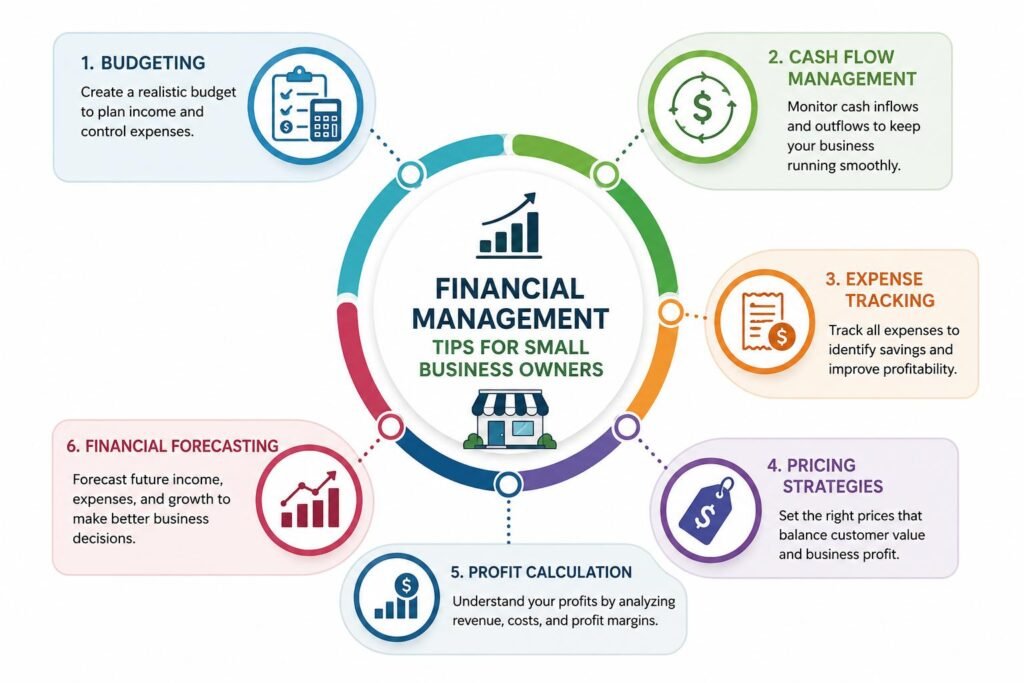
1. Develop and implement a realistic budget.
Budgeting is an integral part of financial management as it is the blueprint for the earning and spending of money. A business budget is a forecast of business income and a plan on how to spend the resources to pay for business expenses like inventory, salaries, rent, marketing, transportation, utilities and tax. If a company owner does not have a budget, he may overspend in some areas, whilst under spending in certain areas that are very necessary for the business to grow. The realistic budget should be determined on historical information, market conditions, anticipated sales volume and future business goals instead of on optimistic assumptions. A review of budgets should be regularly undertaken to compare actual performance with budgeted performance and highlight where there are differences that need to be adjusted to.
A good budget should be broken down into fixed and variable costs. Fixed expenses don’t vary a lot from month-to-month, such as rent, insurance and wage costs for employees. Variable expenses are costs that change with the volume of business and can consist of shipping, raw materials or advertising costs. Having the knowledge of the difference will help businesses forecast better their financial needs and prepare for increased or decreased demand during specific seasons. Monthly or quarterly budget reviews need to be conducted to ensure that spending coincides with the business objectives and not with a last minute surprise that will cause any disruptions in the business.
2. Gain the expertise to manage cash flow.
When it comes to business failures, cash flow is one of the top complaints in small business, not a lack of profit. A company can make a profit on the books and not be able to keep up on the bills with suppliers, employees or operating costs due to the lack of cash on hand when necessary. Good cash flow management makes sure that funds are coming in and out of the business at the right time, so that this will not put financial pressure on the business.
A business owner should check the cash inflows and outflows of the business, keeping an eye on the payments received from the customers, the commitments from suppliers, payroll, loan repayments, and the tax liabilities. Offering incentives or accelerated term for customer payment of invoices can make a huge difference to cash availability. Likewise, having good payment flexibility with the suppliers can be achieved. Having some cash reserve for emergencies is also helpful to a business if there are any sudden events like equipment breakdowns, economic downturns or any fluctuations in the sales. A business owner’s consistent cash flow forecasting helps him or her predict cash shortages in time, and make corrective measures.
To enhance cash flow, strategies include the following
There are a number of practical steps that can boost business cash flow and enhance its financial position. Fewer delays in the collection of payments should be achieved by promptly sending out invoices and regularly following up on late payments with businesses. Multiple payment options will make payment more convenient for customers and allow quicker payment. Money tied up in excess inventory doesn’t generate revenue and taking it down also reduces the amount of money tied up in products that have to be stored in warehouses. Checking the subscriptions, service contracts, and supplier agreements may identify opportunities for saving money and freeing up cash. Fluidity and resilience go hand in hand with businesses with active cash flow management.
3. Why it’s crucial to monitor your budget.
Expense tracking offers visibility of money activity and can enable company owners to locate areas of efficiency. Small expenses that occur regularly can add up over time and can have a big effect on profits, and many entrepreneurs don’t realize this. Businesses can use expense tracking to categorize their expenses and find areas of waste, monitor trends, and make informed decisions about expense reduction. When you have accurate expense records, tax preparation is more straightforward and error-free, minimizing potential tax-related problems.
With the help of modern accounting software and mobile apps, expense tracking is easier than ever, with transactions automatically categorized and reports generated. Any expense, no matter how insignificant, should be noted by business owners, such as Office Supplies, Transportation, Subscriptions, Meals, Utilities, Maintenance. Maintaining and retaining receipts and financial records in an organized manner helps with accountability and better and more accurate financial reporting. Expenses can be easily tracked over time to help businesses identify patterns that may need to be addressed before they become an issue that could impact profitability.
Analyzing spending using Financial Reports
Financial reports like profit and loss statements, balance sheets and cash flow statements add to the value of expense tracking. These reports tell how resources are being used and if spending is in line with priorities. If costs in marketing go up but sales don’t, for instance, you might need to make some changes for better ROI. Financial reports convert data into information that can be used to make decisions and plan for the future.
4. Creating effective pricing strategies
Prices have an immediate impact on revenue, profitability, market positioning and customer perception. If prices are too low, customers may be lured in at first, but later they may result in margins that are not sustainable and financial problems. However, if the product is too expensive, then the competitiveness of the product will decrease and the sales volume will be smaller. Pricing strategies are about achieving a balance between what customers expect and what business costs and desired profit margins entail.
Businesses need to estimate all the direct and indirect expenses that are incurred in providing products or services before setting prices. Direct costs relate to the raw materials, labor, production costs etc., and indirect costs could relate to the renting, utilities, marketing, and administration costs. Another significance of competitor analysis is that it assists companies place themselves in the proper position in the market without compromising their profitability. There are businesses that compete based on their prices, and there are businesses that compete based on quality, convenience, expertise, and/or customer service that are able to charge a premium price.
Some Popular Pricing Methods for Small Businesses
Cost plus pricing requires adding a desired profit margin to production costs, and is one of the simplest pricing models for small businesses. Value based pricing is more about the value perceived by customers and not just about production costs, and it will often enable businesses to sell at higher prices. Competitive pricing refers to the pricing which is based on market prices, and widely adopted in industries where there are a lot of the similar products. Dynamic pricing is the method of pricing which involves changing the price based on demand, seasonality or market conditions. It is becoming more popular in online businesses. The pricing strategy that is sourced is dependent on the understanding of a customer, competitor, and business goals.
5. Understanding Profit Calculation
Revenue and profit are two very different financial concepts, which are often confused. Revenue is the total income generated from sales prior to the deduction of expenses, and profit is the amount of money that is left over after all business expenses are subtracted from the amount of sales made. It is important to grasp this difference because a great sales number can be accompanied by high costs and therefore result in a loss of money for a business.
Gross Profit is defined as revenue minus cost of goods sold and reflects the efficiency of producing products/services. Operating profit is the difference between gross profit and the operating expenses (salaries, rent, utilities, etc.) and is useful in monitoring the business’s performance on a day-to-day basis. Net profit (also known as the bottom line) is the total profit after all expenses, taxes and interest are removed. By tracking these profit indicators, a business owner can gain insight into what they’re doing well and what they need to work on.
Key Profitability Ratios
Profit margins give great insights into a company’s efficiency and financial health. Gross profit margin will be the percentage of the revenue left after deducting the cost of production, and net profit margin will be the percentage left after deducting all expenses. Generally speaking, higher margins mean better financial results and more investment and expansion opportunities. By monitoring profit margins over time, businesses can identify trends and adapt accordingly, ensuring they meet market demands promptly and effectively.
6. Financial forecasting and planning for longer-term success
Financial forecasting is a task that requires predicting future income, costs, cash flow and profitability based on past performance and market expectations. Despite being able to foresee the future to perfection, forecasts can be used as a basis for planning and decision-making. Businesses that are able to predict accurately can anticipate fluctuations in season, funding needs, and analyze expansion opportunities before investing.
Market trends, customer demand, inflation, economic conditions and industry developments should all be taken into account when forecasting. Businesses can benefit from scenario planning because it assumes various scenarios that include best case, expected and worst case. A retailer might predict increased sales at the holidays and have a plan in place for any disruption of the supply chain or unusual drop in sales. Financial forecasting is the process of converting uncertainty to manageable risk and enhancing strategic decision making.
Finance forecasting tools that can be used.
Both accounting software and spreadsheet models and financial dashboards can be helpful in forecasting activities. Businesses can use these to understand various scenarios and to make calculations and generate reports quickly. Forecasting is becoming a vital part of business planning and is proving to be an effective asset in helping businesses stay financially stable over time and adapt to changing business conditions.
How to build up Emergency Fund
Any business operations will come across unforeseen expenses at one point or another. However, things can go wrong, supplier pricing can rise, economic growth can stall or even diminish, and customers’ demand can drop suddenly. When the situation is tough, an emergency fund is there to offer monetary protection and lessen the need of loans or costly credit facilities. The general rule is to keep a financial cushion of at least three to six months of operating expenses; this figure depends on the level of risk and stability in the industry and the business itself.
It takes discipline and consistency to build up an emergency fund. A percentage of profit is a step-by-step way to build up a cushion in the bank without having a major impact on your day-to-day business. Enjoying substantial emergency reserves can help businesses bounce back from crises more quickly and may be able to seize opportunities that are unavailable for others because of their lack of financial reserves.
How to Separate Personal and Business Finances
The first mistake many small business owners make is to keep their personal and business finances together, especially in the initial stages of business. This practice can be confusing, makes tax preparation harder and can make it more difficult to accurately assess the performance of the business. Having separate bank accounts and accounting records help to increase transparency and accountability, and make financial management easier.
Personal and business finances are also kept separate, which enhances credibility with lenders, investors and regulatory agencies. Business owners have a better idea of profitability, as they can make financial decisions by using true and complete information instead of imperfect or false information. By setting this discipline from the outset, complications are avoided as the business expands and financial arrangements become more complicated.
Common Financial Mistakes That Harm Business Growth
The smartest business may be the downfall of the business if there is a financial mistake. The most frequent mistake made is not keeping track of cash flow on a regular basis which can result in missed payments and disruptions in operations. The other common error is the temptation to price products or services too low to secure sales, which leads to a low profit margin and sustainability issues down the line. Also, bad advice is to overspend during a boom period of strong sales, as increases in revenue do not insure a steady stream of sales.
The absence of financial records and inaccurate data can be detrimental to making decisions and not taking advantage of opportunities. Borrowing too much, without a definite plan for repayment, can put an undue burden on the finances and increase risks. If tax payments are delayed or records are not kept proper, penalties and legal issues may ensue that lead to loss of business reputation and profitability. Companies which are aware of these dangers at an early stage will take measures to prevent them from happening and will not suffer the expensive repercussions.
How to work with Financial Professionals
While handling business finances on their own can be very helpful in the early days, as the business grows, it may be beneficial to use professional help. The expertise provided by an accountant, financial advisor, and tax consultant can be helpful in boosting compliance, minimizing errors, and enabling strategic planning. When it comes to funding, going into new markets, tax regulations, or restructuring operations, professional advice is very valuable.
It doesn’t mean that financial literacy is not a necessity for business owners when they work with financial professionals. Rather, it enhances and builds upon current knowledge and provides decisions with informed input and accurate information. Having an in-depth understanding supplemented by expert advice can lead to improved financial results and better decision-making in business.
Conclusion
Financial management is crucial for small businesses to form and maintain a successful business. Budgeting, cash flow management, expense tracking, pricing strategies and financial forecasting is use to guide direction, stability, efficiency, protection of profitability and long term planning. Doing so helps businesses to conserve resources and deal with challenges effectively, while avoiding common financial pitfalls. Financial discipline is key for entrepreneurs to have a better grip on their enterprises and make better decisions for sustainable growth. When small business managers think of financial management as a continuous strategic process and advocate for it as such, they can develop strong companies that will be able to withstand market challenges and fluctuations.
Get more well researched information about Financial Management Tips for Small Business Owners here.