Introduction
Advertising is still rated as one of the strongest means that business can employ to convey value, create brand awareness, and impact consumer behavior. But advertising environment has changed considerably with time. With the conventional print media to extremely sharp digital campaigning, organizations are now able to access a variety of mediums to connect with their audiences.
Knowledge of the classification of advertising is necessary to the marketer, business owner, and communication professional who wish to make informed choices on where and how to spend their resources. The different categories serve different purposes, they work differently, and are best in particular conditions.
This paper will extensively cover the traditional and digital types of advertising, analyze their mechanism and uses, their best use cases and how companies can use the appropriate channels appropriately.
What is Advertising?
The general meaning of advertising is any non-personal communication where an organization pays money to communicate with a target audience to promote the ideas, products, or services. It is generally presented in different media outlets with an aim of informing, convincing or reminding the consumers.
In its essence advertising has three primary functions:
- Informative – Educates the consumers regarding services or products.
- Persuasive – Tries to influence the consumer to buy a brand.
- Reminder based – Strengthens brand presence and loyalty.
Advertising is classified to divide these efforts into different categories depending on the medium, format and method of delivery.
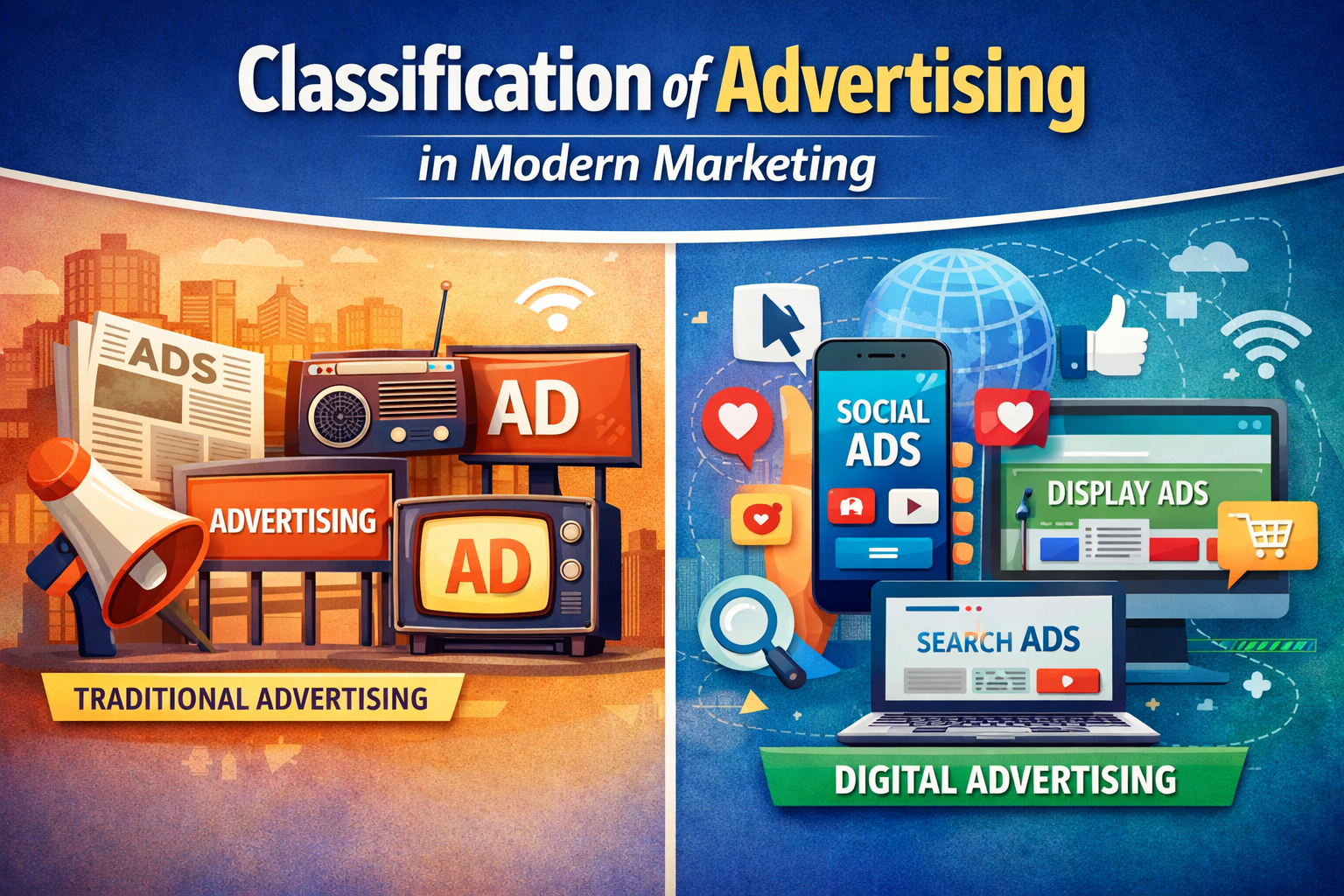
There are two broad categories of advertising:
- Traditional Advertising
- Digital Advertising
Each category and each subtype has its peculiarities, strengths, and weaknesses.
Traditional Advertising
Traditional advertising means the more traditional media that was in use prior to the emergence of the internet. Irrespective of the burgeoning development of the online mediums, conventional advertising remains essential in most fields. Under this, we have:
Print Advertising
Print media consists of newspapers, magazines, brochures, flyers and billboards. It is also among the oldest types of advertisements and remains applicable especially to local and niche audiences.
How It Works
Advertisers seek to buy space in printed media to post promotional information. It is effective with regard to circulation, demographics of the readership, and placement.
Where It is Most Effective:
- Local enterprises that serve a particular community.
- High-end brands that seek high-end magazine consumers.
- Campaigns that need much visual narration.
Advantages
- High credibility and trust
- Tangible and long-lasting
- Strong local reach
Limitations
- Limited audience targeting
- Measuring performance is difficult.
- Falling readership in parts of the world.
Broadcast Advertising
Broadcast advertising involves television/radio advertisements. It enables the use of a large audience in a limited amount of time by the businesses.
How It Works
Ads are aired in particular programs or in particular time slots, usually on the basis of audience demographics.
Where It is Most Effective:
- Mass-market products
- Brand awareness campaigns
- Regional or national advertising.
Advantages
- Wide reach
- Powerful emotional appeal by use of audio-visuals.
- High engagement levels
Limitations
- High costs of production and placement.
- Weak targeting in comparison with digital platforms.
- Short lifespan of ads
Outdoor Advertising
Outdoor advertising Outdoor advertising (also referred to as out-of-home (OOH) advertising) consists of billboards, transit advertising and signage.
How It Works
The advertisements are put in heavily congested areas to make the most out of visibility and repetition.
Where It is Most Effective:
- Planetary locations that are dense-populated.
- Brand awareness campaigns
- Location-based promotions
Advantages
- High visibility
- Continuous exposure
- Supports other advertising activities.
Limitations
- Limited message space
- Minimal audience targeting
- Hardly quantifiable effectiveness.
Digital Advertising
Online advertisement has revolutionized the nature of interactions between companies and customers. It provides sophisticated targeting, analytics in real-time and is cost-effective.
Social Media Advertising
Facebook, Instagram, LinkedIn, and Tik Tok are some of the best social media platforms available to businesses to reach their audiences that are highly specific.
How It Works
The advertisers develop campaigns depending on the user demographics, interest, activities, and location.
Where It is Most Effective:
- Brand interaction and society building.
- Introductions and advertising of products.
- Appealing to more tech-savvy younger audiences.
Advantages
- Precise audience targeting
- Interactive and interactive formats.
- Live tracking of performance.
Limitations
- Ad fatigue among users
- Changes in the algorithm that impact reach.
- Needs regular content development.
Search Engine Advertising
Pay-per- click (PPC) search engine advertising is commonly known as search engine advertising and consists of advertisements placed on search engines such as Google and Bing.
How It Works
The advertisers compete on key words and advertisement is displayed when one searches with a related word.
Where It is Most Effective:
- Product or service seekers who are high-intent.
- Lead generation campaigns
- E-commerce businesses
Advantages
- Immediate visibility
- Highly measurable results
- Good conversion potential.
Limitations
- Price battles on the keywords.
- Needs to be continually optimized.
- Limited visual creativity
Display Advertising
Display advertising will consist of banner advertisements, pop-ups, and video ads that are placed on Web sites and applications.
How It Works
Advertisements are placed on websites in ad networks as well as targeted according to the users behavioral or interests.
Where It is Most Effective:
- Retargeting campaigns
- Brand awareness
- Visual storytelling
Advantages
- Visually appealing formats
- Extensive coverage in various channels.
- Favors remarketing plans.
Limitations
- Banner blindness
- Lower click-through rates
- Potential intrusiveness
Native Advertising
Native advertising fits perfectly with the content of the platform where the content is found.
How It Works
Adverts are crafted to suit the format and style of the content around them, thus less irritating.
Where It is Most Effective:
- Content-driven platforms
- Informational campaigns
- Establishing credibility as an audience.
Advantages
- Higher engagement rates
- Unobtrusive user experience.
- Builds credibility
Limitations
- Demands quality content.
- May seem duperious unless labeled as such.
How Businesses Choose Advertising Channels
The choice of the appropriate advertising medium is a strategic move, which requires a number of factors:
Target Audience
The knowledge of the demographics, preferences, and behavior will determine the most useful platforms. For example:
- Youth audience – Social media.
- Professionals – industry publications or LinkedIn.
- Local consumers -Print or outdoor advertisement.
Budget Considerations
The various types of advertisement have varying cost. Reach and return on investment (ROI) need to be balanced by businesses.
- Constrained budget- Social media or search advertisements.
- Big budget – T.V or integrated campaigns.
Campaign Objectives
Depending on the purpose of campaign will be selected type of advertising:
- Brand recognition – Radio and bill board advertisements.
- Lead generation – Search engine advertisement.
- Interaction – Social media campaigns.
Analytics and Measurability
Digital advertising has more detailed analytics and it is easier to monitor and optimize the campaigns. Conventional advertising, which is powerful, can mostly be based on indirect measures.
Integrating Traditional and Digital Advertising
The contemporary marketing trends are characterized by an increasing combination of conventional and electronic approaches in order to be maximized.
For example:
- A TV commercial can attract visitors to a site.
- A QR code can be added to a billboard, with it directing to a campaign, which is digital.
- Print advertisement can be complemented by social media campaign.
The combination of these techniques will help keep the messaging consistent throughout the various touchpoints, which enhances the performance of the entire campaign.
Conclusion
Advertising classification offers an orderly approach to the comprehension of the variety of channels that can be used in the current marketing environment. Although conventional advertising provides a sense of credibility and a wider coverage, the digital advertising brings precision, flexibility, and quantifiable outcomes.
In the case of businesses, it is not about choosing between one or the other but matching advertising strategies and the predetermined goals, the requirements of the audience, and the available resources. Using the advantages of both types, organizations will be able to come up with successful campaigns that will capture the attention of their target markets and yield quality outcomes.
