Introduction
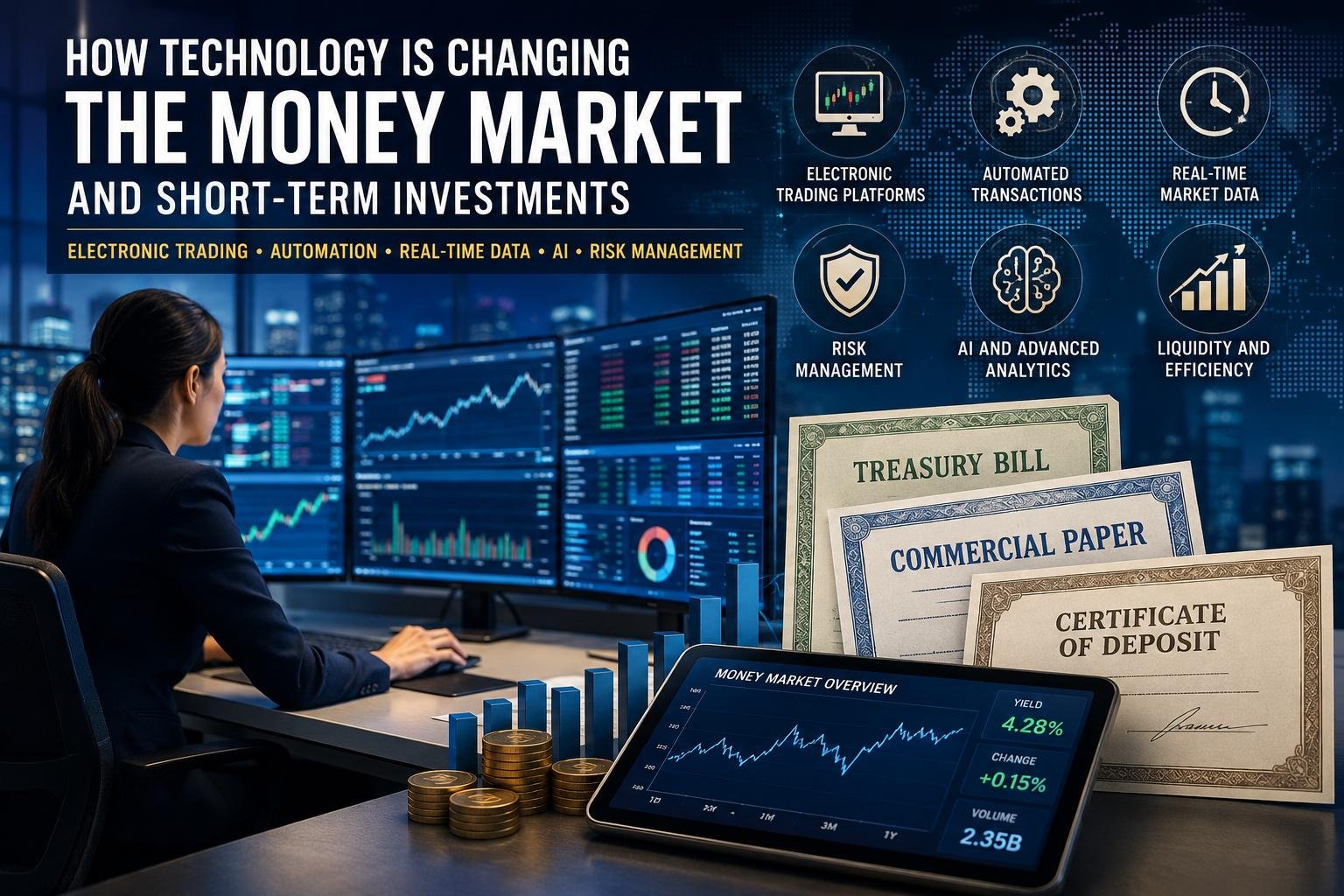
The money market has traditionally been thought of as short term borrowing, lending and investment in financial instruments that typically have periods to maturity less than one year. Treasury bills, commercial paper, certificates of deposit, repurchase agreements and other short-term money market instruments are used by governments, banks, corporations and institutional investors to deal with their liquidity and short-term financing needs. Money market’s fundamental function has not changed significantly, but technology has revolutionized the way money market transactions are managed. The time at which a digital system can reach participants, share information on the markets, process transactions, track risk, and aid investment decisions is difficult to match with traditional processes. Technology has become an integral component of the money-market infrastructure that facilitates the smooth, constant and transparent running of money-markets as financial markets become more closely integrated.
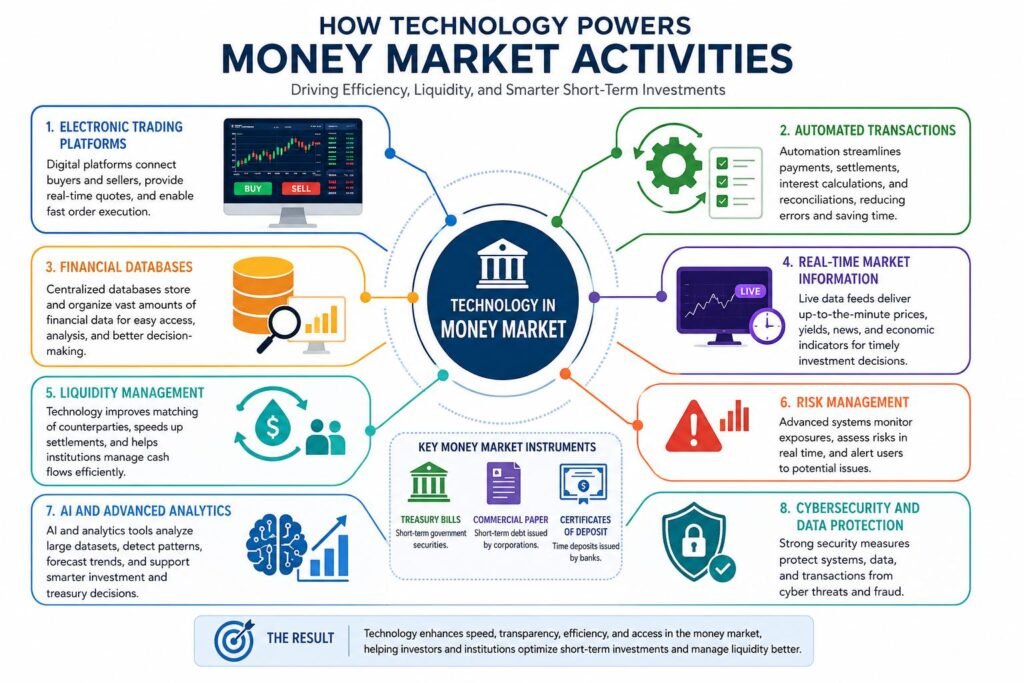
Some of the more conspicuous changes have been the growth of electronic trading platforms that enable traders to gain access to financial instruments, view prices, place orders and make transactions online, rather than using only a telephone or manual procedures. These platforms offer ease of participation, and quicker response to market dynamics for participating buyers and sellers. It also shows how electronic trading platforms are integral to contemporary financial transactions. Analogous technology is used in the money market to facilitate institutions that require funds to be deposited, that want to obtain short-term financing or that want to run their portfolios efficiently. The move towards electronic execution has cut down on delays, facilitated better communication amongst counterparties, and assisted to build a more interconnected marketplace that enables information and transactions to flow swiftly.
The Rise of Electronic Money-Market Trading
The nature of the relationship between market participants, such as investors, financial institutions, dealers and intermediaries has been transformed by electronic trading. Participants can now rely on direct communication alone to find opportunities in the market and make transactions based on their requirements, rather than having to depend on direct communication only. It is very helpful in short term markets, where the price and interest rates can fluctuate rapidly in response to changes in the conditions of liquidity, central-bank policies, economic announcements, and institutional funding needs. The electronic systems can handle huge amounts of information and transactions, without the need for each one to be performed manually. They also generate digital records which can help with reconciliation, reporting and compliance. Consequently, technology has enabled money-market users to react more swiftly to the financial circumstances, while lowering the administrative workload which is typical of short term money-market transactions.
The introduction of technology has also facilitated the availability of the short-term investment instruments. Depending on the market and the investor’s eligibility, it is possible to research, buy, monitor and manage treasury bills in a digital banking and investment system. Corporations can also issue commercial paper and financial institutions can issue certificates of deposit that can be used in electronic investment and treasury-management processes. This isn’t to say that all investors will be able to trade all of these instruments on the same platform; eligibility, minimum investment requirements, market structure and regulation all differ. Digital infrastructure has now enabled the easy access to information on these instruments, and has streamlined some steps in the investment process. Technology and data can be more effective in making short-term portfolio decisions as investors can compare yield, maturity dates, issuers, and other factors more effectively.
Automated Transaction Systems
Automation is yet another key player influencing money-market activities. Financial institutions receive thousands or millions of transactions that involve payments, settlements, transfers, interest calculation, and reconcile transactions, and move money from one account to another. Manually dealing with all these activities would take a lot of time, and would leave room for data-entry errors or delays in processing. Automated transaction systems can run repetitive financial transactions based on set rules that can pass through various transaction stages with little human interaction. For instance, an automatic system might be given an instruction, check if the information is relevant, record the relevant information, start settlement procedures and create confirmation data. In short-term markets, that has a definite advantage of automation as the transactions are relatively short-dated and have to be settled in a timely manner. Anything that makes the process quicker can alleviate some of the friction and stresses found in an operation, giving the financial institution the time to focus more on judgmental matters rather than repetitive administrative ones.
Automation also plays a significant role in the effective treasury and cash management. If a company has large balances of cash, it may have to decide what it should do with the cash that is in excess of operating requirements: should it be kept in an operating account or invested in appropriate short-term assets. Digital treasury systems can track your account balances and can set the rules for transferring money if specific conditions are triggered. Banks may also automate process of maturity management, interest calculation, payment guidelines, and investment records. These features enable businesses to keep their liquidity level just right and lessen the risk of missing out on short-term opportunities due to manual delays. But automation doesn’t mean no supervision. Essential controls, authorization systems, cybersecurity and monitoring protocols must be in place for financial institutions to guarantee that automated processes function correctly and pose no unintended financial or compliance risk.
Financial Databases and Data Management
Financial data is crucial in modern money markets, and databases are an integral component of the technological framework of these markets. Interstate, historical price, issuers, credit characteristics, maturity dates, economic indicators, transactions and market activity information are needed for investors and financial institutions. Financial databases help to structure a vast amount of financial information, which makes it easier for users to access and analyze the data that they need. Analysts can access digital databases to analyze historical trends, compare instruments, and aid in investment decisions, rather than reviewing isolated documents or keeping track of manually maintained records. Data systems can also help companies have a single source of data for various departments, which enhances consistency in trading, accounting, risk management, compliance and treasury departments. As the money market operations become more complex, it has become critical to have reliable data management for day-to-day decision making and for long-term financial analysis.
Financial databases provide much more than just storing data. The advanced systems can integrate information from various sources and enable the uncovering of relations that may not be noticeable otherwise. A treasury department, for instance, could look at past short-term interest-rate changes and the organization’s cash needs to get a better handle on its liquidity. Information on counterparties, maturities and exposures may be used by risk teams to determine if there are concentrations which need to be addressed. Data systems can also aid in financial institutions’ regulatory reporting and internal controls. There is therefore potential to enhance the quality of the data to increase the trustworthiness of financial decisions.
Real-Time Market Information
Real-time market information has made a huge impact on how participants track their short-term investments. The money-market conditions may be sensitive to the interest-rate moves, scarcity of liquidity, economic news, and Government requirements for financing, and shifts in investors’ mood. This can, therefore, impact on an investment or treasury decision, if information is delayed. Information delivery systems can provide real-time market prices, market yield, interest-rate changes, economic information, and other indicators to the professional user through digital information systems. This enables institutions and investors to assess market conditions before making buying, selling, holding, borrowing, and/or repositioning short-term asset decisions. For those organizations with a significant cash position, this is particularly useful as even modest changes in yields or funding costs can affect the return or cost of short-term financial transactions.
Real-time information also helps to achieve transparency as market participants are able to make decisions based on more up to date information. This increased transparency provides investors with a better grasp on market conditions and facilitates the understanding of price and yield movements, besides relying on periodic reports. But transparency does not equate to the same information and the same access to financial markets for all participants. Professional institutions might be able to access more advanced data feeds, analytical systems and specialized research, which may be unavailable to individual investors. Information delays can, however, be minimized and the availability of market information improved through the use of technology. The increased speed and availability of information enable participants to recognize changes in liquidity, understand investment options and respond quickly to changes in market conditions when required.
Technology and Liquidity
Liquidity is one of the most significant factors affecting the quality of a money market since it must be available to everyone to have access to money or funds and the ability to have funds changed into cash with little trouble. Technology helps to drive liquidity by bringing buyers and sellers together more efficiently, and shortens the time it takes to find a potential counterparty. Electronic platforms can connect market participants and offer a means to express or match trading interest. Automated settlement systems can also minimize delays in the settlement process between execution and completion. With smooth transactions, financial institutions will be more effective in handling temporary shortages or surpluses of cash. This is especially relevant for banks and corporations that often have payment schedules that differ, for instance, on the number of days between the receipt and the dispatch of payments. For liquidity to be supported by technology, the infrastructure responsible for its provision needs to be reinforced by technology, and the key to doing this is by enhancing the speed, coordination and reliability of financial transactions.
Making Processes more Transparent and Manage Risks.
Risk management is now more technology-dependent. Although money-market investments are often thought of as being short term and simple, there are still interest rate, credit, liquidity, operational, settlement and counterparty risks involved. The digital risk management system can track exposure on a real-time basis and notify the institutions when they hit or cross the set thresholds. Automated models can evaluate the effect of interest rate fluctuations, default by issuers or liquidity shifts on a portfolio. Institutions can also keep records of who was responsible for the transactions, when they took place and how the position was altered, through the use of technology. These records can be beneficial for internal controls, audits, and regulatory requirements. Technology makes it easier for financial professionals to get access to the risk information, which means that potential issues can be spotted sooner rather than later.
Money-market risk management is now as critical a part of cybersecurity. Cyberattacks, unauthorized access, fraud and disruption to systems that traditionally have been used in financial transactions can affect the systems that manage the trading, payments, data storage and settlement of financial transactions in an electronic environment. In this regard, financial institutions must have robust authentication, encryption, access control, monitoring, backup and incident response mechanisms. New risks can be created by technology, and tools for controlling these risks can be provided by technology. For instance, AI and automated surveillance can detect suspicious transaction patterns which could signal fraudulent activity. However, cyber security is a constant investment, as threats are constantly keeping up with technology. The provision of adequate security and operational controls to the infrastructure is as important as a sophisticated financial system.
Treasury Bills, The Commercial Paper, and Certificates of Deposit
The use of technology has enabled the management of traditional money-market instruments to become more efficient, while preserving their purpose. Treasury bills continue to be considered short-term government securities, that is, securities that are held by the investor as a relatively short-term investment and utilized by the government as short-term financing. Commercial paper is a mechanism for corporations to borrow short-term funds if qualified and certificates of deposit are a mechanism for banks and other qualified financial institutions to borrow funds for a definite term at specified terms. These instruments can be issued, distributed, traded, settled, monitored and reported with the assistance of digital systems. Financial sites and databases can be used by investors to find out details regarding maturity dates, interest rates, issuers, and market conditions. A portfolio-management program can then monitor the holdings and notify the user of future maturities, helping organizations to better plan for the reinvestment or liquidity needs.
AI and Advanced Analytics
Money-market operations are going to be more and more influenced by artificial intelligence and advanced analytics. Financial institutions already have powerful analytical systems that can handle the massive amounts of data, uncover patterns, track transactions and assist in forecasting. The future cash needs, unusual transaction patterns, market conditions, and prioritizing relevant information are areas where AI-driven tools can help treasury departments estimate future cash needs, identify unusual transaction behavior, assess market conditions and prioritize relevant information. Advanced Analytics can simplify the process for the investor to compare a huge number of short-term instruments based on maturity, yield, issuer characteristics and liquidity. The use of AI in financial decision-making should however be used to complement rather than supplant the financial judgment of people. Incomplete data, inappropriate assumptions, and significantly different market conditions can lead to inaccurate conclusions by models. However, human involvement is still crucial in cases of capital intensive financial decisions, regulatory requirements, or unusual market conditions.
Difficulties related to a Technology-Driven Money Market
Although technology has its benefits, in many cases it does not automatically improve the safety and efficiency of money markets. A reliance on digital infrastructure leads to risks in case of system failures, loss of network availability and software bugs. Cyber risks can cause operational disruptions in financial systems and leakage of sensitive information. Issues also involve data quality, errors in the algorithms, system compatibility, and the centralization of critical financial services with few technology providers. The other side of the coin is that faster speeds might tempt participants to jump in and out of trades too hastily in response to price changes rather than considering the information. To make sure technology advances with proper governance, security, resilience, and risk management is therefore a necessary condition for regulators and financial institutions.
The Future of Short Term Investing
What lies ahead for money-market activity will be even more interdependent between electronic trading, automated transaction processing, cloud financial infrastructure, real-time data, AI and sophisticated risk-management systems. As these technologies evolve, the lines between trading, treasury management, investment analysis, accounting and risk monitoring may begin to blur as they are increasingly able to be managed on interconnected platforms. Investors and financial institutions may be able to easily obtain information and more advanced instruments to manage the liquidity and short-term portfolios. Meanwhile, regulators will also have to grapple with the issue of how to keep innovation from threatening financial stability, market integrity and consumer protection. Ultimately, however, it will require not just the technological ability, but also the responsible implementation, the effective oversight, cyber security and quality financial data.
Conclusion
The way modern money markets are organized has fundamentally been transformed by technology. The benefits of electronic trading platforms have gained speed in transactions and connectivity between the participants, while automated platforms have reduced the manual processes and enhanced operational efficiency. Financial databases give organized information for analysis and real-time market feeds enable investors to adapt more rapidly to changing circumstances. These technologies can help provide enhanced liquidity, transparency, risk management and access to short-dated instruments like Treasury bills, commercial paper, and certificates of deposit. However, technological advancements also bring with them cyber security issues, cyber failures, data quality issues, and over-dependence on algorithmic decision making. It is therefore important to be familiar with the pros and cons of financial technology to comprehend the current money market. With the ongoing development of digital infrastructure, technology will play a key role in accessing, trading, monitoring and managing short-term investments.
Get more well researched information about Electronic trading platforms here.