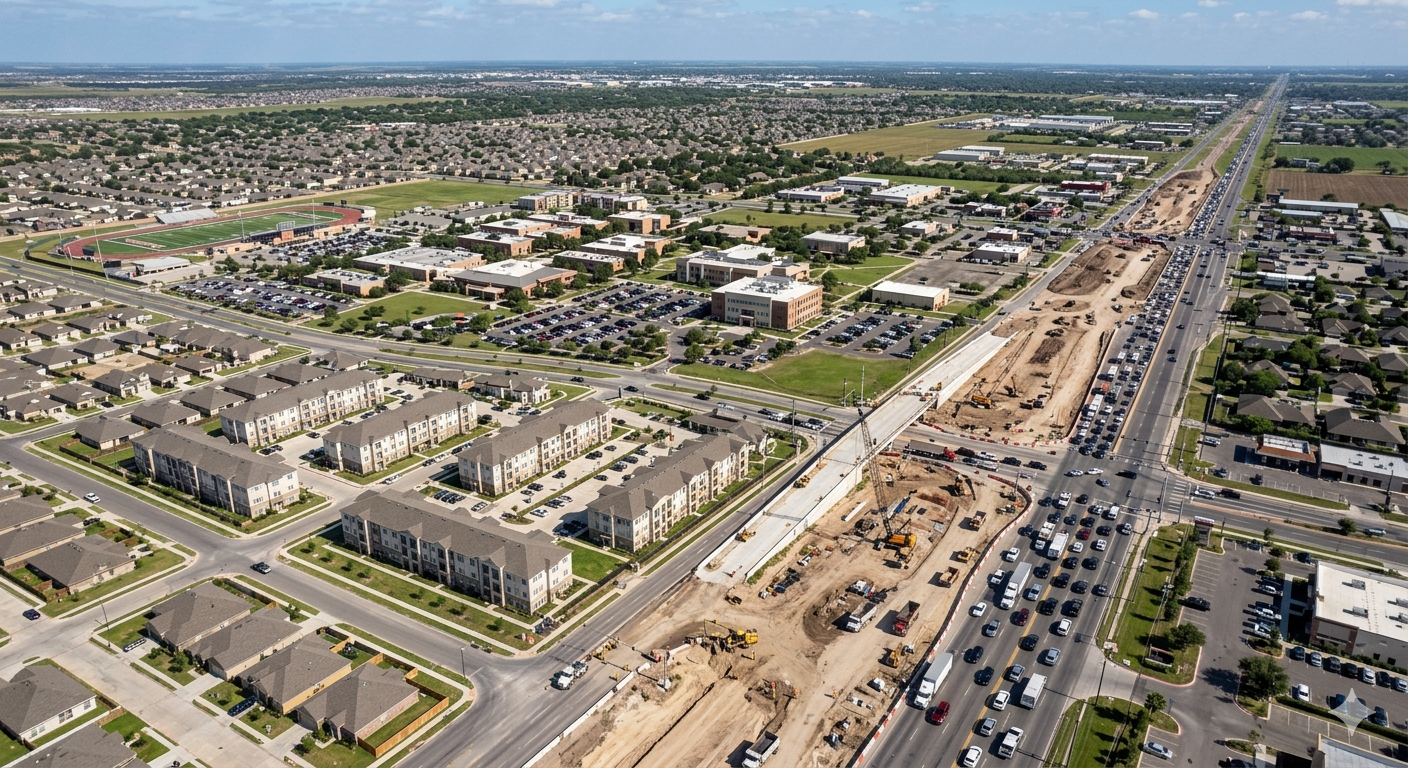
[Featured Image: Aerial view of Edinburg TX showing new residential developments alongside construction on University Drive near UTRGV campus with visible traffic congestion]
Edinburg is the fastest-growing city in the Rio Grande Valley. Between 2020 and 2025, the city’s population increased by over 15%, fueled by the expansion of the University of Texas Rio Grande Valley, new medical facilities, and an influx of commercial development along the US-281 corridor. But that growth has come with a cost that doesn’t show up in economic development reports: a road network struggling to keep pace with the vehicles using it.
Hidalgo County recorded 12,847 total traffic crashes in 2024 according to TxDOT, making it the highest-crash county in the Rio Grande Valley and among the top ten statewide. Edinburg, as the county seat and one of its largest cities, bears a disproportionate share of that burden. For residents navigating these roads daily, understanding both the risks and the legal protections available under Texas law is increasingly important.
Where and Why Edinburg Crashes Happen
Unlike larger Texas metros where highway crashes dominate the statistics, Edinburg’s crash profile is heavily weighted toward arterial road collisions. The city’s growth has turned formerly rural two-lane roads into high-traffic corridors without corresponding infrastructure upgrades.
University Drive (Business 281): This stretch runs directly through UTRGV’s campus and carries a volatile mix of student pedestrians, rideshare vehicles, city buses, and commuter traffic. The combination of frequent pedestrian crossings, closely spaced traffic signals, and high turning volumes creates a crash environment that conventional traffic engineering metrics consistently underestimate. TxDOT data shows University Drive between Sugar Road and Jackson Road averaged 14 reported collisions per month in 2024.
Trenton Road: Edinburg’s eastern growth corridor, Trenton Road connects new residential subdivisions to commercial centers along US-281. The road was widened in sections but not continuously, creating bottleneck points where four lanes suddenly narrow to two. These transition zones are responsible for a disproportionate number of sideswipe and rear-end collisions.
US-281 and Expressway 83 interchange: The busiest interchange in Hidalgo County, this junction processes an estimated 85,000 vehicles daily. Merge conflicts, particularly during the evening rush when northbound 281 traffic meets westbound 83 traffic, generate daily fender-benders and periodic serious collisions.
Monte Cristo Road: Agricultural vehicles from surrounding farmland share this road with commuters heading to Edinburg’s growing northern residential areas. Speed differential crashes between slow-moving farm equipment and passenger vehicles traveling at posted speeds are a recurring problem.
[Image: Heat map of Edinburg showing crash concentration zones along University Drive, Trenton Road, and the US-281/Expressway 83 interchange based on TxDOT 2024 data]
The UTRGV Factor: Student Drivers, Pedestrians, and Rideshare Traffic
UTRGV’s Edinburg campus enrolls over 20,000 students, many of whom commute from McAllen, Pharr, Mission, and other RGV cities. This creates two distinct traffic patterns that contribute to crash risk:
First, the morning and afternoon commuter surges compress heavy traffic volumes into narrow time windows on roads not designed for university-level throughput. Second, the concentration of rideshare pickups and dropoffs around campus creates unpredictable stopping patterns, particularly on University Drive and Schunior Street where Uber and Lyft drivers frequently stop in travel lanes.
Pedestrian accidents near campus are a particular concern. Texas Transportation Code Section 552.003 gives pedestrians the right of way in crosswalks, but the practical reality is that drivers on University Drive frequently fail to yield, especially during peak class-change periods. For students and faculty injured in these incidents, the legal claim process is complicated by questions about crosswalk design adequacy, signal timing, and whether the city met its duty to provide safe pedestrian infrastructure.
If you’ve been injured in a car accident or pedestrian collision in the Edinburg area, consulting with a car accident lawyer Edinburg who understands Hidalgo County’s specific road conditions and traffic patterns can help you build a stronger case than relying on a general-practice attorney or attempting to negotiate directly with the insurance company.
Types of Injuries Common in Edinburg Collisions
The injury profile in Edinburg crashes reflects the types of collisions most common in the area. Rear-end and intersection collisions at moderate speeds (25-45 mph) produce a characteristic set of injuries that may not be immediately apparent but can have lasting impact:
Whiplash and cervical spine injuries: The most frequently reported injury in rear-end collisions. Symptoms may not appear for 24-72 hours after the accident. MRI imaging is often necessary to identify soft tissue damage that X-rays miss. Untreated whiplash can develop into chronic pain conditions.
Herniated discs: Particularly common in T-bone collisions at intersections. The lateral force of impact can cause disc herniation in the lumbar or cervical spine. Surgical intervention (discectomy or fusion) may be required, with recovery timelines of 6-12 months.
Traumatic brain injury (TBI): Even in collisions where the head doesn’t contact a hard surface, the rapid deceleration can cause the brain to impact the inside of the skull, resulting in concussion or diffuse axonal injury. Mild TBI is frequently underdiagnosed in emergency room settings where the focus is on visible injuries.
Knee and leg injuries: Dashboard impact in frontal collisions can cause patellar fractures, ACL tears, and tibial plateau fractures. These injuries often require surgical repair and extended physical therapy.
Psychological injuries: Post-traumatic stress disorder, driving anxiety, and depression are recognized as compensable injuries under Texas law. Documented treatment with a licensed mental health professional strengthens these claims.
Navigating the Insurance Process in Hidalgo County
Texas is a fault-based insurance state, meaning the person who caused the accident is responsible for covering the damages. However, the practical process of recovering those damages involves navigating several layers:
Step 1 — Filing the claim: You can file against the at-fault driver’s liability policy, your own collision coverage (if you carry it), or your uninsured/underinsured motorist coverage. Each option has different timelines and requirements.
Step 2 — The adjuster’s investigation: The insurance company will assign an adjuster who will review the police report, inspect vehicle damage, and request medical records. Be aware that the adjuster works for the insurance company, not for you. Their job is to minimize the payout.
Step 3 — The initial offer: Most initial settlement offers are significantly below the actual value of the claim. Insurance companies count on victims accepting early offers out of financial pressure. In Edinburg, where median household income is approximately $42,000, even a few weeks of missed work can create urgent financial need that makes a lowball offer tempting.
Step 4 — Negotiation or litigation: If the initial offer doesn’t cover your documented damages, the next step is either negotiation through a demand letter process or filing a lawsuit in Hidalgo County District Court. Approximately 95% of personal injury cases settle before trial, but the willingness to litigate often produces better settlement outcomes.
Edinburg residents dealing with injury claims should also be aware that Hidalgo County has specific local court rules that affect filing deadlines and procedural requirements. The 332nd, 370th, 398th, and 430th District Courts each have different scheduling preferences and case management approaches. A personal injury lawyer Edinburg with regular practice in these courts will understand the procedural landscape and be able to advise on realistic timelines for resolution.
[Image: Simple flowchart showing the Texas personal injury claim process from accident → medical treatment → claim filing → adjuster investigation → negotiation → settlement or trial]
Special Considerations for Edinburg Accident Cases
Several factors make Edinburg accident cases distinct from those in other Texas cities:
Construction zone accidents: Edinburg’s growth means constant road construction. The widening of Trenton Road, the US-281 improvements, and the new commercial developments along Canton Road create construction zones with altered traffic patterns, reduced lanes, and temporary signage. Texas Transportation Code Section 472.022 doubles fine amounts in active construction zones, and construction zone accidents often involve questions about whether the contractor provided adequate signage and traffic control.
Agricultural vehicle conflicts: The transition zones between Edinburg’s urban core and the surrounding agricultural land create situations where farm equipment operating at 15-20 mph shares roads with vehicles traveling at 55 mph. Texas Transportation Code Section 545.363 requires slow-moving vehicles to display a reflective orange triangle, but compliance is inconsistent, particularly during pre-dawn harvesting operations.
Uninsured driver rates: Texas has one of the highest uninsured driver rates in the country at approximately 14.1%. In the RGV, the rate is estimated to be higher. If you’re hit by an uninsured driver, your recovery options are limited to your own uninsured motorist coverage (if you carry it) or a personal lawsuit against the at-fault driver’s personal assets.
Medical provider access: While Edinburg has grown, the ratio of medical specialists to population remains lower than the state average. This can create treatment delays for injuries requiring orthopedic surgery, neurology, or specialized rehabilitation. Documenting these delays and their impact on recovery is important for the damages calculation.
Protecting Your Claim: Practical Steps
Based on the specific conditions in Edinburg and Hidalgo County, here are actionable steps that can strengthen your claim:
- Request a crash report within 10 days. Texas Transportation Code Section 550.065 requires crash reports to be available within 10 business days. Obtain yours from the Edinburg Police Department or the DPS online portal. Review it for accuracy, particularly the officer’s determination of contributing factors.
- Photograph the roadway, not just the vehicles. In Edinburg, road conditions are frequently a contributing factor. Document construction signage, lane markings (or lack thereof), traffic signal positions, sight line obstructions, and road surface conditions.
- Establish a medical treatment trail immediately. Visit the emergency room or urgent care within 24 hours even if symptoms seem manageable. Edinburg Regional Medical Center and Cornerstone Regional Hospital are the two primary facilities. Follow up with your primary care physician within one week and follow all referral recommendations.
- Keep a daily pain and impact journal. Documenting how the injury affects your daily activities, sleep, work capacity, and mental state provides evidence for non-economic damages that medical records alone cannot capture.
- Do not post about the accident on social media. Insurance adjusters routinely monitor claimants’ social media accounts for posts that could be used to undermine injury claims.
Looking Ahead: Edinburg’s Road Safety Challenge
Edinburg’s growth trajectory shows no signs of slowing. UTRGV continues to expand, new residential developments are pushing the city’s footprint northward, and commercial investment along US-281 is accelerating. All of this means more vehicles on roads that are still playing catch-up.
The city’s 2025-2030 transportation plan includes several infrastructure improvements, including the widening of Trenton Road, new traffic signals at key intersections, and improved pedestrian crossings near UTRGV. Whether these improvements keep pace with growth will determine whether Edinburg’s crash rates stabilize or continue climbing.
In the meantime, drivers and pedestrians in the Edinburg area should remain vigilant, particularly in construction zones and near campus. And anyone involved in a collision should understand that Texas law provides meaningful protections for accident victims, but those protections require timely action, proper documentation, and an understanding of the claims process to be effective.