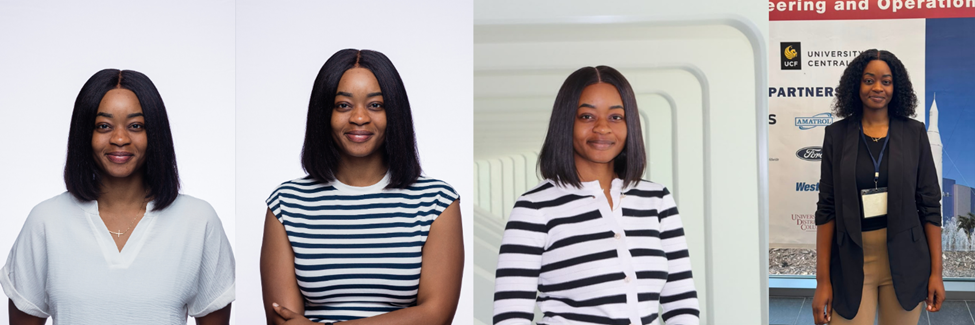
When Dutable.com connected with Champie Joyce Maptue Tagne, she greeted us with the warm, steady confidence of someone who knows exactly why she chose her field. Cybersecurity isn’t just her career it’s her calling. And as she shared her story, it became clear that her journey across three countries shaped not only her expertise but her perspective on the digital world.
We started with her early years.
Dutable: You’ve lived in Cameroon, Ghana, and now the U.S. How did that shape your interest in technology?
Champie: Cameroon gave me my foundation, but Ghana shaped my academic identity. I moved there for my undergraduate studies, and it became my second country. During my Software Engineering degree at Coventry University, I started seeing how vulnerable digital systems really were. That’s when cybersecurity became personal.
She recalls the moment she realized how fragile modern systems could be. “I was learning about secure software development, and it struck me how exposed mobile applications were. People rely on them every day, but they don’t see the risks underneath.”
That curiosity didn’t fade. It grew stronger, eventually leading her to Florida Polytechnic University, where she is completing her Master’s degree in Computer Science.
Dutable: Your research covers Android security, malware detection, software quality, and even Large Language Models. How do these areas connect?
Champie: They’re all part of understanding weaknesses early. Cybersecurity is proactive. You have to anticipate problems, not react to them.
One of her standout projects is SMELLDroid, a dataset she helped develop to identify code smells in Android applications. Code smells are subtle patterns that can weaken software or create vulnerabilities.
Dutable: People are talking about SMELLDroid. What makes it important?
Champie: It helps researchers spot subtle patterns that can weaken software or create vulnerabilities. If we can identify those patterns early, we can build safer apps. It’s about strengthening systems from the inside.
Her background in data analytics gives her an edge. She approaches data with curiosity and precision.
“Data always tells you something,” she says. “Cybersecurity is about learning to read that story before the threat becomes real.”
We asked her what drives her long‑term vision.
Dutable: What’s the big picture for you?
Champie: I want to bridge AI, software engineering, and cybersecurity. Mobile apps are part of everyone’s life now. We need systems people can trust — and that starts with understanding how vulnerabilities form.
Her global journey — from Cameroon to Ghana to the United States — has shaped not just her career, but her worldview.
Dutable: What do you think your international experience adds to your work?
Champie: Cybersecurity isn’t local. It affects everyone. Living in different countries helps me see the bigger picture.
As the conversation wrapped up, Champie reflected on the future of cybersecurity. “Technology is evolving fast,” she says. “If we want digital systems people can trust, we need to understand how vulnerabilities form and how to prevent them. That’s the responsibility I carry.”
Her story is one of curiosity, resilience, and a commitment to protecting digital spaces. And if her work is any indication, she’s just getting started.