Introduction
Digital marketing has revolutionized the way businesses reach customers, gain their trust and ultimately make money. New platforms, new technologies come out every day, but the most successful companies know that success is built on a foundation of tried and proven strategies, not all the latest trends. Businesses that invest in quality search visibility, valuable content, meaningful involvement and communication will achieve sustainable growth, regardless of algorithm updates or behavioral shifts.
As a startup or an established business, it is crucial that you know the value of digital marketing methods that have worked, along with their proper implementation. These strategies boost brand awareness, draw in qualified prospects, enhance customer loyalty, and fortify rivals positioning. Businesses that fail to embrace digital marketing may find themselves at odds with today’s consumers who look for information on a product, read reviews and engage with brands digitally before buying.
Among the most crucial digital marketing ideas that every entrepreneur must have is the knowledge that marketing is not all about utilizing any type of platform that is available. Instead, it’s about choosing appropriate channels to reach out, creating the right mix of valuable content and distributing it regularly, and establishing a genuine connection with customers throughout their purchasing process. From search engine optimization to content marketing, social media engagement to online reputation management, this article covers a variety of evergreen digital marketing concepts that will help businesses see tangible results.
Importance of Digital Marketing
Very few customers are now discovering businesses, comparing products, reading reviews, and making purchasing decisions from traditional print media outlets, the digital marketplace has become the go-to place for all of these. From looking for a local service to investigating an international brand, the Internet has become the initial place to get information. The changing habits of consumers mean that companies that are not savvy online could find themselves missing out on business opportunities that are available to more established and visible online businesses. Digital marketing offers organizations cost-effective ways to target highly targeted audiences, measure the performance of their campaigns and make decisions to enhance their marketing strategies based on real-time data. Digital marketing offers a number of benefits over traditional advertising, including the ability to make fast changes, tailor experiences for customers and optimize ROI. Reliable businesses that invested in digital marketing also form more robust customer relationships as they are not just visible when they are promoting their products and services but are present all the time. In an era of growing competition in all sectors, companies that adopt and implement effective digital marketing strategies are set to thrive and adapt to future technological advancements.
1. Search Engine Optimization (SEO): Building Long-Term Visibility
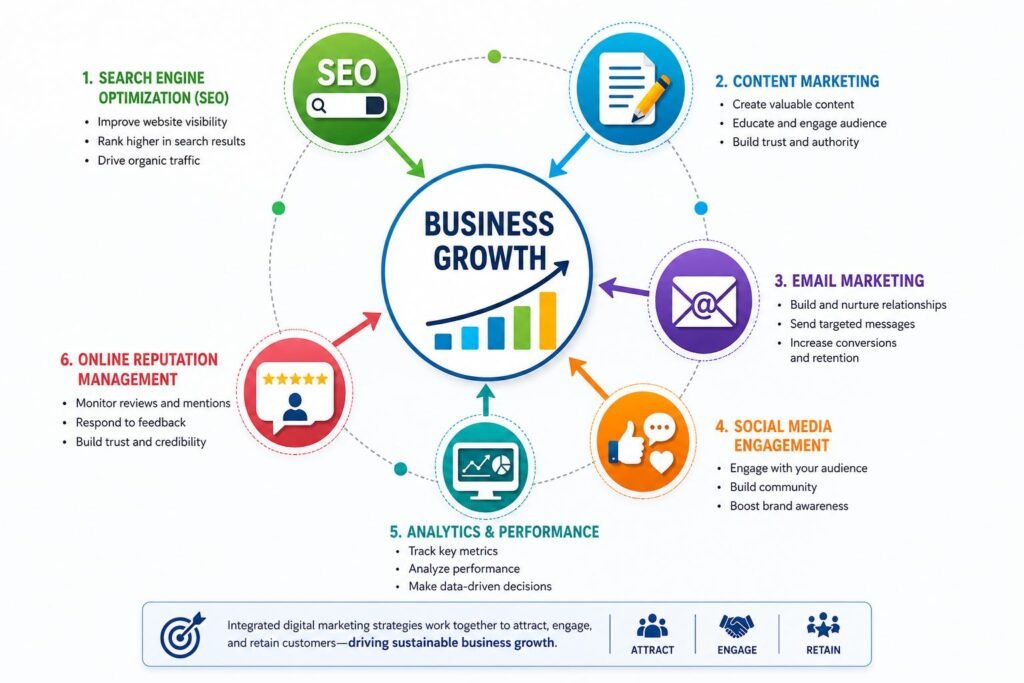
One of the greatest investments for digital marketing is Search Engine Optimization (SEO) and it allows businesses to be found when customers are looking for the products or services they’re interested in. In contrast, SEO efforts are not about paid advertising but involve optimizing the website’s presence in organic search results by creating high-quality content, optimizing technical aspects, and designing its website for user-friendliness. The first step to effective SEO is to know what those customers are looking for and develop content that solves their problems and answers their questions. Businesses should tweak page titles, headings, meta-descriptions, image alt text, website structure and make sure that their pages load fast and work well on all devices. The consistent appearance of the website and its topicality is also reflected by frequent updates, and backlinks with high relevance from good websites also increase the credibility of the search engines. SEO may not be immediate, as results take time, but it will give you the qualified traffic over time, and can be one of the best ROI marketing investments. SEO-building companies build greater online credibility and are seen as trusted sources in their field.
2. Content Creation: Delivering Value before Selling.
The backbone of a successful Digital Marketing campaign is Content Creation, in that it is used to educate, educate, entertain, and inspire your audience before asking them to make a purchase. If a company regularly delivers useful information to customers, they are more likely to be more inclined to believe in them. Great content is used to provide blog posts, video tutorials, podcasts, infographics, guides, webinars, newsletters, and case studies to address actual customer issues and provide industry knowledge. Great content marketing starts with paying attention to the customer’s problem and developing content to solve typical questions at each point of the buying cycle. It’s crucial for businesses to stick to a schedule and have all their posts be relevant to their brand and marketing goals. When you also repurpose your content across different channels, this also boosts efficiency, so that one article can be multiple posts on social media, videos, or email newsletters. Engaging content can help boost search engine optimization, share presence on social media, draw in backlinks, lead nurturing, and leave a lasting impression on the customers when they are ready to make a buying decision, converting them into dedicated clients.
Creating Customer-Centered Content
Creating content to be published regularly isn’t enough; creating content that resonates with your target audience and gives them information that truly helps them make a decision is the key to success. It is important for businesses to understand what questions their customers typically have and to analyze search trends, solicit feedback from their sales staff and listen to what is being said within the industry to find content inspiration. It often works better to include educational material with the content, customers like it if they can learn of a brand without being immediately sold or pressured into a purchase. Storytelling also enhances the effectiveness of content by ensuring it’s more relatable and memorable. The businesses can post customer success stories, behind-the-scenes experiences, expert interviews, and practical tutorials that showcase expertise and create a sense of connection with readers. The consistency of posting valuable content is also crucial, as it helps build trust in your content and keeps your website visitors coming back over time. If companies focus on teaching their customers rather than selling them a product, they will surely begin to develop a loyal customer base and start to become brand advocates.
3. Email Marketing as a way of reinforcing Customer Relationships.
Even with the rise of social media platforms and messaging applications, email marketing remains one of the most effective digital marketing channels as it allows businesses to reach out directly to potential customers. Unlike social media algorithms that restrict access to content, email allows businesses to have more control over what customers see and can help in personalized marketing campaigns. The first step in effective email marketing is to create lists of subscribers who have opted in to receive emails from your business in exchange for valuable and useful information like downloadable resources, exclusive updates or educational newsletters. Audiences should be segmented by customer interests, purchase history, or engagement and content should be highly relevant, boosting open rates and conversions. Auto email sequences are email sequences that automatically activate when someone subscribes. Auto email sequences are email sequences that let you welcome new subscribers, nurture potential customers, promote products and remind them to buy again, without needing to do it manually. Newsletters are also used to foster customer relationships through valuable and insightful information, company news, educational resources, and exclusive offers. When a business is able to deliver relevant, informative email content more often than not, the company will see higher customer retention rates, a higher customer lifetime value, and greater brand loyalty.
4. Social Media Engagement: Focusing on Communities rather than Audiences.
Social media is not only a place for promoting your business or product. Today’s thriving businesses are leveraging social media to create real communities where customers are listened to, valued and feel a connection to the brand. Engagement is about who you can engage in timely interactions, who you can answer questions, who you can join industry discussions, and who you can encourage to engage with you, rather than just who has the most followers. Each social media site has a specific purpose, and it’s essential for businesses to know where their audience is going and what kind of content will work best on each social media site. The type of content that tends to get more engagement includes videos, behind-the-scenes content, customer reviews or comments, live streaming, polls and interactive discussions, which can be more effective than endless sales pitches. It is also important for businesses to ensure they are consistent with their brand across all platforms and tailor their content to each specific platform. Such social media analytics information can be valuable to organizations to fine-tune their strategies over time, based on customer preferences. Businesses that are proactive in their community efforts have more trust, more loyal customers, more referrals and have genuine relationships that help your business flourish for years to come.
Leveraging User-Generated Content
An effective way of boosting credibility on social media is to encourage customers to make and publish content that includes a business’ products or services. The user generated content are reviews, testimonials, photographs and videos offered by happy customers. It is a piece of content that can help in providing real-world social proof, as it is very likely that other consumers will resonate more with each other than any regular advertisement. Businesses can host contests, create a hashtag to attract customers, create a customer appreciation program, or just ask customers to provide feedback after they have made a successful purchase. Customer stories also reinforce community engagement by honoring those who are customers and showing appreciation. However, UGC not only increases brand visibility, but also brings a reduction in content costs, and helps build trust with potential customers. Those companies which regularly honor their customers foster more meaningful relationships and stimulate more interaction from their wider community.
5. Online Reputation Management: Building Trust with Your Brand.
For a business, online reputation is one of the most important factors that can affect the purchase of products or services because today’s buyers generally read reviews of a business before making a decision to buy. Bulk amounts of positive customer reviews online can boost credibility and drive in new customers and if there are complaints that are not resolved, potential customers will be deterred from buying. Online reputation management is the process of keeping track of customer reviews on review sites, social media, forums and search engine results and acting professionally with any positive or negative comments. It is important to businesses to thank happy customers who have been happy about what they have done and deal with complaints immediately by listening, solving the issue and showing that they are keen to improve. When things are done transparently and professionally, this helps build public trust, even in case of wrongdoings. In addition, it is important to promote positive reviews by happy customers, as genuine positive reviews can boost search visibility and customer trust. Reputation Management is not just about reacting to reviews; it’s also about ensuring that information about the business is accurate, publishing trustworthy content, and providing great customer experiences that result in positive word-of-mouth recommendations.
6. Analyze and Enhance Marketing Performance using Analytics
Data-driven decision-making is what makes successful digital marketers stand out from the rest who are based on assumptions. Digital marketing platforms offer a wealth of data on customer behavior, such as their methods of finding businesses, engaging with content, and making purchases. It is important to track website traffic, conversion rates, bounce rates, email open rates and click-through rates, social media engagement and customer acquisition costs to assess the effectiveness of campaigns. By reviewing this data, strategies that have been successful can be identified and strategies that could be improved can be identified. Businesses should aim for metrics that are closely linked to their business goals, such as lead generation, customer retention, revenue growth, and ROI. Continuous testing can also enhance the performance of marketing, as it allows for testing various headlines, images, calls-to-action, landing pages, and email subject lines. The organizations that adopt the philosophy of continuous optimization make good marketing decisions, spend their money and resources more wisely, and quickly adjust to the changes of customer habits without compromising their growth.
Combining the Various Marketing Channels
The power of digital marketing lies in its ability to combine and collaborate multiple channels to create an effective strategy, rather than each channel working individually. SEO brings new traffic looking for information that’s relevant to them, and valuable content provides what they want once they’re already on the site. Email marketing helps to keep the communication going, social media can help build community engagement and reputation management helps to build trust along the customer journey. That analytics then give insights that enhance each step of the marketing process. It is important that businesses use the same branding, messaging and customer experience found in all their online channels and that customers are met equally no matter where they come into contact with the business. Additionally, integrated marketing helps to boost efficiency, as content is often repurposed across marketing platforms without compromising its quality. Those companies that integrate several marketing activities into one composite project are leading to increased brand awareness, better customer experiences and maximizing every marketing dollar.
Preparing your Digital Marketing Strategy for the Future
Technology will keep changing, and new tools, platforms and avenues will emerge that will shape the way businesses can operate. The basics of a successful digital marketing campaign, however, are very similar. Rather than focus on the latest trends, businesses need to prioritize creating value for their customers, communicating effectively, building trust with their clients, and fostering lifelong learning. While the tools of artificial intelligence, marketing automation, voice search and personalization provide useful marketing enhancements, these tools are only effective when underpinned by good marketing fundamentals. Organizations need to continually review marketing strategies, keep track of customer expectations, train employees and be able to be flexible enough to adjust but not give up on successful practices. In a digital landscape, businesses that are innovative, but still customer-centric, stand better chances of winning and sustaining a competitive advantage.
Conclusion
Digital marketing is not a choice but a business necessity, it is a key part of growth and sustainable competitiveness. While technology and consumer habits evolve, the strategies that have served businesses well over the years are still proving effective for business results: search engine marketing, creating compelling content, email marketing, social media engagement, and maintaining a positive online reputation are all effective evergreen strategies that continue to work well for businesses. These tested strategies help to draw in new buyers, cultivate existing customer relationships, foster a sense of trust and credibility in the brand, and boost customer lifetime value by providing sustained engagement and fostering trust in the brand.
Entrepreneurs familiar with these online marketing tips can develop a comprehensive marketing plan that can help in customer acquisition as well as retention and boost their business performance. Instead of trying a quick marketing gimmick, it’s best to concentrate on providing value that becomes consistent, understanding customer wants and needs, and then modifying them as time goes on based on performance data. By embracing these enduring digital marketing fundamentals, businesses can ensure their online presence, build meaningful connections with customers, and thrive in the digital age.
Get more well researched information about Digital Marketing Trends here.