As the Australian summer approaches, venue owners—from holiday parks in Queensland to aquatic centres in Victoria—are actively looking for ways to boost seasonal revenue and maximise peak-season bookings.
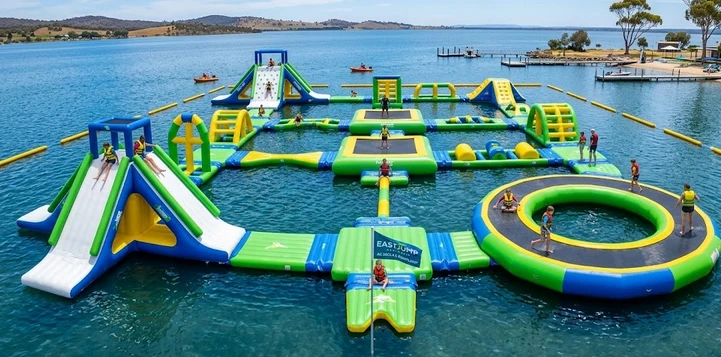
In recent years, the water-based entertainment sector has evolved rapidly. Floating inflatable obstacle courses have become a “must-have” attraction for waterfront venues looking to stand out and increase visitor spending.
However, one common misconception remains: not all inflatables are built the same.
In a market filled with low-cost, light-duty alternatives, how can you tell the difference between a serious business asset and a short-term pool toy?
Understanding the Key Safety Benchmark in Australia
While land-based jumping castles are generally associated with AS 3533.4.1, floating inflatable attractions are typically expected to align with the principles of AS 3533.4.5 (2017), which covers contained inflatable floating devices.
In practice, insurers and local councils often require documentation that reflects this standard before approving commercial operation.
Many Australian insurance providers may also decline coverage if equipment does not align with recognised safety guidelines—making compliance one of the most important considerations for professional operators.
These standards are not just paperwork. They influence real-world design decisions, including:
- Minimum buoyancy requirements
- Stability under load
- Safe connection gaps between modules
- Resistance to tipping and overcrowding
This is where lower-cost, “toy-grade” inflatables often fall short.
Material Matters: Why Thickness and Construction Are Critical
One of the clearest differences between commercial-grade inflatable water parks and entry-level products is the material specification.
Most high-quality commercial systems typically use 0.9mm (1000D) or thicker PVC, designed specifically for long-term outdoor and water use.
This added density plays a crucial role in performance:
UV Resistance
Australia’s intense UV exposure can quickly degrade lower-grade materials. Thicker PVC with protective coatings helps prevent cracking and brittleness over time.
Heat-Welded Seams
Unlike stitched land inflatables, water parks rely on high-frequency heat welding. This creates airtight, sealed seams that perform reliably in both chlorinated pools and saltwater environments.
Chemical Durability
Commercial-grade materials are designed to withstand ongoing exposure to chlorine, salt, and temperature fluctuations without losing structural integrity.
Built to Grow: The Advantage of Modular Design
A typical low-cost inflatable is a single, fixed unit with limited flexibility.
In contrast, professional inflatable water parks are modular systems.
This allows operators to:
- Start with a core setup (e.g. slide + trampoline)
- Expand gradually over time
- Reconfigure layouts each season
- Introduce “new” experiences without replacing the entire park
For venues aiming to build repeat business, this flexibility is a major advantage.
The Hidden Factor: Anchoring and Stability
One of the most critical—but often overlooked—elements of a commercial inflatable water park is the anchoring system.
In fact, improper anchoring is one of the most common causes of inflatable-related incidents worldwide.
Professional systems are designed with:
- Reinforced attachment points
- Marine-grade stainless steel D-rings
- Multi-point anchoring configurations
These are used to secure each module to underwater weights or fixed moorings, ensuring the structure remains stable even under heavy use or changing weather conditions.
Final Thoughts: Focus on Long-Term Value, Not Just Price
When evaluating an inflatable water park, the most important factors are often not immediately visible.
It comes down to a combination of:
- Alignment with Australian safety standards
- Material durability and construction quality
- Structural design and anchoring reliability
For operators in Australia, choosing the right system is not just about upfront cost—it’s about ensuring your equipment remains safe, insurable, and profitable over multiple seasons.
Many successful venues start with a smaller setup and expand over time. Making the right choice at the beginning can have a significant impact on both safety and long-term return on investment.