Introduction
The preclinical training phase is considered an indispensable component of the dental training program, and it plays a fundamental role in molding the future skills of all dental students. This level of learning exposes students to controlled laboratory settings in which they may use the knowledge they have gained about dental sciences without the added stress of working with actual patients. This stage of the process can hardly be overestimated because the skills that it teaches form the basis for competent dental practice, as well as psychomotor comprehension and a clinical approach. These sessions start students on the journey of taking the abstract concepts of cavity design, restorative principles, material science, and others and applying them to real-life hands-on procedures. This is a planned sequence to ensure students, when they finally arrive at a clinical setting, have the necessary thinking and knowledge as well as the skill sets to carry out procedures effectively and competently.
Sessions in the preclinical dentistry laboratory are critical, as they provide ample opportunities to practice numerous times, and provide feedback and repetition. Study in a laboratory setting involves active research and has a problem-solving approach, as opposed to theoretical lectures, which is more passive. It is imperative that students learn how to adjust to the various shapes in the teeth, instrument handling and become Spatial aware to ensure they have the ability to achieve operative success. The experiential learning process is crucial in the development of competent and adaptive future clinicians. Despite the ongoing evolution in dental education, preclinical training is, and will continue to be, the foundational building block that keeps patient safety, clinical efficiency and professional competence on track in today’s dental practice.
Developing skill in preclinical training
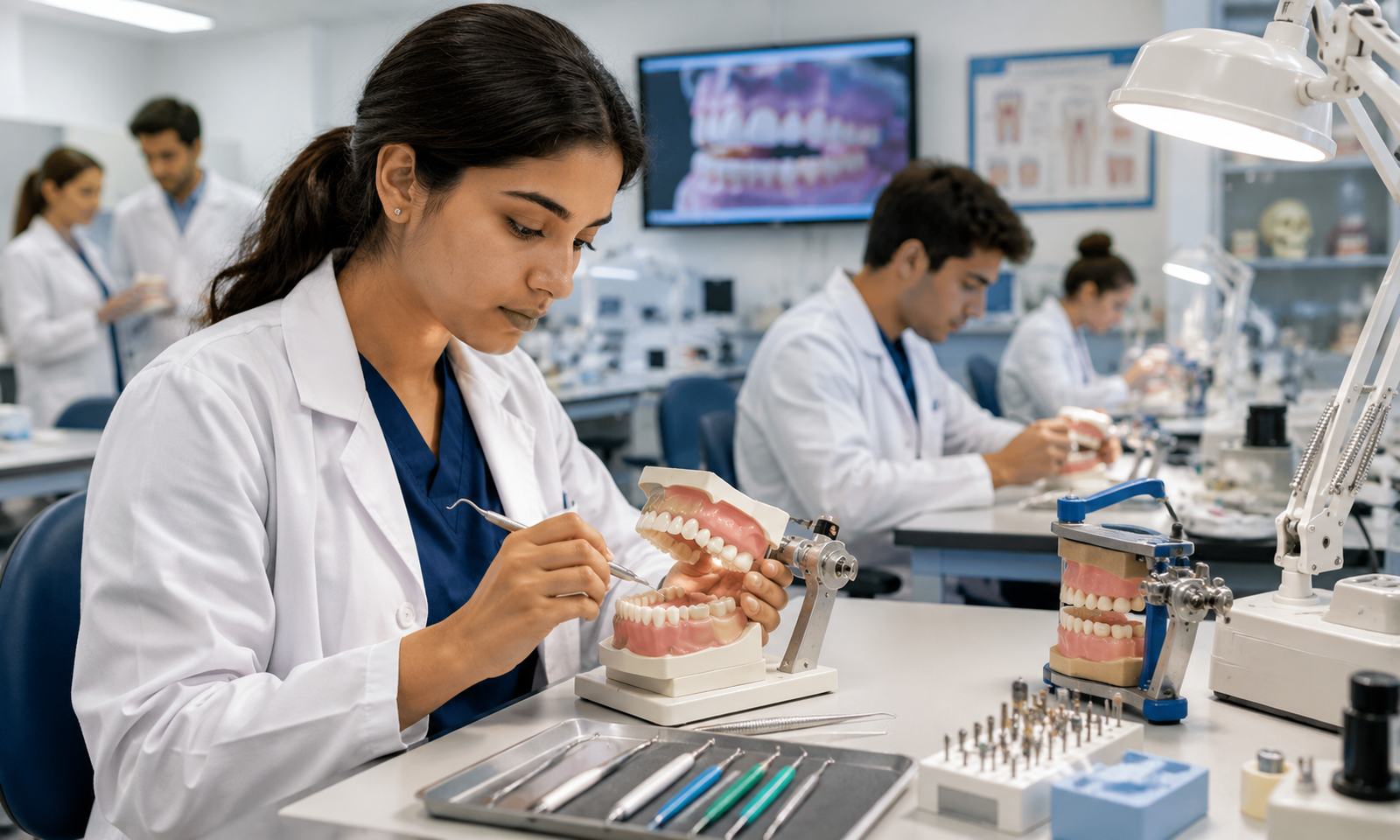
One of the basic goals of the preclinical laboratory session is the development of manual dexterity and psychomotor skills. It is a very technical profession – a few patients will never survive a surgery without an adequate supply of precision, coordination, ample hand control, etc. which can’t be learnt just by theory. The purpose of using the dental simulators, typodonts, and artificial teeth in the dental lab is to simulate real clinical setting, which affords students an opportunity to practice important procedures including cavity preparation, placing of restoration materials, and finishing and polishing techniques, in a pre-clinical setting. Learners acquire muscle memory from repetitive performance, a critical component for execution of procedures efficiently and accurately while conducting real patients.
Preclinical training is also important because of its reinforcement of dental cognitive learning, as well as hand skills. The students must be able to recite some basic theories and put them into practice, which could enhance their understanding of the theories. For example, the concept of cavity classification is more meaningful to the students if they can actually design and prepare cavities based on the cavity classification. The incorporation of theory and practice in this manner not only helps students retain the material but also can enhance students’ appreciation for why the steps are being used. Through this carefully planned pedagogical approach, confidence is developed, anxiety is alleviated and a professional orientation toward responsibilities in the clinical setting is engendered.
Improving conceptual knowledge by application
The great thing about the lab based Learning is that it comes with the very best component of conveying theory into practice. For convoluted dental procedures, students may find it difficult to imagine and visualize what the technique is. Traditional lectures may make it hard for students to grasp how abstract concepts apply in practice. This gap is addressed in preclinical laboratory sessions, in which students get hands-on experience with materials, instruments, and virtual oral environments. This is a hands-on experience involving students directly, which leads to more meaningful and memorable learning by engaging with theoretical concepts.
For instance, when preparing indentations on teeth and setting in place restorations during operative dentistry, concepts like resistance form, retention form and marginal integrity resolve themselves more clearly. This is important for integration because the tactile nature of using a dental instrument aids memory and comprehension more so than relying on mere reading or hearing alone; and the nature of having step by step procedures offers structure and guidance in preclinical operative dentistry The theory and practice meet in this approach so students will gain not just what they are expected to do, but why and how they should do it and enhance their clinical reasoning skills.
Clinical Confidence & Procedural Competence Development.
Training in the preclinical laboratory is crucial in establishing the confidence of dental students prior to entering clinical practice. In a controlled setting, students can make errors, get feedback, and practice until they have the skill up to scratch without risking the harm of patients. This process of trial and error is important and a gradual learning curve that helps to diminish anxiety and boost confidence in performance. Learners gain confidence as they perform cavity preparation, matrix placement and polishing multiple times, thereby promoting successful clinical practice.
Furthermore, the structured lab exercises are an effective way of supporting procedural competence. Students receive instruction on standardized procedures that simulate true clinical procedures, and are able to learn about the trajectory and the “reasonableness” of each procedure. This systematic exposure will ensure that they are aware of patient care expectations and requirements by the time they have patient care rotations. Procedural competency and efficiency which can only be achieved through theory knowledge and numerous practical applications/labs.
Role of Simulation in preparation of real clinical scenarios
Simulation based learning is the backbone of the Pre-Clinical Operative Dentistry in providing a controlled environment that is realistic in teaching the fundamental skills in dentistry. A dental simulator is a dental model that mimics the anatomy and clinical situation of a patient, which helps students to replicate procedures in a space that will closely mimic a real patient setting. This training method will be of great value because it provides students with an introduction to the variability of tooth structure, spatial limitations, and procedural complexity, as is often present in actual clinical settings.
Students learn to use time, build hand-eye coordination and adjust to different procedural challenges through simulation. These experiences are essential in setting up them for the uncertainty of actual patients, with anatomical complexities and clinical issues prevalent. Moreover, simulation-based training allows for the development of the skill of critical thinking and decision making, because students need to often navigate through mistakes and modify their approach as needed. This high level of engagement supports pupils to not just complete a task but to learn how to make decisions and draw clinical conclusions and skills for independent practice.
Incorporating feedback and continuous improvement.
Feedback is important for the success of pre-clinical laboratory sessions. Instructors closely supervise students and give timely feedback knowingly from their performance and correction for the technique and understanding of the students. This process of feedback retraining helps to detect the errors and make corrections in time before they become bad habits. Feedback also assists students to gain an understanding of their weaknesses and develop a need to systematically work towards improving their performance.
Continuous improvement is integral to dental education and fosters a growth mindset and opens the door to ongoing learning. Pupils develop an understanding of their own effectiveness, identify areas for improvement and take improvement action. This self-look process is equally vital in the dental care method, in which accuracy and precision straight result in patient successes. Preclinical training instills in students the idea of envisages a culture of feedback and self-assessment, where they acquire not only the skills of their tricks but also the capacity to critically review and continuously improve their clinical abilities.
Conclusion
The preclinical laboratory sessions in dentistry are a vital link between theory and practice. They offer a setup wherein students can convert classroom learning into hands-on abilities, enhance dexterity in physical operations, and gain confidence in taking care of patients. Students gain competence through the use of hands-on experience, simulation activities and feedback over time. These types of learning sessions are also important for developing cognitive knowledge so not only does the student know how to conduct procedures but they also know the principles that underlie them.
The relevance of preclinical training is unchanged as dental education continues to develop. Within these controlled environments, future dentists build the core of their clinical identity, which determines their capacity to provide safe, effective and patient-oriented care. The combination of theory and practice and the ability to transfer clinically, in a skillful manner and with confidence and professionalism, will help students to be well-prepared to face the challenges of today’s dental practice in the real clinical world.