Is one API key for every model the hard part? Most roundups of the best OpenRouter alternatives rank products by catalog size and stop there. Catalog size is the easy half. The hard half is who owns the keys, where prompts land, and what a failed route costs you in tokens and time.
You want one endpoint for many models. OpenRouter's markup, hosting, or routing may still be the wrong fit for your team. The options below fall into three groups: managed gateways, self-hostable gateways, and direct inference providers. Managed gateways resell or proxy access so you stop juggling vendor balances. Self-hostable gateways sit on infrastructure you run and use accounts you already hold. Direct providers are specialists. They are not full OpenRouter replacements, and treating them as one will waste a migration week.
In 2024, 82% of organizations surveyed by Gartner reported using APIs internally, while 71% used third-party APIs such as SaaS and generative-AI APIs, according to Gartner's API research. A gateway choice now sits next to ordinary API governance, not in a side experiment.
Judge each option on model selection, routing, pricing structure, integrations, privacy posture, and the team it fits. Shortlist two. Run one real workload. The list is built for that comparison, not for a universal winner.
Table of Contents
- 1. UberLLM
- 2. Vercel AI Gateway
- 3. Cloudflare AI Gateway
- 4. LiteLLM
- 5. Portkey
- 6. Requesty
- 7. Helicone AI Gateway
- 8. Together AI
- 9. Fireworks AI
- 10. DeepInfra
- 11. Cerebras Inference
- OpenRouter Alternatives at a Glance
- How to Choose the Right OpenRouter Alternative
1. UberLLM
UberLLM is the managed marketplace that still feels closest to a single prepaid balance across labs and media types. It connects callers with third-party sellers offering unused capacity, then sends each request to a healthy seller for the model id you asked for.
The dashboard is where you compare outputs before you change a production base URL.

One key and one endpoint cover text, image, video, music, and speech through OpenAI-compatible and Anthropic-compatible interfaces. Families in the catalog include Claude, GPT, Gemini, DeepSeek, FLUX, Kling, and Veo. You keep the SDK shape and swap the model identifier. Text can stream. Media jobs are asynchronous, with polling and webhooks when the file is ready. A playground lets you compare parameters before you commit a client.
Routing and what you actually pay
Routing selects the cheapest healthy seller and moves the call if that seller slows or drops. Billing follows provider charges with no separate request fee, no monthly minimum, and no charge on failed generations. One prepaid balance covers the modalities. Card top-ups carry a fee the site discloses at purchase, a cost on buying credit rather than a tax on every call. Keys are scoped and revocable, traffic is encrypted in transit, and the site states customer traffic is used to serve requests rather than train models.
The marketplace shape has one trade-off worth weighing. Requests route to independent sellers, so prompts can reach parties beyond UberLLM itself. Check its data-handling terms and which subprocessors can see traffic before sending sensitive workloads through it.
Practical rule: Pick a marketplace when five vendor invoices and a dead video job are the pain. Skip it when every provider contract has to stay in your company's name.
Sellers list spare capacity and earn when traffic lands on their offer. Prices can sit under published list rates when that spare capacity exists. That is availability, not a promise that every model is cheaper every hour.
2. Vercel AI Gateway
If the app already deploys on Vercel, a second vendor for routing is usually wasted motion. Vercel AI Gateway puts a multi-provider catalog behind one managed gateway, with failover and a single view of usage and spend. It speaks OpenAI Chat Completions and Anthropic Messages, and it can use provider keys you already pay for.
Usage lands in the same place as the rest of the project.

- Catalog without a custom proxy: One gateway fronts models from several providers, so you don't maintain an adapter per lab.
- Failover you don't write: Routing and automatic provider failover sit in the gateway instead of in application retries.
- Spend in one place: Usage visibility spans models and providers on the Vercel AI Gateway account you already bill.
- Bring your own key: Existing provider commitments can stay in place. Vercel says token charges follow upstream prices without a gateway markup.
You still need a Vercel account and its credit workflow. You can't self-host the gateway. Model lists and prices move with each upstream provider, so a config change that works in staging can price differently next month. I would use it when the AI SDK is already in the repo. I wouldn't pick it as a company-wide router for services that never touch Vercel.
3. Cloudflare AI Gateway
Say your workers, cache, and WAF already live on Cloudflare. Adding another hosted router means another login, another status page, and another place logs can leak. Cloudflare AI Gateway is a managed proxy in front of Workers AI and third-party providers, with an OpenAI-compatible endpoint where the provider supports it. You can also register custom providers, including an internal model that already speaks that shape.
The analytics view is the reason platform teams keep it, not a giant resold catalog.
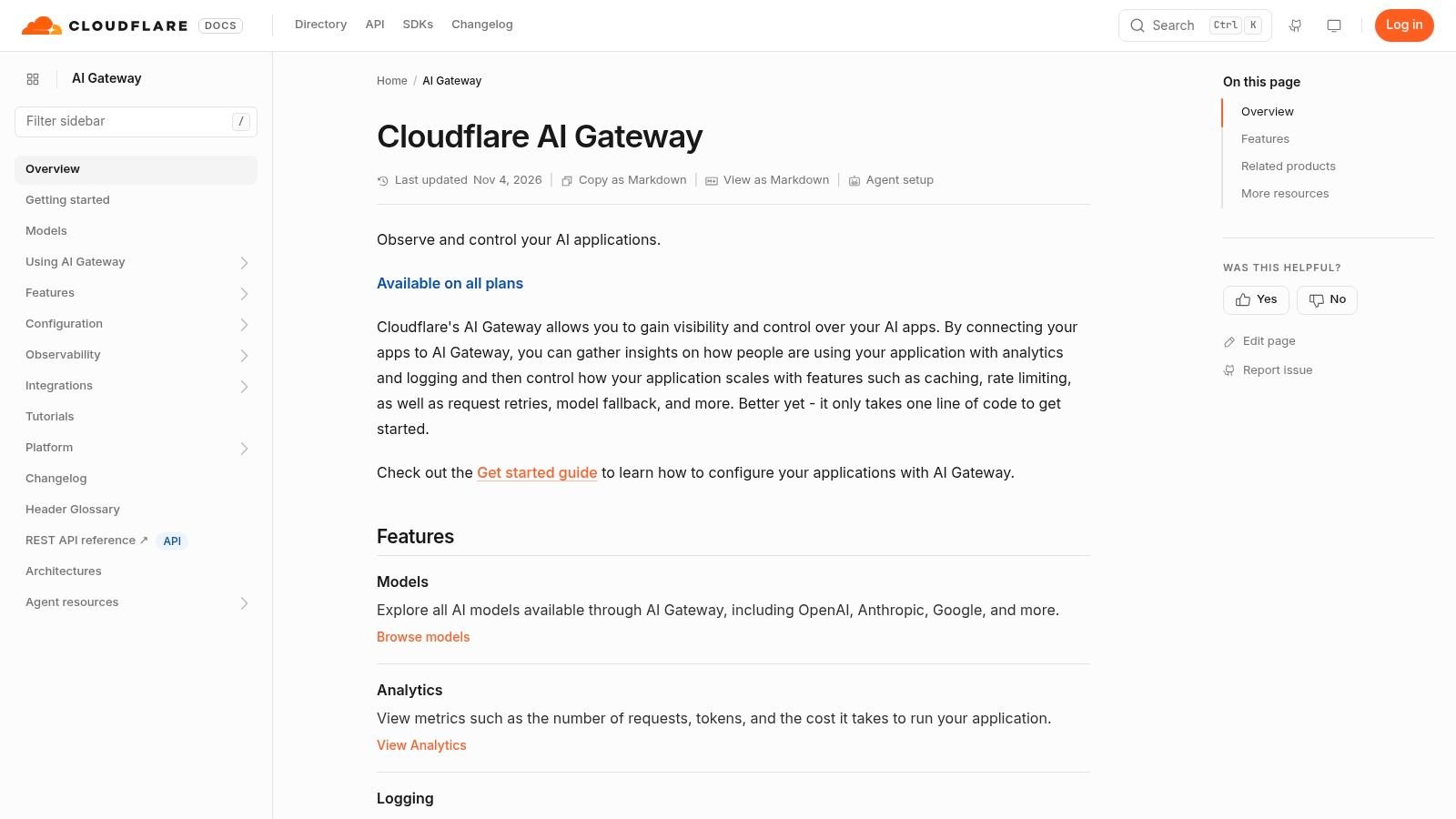
Core features on the Cloudflare AI Gateway docs include request analytics, caching, rate limiting, and automatic routing with fallbacks. Those core controls are described as available on all plans and free to use. That is attractive until you notice what it doesn't do. It isn't one bundled catalog and one bill for every lab. You still hold provider keys and pay those invoices. Endpoint support varies by API feature, so a tool-call path that works on one provider can fail on the next. You also accept a Cloudflare account as a dependency in the request path. Use it for controls and caching. Don't use it when the goal is a single prepaid balance.
4. LiteLLM
LiteLLM is the self-hosted default when you refuse to let a marketplace hold the credentials. It's an open-source Python library and proxy. You configure your own provider accounts, then expose one OpenAI-compatible endpoint to the app. Load balancing, retries, fallbacks, virtual keys, budgets, and spend tracking are all things you turn on in config, not things a vendor invoices.
You operate the process. That is the product.

In the ai-gateway-bench results published by LiteLLM's own maintainers, a lighter-weight gateway runtime posted 0.9 ms median overhead against a local mock, while the Python proxy measured 79.3 ms median and 1,587.8 ms p99 in the same run. That Python process also peaked near 2.92 CPU cores and 9,553 MiB of memory. Mock-based numbers remove upstream variability, so treat the gap as directional and load-test the exact deployment you will ship, with auth, streaming, and retries enabled.
Self-hosting avoids a hosted markup. It doesn't avoid provider bills, patches, or a bad tail if you pick the heavy runtime.
The LiteLLM proxy fits a platform team that already runs services and wants cloud models mixed with self-hosted ones. It doesn't fit a two-person app team that wanted a gateway so they could stop operating infrastructure.
5. Portkey
Portkey sits between a hosted control plane and an open-source gateway you can run yourself. The unified API spans a wide provider catalog. Routing, retries, load balancing, and automatic fallbacks are there. So are logs, traces, metadata filters, prompt management, caching, and guardrails on eligible plans. Pick it when the ticket from security is "show me the call," not "find me a cheaper token."
Traces are the reason to pay for the control plane.
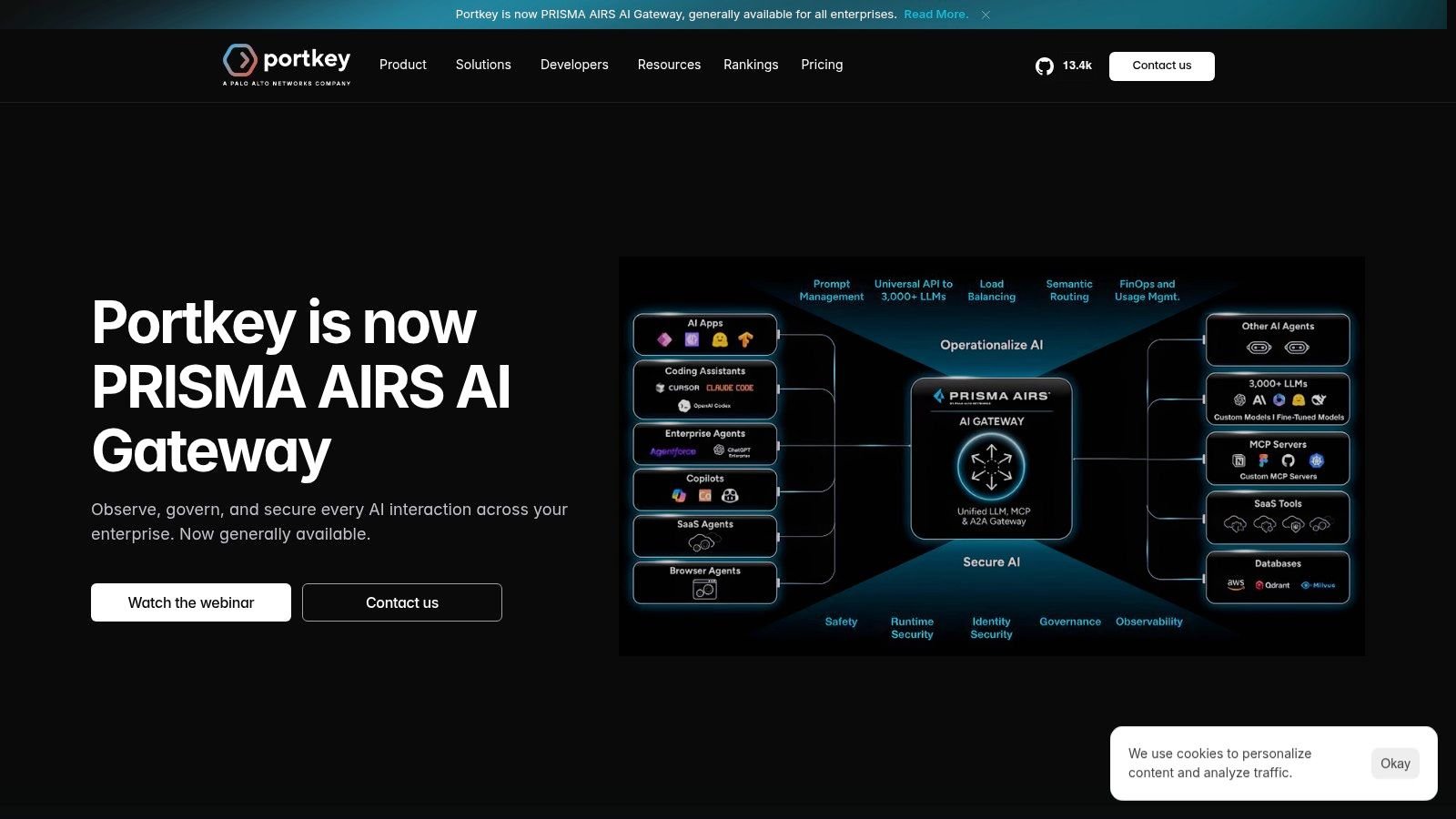
- One API, many labs: App code targets Portkey and you swap providers behind it.
- A free tier for a spike: Useful for prototyping. Log retention on that tier is short, and it isn't meant for production traffic.
- Production pricing is separate from tokens: The listed Production plan is $49 per month, on top of whatever the model providers charge.
- Self-host if you must: You can run the gateway. Advanced security, compliance, and private cloud sit on enterprise terms.
I like the split when observability is the job. I don't like it when a small team only needed a base URL change and then discovers the free tier's log window can't support an incident review.
6. Requesty
Requesty is one of the closer hosted stand-ins for an OpenRouter-style experience. One OpenAI-compatible API, a large multi-provider catalog, routing policies, load balancing, automatic fallbacks, caching, spend limits, and request-level analytics. There is an EU gateway option and a set of enterprise governance features if procurement asks for them.
The analytics screen is what you check before you trust a routing policy.
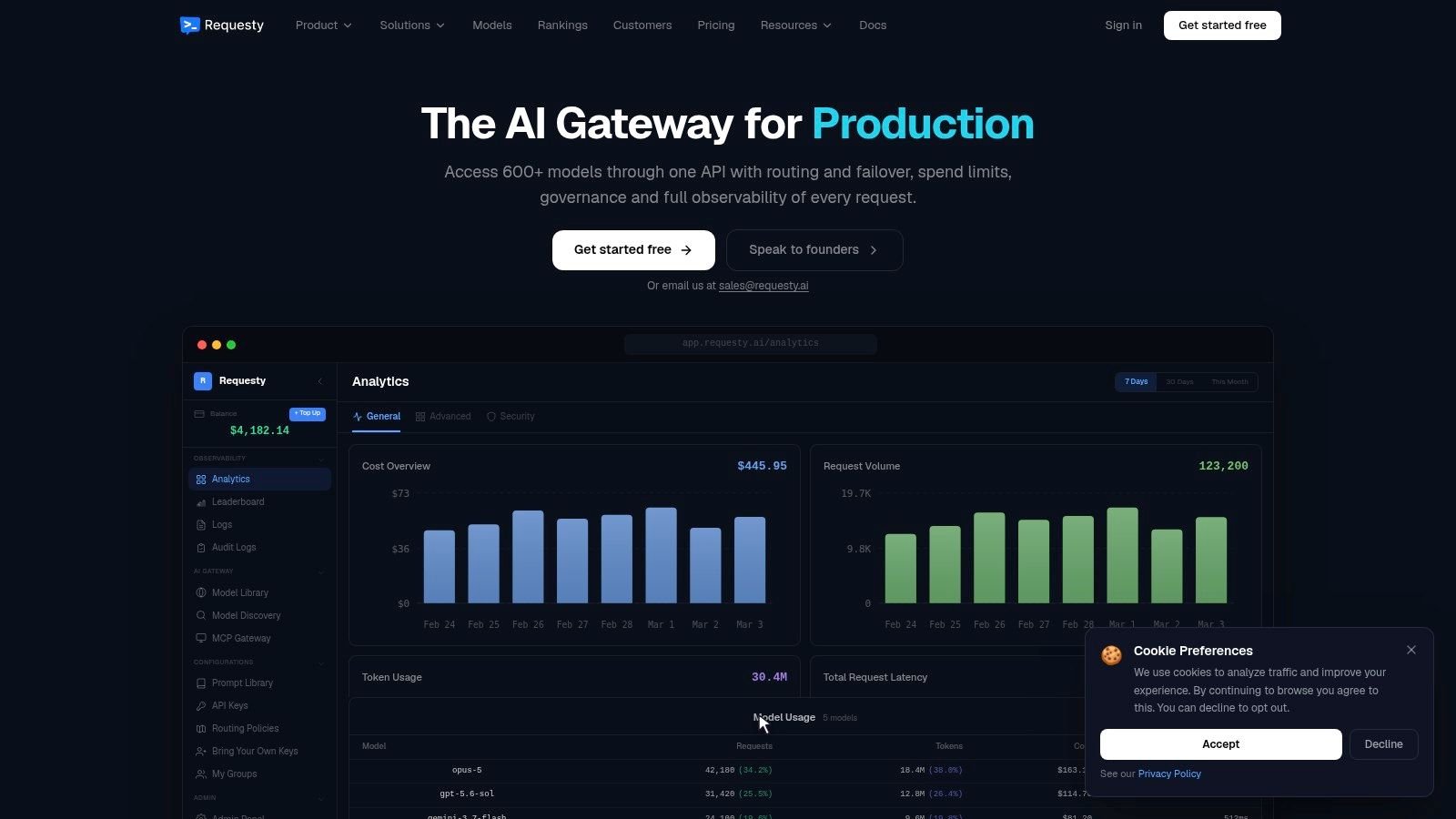
The pricing page on Requesty describes a free tier, a pay-as-you-go markup, and a bring-your-own-key option. The free plan lists 200 daily requests for free models, which is enough to prove a client and not enough to run a product. The listed pay-as-you-go plan adds a 5% markup on model costs. That is the number to put next to any "no fee" competitor before you migrate. SSO, advanced RBAC, and custom SLAs are enterprise-shaped. Model features and data-handling terms still vary by upstream provider, so an EU entry point doesn't automatically mean every model stays in-region. Use Requesty when you want hosted routing and team budgets without operating a proxy. Recheck the markup against your monthly token bill before you call it cheaper.
7. Helicone AI Gateway
Helicone grew up as an observability layer and now ships a gateway you can also self-host. The draw is request logs, traces, and usage analysis next to provider switching, not a marketplace that resells every lab. An OpenAI-compatible API covers models from multiple providers. Caching, rate limits, and fallbacks are part of the gateway. A free Hobby plan covers observability usage while you decide if the traces are worth keeping.
Debugging a bad completion is easier when the log and the route live together.

Gateway billing and observability plans are separate decisions. Read both before you migrate, because a cheap router plus a paid log tier can cost more than the gateway you left. The Helicone stack is more tooling than a team needs when the only requirement is one inference API and a prepaid balance. It's the right shape when you already want to see why a prompt failed, and when self-hosting the gateway beats trusting a fully managed path. It isn't the right shape when nobody on the team will read the traces.
8. Together AI
Together AI is a direct inference provider for hosted open-weight models, not a neutral router to every proprietary lab. If your workload is Llama-class or similar models in its catalog, plus fine-tuning or dedicated capacity, it can replace the slice of OpenRouter you call. If you need Claude, GPT, and Gemini behind one key, it won't.
The landing page is a catalog and a serving platform, not a multi-lab marketplace.

Serverless inference is priced per token for many language models, and Together AI publishes those rates per model. Fine-tuning and dedicated inference sit beside the serverless API, which is a key reason to leave a gateway. You talk to one provider's infrastructure, so failover across unrelated companies isn't part of the deal. Latency and cost move with the model and the serving option. Dedicated capacity is a procurement conversation, not a credit-card top-up. I would benchmark it when open weights are the product. I wouldn't list it as a drop-in OpenRouter replacement in an architecture review.
9. Fireworks AI
A coding agent that only calls one open model family doesn't need a router with forty providers. It needs predictable serving and a place to put a fine-tune. Fireworks AI is managed inference and customization, with serverless billing plus dedicated GPU deployments. Standard and priority serving exist for supported models. Fine-tuned models can stay on the same infrastructure, which is the operational win versus training in one place and serving in another.
Treat the platform page as a serving menu, then price the tier you will leave on.

Fireworks AI publishes pricing and training details, and both pay-per-token and dedicated GPU paths are real options. Dedicated GPUs need workload planning. An idle reservation is a hidden cost that token markups never show you. Tiers differ by model, so a spreadsheet that compares "Fireworks versus a gateway" on one headline rate will lie. This is not a universal multi-provider router. Use it when the catalog and the fine-tune path match the app. Keep a gateway if next quarter's model might come from a different company.
10. DeepInfra
DeepInfra is the straightforward hosted catalog for teams who want open-weight families behind an API and don't want to run GPUs. Per-token prices for many language models are published, which makes a first-pass cost estimate possible before you integrate. OpenAI-compatible support on the relevant endpoints means a base URL change for a lot of existing clients. Custom deployments and dedicated GPUs are there when shared inference isn't enough.
Compare families on the pricing view, then confirm quantization for the model you will ship.
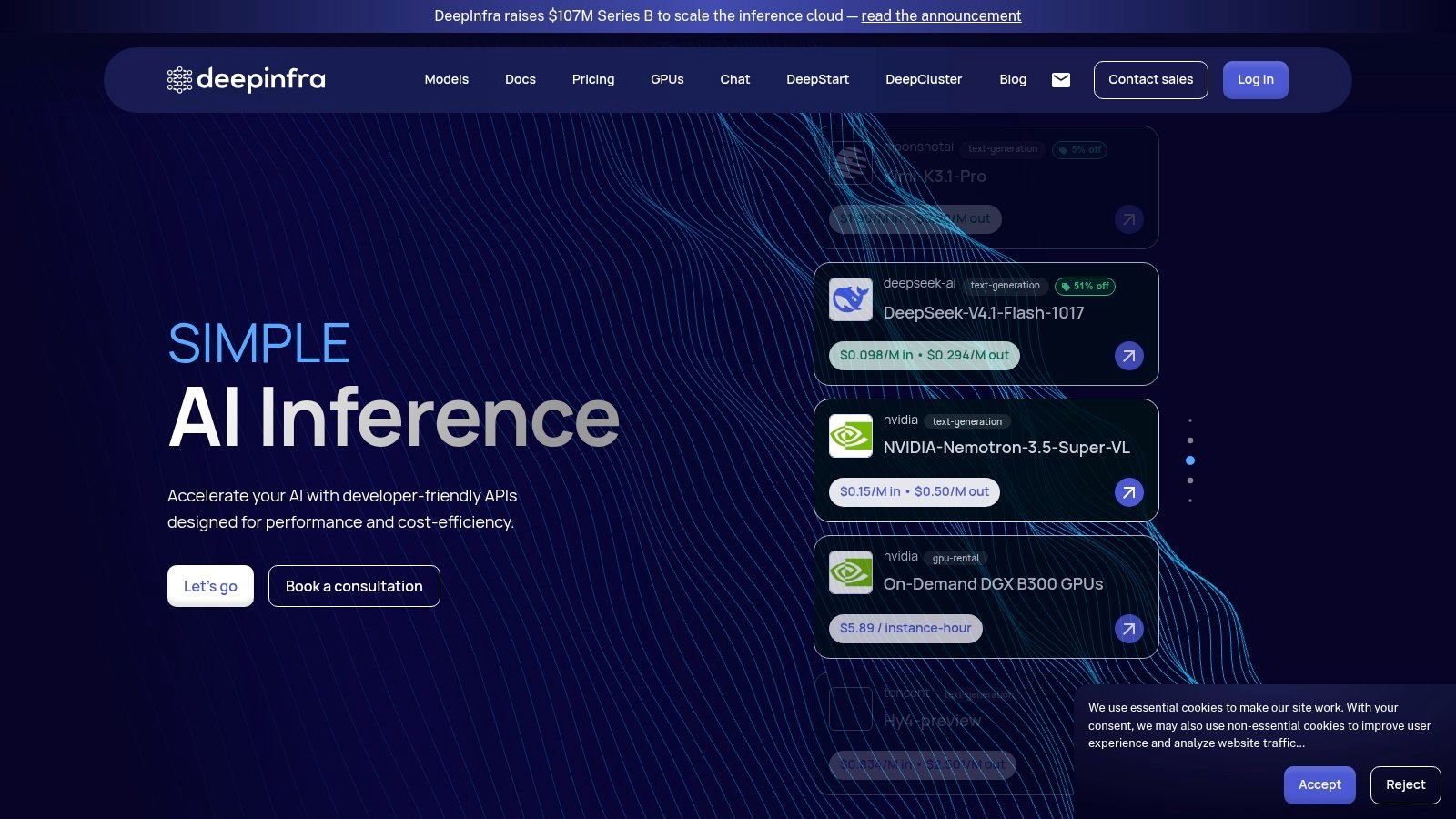
- One catalog, many open families: DeepInfra is useful when you're choosing among open models, not among closed labs.
- Shared or dedicated: Custom deployment exists, and it won't bill like the cheap shared tier.
- Serving details vary: Quantization and billing approach can differ by model. Read the model card before you promise latency.
- Not a neutral router: You don't get broad fallback across unrelated proprietary providers.
It's a clean direct provider. It isn't an OpenRouter clone, and your fallback story has to live in your own code or in a gateway in front of it.
11. Cerebras Inference
Speed is the only reason to add Cerebras Inference to a shortlist. Selected models run on Cerebras hardware. The catalog is narrow on purpose. A free access tier with lower rate limits lets you test. Enterprise options cover custom limits, fine-tuned models, and SLAs. If a supported model meets your quality bar, benchmark throughput. If it doesn't, the hardware doesn't matter.
The console is a small catalog. That's the scope.
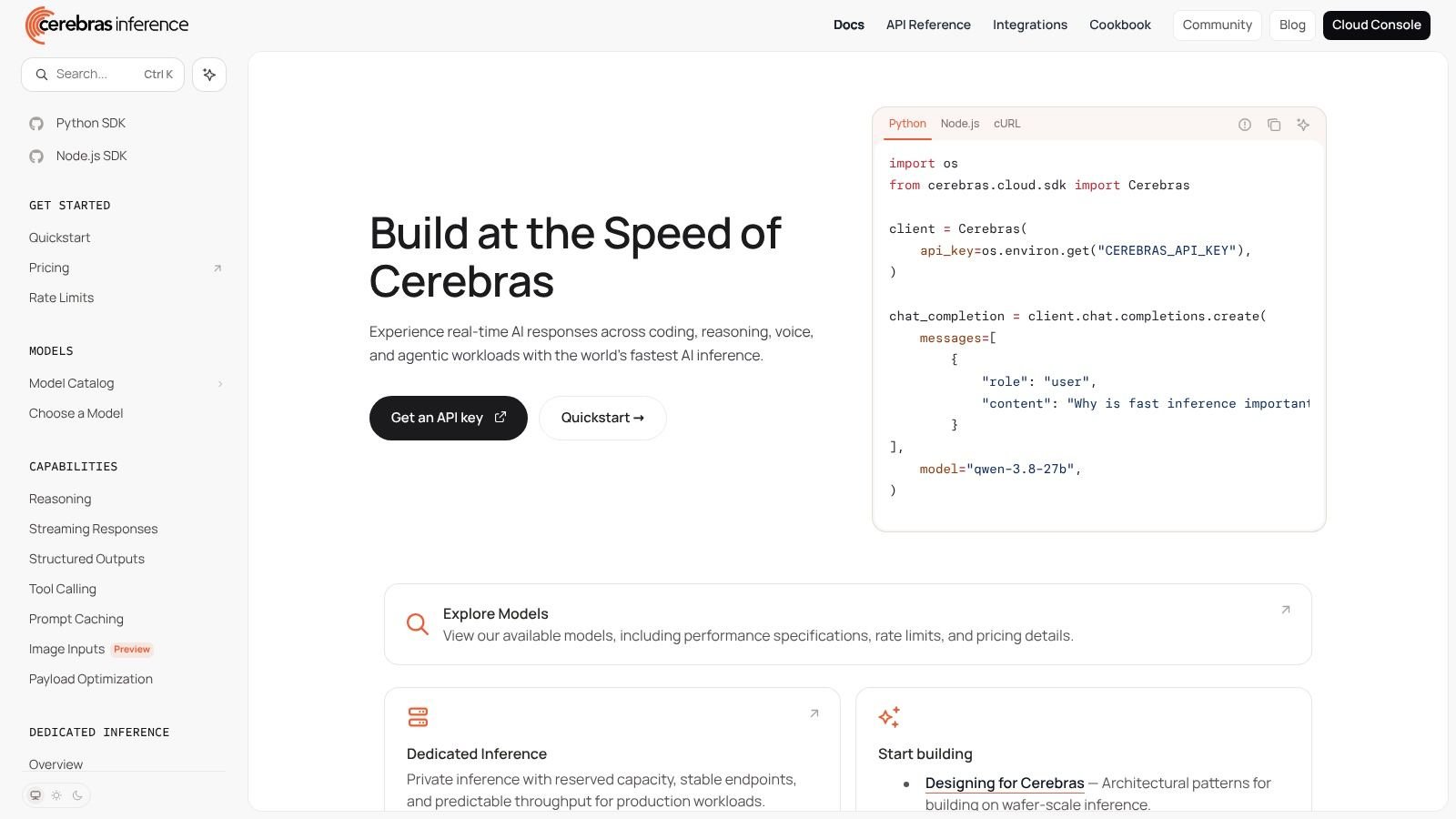
The Cerebras Inference docs cover API use and tiers. Free-tier rate and context limits are a demo, not a production plan. Commercial prices for exploration can change or disappear, so confirm them before you put the endpoint in a budget. There is no general multi-provider router here. I would keep it as a specialized route for a latency-sensitive call, behind whatever gateway or client already handles fallback, rather than as the only inference dependency.
OpenRouter Alternatives at a Glance
Three different products sit under the alternatives label: gateways that resell or route many providers, gateways you operate yourself, and inference providers that sell model capacity. The table keeps that split visible, because a fast catalog is not a replacement for cross-provider failover.
| Type | Pricing Model | Routing & Failover | Self-Hosting | Best For |
|---|---|---|---|---|
| AI inference marketplace | Provider charges, prepaid balance; no request fee; card top-ups have a fee | Selects the cheapest healthy seller and reroutes on slowdowns or outages | Not offered; managed marketplace | Multi-provider text and media access with automatic failover |
| Managed multi-provider gateway | Upstream token prices, with no gateway markup stated | Provider routing and automatic failover | Not available | Teams using Vercel or its AI SDK |
| Managed AI proxy | Core gateway features currently described as free; provider billing varies | Routing and fallback options | Not a self-hosted gateway; can connect custom or self-hosted models | Cloudflare users needing traffic controls and analytics |
| Open-source gateway | No mandatory gateway markup; provider usage billed separately | Load balancing, retries, and fallbacks | Available; requires operating and securing infrastructure | Teams wanting control over providers, credentials, and deployment |
| Managed gateway and control plane | Free plan; Production plan listed at $49/month; provider charges separate | Routing, retries, load balancing, and fallbacks | Available | Teams needing observability and production controls |
| Hosted AI gateway | Free tier; pay-as-you-go adds a 5% markup; BYOK option | Routing policies, load balancing, and automatic fallbacks | Hosted only; no self-hosted option covered here | Teams seeking a hosted multi-provider gateway with spend controls |
| Gateway and observability platform | Free Hobby plan for observability; gateway and observability billing are separate | Caching, rate limits, and fallbacks | Open-source gateway can be self-hosted | Teams needing request tracing and usage analysis |
| Inference provider | Model-specific usage pricing; dedicated inference priced separately | Focuses on its own catalog, not cross-provider routing | Hosted only; no self-hosted option covered here | Workloads centered on hosted open-weight models, fine-tuning, or dedicated inference |
| Inference provider | Usage-based serverless pricing; dedicated GPU options vary | Focuses on its own catalog, not cross-provider routing | Hosted service; dedicated GPU deployments available | Teams needing hosted inference, fine-tuning, or dedicated capacity |
| Hosted model API provider | Per-token shared pricing; dedicated deployments priced separately | Catalog access, not broad neutral multi-provider routing | Hosted service; custom deployments available | Developers wanting hosted open-model inference without running their own stack |
| Specialized inference provider | Free tier available; commercial pricing should be confirmed | Selected models only; not a general multi-provider router | Hosted only; no self-hosted option covered here | Speed-sensitive workloads with a supported model |
Read the Self-Hosting column narrowly: dedicated or custom deployments still leave the provider operating the service. The rows that move credential custody and operations onto your team are the open-source or self-hostable gateways, and that convenience trades directly for deploys, secret storage, and tail latency owned by you.
How to Choose the Right OpenRouter Alternative
Match the constraint you have, then ignore the rest of the list.
Already on Vercel or Cloudflare. Stay on that platform's gateway only if the link you need is routing and spend, and you accept their account model. Cloudflare is the better fit when you bring keys and want caching and rate limits without a resold catalog. Neither one is a self-hosted control plane.
You must hold the credentials. LiteLLM or a self-hosted Helicone or Portkey gateway is the honest path. Budget time for deploys, secret storage, and tail latency. A Python proxy and a Rust proxy are not the same capacity plan.
You need traces more than a cheaper token. Portkey or Helicone earns the extra product surface. Requesty fits when you want hosted routing, budgets, and a markup you can put in a spreadsheet. UberLLM fits when one prepaid balance should cover text and media, and spare-capacity pricing is worth a marketplace.
The workload is open weights or raw speed. Together, Fireworks, and DeepInfra are inference specialists. Cerebras is a speed test for a short model list. Put a gateway in front if you still need a second provider.
What breaks after you pick
Bring-your-own-key setup fails when the gateway's compatible endpoint doesn't support the tool-call or streaming flag you use. A markup looks small until retries and fallbacks double the tokens. A free tier's daily cap or short log window will not survive the first incident. Data-handling terms are two hops: the gateway and the model host. Self-hosting isn't automatically safer if logs, backups, and provider keys are loose.
EU obligations for general-purpose AI providers began applying on 2 August 2025, with enforcement scheduled from 2 August 2026, under the European Commission AI regulatory framework. Ask where prompts are processed, which subprocessors can see them, and whether you can prove deletion. A region label on a gateway isn't the same as inference residency.
Price shopping on a single advertised rate also ages fast. Stanford's 2025 AI Index reports that querying a model with a GPT-3.5-equivalent MMLU score of 64.8 fell from $20 per million tokens in November 2022 to $0.07 by October 2024, more than 280 times cheaper, with Gemini-1.5-Flash-8B as the benchmark case, in the Stanford AI Index. Re-check input, output, cache, and latency on the models you call.
Switching is rarer than architecture diagrams imply. Menlo Ventures data cited by InfoWorld put Anthropic at 40% of enterprise LLM API usage in 2025, OpenAI at 27%, and Google at 21%, together 88%, while only 11% of teams changed providers in the prior year and 66% upgraded inside the same vendor, in InfoWorld's report on model switching. An OpenAI-compatible base URL, aliases, and a fallback that doesn't downgrade quality are how you keep that option open.
Benchmark two shortlisted options on one production prompt set. Compare task accuracy, JSON validity, time to first token, p95 latency, and cost per successful task. HTTP 200 with an empty body doesn't count as success.
Pick the two options that match who holds your keys, then run that workload this week before you rewrite clients. For adjacent reading on model APIs and infrastructure trade-offs, use Dutable's technology guides.