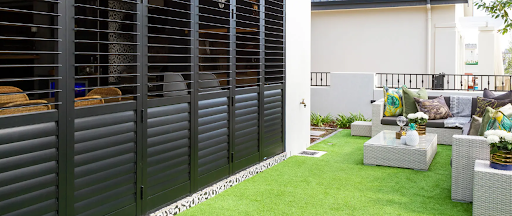
There is a moment every homeowner reaches — usually after wrestling with a warped louvre that no longer sits flush — where the question stops being about appearance and starts being about durability. Timber looks wonderful in a showroom. Fabric blinds photograph well in lifestyle magazines. Neither of these facts is particularly useful when the bathroom steams up every morning or the kitchen window faces a garden that gets the full force of every season. Aluminium shutters do not arrive with the same romantic appeal. What they arrive with instead is a track record that the alternatives genuinely cannot match.
Timber’s Uncomfortable Truth
Timber shutters appear in almost every high-end interior design feature ever published. What those features never follow up on is how the same shutters look after a couple of winters in a room with real humidity. Timber is hygroscopic — it pulls moisture in and pushes it back out depending on whatever the air around it is doing. That constant, slow movement eventually shows itself. A louvre that will not close evenly. A panel that drags against the frame. A painted finish is cracking quietly along the grain. None of this is a defect. It is simply timber behaving exactly as timber does, in precisely the environments where shutters tend to be most useful.
What Sets Aluminium Apart
The difference is not subtle once it is understood. Aluminium shutters do not participate in the expansion and contraction cycle that makes timber unpredictable over time. Humidity does not affect them. A louvre angled on a dry winter morning will be sitting in the same position during a humid summer afternoon, without any intervention. For coastal properties, this matters in a way that is difficult to overstate. Salt air is corrosive and relentless. Powder-coated aluminium handles it without complaint, continuing to operate cleanly in conditions that begin wearing timber down not long after installation.
Mechanisms Fail Before Materials Do
Shutters are purchased for how they look but lived with as mechanisms. The louvre adjustment system gets used repeatedly — responding to changing light across different seasons, different times of day, and different weather outside each window. Every adjustment is a quiet test of whether the engineering holds. Well-made aluminium shutters pass this test consistently because the material does not fatigue or distort in ways that introduce looseness into the mechanism. The tilt rod stays properly connected. The louvres move together without any stragglers. The panel folds without the bottom corner catching on the sill. These details sound minor until they stop working correctly, at which point they become impossible to ignore in an otherwise well-considered room.
Security Gets Dismissed Too Quickly
The security contribution of shutters tends to get mentioned briefly and then dropped from the conversation, as though raising it feels somehow at odds with talking about interior design. That is a mistake. A ground-floor window with properly fitted shutters closed behind it presents a very different proposition to one dressed with a fabric blind. Aluminium handles this without looking defensive or industrial — the same panel that is managing morning light and street-level privacy is simultaneously doing security work. In urban terraced houses where ground-floor windows sit directly beside a public pavement, that dual function is practical rather than theoretical.
Conclusion
Aluminium shutters tend to be chosen last and appreciated longest, which is an unusual combination in home interiors where the reverse is far more common. The material asks very little across its lifespan whilst continuing to deliver the light control, privacy, and mechanical reliability it offered on the day it was fitted. For rooms dealing with moisture, heat, or coastal air the case is fairly straightforward. For any property where window treatments are expected to perform rather than simply look good for a season or two, aluminium earns its place through something far more valuable than novelty. It earns it through a kind of quiet, sustained reliability that most alternatives simply cannot sustain once real conditions get involved.