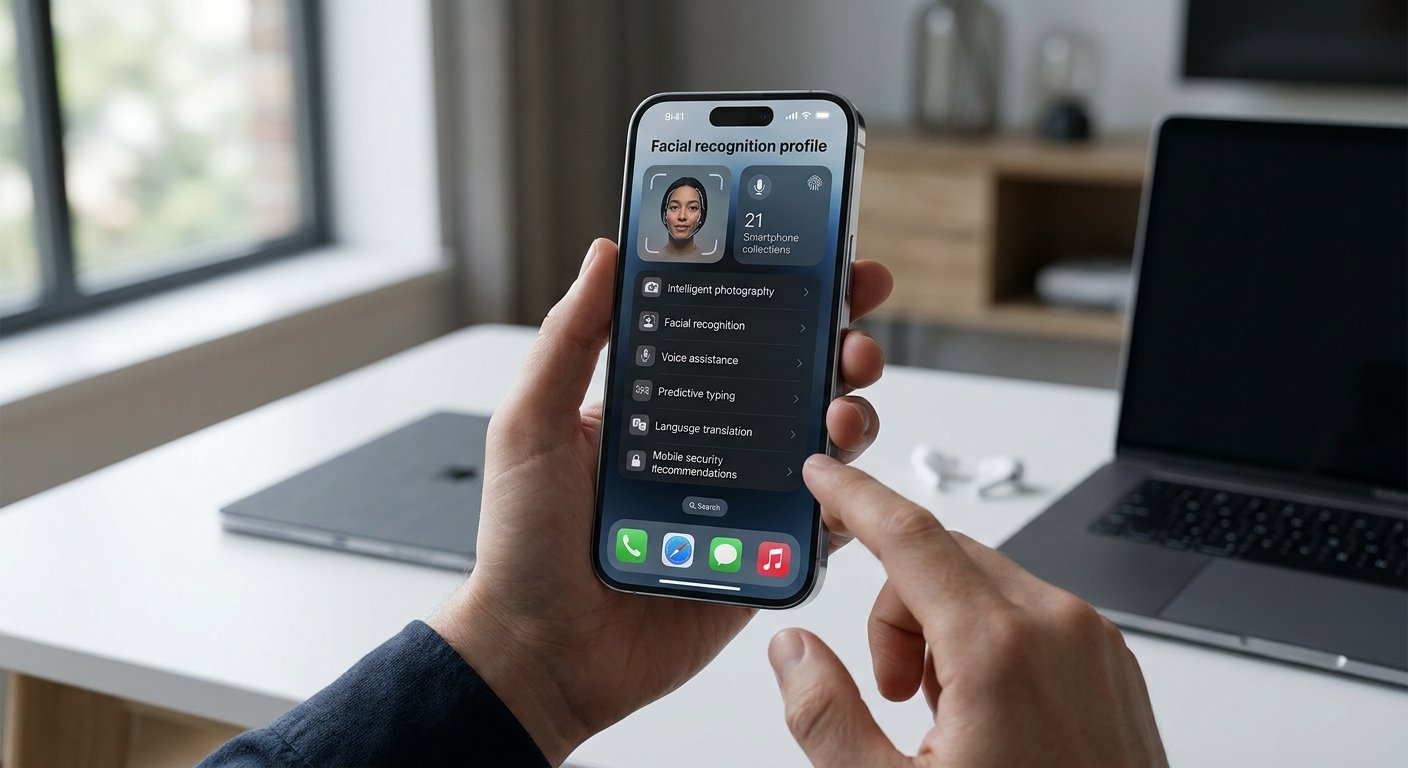
AI in smartphones plays an important role in modern mobile technology. Artificial intelligence is used in various features such as improved cameras, facial recognition, voice assistants, predictive typing, battery optimisation and recommendations. This means smartphones can understand user behaviours, recognise patterns and process information efficiently.
Modern smartphones use machine learning, computer vision, natural language processing and local AI to help improve performance. Many newer phones now have generative AI features to help users improve their writing, editing photographs, summarizing information and translating conversations.
Understanding how Artificial Intelligence can be used in Smartphones can help us understand how smartphones have become more intelligent. There are 15 important examples below:
1. AI-Powered Cameras
AI-powered cameras help improve the photo quality. Using computer vision and machine learning, the camera can identify objects, faces, landscapes and lighting conditions. This then adjusts the phone so it can produce better quality photos with the correct exposure, contrast, brightness and colour balance.
Features like night mode, portrait mode, noise reduction and scene recognition can be achieved with AI. Some phones can take multiple images to improve quality and make sure details aren’t lost. This means you can take advanced photos with your smartphone.
2. Facial Recognition
Facial recognition can help identify authorised users. The AI powered system will look at facial features and help determine if it’s the correct user.
Some phones have additional sensors and depth perception to help with facial recognition. Facial recognition can also help with verifying identities and adding security to mobile applications. However, it depends what hardware and security features the manufacturer has included.
3. Voice Assistants
Voice assistants like Siri and Google Assistant use AI to help understand what users are saying. The voice recognition and natural language processing can help users ask questions, create reminders, make calls, send messages and search for information.
Modern voice assistants can understand more complex requests through understanding natural language. They can also interact with applications and smart home devices to make your smartphone more convenient.
4. Predictive Typing
Using machine learning, the phone can help suggest words and phrases. This can be done by looking at language patterns and previously typed words.
This makes typing much easier and quicker. Some systems will learn common phrases and names to help improve suggestions. Occasionally there can be inaccurate suggestions so make sure you check your messages.
5. AI-Powered Keyboard
An AI-powered keyboard can help typing on your smartphone. The AI can help with correcting spelling, grammar suggestions and smart word suggestions. It can look at your typing patterns and can identify any potential errors.
With Generative AI there are more features that can help. Depending on your device, you can rewrite sentences, change the tone of your messages, improve grammar and summarise text. This can be useful when creating emails, messages and other documents.
6. Battery Optimisation
AI can help smartphones optimize their battery life. By looking at what apps you use, it can identify any unnecessary background activity. With machine learning, it can predict what apps you’ll need and allocate resources.
Some phones have smart charging features to help improve battery life. They can learn your charging patterns and help manage them. This can help improve energy efficiency and reduce unnecessary battery drain.
7. Call Screening
AI can help identify any unwanted calls, suspected scams and spam. The phone can look at the caller information and identify any suspicious patterns. This can let you know or block certain calls.
Advanced systems can use voice recognition to interact with the caller and help identify why they’re calling. This can help ensure you aren’t disturbed by unnecessary calls but can sometimes cause issues with identifying genuine calls.
8. Translation
AI can help with communicating with others using different languages. Using natural language processing and machine learning, the phone can translate written text and conversations.
Some modern devices can translate in real time. This can make it easier to communicate with those using different languages. This is very useful when travelling, studying or working internationally. However, some translations can get confused with slang, technical terms and other cultural terms.
9. Mobile Security
AI in smartphones can help improve mobile security by identifying suspicious activities, recognising unusual login attempts and detecting potentially harmful applications. However, artificial intelligence alone cannot guarantee complete protection, so smartphone users should also understand how to protect personal information when using mobile applications and online services. Reviewing app permissions, managing personal data carefully and using trusted applications can help reduce privacy risks and make smartphones safer to use.
Some banks may use AI to spot any suspicious activity or logins. But make sure you use strong passwords, update your software and check app permissions.
10. Recommendations
Many apps on your smartphone will use AI to provide recommendations. Streaming services, shopping apps, social media and news can review your activity.
Music apps will be able to recommend songs based on what you have listened to. Shopping apps can recommend products based on your searches. This can make it easier to find content but there can be privacy issues.
11. Photo Editing
AI can make it easier to edit your photos. You can improve lighting, remove objects, improve the quality and edit your background.
If you use generative AI there will be more features. You can scale up your images and edit certain areas of your image using text prompts. This can make it easier to creatively edit your photos. However, your photos could change how they look.
12. Health & Fitness
AI can help with health and fitness apps. These will look at your activity patterns and information from your smartphone and wearables. This can help track the activities that are supported, organise your fitness information and provide recommendations.
Some can look at your sleeping patterns and other wellness factors. However, AI cannot diagnose any issues and it will depend on the information available on your device.
13. App Management
Smartphones will use AI to manage your apps. The intelligent systems will be able to see which apps you use the most and change the background activity.
This can help your smartphone manage its memory, processing and app activity. This is useful if you are multi-tasking, gaming or using demanding apps. However, it will depend on your hardware and software.
14. Generative AI
Generative AI can help summarise long documents, messages, webpages and other supported content. This can help you by giving you a shorter summary.
Some devices will use AI to help with note taking, summarising and writing. This can help organise your information and make everyday tasks easier. However, make sure to always double check as AI can miss out key points or get confused.
15. Local AI

Local AI can help your smartphone complete certain AI tasks. Modern devices are getting more advanced with dedicated processors for AI such as Neural Processing Units.
This can help with image recognition, voice recognition, translating and writing. This can help improve speed, reduce reliance on the internet and improve privacy. However, some advanced AI features will need to be processed in the cloud.
How Smartphone Manufacturers Use AI
Manufacturers use various AI technologies to improve the experience on their smartphones. Machine learning can help with predictive text, recommendations and optimising battery life. Computer Vision can help with facial recognition, object detection and improving cameras. Natural Language Processing can help with voice assistants, translating and writing.
Generative AI can provide additional features to help you create content, edit photos and summarise. They also use dedicated processors to run AI models on their devices making them more intelligent.
Advantages of AI in Smartphones
AI can help make smartphones more convenient. Automating tasks can help with predictive text, smart cameras and app management.
They can help provide personalisation, make smartphones more accessible, improve security and help with communication. Voice assistants and translating can help make your smartphone easier to use. Smart recommendations can help you find relevant information. However, it will depend on how accurate the technology is.
Disadvantages of AI in Mobile

AI in smartphones can also raise concerns about privacy, security and the protection of personal information. Although intelligent security systems can help identify suspicious activities, users should not depend entirely on automated protection. Practising good digital security habits, including using strong passwords and account security, enabling additional authentication where available and reviewing application permissions, can help reduce potential security risks. Understanding these precautions is important as smartphones increasingly handle personal information, financial activities and private communications.
AI can lead to incorrect translations, recommendations and generated content. Advanced AI can use a lot of computing power and battery. Make sure you are aware of the limitations of AI features and check your apps privacy settings.
Future of AI in Smartphones
AI will likely become more integrated into smartphones. As processors and machine learning models become better you may start to see more advanced voice assistants, recommendations, real time translating and automation.
Generative AI will become more advanced with writing, photography and managing information. However, manufacturers will need to make sure they balance AI advancements with privacy, security, accuracy and responsible AI.
Conclusion
Artificial Intelligence has helped make modern smartphones more intelligent. With features such as photography, facial recognition, voice assistants, battery optimisation, security and generative AI there are 15 examples of how AI affects our everyday lives.
As manufacturers improve with machine learning, computer vision, natural language processing and local AI features mobile devices will become more advanced. Although there are some concerns with privacy, security and accuracy AI will continue to play an important role in the future of smartphones.