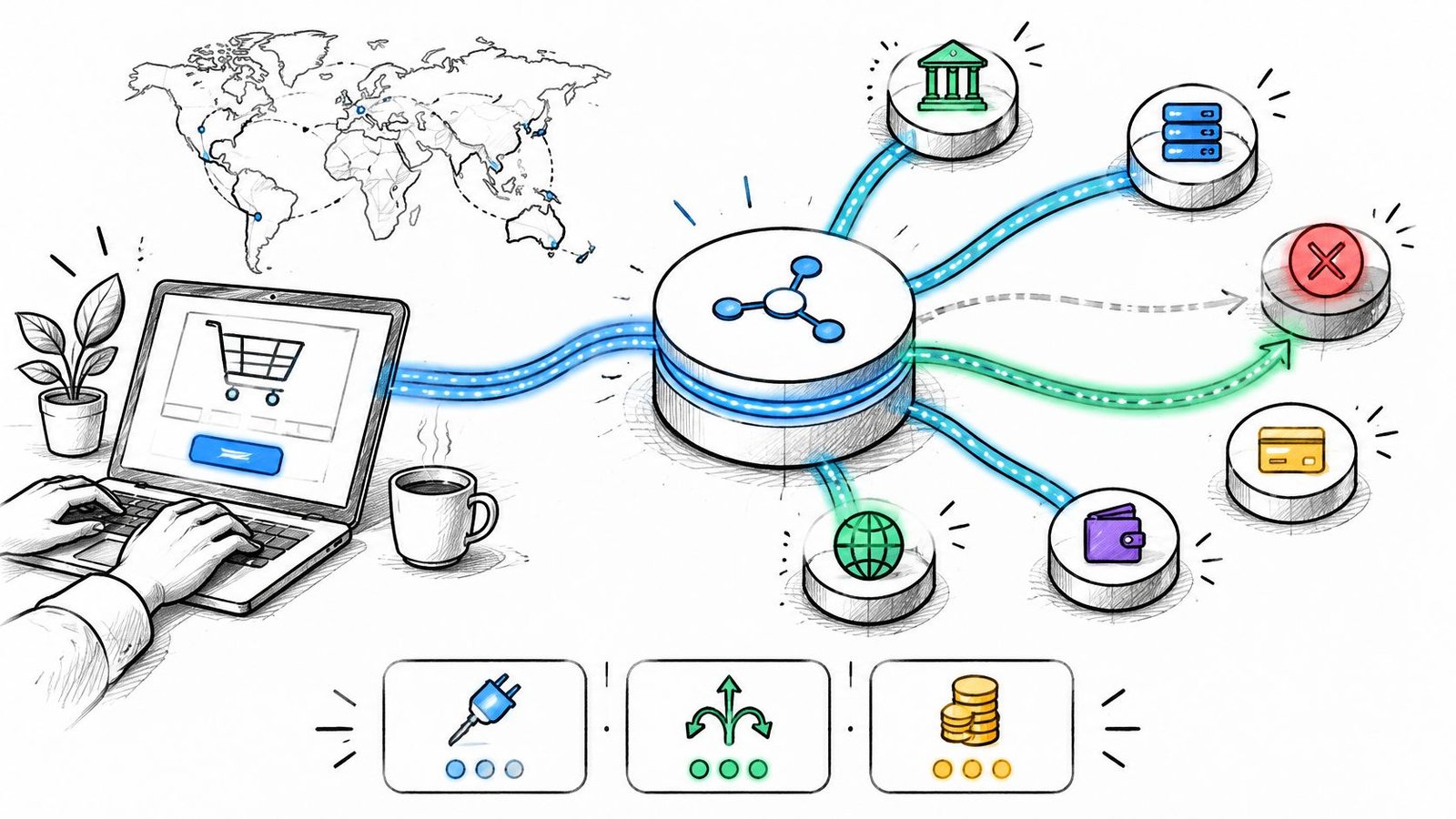
A regional approval rate drops on a Tuesday afternoon. The processor that covers that market is down, checkout still loads, and the payments team has no quick way to send those card transactions to a second acquirer before the evening peak. Finance sees the hole in the next settlement file. Engineering would need a fresh integration to close it.
That is when one processor stops being enough. Payment orchestration software sits between your checkout and the processors, acquirers, wallets, and bank-transfer methods you already pay for. It applies routing rules, retries eligible failures, and fails over when a provider times out, without asking the shopper to start again.
The pressure comes from how people pay, not from a feature trend. Worldpay reported that digital payments rose from 34% of global e-commerce transaction value in 2014 to 66% in 2024. Local wallets, cards, and buy-now-pay-later products rarely share one acquiring link that also covers fallback.
The platforms below are not ranked on a single score. They are grouped by the buyer they fit: an established PSP stack, an enterprise that needs data isolation, a travel merchant, or a team that wants to self-host. Several do not process payments themselves. They route, vault, and report while you keep the merchant role and the downstream contracts. Public list pricing is scarce, so the limits matter as much as the connectors.
Table of Contents
- 1. Spell
- 2. Primer
- 3. Spreedly
- 4. Gr4vy
- 5. IXOPAY
- 6. APEXX Global
- 7. BR-DGE
- 8. CellPoint Digital
- 9. Payrails
- 10. Juspay Hyperswitch
- 11. Yuno
- How the 10 payment orchestration platforms differ by deployment, fit, pricing visibility, and main limitation
- Matching an Orchestration Platform to Your Payment Stack
1. Spell
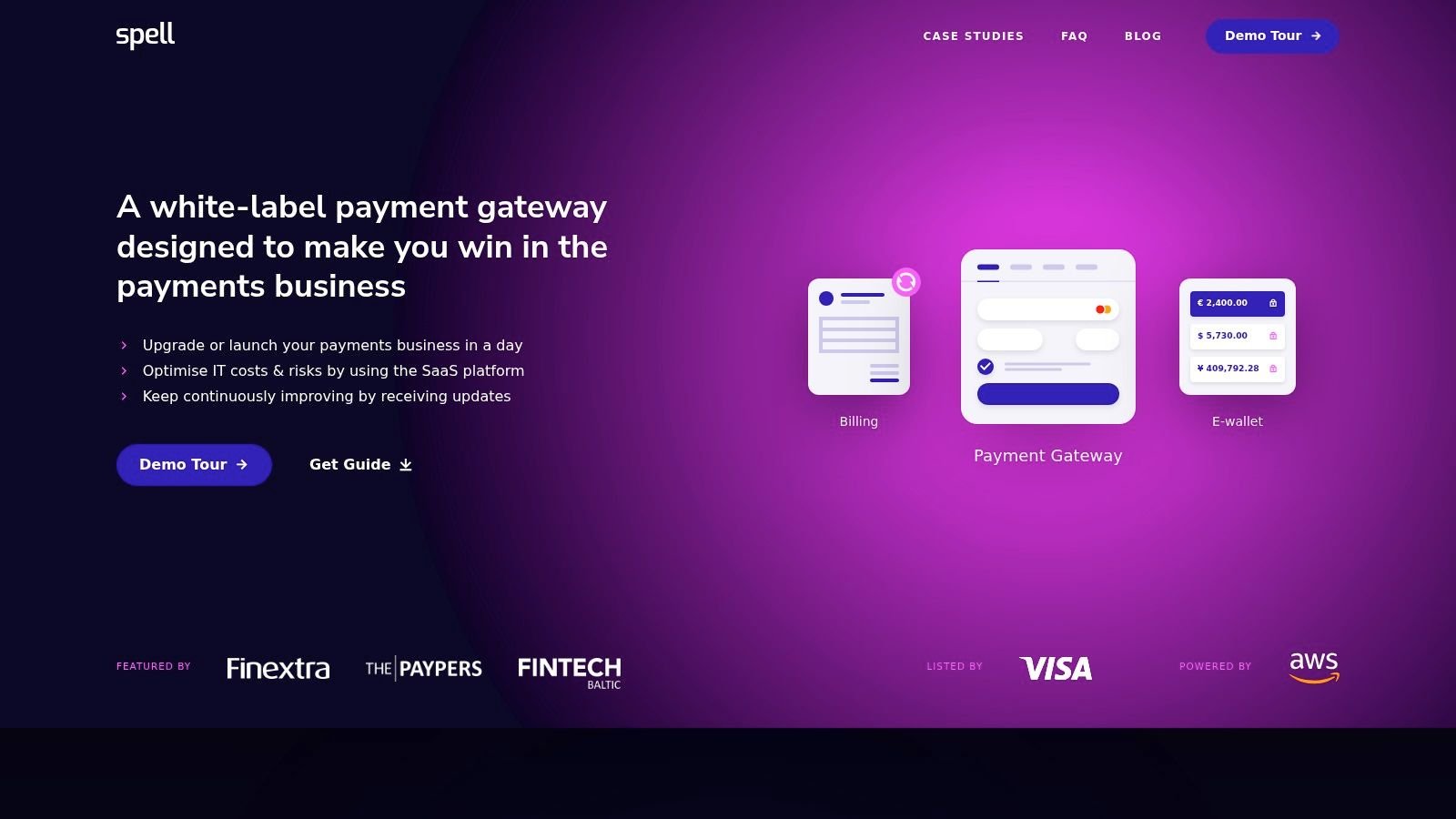
Spell is for a team that wants to run a branded payments business, not only reroute an existing store checkout. Payment orchestration software here is white-label and delivered as SaaS, combining a gateway, billing, and an e-wallet on the customer's own domain. You are not assembling those pieces as separate products.
What the stack actually covers
- White-label gateway: Card processing runs through connections Spell already maintains, so you are not commissioning a gateway from scratch.
- Billing and wallet in the same place: Account balances, payment feeds, billing links, and dashboards sit in one customer account, with a RESTful API for your own systems.
- A stated orchestration path: Card payments and alternative methods can route through a direct PaymentIQ connection, described as available without a separate contract or extra launch cost.
- Back-office work: Tickets, clients, pricing, rules, team settings, and automatically generated account-manager tasks replace a pile of side spreadsheets.
Who should buy it, and who should not
Choose Spell when the product you sell is payments under your brand, and the cost you want to avoid is building front office, back office, and connections yourself. Spell states PCI DSS Level 1 certification, insured corporate liability, fault-tolerant AWS hosting, and continuous updates inside the SaaS model. The site also says a launch or upgrade can be done in a day, which you should treat as a claim to test on your own scheme and method list, not as a promise for a messy legacy stack.
Spell does not remove the need for real acquiring and method coverage behind those connections. A merchant that only wants failover between two processors will pay for billing, wallets, and account-manager workflows they may never use. I would pick it when the business is a payments operator. I would not pick it as a thin routing shim on top of a retailer checkout.
Practical rule: If the job is a branded payments business, Spell is in scope. If the job is only to move a failed authorization, start with a thinner layer.
2. Primer
Primer fits a payments team that already has providers and wants to change routes without a release train. You connect providers through one integration, then run routing, checkout, vaulting, monitoring, and reconciliation from the same platform. The visual no-code Workflows builder is the part that changes day-to-day work. Someone who owns approvals can adjust logic and retry paths without waiting on engineering for every rule tweak.
- Fallbacks: Eligible failed payments can move to another processor on rules you set.
- One vault: Stored credentials and provider links sit in a central place instead of inside a single PSP.
- Ops view: Monitoring and reconciliation come with the routing layer, which helps when finance is tired of three portal exports.
The limit is scope and price clarity. Primer is more product than a merchant that only needs basic failover, and standard public pricing is not on the site. Fit also depends on whether your current PSPs and payment-data setup are already in its connection list. Confirm that before you treat the workflow canvas as the decision.
3. Spreedly
Spreedly is the clearest fit for a merchant that already has PSP contracts and does not want a new company in the middle of authorization.
Spreedly does not process payments. You stay merchant of record, and you still choose, contract, and manage every downstream PSP.
What you buy is an independent orchestration layer and a provider-agnostic vault. Credentials are meant to stay portable, so adding or swapping a processor does not force every returning customer to type a card again. Routing and payment optimization sit on top of connections to payment and fraud services. That is useful when the stack is already working and the pain is lock-in, not a missing acquirer.
Portability is not magic. Some wallet tokens do not move cleanly between providers, and you should test stored-credential migration on a sample of real cards before you promise finance a clean cutover. Spreedly also does not publish standard pricing, so model the vault and connection fees against the cost of a forced re-entry event, not against a vague "optimization" line.
4. Gr4vy
Gr4vy is the isolation option. Instead of a shared multi-tenant control plane, it runs dedicated cloud instances you can place in chosen regions. That matters when security or data-residency review will block a pooled platform, or when noisy-neighbor performance is a real objection from infrastructure.
The dashboard covers routing, dynamic retries, and failover without a code change for every rule. Integrations span payment providers, methods, and risk services, with API, SDK, and ecommerce-platform options for the checkout side. It is built for multi-provider operations, not for a single-market shop.
- Check residency in writing: "Dedicated" only helps if the instance, logs, and vault sit where your policy says they must.
- Budget for expertise: Breadth and configuration assume someone who already understands acquirers, retries, and risk tools.
- Skip it if you are small: Dedicated infrastructure is extra weight when two PSPs and one region would do.
Gr4vy does not list standard public pricing. Ask what you pay for the instance itself, separate from payment volume, before you compare it with a shared SaaS quote.
5. IXOPAY
IXOPAY is for an enterprise whose problem is not "we need a second processor" but "we cannot see cost, settlement, and method coverage across the processors we already have." One API reaches a wide set of providers and methods. Routing rules can use cost, geography, customer details, or risk. On top of that you get automated reconciliation, standardized reporting, fee-management tools, and checkout options that include hosted pages as well as APIs.
White-label support makes it plausible for a platform or a payments business, not only a direct merchant. The financial-operations layer is the reason to stay in the conversation when your PSP list is fragmented and finance is reconciling by hand.
The same depth is the reason to walk away from a simple setup. Pricing is not public on IXOPAY. Reporting and fee tools are only as good as the data each connected provider returns, so a polished consolidated report can still hide a processor that sends thin fee files. Test that with your real MID mix, not a demo file.
6. APEXX Global
APEXX is an independent connection hub. It routes across acquirers, PSPs, and alternative methods, and it is not tied to an APEXX-owned acquiring platform. That independence is the point for a merchant who has been nudged toward the orchestrator's own rails.
The operating tools match a multi-region enterprise more than a starter stack. You can cascade eligible declines to another provider, split volume across PSPs or merchant IDs, protect against an outage, and read consolidated reporting instead of five portals.
None of that creates the underlying contracts. You still need acquirers that will take your category, your currencies, and your volumes in each target market. Standard pricing is not published on APEXX Global. Before you commit, run a coverage check on the specific methods and issuers that fail for you today, and ask how volume splitting is logged so it cannot be mistaken for hiding chargebacks across MIDs.
7. BR-DGE
BR-DGE sits in a similar independent spot, with a bias toward platforms and ISVs as well as direct merchants. One API or SDK reaches providers and methods. Routing rules can use currency, time, transaction value, and card details. Centralized tokenization and universal tokens are meant to keep credentials usable as you add routes. White-label orchestration is an explicit offer, not an afterthought.
Published security claims are more concrete than most of this list. BR-DGE states PCI Level 1 certification and SOC 2 Type II attestation, which gives a security review something to read before a long proof of concept. Reconciliation and risk tools sit beside routing and outage failover, and you can integrate from web, mobile SDK, or server to server.
It is still an enterprise-shaped product. Low-volume businesses will feel the weight, pricing is not public on BR-DGE, and a token strategy does not help if the local method used in your market is missing. Verify providers country by country, then decide whether white-label is a requirement or a distraction.
8. CellPoint Digital
Say an airline takes a card deposit on the website, a local wallet on a partner site, and a split payment when a hotel is added to the same trip. A generic checkout orchestrator will not know what to do with the booking record, the passenger system, or the itinerary data that finance and fraud both need.
CellPoint Digital's One Source Orchestration is built for that travel shape. It coordinates providers, channels, and markets for airlines, hotels, OTAs, and similar merchants. Materials describe ties into PSS, GDS, and booking environments, plus flows such as installments, split payments, and itinerary data. Routing and method management are aimed at international travelers, not at a single domestic card mix.
A general retailer or a SaaS company should look elsewhere. Implementation can mean legacy booking systems, not a week on a hosted checkout. Pricing is not listed on CellPoint Digital. If you are not in travel, the specialization is a constraint, not a bonus.
9. Payrails
Payrails is the modular bet for a company that has outgrown one provider and is feeling the pain in finance operations, not only at authorization. Orchestration and routing are the front door. Tokenization, chargebacks, analytics, payouts, and financial reconciliation are separate rooms you can open.
Stated use cases run through retail, delivery, hospitality, mobility, marketplaces, ecommerce, and subscriptions. That spread is a signal to scope hard. A delivery marketplace that needs payouts and a retailer that only needs smarter card routing should not buy the same package and hope the unused modules stay cheap.
Results still depend on how cleanly you integrate and how you configure rules. Payrails does not show public list pricing, so ask which modules are in the proposal and which are later change requests. A broad catalog is not a benefit if reconciliation quality hinges on providers you have not connected yet.
10. Juspay Hyperswitch
Hyperswitch is the self-hosting choice, and it is a different kind of commitment. The community edition is open source under Apache 2.0. You can run it yourself or take Juspay's managed cloud. Routing, retries, redundancy, modular payment components, and provider integrations are the functional core.
Self-hosting appeals when you want the binaries, the routes, and the data plane under your own change control. It also moves infrastructure, upgrades, monitoring, and on-call onto your team. Community support is not the same thing as a paid enterprise contract or a managed-service SLA, and you should write that distinction into the business case before anyone calls it "free."
Juspay Hyperswitch will not forgive a missing connector. Validate the providers you use, on the deployment model you will run, before you treat open source as a shortcut around procurement.
11. Yuno
Yuno closes the list for buyers who sit between a merchant and a financial-services business. It offers orchestration and routing, payment infrastructure for online commerce, and white-label options if you want to resell or embed payments under your own brand. Published materials also stress real-time analytics and cross-border use.
The risk is a bundled proposal that sounds broader than the contract. Clarify which modules you are buying, which providers and methods exist in each target market, and what "intelligent routing" is allowed to decide without a human rule. Public list pricing was not on Yuno. If you only need failover for one brand in two countries, a white-label financial-services package is the wrong shape, even if the demo looks complete.
How the 10 payment orchestration platforms differ by deployment, fit, pricing visibility, and main limitation
| Item | Deployment model | Best suited to | Public pricing | Key limitation |
|---|---|---|---|---|
| Spell | White-label SaaS on the customer's domain | Businesses launching or scaling a branded payments operation | Not publicly specified | Pricing and contract terms require inquiry |
| Primer | Unified cloud payments platform | Teams managing provider routing, checkout, and reconciliation | Not publicly listed; contact sales | Fit depends on integrations and payment-data setup |
| Spreedly | Independent orchestration platform with a provider-agnostic vault | Merchants with established payment stacks seeking portable credentials | Not publicly listed | Does not process payments; merchants manage downstream PSPs |
| Gr4vy | Dedicated, single-tenant cloud infrastructure | Enterprises needing deployment control, data residency, and complex routing | Not publicly listed | Dedicated infrastructure may be excessive for smaller merchants |
| IXOPAY | Enterprise orchestration platform with hosted-page and API integrations | Businesses managing many providers and complex payment operations | Not publicly listed | Enterprise feature depth can add complexity |
| APEXX Global | Independent orchestration layer connecting merchants and providers | Enterprise merchants seeking flexible routing across regions | Not publicly listed | Requires suitable underlying PSP and acquirer arrangements |
| BR-DGE | Independent orchestration layer with API, SDK, and white-label options | Merchants, platforms, and ISVs needing routing and tokenization | Not publicly listed | Enterprise focus may not suit low-volume businesses |
| CellPoint Digital | Travel-focused orchestration platform | Airlines, hotels, OTAs, and other travel merchants | Not publicly listed | Travel-system integrations can be complex |
| Payrails | Modular payments and financial-infrastructure platform | Businesses needing orchestration alongside broader financial operations | Not publicly listed | Broad scope requires careful module selection |
| Juspay Hyperswitch | Open-source self-hosted software or managed cloud | Technical teams seeking control or a managed orchestration option | Community version is open source; managed pricing not publicly specified | Self-hosting requires operational ownership |
| Yuno | Payment infrastructure with orchestration and white-label capabilities | Merchants and financial-service businesses expanding across markets | Not publicly listed | Package scope and market coverage need confirmation |
Matching an Orchestration Platform to Your Payment Stack
Start with a map of your own stack. List every processor and acquirer, the regions and currencies they clear, the methods shoppers use, and the failures that cost you money. Soft declines, timeouts, and missing local methods are different problems with different fixes. A platform that shines at card cascading cannot invent a local bank transfer you never contracted.
Shortlist two or three tools whose deployment model matches the team you have, then match the tool to the buyer type it was built for. A shared SaaS layer suits established PSP stacks. Enterprises that need data isolation should look at single-tenant deployments. Travel merchants get more from a stack built around airline and OTA integrations, and teams with the operational appetite to self-host gain control that a managed service will not give them. These are different products wearing the same label. Then read the limits in this list again. If the vendor does not process payments, you still own PSP contracts, scheme registration, and the merchant relationship.
Put three demands in writing before anyone signs.
- Price on paper: Platform fee, per-transaction fee, and what sits outside the quote. Most vendors on this list do not publish a standard rate card.
- Connectors for your markets: Named providers and methods in the countries where you sell. A global logo wall tells you nothing.
- A failover test on real volume: Authorization rate, soft-decline recovery, latency, fraud rate, and cost per successful payment, split by country, issuer, method, and rule.
Routing gains do not appear just because you switched the feature on. A 2026 analysis of 110 U.S. companies found that 69% of organizations using all five core orchestration capabilities approved more than 97% of transactions in a typical month, compared with 32% among companies using only one or two. The same analysis found 78% of the highest-capability group gained at least 2% on payment completion, versus 10% in the middle tier and 7% in the lowest. Uplift also depends on the instrument. Measure your own baseline first, because a vendor's published result is a figure you cannot paste into your business case.
Economics bend the other way once the platform gets heavy. Javelin Strategy & Research argues the benefits are not linear: connectors, fraud tools, methods, geographies, and channels each add platform and operating cost that can pass the revenue you recover. In that work, 60% of enterprises using third-party orchestration cite software-to-PSP integration as a motivation, and 81% of companies that need orchestration also need in-person POS integration. One PSP, one market, and no recurring billing to protect is a profile where a direct connection usually wins on total cost.
Someone still owns the risk when a smart route and a compliance rule disagree. PCI DSS v4.0 tightened payment-page requirements, so confirm your PCI scope before routing through a new provider. You can remain responsible for privacy, sanctions screening, authentication, refunds, disputes, and evidence even when a vendor routes or tokenizes. Routing into an unfamiliar acquirer can weaken local fraud signals, and splitting volume across merchant accounts can be abused to hide chargebacks. Demand explainable rules, audit logs, documented failover behavior, data residency terms, and a named owner for the fraud model.
The spend around this layer is large enough that a sloppy buy gets expensive. Mordor Intelligence valued the worldwide payment-orchestration-platform market at about USD 2.65 billion in 2025, with a projection of USD 7.27 billion by 2031. Treat those figures as directional market estimates. Capgemini's World Payments Report adds a split in who has already deployed the layer: in 2025, 70% of surveyed PayTechs had payment orchestration in place, compared with 47% of banks. Buy for your stack's failure modes. Category growth explains why these vendors exist; it says nothing about whether you need one.
Pull last quarter's decline file and mark the regions where one processor is a single point of failure. Take that list to two vendors whose deployment model you could operate, ask for pricing in writing, and run a failover test on a slice of real volume before you sign.