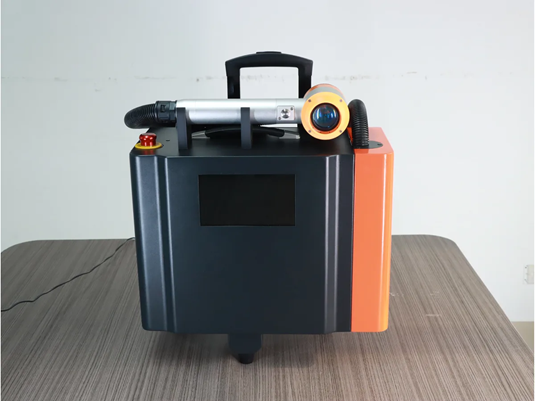
In modern manufacturing and maintenance, surface cleanliness is no longer a secondary concern it directly affects product quality, coating adhesion, weld integrity, and equipment lifespan. Traditional methods such as sandblasting, chemical stripping, and mechanical grinding have long dominated the field, yet they bring well-known drawbacks: substrate damage, hazardous waste, high consumable costs, and inconsistent results. A laser cleaning machine addresses these issues by using focused light energy to remove contaminants selectively and without contact. Over the past decade, this technology has moved from specialized laboratories into everyday industrial use, delivering measurable gains in precision, environmental performance, and operating cost.
How a Laser Cleaning Machine Works
At its core, laser cleaning relies on selective laser ablation. A fiber laser, typically operating at 1064 nm, delivers short, high-intensity pulses or a continuous beam onto the surface. Contaminants such as rust, paint, oxide layers, oil, and coatings absorb the laser energy far more readily than the underlying metal. The absorbed energy rapidly heats the unwanted layer, causing it to expand, vaporize, or fracture through thermal stress and micro-plasma formation. The clean substrate reflects most of the remaining energy, limiting heat transfer into the base material.
This self-limiting behavior is one of the process’s greatest strengths. When parameters are correctly set, the laser removes the contaminant layer while leaving the substrate largely unchanged in chemistry, roughness, and dimensional integrity. Handheld systems scan the beam across the surface in controlled patterns, while automated or robotic setups integrate the process into production lines for consistent, repeatable results.
Pulsed Versus Continuous-Wave Systems
Laser cleaning machine fall into two main categories. Pulsed systems deliver energy in brief, high-peak-power bursts (often nanoseconds). They excel at low heat input and are preferred for precision work on molds, thin sheet metal, aluminum components, weld seams, and delicate parts where surface integrity matters. Continuous-wave (CW) systems output a steady beam at higher average power, typically in the kilowatt range. They remove thick rust or heavy coatings from large steel structures more quickly but transfer more heat and may alter surface roughness.
The choice depends on the job. For parts, tooling, and controlled surface preparation, pulsed fiber lasers in the 100–500 W range are common. For high-volume structural cleaning, higher-power CW units become more practical. Many modern machines offer adjustable pulse parameters, scan patterns, and power settings so operators can fine-tune performance for different materials and contamination levels.
Clear Advantages Over Conventional Methods
A laser cleaning machine stands apart from sandblasting, chemical baths, and grinding in several practical ways. Because the process is non-contact, there is no mechanical abrasion, media embedment, or risk of thinning critical dimensions. No grit, solvents, or strippers are required, eliminating ongoing consumable purchases and the associated disposal costs and regulatory burdens. The only byproducts are fine particles and fumes that a proper extraction system captures.
Results are highly selective and repeatable. Operators can clean a narrow weld zone without affecting surrounding paint or strip oxide from a precision mold cavity while preserving the original geometry. Energy consumption is limited mainly to electricity, and modern air-cooled units keep infrastructure simple. Over time, many users report lower total cost of ownership once the initial investment is amortized, especially in shops that clean regularly.
Environmental and safety profiles also improve. The absence of silica dust, chemical waste streams, and high noise levels simplifies compliance and reduces operator exposure risks, provided laser safety protocols are followed.
Where Laser Cleaning Delivers the Most Value
Applications span multiple industries. In metal fabrication and welding, laser systems remove mill scale, rust, and heat tint before and after joining, improving weld quality and coating adhesion. Mold and die shops use them to clean residual plastic, rubber, or release agents without damaging cavity surfaces. Automotive and aerospace manufacturers rely on the technology for selective paint removal, oxide cleaning on high-value alloys, and preparation of bonding surfaces.
Maintenance teams clean pipelines, structural steel, rail components, and heavy equipment in the field with portable units. Cultural heritage restoration and electronics manufacturing benefit from the gentle, controlled action on sensitive materials. In each case, the common thread is the need for clean surfaces without collateral damage or secondary contamination.
Practical Considerations When Selecting Equipment
Not every laser cleaning machine suits every task. Power level, pulse characteristics, scan width, cable length, cooling method, and mobility all matter. Higher power increases throughput on heavy contamination but raises heat input and system cost. Air-cooled pulsed units are simpler and more portable; water-cooled systems may be needed for continuous high-duty operation.
Safety is non-negotiable. These are Class 4 lasers. Proper wavelength-rated eyewear, controlled access, and effective fume extraction are mandatory. Operators must understand parameter selection too much power or dwell time can mark the substrate, while insufficient energy leaves residue. Training and sample testing remain essential before full production use.
Maintenance is relatively light: protective lenses require regular inspection and replacement when clouded, and the optical path must stay clean. Running costs are dominated by electricity rather than media or chemicals.
Looking Ahead
As fiber laser technology continues to improve in reliability, beam quality, and cost, laser cleaning machines are becoming more accessible to mid-sized shops and mobile service providers. Integration with robotics and vision systems is expanding automated applications. The fundamental advantages selectivity, low waste, and substrate protection align well with stricter environmental regulations and rising quality standards.
A well-chosen laser cleaning machine does not simply replace an old process. It changes how surface preparation is approached, enabling cleaner results with fewer secondary problems. For operations that value precision, consistency, and long-term operating efficiency, the technology has moved from promising alternative to practical standard. When evaluated against real production needs and total cost of ownership, it frequently proves to be the more intelligent solution