Introduction
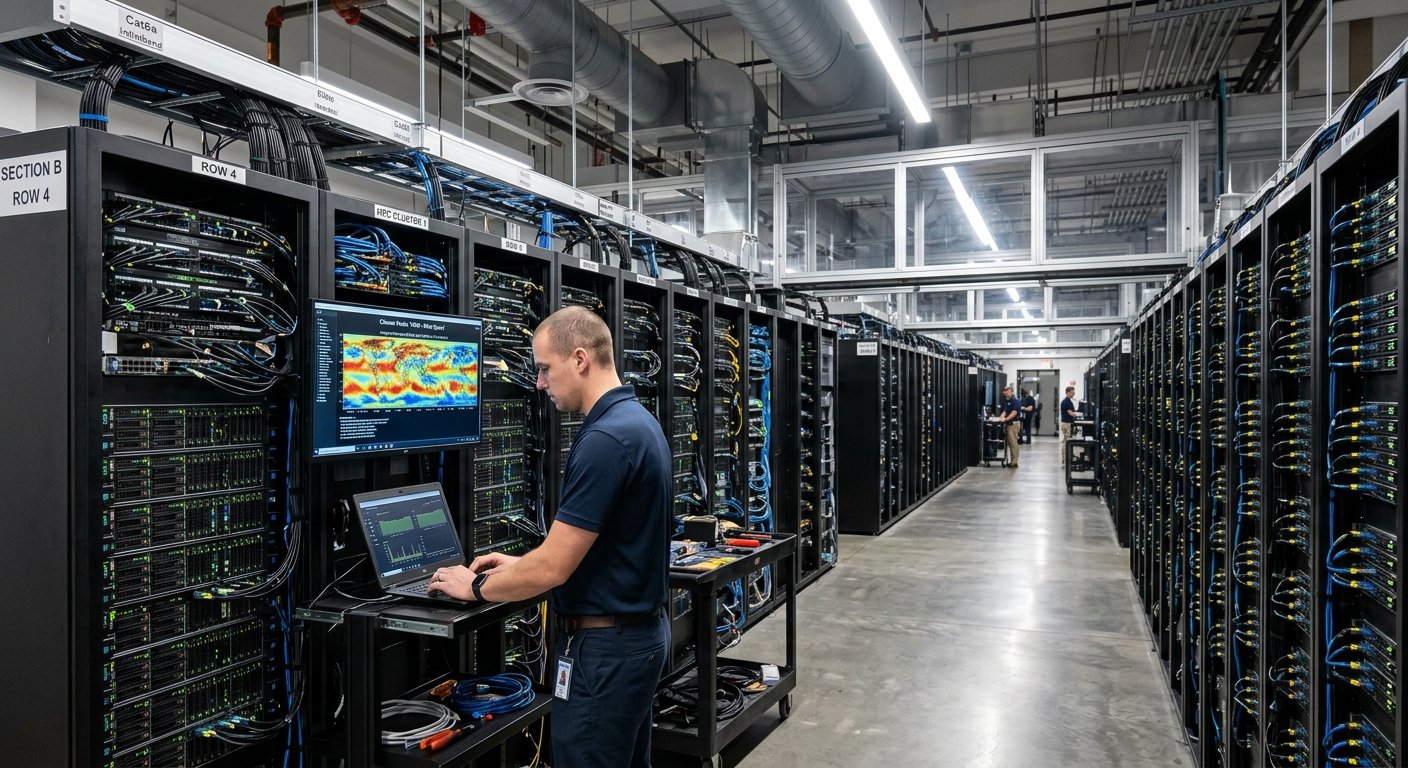
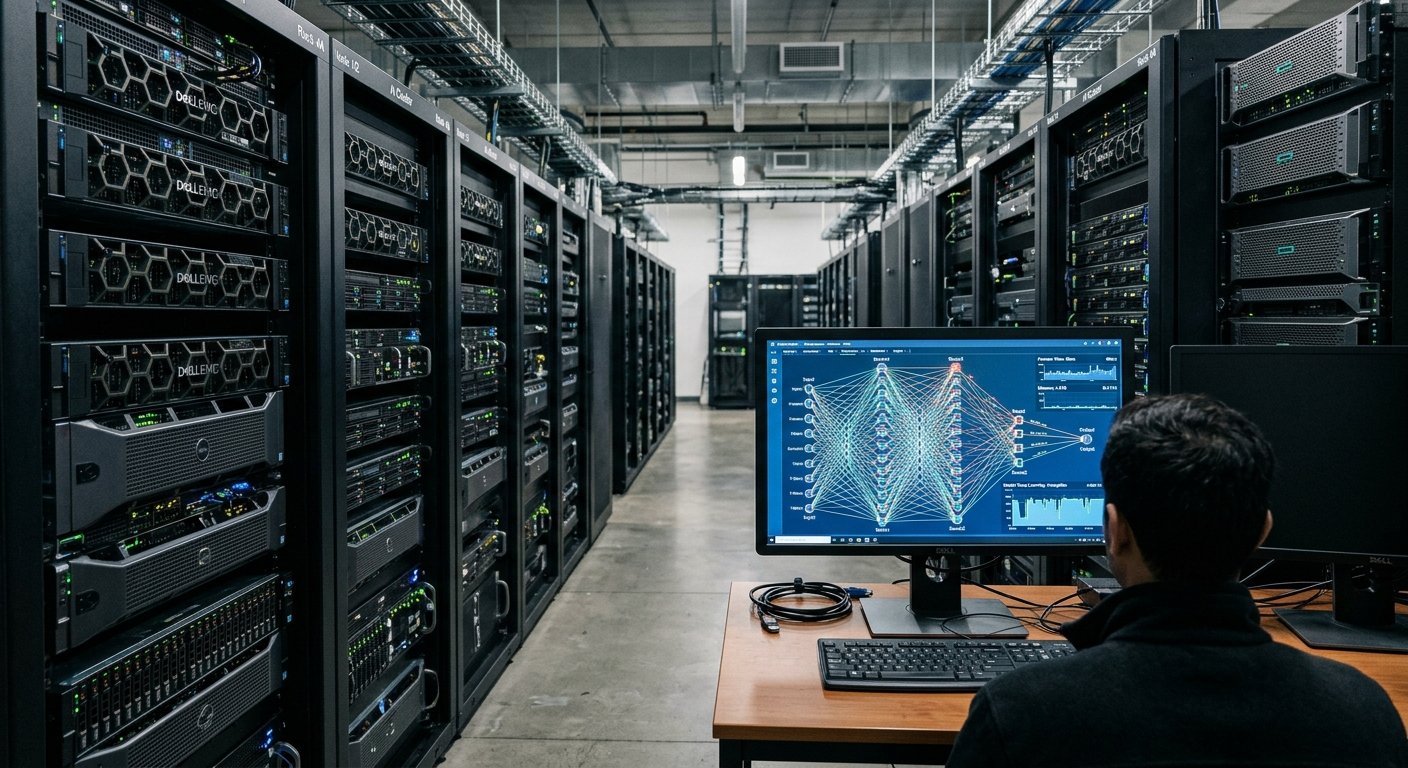
Artificial Intelligence (AI) and Machine Learning (ML) are now known as necessity of modern computing technologies which are used to power virtual assistants, recommendation systems, facial recognition, medical image analysis and generative AI tools. These applications involve intricate computing methods that involve processing vast amounts of data, recognising patterns and generating meaningful outcomes, all of which necessitate the use of computers. The more advanced the AI models, the more computing power that is required to train and run them. These heavy workloads may not be accomplished within a reasonable time frame using traditional computing methods that process numerous operations sequentially. This is where parallel computing plays a role. The idea behind parallel computing is to have multiple processing units handle different parts of the calculation, thereby performing many operations in parallel. It allows AI researchers and developers to train larger models, work with vast amounts of data, and make predictions more efficiently on the available hardware and make better use of the hardware resources.
Concept of Parallel Computing and its Applications in Artificial Intelligence
Parallel computing is a method of computing by using a set of processors or processing units that operate simultaneously on the different parts of a problem. A parallel system breaks down a task into smaller tasks that are carried out concurrently (or concurrently overlapping) instead of having one processor take each task one by one. These tasks can include analyses of individual data samples, mathematical computations, or running individual parts of a larger computational model. This method is especially useful in AI where machine learning algorithms often run the same mathematical steps on vast amounts of data. Training a neural network could require millions or billions of calculations for deciding on the changes in the parameters of a neural network. If a suitable calculation can be broken up into several processors, then the total time to perform the calculation can be reduced if the tasks can be efficiently parallelized and the overhead of coordinating the multiple processors is not too large.
Connection between Parallel Computing and Machine Learning
Machine learning is the process of training a machine to identify patterns in data and, using those patterns, generate predictions or outputs. In training, the algorithm is fed with examples, errors are computed, and internal parameters are modified to better adapt the algorithm to the examples. Artificial neural networks, which form the basis of deep learning, may need high levels of computation as they have many layers and parameters and are interconnected. These mathematical operations can be spread over several processing units with parallel computing, so that more calculations can be performed within a certain time frame. For example, in the case of training an image recognition model, both processors can process a subset of images and learn from the same set of images. However, not all the operations can be independent and some of them have to wait for some results of the previous operations. Thus, the degree of success of parallel computing relies on the structure of the model, the work to be done, the hardware available, and the efficiency of communication between the processing units.
Sequential Computing vs. Parallel Computing
Sequential computing has instructions that are executed in a sequence, and the later instructions require the earlier ones to be executed if necessary. It is suitable for many common uses such as basic arithmetic operations, office software, and operations with moderately-sized data sets. If the problem can be broken down into independent or partially independent tasks, however, then parallel computing can be useful. What about an AI that has to process thousands of photos? When using a sequential approach, the individual photographs will be processed in order, while a parallel approach would allow for several processors to process different photographs.
The images assigned to each processor are analyzed by the processor and if a combination is needed, the results from each processor are combined. However, not all applications will be faster with parallel computing. The performance improvement will be modest if tasks have a high dependency among each other or if the workload is not large enough to warrant significant overhead in coordination or if processors spend a lot of time communicating. The developers have to decide which operations are allowed to be executed in parallel and select an appropriate parallelization strategy.
Why AI Demands Parallel Computing.
AI systems of the modern era rely heavily on extensive data sets, complex mathematical algorithms, and iterative training processes. Model processing, making predictions, measuring errors and adjusting its parameters can occur many times before a model achieves a satisfactory performance. These calculations can require significant computing resources and memory when the dataset is very large or the neural network has a large number of parameters. This task can be broken up and divided among appropriate subsets of processors, graphics processors or networked computers in parallel computing. This can reduce training time and enable researchers to try out more complex architectures. It also helps process larger amounts of information and to create systems that would be impossible to use on one machine. The advantages are, however, dependent upon careful distribution of workloads, adequate memory, efficient handling of data and reliable coordination of the various parts of the computing system.
- Processing Large Datasets Efficiently
AI models are trained through examples and the more the models are trained, the more their performance will depend on the quality and quantity of the examples. The training datasets can be a text document, a picture, a video, a measurement (a number) or a mix of various data types. When the system is required to read, transform, and analyze each example multiple times, the costs of processing these collections can be high. A parallel computer assists by dividing up the data processing done by the various processing units so that several pieces of data can be processed at the same time. For instance, in a computer vision project, thousands of training images can be split into smaller groups and each group can be given to a different GPU.
The preparation of training batches, resizing images, normalizing numerical values and other data preparation tasks can also be parallelized when there are dependencies. For meaningful improvements, the processors must be able to get the data quickly enough and they must be able to combine the results in the correct manner. Otherwise, the hardware may not be utilized to its full potential due to slow storage systems or inefficient data pipelines.
- Training Complex Neural Networks
The numerical parameters in a neural network are adjusted through learning, which is known as weights and biases. In training, a network takes the input data, makes a forward pass through it to produce an output, determines the error between the actual output and the desired output, and then performs a backward pass, estimating how the errors in the network’s parameters were caused, to adjust them accordingly. The parameters are then updated with an optimization algorithm using this information. This procedure is repeated for numerous sets of training instances. Many of the operations neural networks often use, such as multiplying matrices, are also performed on large numbers of numbers at the same time, making them ideal for hardware that can perform many calculations.
These calculations can be split up between the processing units and thus shorten the time for certain aspects of the training process. In very large models, distinct portions of the network may also reside on distinct devices and be processed on those devices as well. These are methods that can help make systems more capable, but require extra planning to handle memory, synchronize calculations and keep the behaviour of the system stable when training.
Key AI-related Parallel Computing Techniques.
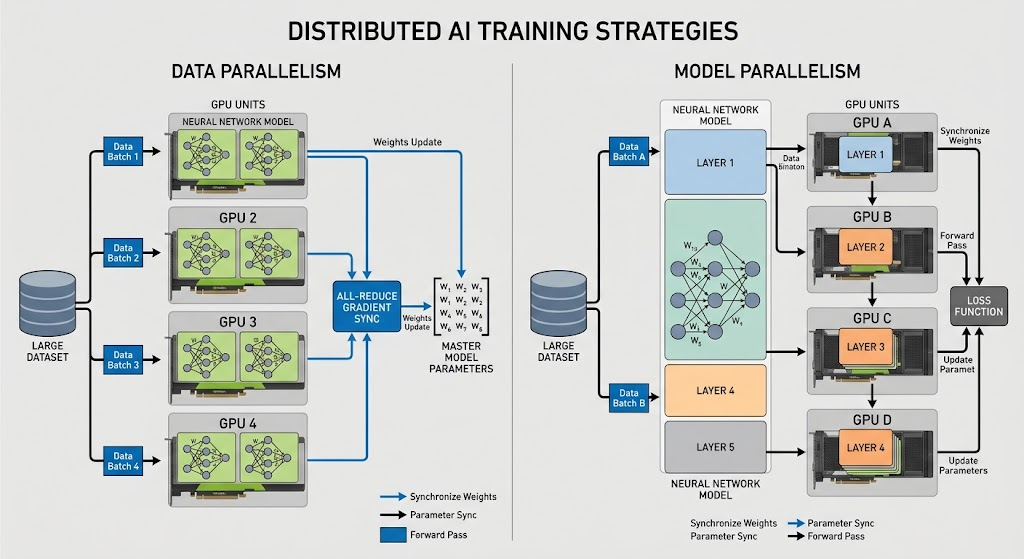
There are different parallel computing approaches that overcome different computational challenges to enhance the training and inference of AI. The most suitable is to see which is the main problem: either size of the dataset, complexity of running the model, memory available on each processor, or amount of communication between processors. In data parallelism, different subsets of the training data are spread across multiple devices with a replicated model. Model parallelism allows the model to be divided across multiple devices, enabling this to work with networks that can not fit easily in a single device’s memory.
There are multiple ways to divide certain mathematical operations (called tensor parallelism) and multiple ways to assign different stages of the model to different processors (called pipeline parallelism). Distributed training combines these techniques over multiple GPUs/cpus, if required. Knowing the differences helps the developers of AI—when designing—pick an appropriate architecture rather than deciding to go with more processors, believing that would bring better performance.
- Data Parallelism
One of the most popular methods of network training distribution is data parallelism. This approach involves several processors or GPUs all computing the same model and processing different chunks of the training set. These devices compute predictions for each example they’re given, then find gradients to show how the model’s parameters should be updated. The gradients are then added together and synchronized between the devices to ensure that they update their model parameters in the same way before moving on to the next step in training. This enables the system to handle a greater number of examples at once than could one device.
For instance, a training task with many photographs of the product would send separate sets to four GPUs. The calculations for each GPU would be executed on the images assigned to it and the training system would manage the updating of those images. To get a more detailed help about this approach, check distributed training and data parallelism. The model is best suited for data parallelism when it can be stored on each device and when there is no need to synchronize data.Data parallelism is best if the model fits into each device, but there are limits of scalability due to synchronizing and memory requirements.
- Model Parallelism
Model parallelism can be beneficial in the event the neural network is too massive to be stored in the memory of a single GPU, or when computations can be split between GPUs and practical advantages of this are achievable. Developers break up the model into chunks and assign each chunk to a device, rather than copying the whole model to all the processors. For instance, the first set of neural network layers could be performed by one GPU and the latter set of layers performed by another GPU. In a forward pass, the intermediate results will pass from one device to the other as information flows through the network. In the back propagation mode, the gradients required also flow through the distributed parts of the model. This way, a group of devices can cooperate with a model whose memory requirements are greater than the capacity of a single device. But communicating between partitions may be a scottish obstacle, especially when devices need to rely on results from other devices to carry out their calculations. But to achieve successful model parallelism, it is important to carefully partition the data, provide sufficient communication bandwidth, and schedule the execution to ensure that there is no excessive idle time.
- Tensor parallelism
There are two techniques to help distribute large neural network computations across multiple devices: tensor parallelism and pipeline parallelism. Tensor parallelism divides the individual math operations, like a large matrix multiply, into smaller math operations that can be performed in parallel across different GPUs. The partial results are then in turn merged to generate the desired output. Rather, parallelism in the pipeline divides various sets of layers in the neural network to separate devices. The training batch can be split into smaller micro-batches, which can flow through these stages, so that one device is training one microbatch while another is training an earlier microbatch. This can increase the efficiency of the hardware used versus a simple arrangement where most of the devices idle until one stage is complete. But idle periods can exist in pipeline parallelism, and tensor parallelism can involve devices communicating often. To meet memory capacity, compute load and communication requirements, large AI training systems typically use a combination of data parallelism, tensor parallelism and pipeline parallelism across the hardware.
Role of GPU Acceleration in AI
Large numbers of mathematical operations can be performed concurrently by graphics processing units (GPUs), which are crucial in modern AI. Graphic Processing Units (GPUs) were created to manage graphics workloads, yet they likewise have turned out to be valuable in machine learning because numerous neural network activities include running comparable calculations on expansive clusters of numerical worths. The CPU will have a relatively few powerful general purpose processing cores in it, while the GPU is designed to be able to perform many operations in parallel. Modern AI accelerators also feature special hardware for typical deep learning operations.
With proper software, these devices can make matrix multiplications and other operations much more efficiently than many computing configurations. GPU acceleration is particularly helpful in the training of neural networks, where similar operations can be performed many times on a large number of examples. However, the performance will vary according to the processor, software implementation, memory size and workload. While a GPU can help solve every problem, it cannot solve every problem, and inefficiency in data movement or in code can make it unable to realize its computational power.
- How GPUs Speed Up Training for Neural Networks
When training a neural network, the computations on weights, activations, inputs, and gradients are repeated. Many of these calculations can be formulated as matrix operations and thus be accelerated with the help of GPUs. A GPU can perform many of the same operations in parallel, rather than one at a time, as a result of its parallel processing capabilities. The performance may be further enhanced with specialized accelerator hardware for certain numerical formats and operations supported. A large matrix multiplication, for instance, could be broken up into smaller blocks and each block could be calculated in parallel, all the partial results added together and combined into the larger matrix.
In training, the GPU performs forward and backward calculations, and the framework takes care of the memory and operations. If the processing power or memory capacity of a single GPU is not sufficient, multiple GPUs can be used. But there are still costs to be taken into account for transferring data from CPU memory to GPU memory and from GPU memory to other devices. Careful selection of batch sizes, efficient kernel design, and a data flow that ensures that all GPUs have work to do are key to optimizing GPU utilization.
- CPUs, GPUs, and Specialized AI Accelerators
GPUs are popular for AI, but AI machine learning systems involve more than just GPUs. CPUs are important to keep programs running, prepare the data, control the processes, and run tasks for which the benefits of massive parallelism are not as great. There are other accelerators such as tensor processing units and other neural processing units that are optimized for specific machine learning functions. Various devices may have different architectures, memory, numerical precision, power consumption, and software support and thus be more appropriate for various workloads.
For instance, the CPU can load batches of training data, and the GPU can carry out calculations for neural networks, so that different parts of the task can run concurrently. There are specialized accelerators that can be useful for specific matrix operations and/or inference workloads, but these are dependent on the model and the tools that are available for development. Instead, AI engineers assess the entire computing system, not just the processors’ theoretical processing power. The goal is to use appropriate hardware for each task without transferring data, spending too much idle time, or suffering data contention.
Distributed Training and Processor Coordination
Distributed training is the parallelism of the training across multiple computing devices and, if needed, multiple computers linked by a network. It is particularly beneficial where the training required is greater than can be achieved with one machine. In a distributed system, there can be multiple servers, each having multiple GPUs, and software can be used to manage the distribution of data and computations between the different GPUs. Just splitting the work is not enough, devices have to exchange information with each other, set and maintain compatible model parameters, and recover appropriately in the event of error.
During data parallel training, for instance, workers compute gradients based on different batches, and then synchronize the gradients before updating the parameters uniformly. Model-parallel training: in parallel devices share intermediate activations and gradients during traversal in different parts of the network. These methods can be applied using frameworks like PyTorch or TensorFlow which offer tools and utilities for implementation, but the developer must configure the framework to ensure it operates correctly, track performance, and make sure that the extra computation is not causing more communication overhead than it is worth.
When processors run a shared training job they need to synchronize their operations, with the model being trained via a consistent training procedure. All-reduce is an operation that is typically used in data-parallel training, and it takes values like gradients from several devices, and sends the sum of those values back to the devices. After synchronizing, the devices can update the model parameters and start training again. Communication is necessary for intermediate results to be transferred between the various portions of the model in model-parallel training. The reason for these exchanges is that the output of a device can be needed by another device before that device can be used for the next calculation. The delay in communication may cause some processors to be idle, when there is computational work to be done elsewhere. Engineers solve this problem by using efficient communication libraries, high bandwidth interconnects, appropriate partitioning and techniques that align communication and computation as much as possible. The aim is to maintain devices utilised in a way that allows for their productive use but also ensures that the correct training process itself is maintained.
Distributed Training Frameworks and Tools
There are several machine learning frameworks to coordinate computations across multiple GPUs and computers, making distributed training a possibility. PyTorch offers DistributedDataParallel for data parallel training, and other methods for more sophisticated memory management or partitioning of models. TensorFlow provides distributed training strategies that allow partitioning model computation over available devices. Other tools help to train large neural networks in specialized ways, such as partitioning of model parameters, partitioning of layers, or communication optimization between workers.
While these are tools that help to lessen the amount of low level infrastructure that the developer must construct, the use and efficacy of such tools depend on knowledge of workload and hardware. For some models, a simpler training setup might be appropriate because they fit comfortably on a single GPU, while for a very large transformer, multiple parallelization techniques may be necessary. Developers should consider the amount of training throughput they need, how much memory is being consumed, the amount of communication overhead incurred, and how well models converge — not simply assume a more complex distributed configuration is faster and/or cheaper.
Parallel Computing in the age of AI and the Future
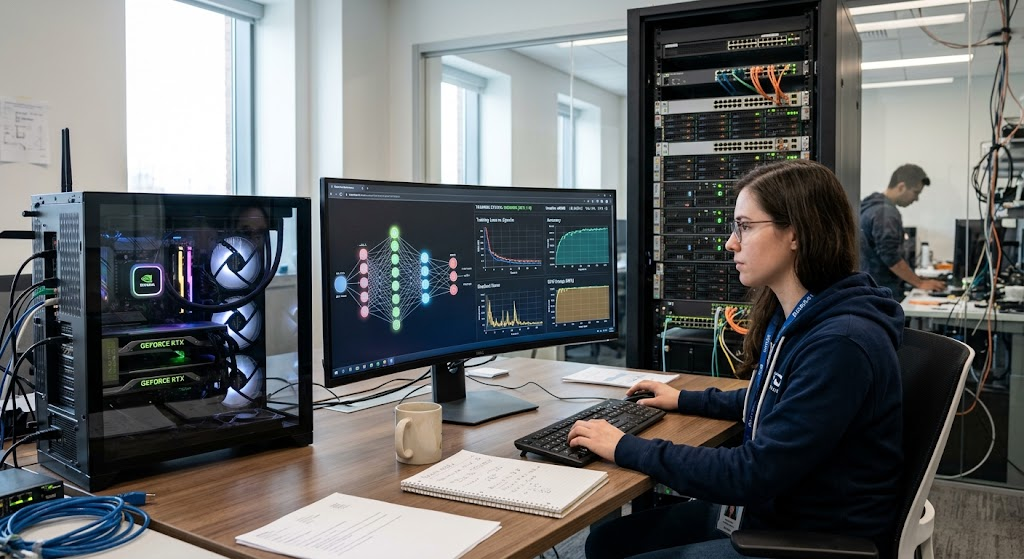
Many AI applications can benefit from parallel computing, as it can help to process information faster and allow for larger models to be used. It’s notably significant in generative AI, recommendation systems, computer vision, and NLP. These applications vary in their data types, computational needs, and can involve workloads that can take advantage of parallel processing of multiple operations. Training neural networks on vast amounts of text, images, audio, or other types of information can require significant computing power for generative AI systems.
The key challenge of recommendation systems is to understand the user’s behavior and product information to forecast what products might matter to a particular user. CVS’s analyze visual data, and NPS’s analyze or create human language. For these applications, parallel computing can be applied to training and inference, but the faster the application requires the more data is available, and the different architectures of the model, the more suitable parallel computing scheme can be used. The examples illustrate how parallel processing can give rise to practical abilities in contemporary technology.
- Generative Artificial Intelligence
Generative AI systems create new content, including text, images, audio, video, and computer-generated code. Many of these systems use large neural networks trained on extensive datasets, with transformer-based architectures playing a major role in text generation and related tasks. Training such models can involve repeated matrix operations across numerous layers and large quantities of data, making parallel computing particularly valuable. Data parallelism allows different GPUs to learn from separate training examples, while tensor and pipeline parallelism can distribute the computations and parameters of large models across devices.
Once a model has been trained, parallel processing can also help serve requests from many users or calculate different parts of a generation workload efficiently. However, inference does not always scale in the same way as training because some generation steps depend on earlier outputs. The computing requirements also vary according to model size, output length, and the number of simultaneous requests. Parallel computing therefore helps generative AI systems scale, but efficient scheduling and memory management remain essential for controlling latency and cost.
- Recommendation Systems
Recommendation systems help people discover products, films, music, articles, and other items that match their interests. Online stores, streaming services, and digital platforms may need to analyze large volumes of user activity, product information, ratings, and interaction histories to produce useful suggestions. Parallel computing can accelerate the processing of these records and the training of models that learn relationships between users and items. For example, a recommendation model may learn from millions of interactions to estimate which products a particular customer is likely to find relevant.
Data processing can be distributed across multiple computers, while model training can use parallel operations to calculate predictions and update parameters more efficiently. Parallel systems can also support recommendation services that must respond to many requests concurrently. Nevertheless, the system must account for data freshness, storage access, and response-time requirements. An effective recommendation architecture combines efficient computation with good data quality and evaluation methods, ensuring that the system’s predictions are useful rather than merely fast to produce.
- Computer Vision
Computer vision enables computers to interpret visual information from photographs, videos, medical scans, industrial cameras, and other imaging devices. Common applications include object detection, facial recognition, quality inspection, autonomous navigation, and medical image analysis. Training computer vision models can require processing large collections of high-resolution images and performing many mathematical operations across convolutional or transformer-based neural networks. Parallel computing allows different images or image batches to be processed concurrently, while GPUs accelerate the calculations required by the model.
In a manufacturing environment, for example, a vision system could analyze images of products to identify visible defects, helping inspectors prioritize items that require further examination. Parallel processing can improve the throughput of this analysis when the workload and hardware support concurrent execution. However, real-time systems must also consider camera input rates, image transfer, memory usage, and inference latency. For safety-critical or medical applications, high computational performance must be accompanied by rigorous testing, suitable accuracy, and appropriate human oversight.
- Natural Language Processing
Natural language processing (NLP) allows computers to analyze, interpret, and generate human language. It supports applications such as translation, document classification, sentiment analysis, information extraction, summarization, and conversational assistants. Modern NLP systems often use neural networks that process sequences of tokens, with transformer architectures relying heavily on attention and matrix operations. During training, parallel computing enables the system to process multiple examples together and distribute calculations across available accelerators.
Some operations within a training batch can be performed concurrently, although the relationships between tokens and model layers create dependencies that limit complete independence. Large language models may also require model parallelism when their parameters and intermediate activations exceed the memory available on one device. During inference, systems can process multiple user requests together or distribute a model across devices to improve throughput. These strategies make it possible to support increasingly capable language applications, but developers must balance computational speed with memory use, response latency, reliability, and the quality of generated results.
Major Challenges of Parallel Computing in AI
Despite its advantages, parallel computing introduces technical and operational challenges that can limit the performance of AI systems. Adding more processors increases the available computational resources, but it also creates additional demands for communication, memory, data management, and coordination. Some machine learning operations can be distributed efficiently, while others depend on results that must be produced first. In distributed environments, network delays can reduce the benefits of using additional devices, and differences in processing speed may leave some workers waiting for others.
Hardware availability can also be a problem because advanced accelerators may be expensive or difficult to access in sufficient quantities. Energy consumption, cooling requirements, and infrastructure costs further complicate large-scale AI development. These challenges mean that parallel computing is not simply a matter of adding more GPUs to a machine learning project. Developers need to identify bottlenecks, measure real performance, and select a parallelization strategy that delivers worthwhile improvements for the resources available.
- Memory Limitations
Memory is a major constraint in AI training because a neural network requires space for its parameters, intermediate activations, gradients, and optimizer states. Large training batches and high-resolution inputs can increase these requirements substantially. When a model exceeds the memory capacity of a GPU, the training process may fail or require changes to the model, batch size, or memory-management strategy. Model parallelism can address this problem by distributing different portions of a network across multiple devices, while sharding techniques divide model states among workers rather than maintaining every component in full on every GPU.
Other approaches include activation checkpointing, which trades additional computation for lower memory requirements, and mixed-precision training, which uses supported lower-precision numerical formats for appropriate operations. Each technique involves trade-offs involving speed, memory use, complexity, or numerical behavior. Developers should monitor memory consumption throughout training and choose a combination of strategies that allows the model to run reliably without sacrificing more performance than necessary.
- Communication Delays and Network Bottlenecks
Communication delays become increasingly important when an AI workload is distributed across multiple devices or computers. A GPU may complete its local calculations quickly but then need to wait for gradients, model parameters, or intermediate results from other workers. In data-parallel training, synchronization can become expensive as the number of devices increases or the amount of information exchanged grows. In model-parallel training, frequent communication between partitions may slow down the forward and backward passes.
Network bandwidth, communication latency, device interconnects, and the placement of model components all influence the outcome. Engineers can reduce these costs by choosing suitable hardware, improving data placement, overlapping communication with computation, and organizing workloads to limit unnecessary transfers. They may also test whether using multiple GPUs within one server is more efficient than distributing the workload across several servers. The goal is to ensure that communication overhead remains small relative to the useful work being performed by the parallel system.
- Hardware Availability and Financial Costs
Training large AI models can require specialized accelerators, substantial memory, fast storage, high-bandwidth networking, and reliable power and cooling systems. Purchasing and maintaining this infrastructure can be expensive, especially for small businesses, independent researchers, educational institutions, and early-stage technology companies. Access to rented computing resources can reduce the need for large initial investments, but extended training jobs may still generate significant expenses. Hardware availability can also limit experimentation when many organizations compete for suitable accelerators.
Developers can manage these challenges by starting with smaller models, optimizing data pipelines, using pretrained models when appropriate, and evaluating whether distributed training is genuinely necessary. They may also compare the total cost of different computing configurations rather than focusing exclusively on raw processing speed. A more expensive configuration is not automatically the best choice if its performance advantages are small or its hardware remains underutilized. Careful planning helps organizations balance model quality, development time, computational capacity, and budget constraints.
- Energy Consumption and Environmental Impact
Large-scale AI computation can consume substantial amounts of electricity, particularly when many accelerators operate continuously during extended training runs. Energy use also creates heat, increasing cooling requirements and contributing to the overall operating cost of computing facilities. Parallel computing may reduce the time required to complete a task, but using more processors does not guarantee that the task will consume less total energy. The result depends on hardware efficiency, communication overhead, workload utilization, and the duration of the computation. Organizations can improve efficiency by selecting suitable accelerators, reducing unnecessary experiments, optimizing numerical operations, and ensuring that computing resources are not left idle while powered on.
They can also evaluate whether smaller models or more efficient inference methods meet their requirements. Measuring energy use alongside training time and model quality provides a more complete view of system performance. As AI adoption expands, improving computational efficiency will be important for managing operating costs and limiting the environmental impact of increasingly demanding workloads.
Strategies for Improving Parallel Computing Performance in AI
Improving parallel computing performance requires developers to evaluate the entire machine learning workflow, from data preparation to training, synchronization, and inference. A useful starting point is profiling the application to determine where time and resources are being spent. If a GPU frequently waits for data, improving the input pipeline may produce more benefit than adding another accelerator. If the model cannot fit into memory, model sharding or other memory-management techniques may be necessary.
If communication dominates execution time, changing the distribution strategy or improving the hardware interconnect may help. Developers should also select batch sizes and numerical precision carefully, because these choices can affect both speed and model quality. Distributed configurations need to be evaluated under realistic conditions, with measurements of throughput, latency, memory usage, energy consumption, and training convergence. This approach helps identify improvements that deliver measurable benefits instead of increasing system complexity without solving the actual performance problem.
- Choosing the Right Parallelization Strategy
Selecting a parallelization strategy begins with understanding the workload’s main limitation. When a model fits on one GPU but training data is extensive, data parallelism may be a practical way to increase training throughput. When model parameters and intermediate calculations exceed the available memory, model parallelism or sharded training may be more appropriate. Models with many repeated layers may benefit from pipeline parallelism, while operations involving very large matrices may benefit from tensor parallelism.
Some large-scale projects combine multiple strategies to accommodate both dataset size and model complexity. Developers should also consider the cost of transferring data, the available network infrastructure, and whether the training framework supports the required approach. It is often sensible to establish a reliable single-device baseline before introducing distributed training, since a simple implementation can be easier to debug and may already meet performance requirements. The best solution is the one that meets the project’s objectives with an appropriate balance of speed, accuracy, reliability, and cost.
- Monitoring, Profiling, and Optimization
Performance optimization should be guided by measurements rather than assumptions. Profiling tools can reveal whether a workload is limited by computation, memory transfers, data loading, communication, or synchronization. Developers can monitor GPU utilization, memory consumption, training throughput, time spent in communication operations, and the time required to process each batch. They should also measure model quality during optimization because changes to batch sizes, numerical precision, or training configurations can influence convergence.
For example, increasing the number of GPUs while keeping the local batch size unchanged may increase the overall batch size, which can require adjustments to training parameters. A useful optimization process establishes a baseline, changes one or more clearly identified factors, and compares the results under consistent conditions. Repeating this process helps teams distinguish genuine improvements from measurement noise and identify configurations that work reliably. Performance testing should continue after deployment because production workloads can behave differently from controlled experiments.
The Future of Parallel Computing in Artificial Intelligence
The future of AI will likely involve continued efforts to improve the efficiency of parallel computing as models and datasets become more complex. Hardware developers are designing accelerators with improved computational throughput, memory bandwidth, and support for common machine learning operations. Software researchers are developing more efficient distributed training systems, memory-management techniques, and scheduling methods that reduce communication overhead. At the same time, AI developers are exploring smaller specialized models, mixture-of-experts architectures, and other approaches that can reduce the amount of computation required for particular tasks.
These developments do not eliminate the need for parallel processing; instead, they aim to use available computing resources more effectively. Future systems will need to balance performance, accuracy, cost, accessibility, and energy consumption. Progress will therefore depend not only on increasing the number of processors but also on improving how software and hardware cooperate. Efficient parallel computing will remain an important part of making advanced AI systems practical for research, businesses, and everyday applications.
Making Advanced AI More Accessible
Access to computing resources can influence who is able to develop, evaluate, and deploy AI systems. Large organizations may have the resources to operate extensive GPU clusters, while smaller teams may need to work within more limited budgets. Improvements in parallel computing can help make advanced workloads more manageable by reducing training time, improving hardware utilization, and allowing computational tasks to be distributed more efficiently. Cloud computing services can provide access to accelerators without requiring organizations to purchase an entire infrastructure, although the cost of using these resources still needs to be considered.
Developers can also build on pretrained models, optimize existing systems, or choose architectures that require fewer resources. Open-source frameworks and accessible educational materials help more people learn how distributed training works. However, access involves more than computing power: high-quality data, technical expertise, reliable infrastructure, and responsible evaluation are also necessary. Making AI more accessible will require continued progress in hardware efficiency, software design, and practical approaches to managing computational costs.
Conclusion
Parallel computing has become a fundamental part of modern artificial intelligence and machine learning because it enables computational workloads to be distributed across multiple processors and devices. Techniques such as data parallelism, model parallelism, tensor parallelism, and pipeline parallelism help AI developers train complex neural networks, process large datasets, and support demanding applications. GPU acceleration provides substantial benefits for many mathematical operations, while distributed training allows multiple devices and computers to cooperate on workloads that exceed the practical limits of a single machine.
These capabilities support advances in generative AI, recommendation systems, computer vision, and natural language processing. Nevertheless, effective parallel computing requires careful management of memory, communication, hardware costs, and energy consumption. More processors do not always translate into proportionally better performance, so developers must measure bottlenecks and select appropriate techniques. Ultimately, the successful development of increasingly capable AI systems will depend on combining efficient algorithms, suitable hardware, well-designed software, and responsible resource management.