While many modern computer programs can run simultaneously, classic programs will typically run one after another. Parallel programming is the technique that is used by developers to make use of multiple processing units which enable different portions of a problem to be solved in parallel. In contrast to a single processor core doing all of the operations one by one, a parallel program distributes appropriate work among smaller chunks and assigns them to multiple threads, CPUs, GPUs, or even separate computers via a network.
It can greatly speed up challenging applications and is particularly beneficial in scientific simulations, artificial intelligence, data analysis, image processing, video applications, and large-scale business systems. A new introduction to programming may find parallel programming difficult to take on because of the concepts of race conditions, communication, synchronization, processes and threads that are brought into the mix. But the concept is simple: determine independent work, break it into sections properly, perform the sections simultaneously, and combine them when necessary.

What Is Parallel Programming?
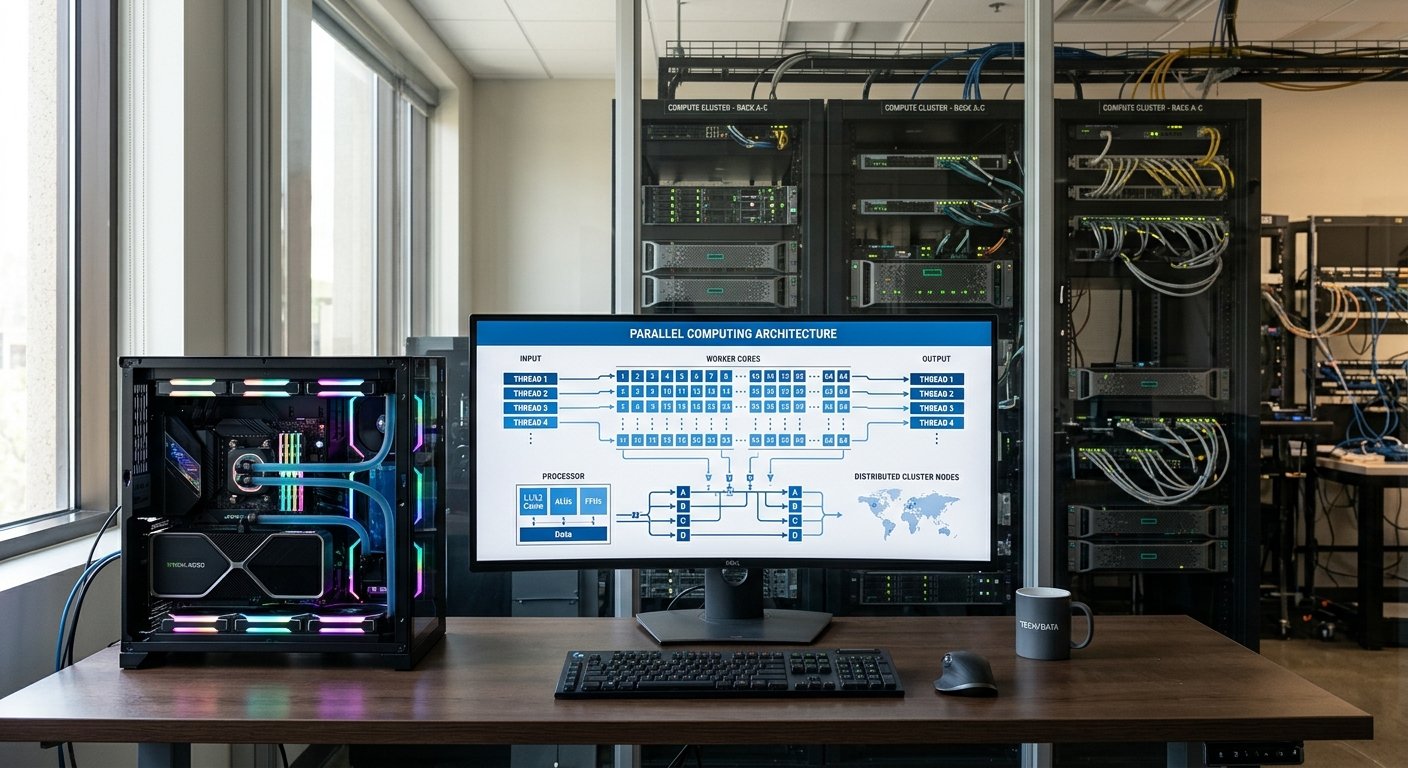
Parallel programming is software development technique which is based on dividing a problem into smaller parts and solving them concurrently. Typically, a sequential program is going to have a sequence of tasks: Task A, Task B, Task C, and so on, until the program ends. A parallel program searches for any opportunities where A and B can be executed in parallel without dependency. Suppose there is one application which requires one million independent numbers. A sequential program may process all the numbers via one execution path, and a parallel program may split the numbers into multiple groups, enabling multiple CPU cores to work simultaneously on these groups. The results can then be compiled: Thus, parallelism isn’t just about getting the program to run on multiple cores, but about structuring the work to enable multiple computing resources to advance usefully at the same time.
Concurrency is similar, but not synonymous with parallel programming. Concurrency refers to the ability to have several tasks making progress at the same time; parallelism is concerned with performing multiple operations concurrently, typically on multiple processing resources. A computer with multiple CPU cores can simultaneously run multiple threads, and thus can be used for parallel workloads. While a single-core system might be able to handle multiple tasks at once by rapidly switching between them, it does not mean that the tasks are necessarily being done concurrently. This concept is very important to know for the beginning programmer in order to select the proper programming method. Some applications only gain advantages from concurrency, when it waits for input or network operations, others gain advantages when they are able to be executed truly parallel with multiple CPU cores or GPUs and are computationally intensive.
Threads and Processes
One of the most frequently used fundamental constructs of parallel programs is the thread. A thread is a single flow of instructions that is part of a process. Within the same process, different threads typically have access to the same memory, and it is relatively easy for them to communicate. For instance, the user-interface operation could be processed by one thread and a lengthy calculation performed in a second thread. Several worker threads can share computational tasks across multiple CPU cores in an appropriate environment. Shared memory poses problems, however, due to the possibility of two threads reading or trying to change the same memory at the same time. When shared resources are to be accessed safely, developers are thus required to use mechanisms for synchronization. Threads can be very efficient, but need to be carefully designed as bugs with timing or shared state can be hard to replicate.
Another type of organizing parallel work is by using processes. Processes are separate running instances of a program (with their own memory space). Processes are typically not directly shared by other processes in the same way that threads are shared in ordinary memory, giving them more ability to offer stronger separation of tasks. To communicate between processes, one has to use some other IPC techniques like queues, pipes, shared-memory systems, etc. Processes can be especially helpful when one programming language or runtime system restricts the ability of threads to perform CPU intensive tasks. For example, Python has a multiprocessing module for allowing the creation of multiple processes for computational operations. The downside is that processes tend to consume more resources than threads, and it can be possible to add more overhead when transferring data between threads and processes. Therefore, the decision between threads and processes will be based on the workload, the programming language used, the amount of data to be shared and the goal of the application.
Task Decomposition: Dividing Up a Problem
The first crucial skill for parallel programming is task decomposition. Task decomposition involves dividing a large task into smaller sub-tasks that may be able to be performed independently. Good decomposition allows the work to spread across CPU cores, across the GPU execution units or across several computers. Suppose, for instance, there’s an application that needs to resize 10,000 independent images. The program can split up the images into groups, and have different workers perform these groups. The workload is naturally parallel as the result of one image is not needed for processing another image. The same methods can be employed by developers when working with a large data set, when performing mathematical functions, when graphing images, when simulating phenomena, or when analyzing independent data records.
Efficient division is not possible for every problem. Certain operations are highly dependent on results of previous operations and they can’t be executed in parallel with that. Think about calculating something where the results of each step are used in the next step. If done concurrently, those steps might yield the wrong results as the data needed will not yet be available. Other workloads might be partitioned, but in each partition may be too small of a workload to surpass the overhead of worker creation and coordination. Creating many threads is not sufficient for effective parallel programming. Developers must understand the inter-dependencies within the workload, determine how much useful work can be performed in parallel, and decide whether or not the running time of the parallel configuration will be shorter than the running time of the sequential configuration.
Synchronization and Race Conditions
Synchronization is necessary when several workers are working on the same data. Synchronization is the coordination of concurrent operations to ensure safe concurrent operations that yield predictable results. Some of the popular synchronization techniques are Locks, Mutexes, Semaphores, Barriers, Atomic Operations, and Thread-safe Data Structures. For instance, assume that some threads are concurrently accessing a single counter. If both threads access the same variable at the same time, increment by one and then store them back, one update might be lost. The end result may consequently be less than anticipated. A synchronization mechanism could be implemented to ensure that only one worker can update the shared counter at the right time. While many errors can be prevented by synchronizing the workers, too much synchronization can also lower the overall performance as workers can be waiting too long for each other.
A race condition is when the outcome of a program relies on the unpredictable timing or ordering of concurrent operations. One of the toughest bugs in parallel software are race conditions, which can occur where a program might work on one run and fail on the next. The problem only occurs when two or more threads simultaneously execute the same part of a program at the same time. Minimizing shared mutable data, using safe communication patterns, protecting critical sections and carefully defining resource ownership will help with minimizing race conditions. Testing parallel programs is also difficult because they must be executed repeatedly, and the process must be deliberately stressed, since a program that is correct one time does not automatically imply that it is safe to run under a different scheduling.
OpenMP for Shared-Memory Parallel Programming
OpenMP is a popular parallel programming framework used in C, C++, and Fortran. It is optimized for shared memory systems, in which multiple threads run in the same memory environment. OpenMP provides the ability to insert compiler directives, library calls, and environment variables to affect parallel execution. It has some important benefits for novice programmers, too: It can be possible to incrementally parallelize a sequential program without having to redesign it entirely. A loop that does the same calculation on thousands of elements, for instance, might be appropriate for parallel processing. OpenMP can partition that loop into different iterations across multiple threads, thereby enabling multiple CPU cores to operate concurrently.
A basic OpenMP concept is to split the iterations of a loop (e.g., calculating square for each element of an array) across the parallel threads by dividing them as per OpenMP rules. Every thread gets a chunk of the loop and does its own calculations. The programmer is still responsible for determining if the variables are shared or private and if any operation needs synchronization. OpenMP is particularly valuable for applications that leverage a multi-core CPU system where the application developer requires more control over the thread-based parallelism without having to construct a complex distributed application. It supports concepts like parallel regions, work sharing, reductions, thread counts and synchronization and can be very similar to writing in C or C++.
Message Passing Interface (MPI) for Distributed Computing
Message Passing Interface (MPI): It is intended for a different parallel environment. MPI provides explicit passing and receiving of messages so that the various processes don’t have to assume that everyone has the same memory. This is especially useful for distributed-memory machines and computing clusters (a set of computers that share a large problem). Each process may have its own memory, and information is shared via communication operations. For instance a large geographic region may be broken up into several regions and each process assigned a geographic region, with the neighboring processes sharing information with the other regions as the simulation proceeds.
The reason behind the power of MPI is that it can be spread across a single computer, implying it can be extended across multiple computers. Many machines can comprise a cluster, and a well-designed application can spread a tremendous amount of work out across a mass of computing resources. But MPI adds more complexity for the developer to consider issues such as data distribution, communication overhead, process synchronisation and failure. If too many processes are spending a long time in the exchange of messages rather than doing some useful computation, the application could have poor scalability. MPI is thus well suited for scientific computing, engineering simulations, large scale numerical calculations, etc., where the problem can be split between a number of machines.
CUDA and GPU Programming
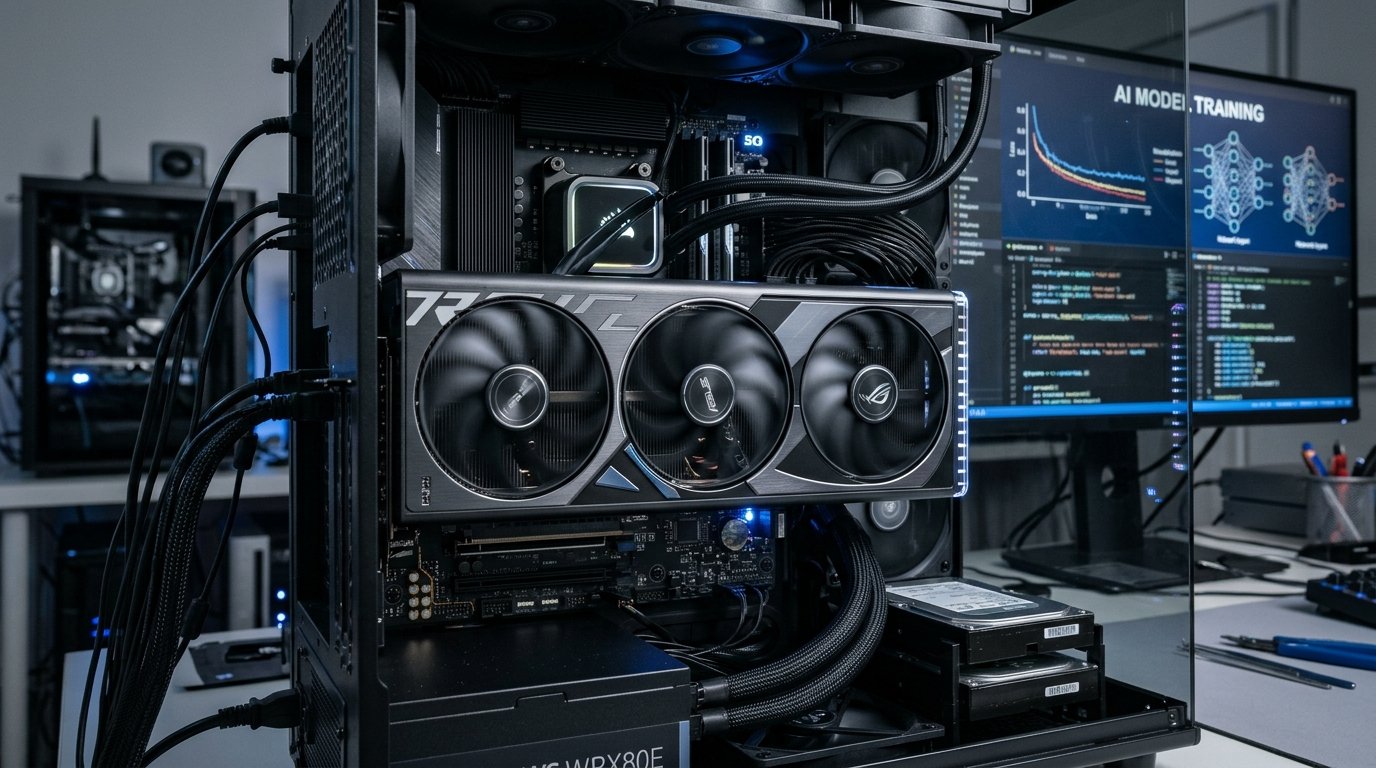
Graphics processing units (GPUs) have numerous processing units that are capable of performing a vast number of similar operations quickly. While initially designed for graphics, GPUs are now being used for scientific computing, machine learning, numerics, image processing and more, of course, where there is significant data parallelism. NVIDIA gives CUDA as a platform and model for software development which leverages compatible NVIDIA GPUs. GPU programs can run a very high number of lightweight execution units running in parallel, rather than a few large tasks being assigned to CPU cores.
CUDA offers an introduction to the platform and its history for novices who want to learn more about GPU computing. The developers need to be familiar with the concept of the difference between the CPU (the host) and the GPU (the device) used in CUDA programming. In between calculations, data might be required to be moved from CPU memory to GPU memory, and the other way around. Those transfers can add overhead, so GPU acceleration is best utilized when there is sufficient amount of parallel computation to warrant it. Examples of workloads that may benefit from execution on a GPU include image transformations, simulations, machine learning calculations and matrix operations.
CUDA also presents a new way of thinking about parallel algorithms. Developers can write a single number of CPU threads (GPU kernels) that will be run by many CPU threads (GPU threads). The threads are grouped into blocks, then organized into grids, and finally the computer’s graphics processing hardware allocates them over its available resources. The most beneficial applications of the GPU tend to have a lot of computations on data that can be computed independently. Algorithms that have significant branching, synchronization, or data movement may not be as well suited. By learning CUDA, the programmers gain insight of how to use the hardware architecture to influence the design and performance of the software.

Parallel Programming in Python
Multiprocessing and Numerical Computing Libraries
Python is widely used by programmers and is also easy to learn due to its readable syntax and rich libraries, while also offering multiple methods for parallel/concurrent programming. The multiprocessing module lets you write multiple processes that do CPU intensive work independently. This can be beneficial for working with large sets of files, independent numeric calculations, or analyzing individual parts of a data set. A typical architecture is to have a pool of worker processes and assign tasks to them. The main program receives the results from the workers when finished. Process startup costs and the amount of data that needs to be sent from one process to another should still be taken into account by developers; if the amount of communication is too great the performance benefit will be lost.
Python also has strong numerical libraries that may allow for more accessible parallel and/or optimised computation. Many mathematical operations are available that can perform these operations much faster than equivalent pure-Python loops, thanks to efficient array operations provided by NumPy, which are implemented mostly in optimized native code. There are also libraries that offer other scientific-computing features (SciPy), and other Python software that can enable multiprocessing, distributed computing, machine learning, and GPU acceleration. In practice, the developers of Python programs often optimize their programs for performance using a number of optimized array operations or specialized libraries, rather than implementing a large number of Python-level threads. It varies based on the workload type like CPU bound, I/O bound, numerical, distributed, and GPU bound.
A Simple Example of Parallel Programming
Suppose one novice is about to add up one million numbers. A sequential approach would work on a number from one to the other and have a running total. A parallel method may consider four of the pieces of the collection, and have four workers sum parts of the collection. When the workers are finished, the program sums the four partial sums to get the total. The key is that each worker is able to make its own calculation without having to wait for the other workers. The last combination is coordinated. This is a typical pattern in real-life applications such as totaling, maximum, counting, and numerical aggregation.
This can be extended to more stimulating projects. A novice might write a program that uses multiple processes to count the words in a folder of thousands of text files. A second project might be splitting up a big set of images and determining some basic properties like dimensions, file size or pixel statistics. These projects involve real-life practice of task decomposition, worker management, communication and aggregation of results. With those concepts established, students will be able to take steps toward more complex applications like numerical simulations, matrix operations on parallel processors, processing images on the GPU, and distributed data analysis.

Common Debugging Challenges
Debugging parallel programs can be harder than debugging sequential programs because things can run in different order from one run to another. Under the same conditions, it may fail at the same line in a sequential program, and the problem may be easily reproduced. A parallel program might have varying behavior in various ways of scheduling threads or processes. Difficult failures can occur due to Race conditions, Deadlocks, Incorrect synchronization, Lost messages, and Unexpected data dependency. For example, a deadlock can result when two workers are waiting for a resource being held by the other, thus becoming stuck in an infinite wait. Thus, debugging tools for concurrent systems are required for developers.
One good approach is to first implement the code sequentially, then add parallelism. The sequential version serves as a reference to compare with the parallel version. The developers can then take one part at a time, parallelize it and test the result after each change. Logging can be useful to get a sense of when tasks are being started and finished by workers, but too much logging by too many workers can make programs slower and less comprehensible. Profilers and timing tools should also be utilized by the developer to find out where the real time of the program is going. It is very important to measure the performance before and after parallelization because increasing the number of workers does not necessarily increase the speed of execution.
Selecting the Appropriate Parallel Programming Tool
The choice of the tool will be largely influenced by the amount of work and hardware available. OpenMP is a good choice if the application is implemented in C, C++ or Fortran and is intended to make use of multiple CPU cores in a shared memory system. MPI is more appropriate for applications that need to partition work among several processes or computers, such as applications involving clusters or large scientific jobs. When a numerical or data-processing application is highly parallel and is capable of leveraging NVIDIA GPUs that are compatible with CUDA, then CUDA is a natural fit. Python multiprocessing can be used for CPUs tasks that can be split into independent tasks, and Python numerical libraries offer highly optimized operations without having to implement all the low-level parallel details the beginner has to work out.
One good approach to making the decision is to start off with the problem instead of the technology. Check if the workload has independent tasks. Then, check what hardware is available and whether the application is limited by CPU computation, memory access and/or input/output and communication. Shared memory programming models like OpenMP or multiprocessing can be used if the work load can be fitted on a single multicore machine. MPI or some higher-level distributed framework may be better if it has to run across multiple computers. GPU programming could be of significant value if the calculations involve many similar operations that can be performed concurrently. This is a problem-first approach that will prevent developers from selecting a complicated technology because it’s hot.
Beginner-Friendly Parallel Programming Projects
Beginners can learn parallel programming effectively by starting with projects where the tasks are naturally independent. A parallel image-processing application is a good example because individual images can often be processed separately. Another project could calculate statistics for a large collection of files, with each worker handling a different group of files. A Monte Carlo simulation is also useful because many independent random trials can be executed separately before their results are combined. These projects allow learners to practice dividing work, creating workers, collecting results, measuring execution time, and checking whether the parallel version produces the same results as the sequential version.
After completing simple projects, learners can increase the complexity by introducing shared data and synchronization. For example, a program could process many files and maintain shared counters for different categories. This creates opportunities to study locks, race conditions, and safe result aggregation. More advanced learners can then experiment with OpenMP for multicore CPU applications, MPI for cluster-style workloads, or CUDA for GPU acceleration. The goal should not simply be to use as many workers as possible. Instead, learners should develop the habit of measuring performance, identifying bottlenecks, considering communication overhead, and selecting a parallel strategy that fits the structure of the problem.
How to Start Learning Parallel Programming
The best way to begin parallel programming is to build a strong foundation in ordinary programming first. Learners should be comfortable with variables, functions, loops, data structures, file handling, and basic algorithms before attempting advanced concurrency. Once those fundamentals are familiar, the next step is to learn how threads and processes work and to experiment with small programs where the work can be divided naturally. Python multiprocessing is accessible for beginners, while C or C++ developers can explore OpenMP. Learners interested in high-performance computing can later study MPI and GPU programming. At every stage, it is important to compare the parallel implementation with a sequential version and verify that the results remain correct.
Performance measurement should become part of the learning process. A program that uses eight workers is not necessarily eight times faster than a program using one worker. Worker creation, synchronization, communication, memory access, and other overheads can reduce the theoretical speedup. In addition, some parts of an application may remain sequential, limiting the maximum benefit of parallel execution. Beginners should therefore record execution times under different conditions and ask why performance changes. This habit teaches an important lesson in parallel computing: good parallel software is not defined by the number of threads or processors it uses, but by how effectively it turns available computing resources into useful work.
Conclusion
Parallel programming enables developers to design software that takes advantage of multiple CPU cores, GPUs, and computing systems working together. Its central idea is to divide suitable workloads into smaller pieces, execute independent operations concurrently, and coordinate the results safely. Understanding threads, processes, task decomposition, synchronization, and race conditions provides the foundation for working with more advanced technologies. OpenMP offers a practical approach to shared-memory CPU parallelism, MPI supports communication between processes across distributed systems, CUDA enables programming for compatible GPUs, and Python provides accessible multiprocessing and numerical-computing options for many applications.
For beginners, the most effective path is to start small and focus on problems that naturally contain independent tasks. Simple projects involving file processing, image operations, numerical calculations, or simulations can demonstrate the fundamental principles without requiring a large computing cluster. As skills develop, learners can experiment with multicore CPUs, distributed systems, and GPUs while learning how to measure performance and diagnose concurrency-related bugs. The most important lesson is that parallel programming is not simply about making many things run at once. It is about understanding a problem deeply enough to identify useful parallel work, choosing an appropriate programming model, coordinating that work safely, and measuring whether the resulting application is actually better.