Introduction
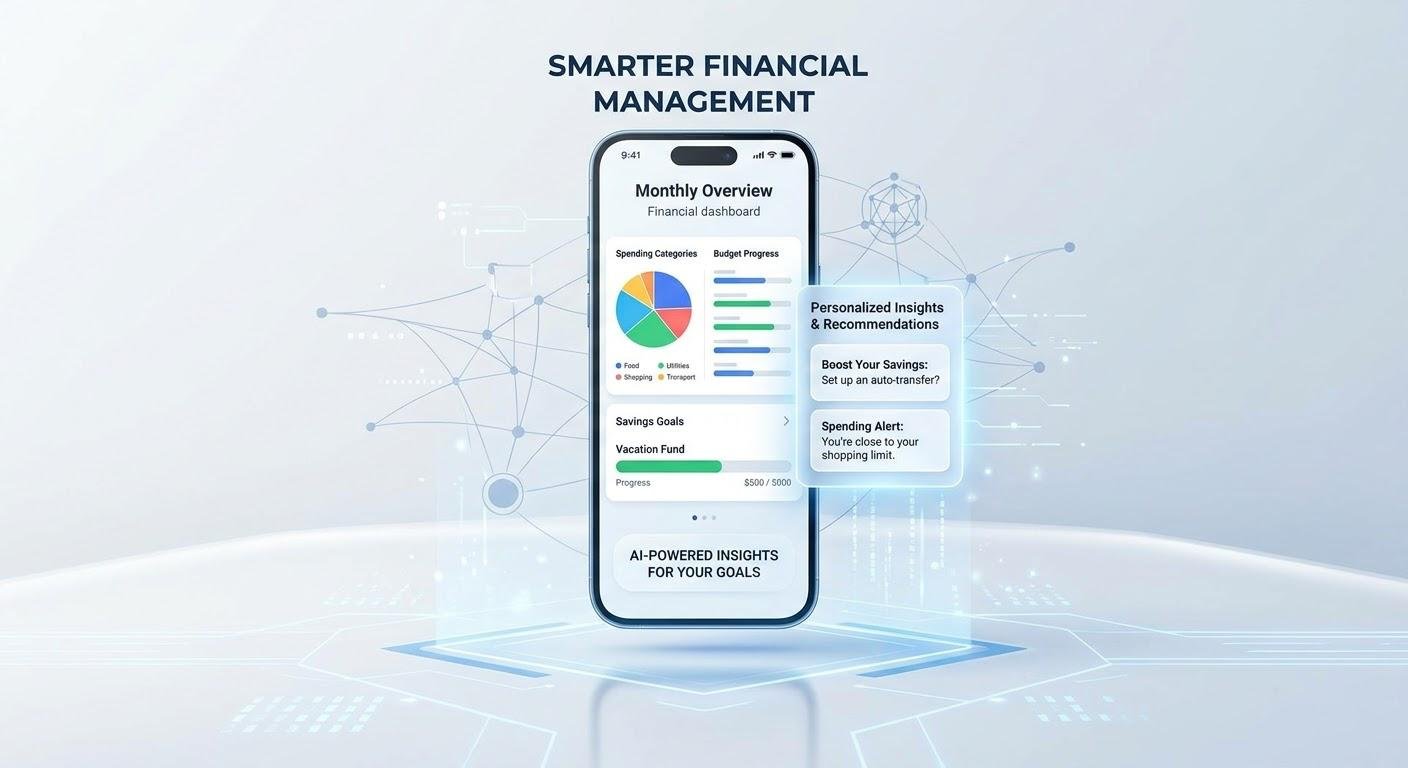
Good financial management is more than just earning income and making timely payments on bills. People also require an understanding of their spending patterns, to plan for future costs, to save, and to be able to make a sound financial decision. Artificial Intelligence (AI) is playing a significant role in meeting these needs and changing the way customers interact with their money, for banks and financial technology businesses. By leveraging personalized financial services, financial institutions can generate insights based on transaction data and analysis tools, which will be tailored to the financial situation of the individual customer, rather than making the same type of recommendations to all. Mobile banking applications can classify purchases, approximate future expenses, give suggestions on saving and alert with relevant notifications. These features enable customers to gain insights into their financial habits and make informed decisions to manage their finances more effectively.
Personalization of Banking Services with AI
Traditional banking services are primarily transactional, account-centric, payment oriented and offer basic financial products. With AI, there’s a more personalized approach as patterns of customer activity are analyzed and used to create relevant information. Machine learning models can analyses transaction data, deposits, regular bills and account balances to detect behaviors which could impact a person’s financial situation. For instance, an app could identify that the customer has a lot more spending power for transportation during certain weeks, or frequently buys a few transportations every month. It can then provide information to the customer that will enable him or her to gain an understanding of these costs. But the value of such recommendations relies on the precision of the info available, the efficacy of the analytical model and if the customer has actually given the required data processing.
Spending Categorization using Artificial Intelligence
An automatic categorization of the funds spent is one of the most useful uses of AI for individual finance. An application could be used to categories transactions based on the description, merchant, payment volume and previous spending trends of customers, eliminating the need for them to manually enter each transaction. This helps to give a clearer view of the spent cash flow every month. For example, a consumer who thinks that he or she is spending money on “lifestyle” purchases might find out that he or she is spending more on groceries and other small electronic purchases.
AI can also enhance the categorization process by learning from corrections made by the customer when he or she catches a category mistake. This can be useful in the long run to make spending reports more useful. However, automated systems may not be smart enough to recognize the merchant description, cash withdrawals or multiple types of purchases. So, customers need to be able to check and edit categories. It’s essential that they’re accurate, as the budgeting recommendations and financial forecasts can get confused if the dollar details of the transactions aren’t complete or properly organized.
Intelligent Budgeting Assistance
Customers can use AI-assisted budgeting tools to help set a budget and track their usage all month long. Historical purchases, income and regular expenses are analyzed, and an application can recommend reasonable budgets for various expenses. It is not recommended to apply the same food budget to all people, but may take into account the previous experience of the food budget, the commitments of the household and the income available to the person. An active customer who keeps hitting a transportation budget might get a warning if they’re nearing their selected transportation budget, so that they may make some other adjustments.
Suppose a customer has an income of ₦250,000 per month but his expenditure is: Housing = ₦80,000, Food = ₦60,000, Transport = ₦30,000, and other expenses = ₦40,000. An AI budgeting tool may be able to spot potential discretionary expense savings; it can also help the customer save a portion of the money. The figures would be indicative and the most appropriate budget would depend on individual commitments. While AI can streamline and simplify planning, it’s important to remember that it shouldn’t be used to rule out any cost. In order to make a helpful budget, essential costs, family duties and unforeseen events need to be taken into account.
Personalized Savings Recommendations
It can be challenging to save when customers have other economic priorities or find it difficult to identify an amount to save. AI can assist by analyzing income trends, regular bills, spending, and account balances to recommend a suitable savings goal. For some applications it’s possible for customers to set up distinct goals for emergencies, education, rent, travel and big purchases. The system can calculate the amount of saving required regularly up to a target over a given time.
If someone wants to save ₦120,000 for 6 months, then it is estimated that they would save around₦20,000 per month (assuming there were no interest or fees accruing). An application could monitor income and expenditures and recommend modifications if there are fluctuations in income or unforeseen costs. Certain banking products have automatic transfers as well, if certain conditions are met. Automated saving shouldn’t, however, deplete customers’ bank accounts, leaving them with inadequate funds to pay bills. Recommendations should consider cost of the recommendation and the customer should continue to control the transfers. The success of reaching a savings goal is not guaranteed with an AI system, because it is impossible to know what income or expenses will be in the future.

Determine Cash Flow Forecasts and get Financial Alerts.
Cash flow forecasting is a tool that will assist customers to visualize the amount of cash that might remain following anticipated income and expenses. Or AI systems can inspect deposits, regular payments like bills or loan re-payments, subscriptions and previous transactions to forecast future account balances. The forecasts can assist customers to plan ahead when their costs are anticipated to be higher than their income. For example, an application could determine that rent, utilities and a payment on a loan are due before the next paycheck. It might alert the customer to think twice about purchases that are not essential, to transfer funds between accounts that are eligible for the transaction.
These insights are more actionable with personalized alerts. The notifications can point out unusual spending, low balances, upcoming bill dates, recurring subscription charges, or progress to a budget limit, based on the service and permissions set by customers. A handful of systems can even mark transactions that don’t fall into a pattern of which they have been seen before for additional scrutiny. These alerts are not guaranteed to be accurate: a big order could be on the horizon and a forecasted shortage could never happen. It is important for customers to be able to view alerts and have the ability to change their preferences, rather than being depended on as a given based on predictions.
Make Personalized Financial Product Recommendations to Clients.
AI can be used to recommend products to customers, according to their financial requirements and their behavior. Some of these options might cover savings accounts, budget planning tools, payment tools, insurance products and/or qualified credit facilities, depending on the institution. If a customer has a regular savings account, they may be shown details of an account that is better suited to longer term savings; and if a customer pays out a lot of money internationally they may be given details on a service that is better suited to international payment.
While personalization can help make the discovery of products easier, a recommendation may not be in the customer’s best interests. An individual that is already in debt may not be a good candidate for a credit product or the fees or withdrawal restrictions of an account with promising advertised terms may not be appropriate for the customer. Financial institutions should provide essential facts, offer the costs that are relevant, and refrain from promoting unescrowed loans. There is a need to look into other options and think about the goals before making an acceptance. AI shouldn’t push people to buy products just because it thinks they will react to it, but rather help them determine if there is a potential there.
Practical Applications of Mobile Banking and Finance Applications
In fact, mobile banking apps and budgeting tools are becoming more and more personalized with options for financial management. Customers can access spending summaries, auto-categorize transactions, set up reminders to pay them, save money and see budgeted balances in one place, depending on the provider. Some can even integrate data from several eligible accounts, and provide customers with a comprehensive financial picture, when supported and authorized.
Imagine a customer who gets a paycheck once a month, provides for their family, and have a number of bills they pay regularly. One banking app could classify its spending, display that you’ve spent more on food than usual, predict how much you will have left over after payday, and recommend a maximum amount that you can spend each week. Then the customer may save on unnecessary spending and allot some of that money for an emergency savings account. A different customer that has irregular income may rely on cash flow projections to determine the amount of money that is available for the discretionary purchases before it makes any essential purchases. The following are some examples of how AI can be used to make sense of transaction data. The actual features will differ based on the provider, and customers should verify an application’s recommendations and where the data comes from used by an application.
Information Protection, Consent and Bias in Algorithms
Personalized banking relies on financial data that could contain personal sensitive data regarding people’s practices, obligations, etc. It is important that banks and fintech companies put measures in place to ensure that customer information is safe, whether it is by implementing the right security measures, restricting access, using the right encryption or being managed responsibly. An application should give the customer information on what data is being gathered, why it is being processed, whether it is being shared with third parties and how he can revoke the data he is providing if it is applicable. Consent must be meaningful and not camouflaged in the terms of consent. The institution has to also meet the applicable data protection obligations and have to enunciate their practices clearly.
There are other important worries about algorithmic bias. Recommendations may be less accurate or fair if a model requires incomplete data or if the model is based on patterns that are unbalanced toward certain customer groups. These recommendations may be inappropriate for individuals who have irregular income, a not-so-long history of banking or financial situation updates. Systems should be tested to check for unfair outcomes, monitored and corrected for system errors, and allow customers to appeal to system decisions. In certain cases, the review needs to be done by humans if automation of the assessment will impact access to credit or other major financial services. Responsible personalization is not just a matter of correctly predicting what customers want, it’s also about making sure it is fair, transparent, accountable and respects customer choice.
Distinction between Regulated Financial Advice and Financial Guidance
Very often, AI-driven applications offer broad financial advice, like a customer noticing a trend they’re making in spending maybe they need to save more – or they’re about to get a bill. These functions may help to raise awareness about finance without being regulated financial advice. The term regulated advice generally refers to giving an individual a specific financial product or investment, based on the circumstances of the individual and the type of advice given (depending on the jurisdiction, product and nature of the advice).
Before acting upon an AI-generated suggestion, customers need to be aware of this difference. While a budgeting tool can get a good estimate of how much you can save each month, it might not be able to capture all the medical expenses you are going to have in the future, all the other costs that you will incur, or all the other risks that you have. Likewise, a product recommendation could be different to the one that is best suited, for commercial considerations. When a decision involves an investment, a significant amount of borrowing, insurance or a complex financial planning, then customers should take the time and hire professional advice if they want to, and make sure the financial adviser is authorized. While AI can assist in decision making it should not replace careful judgment or the advice of the appropriate professional.
Conclusion
AI in banking is making the system more responsive to personal finances by assisting customers with categorizing spending, budgeting, saving, cash flow planning and alerting them on issues that would be relevant. When used responsibly, this power can expose to the user spending patterns that he might be unaware about and assist in making informed decisions about his money. Personalized product recommendations can also help in making financial decisions easier, if the customer is provided with transparent cost, risk and alternative information. But there are several critical components of personalization: data reliability, meaningful consent, robust security, fair algorithms and human oversight. Consumers should not be left to take decisions for them and should not take the automatic recommendations for granted. In the end, AI’s greatest value lies in boosting an individual’s financial awareness and providing them with practical applications to take control of their finances, with greater long-term purpose, with greater confidence and control.
Get more well researched information about Personalized Banking with AI here.