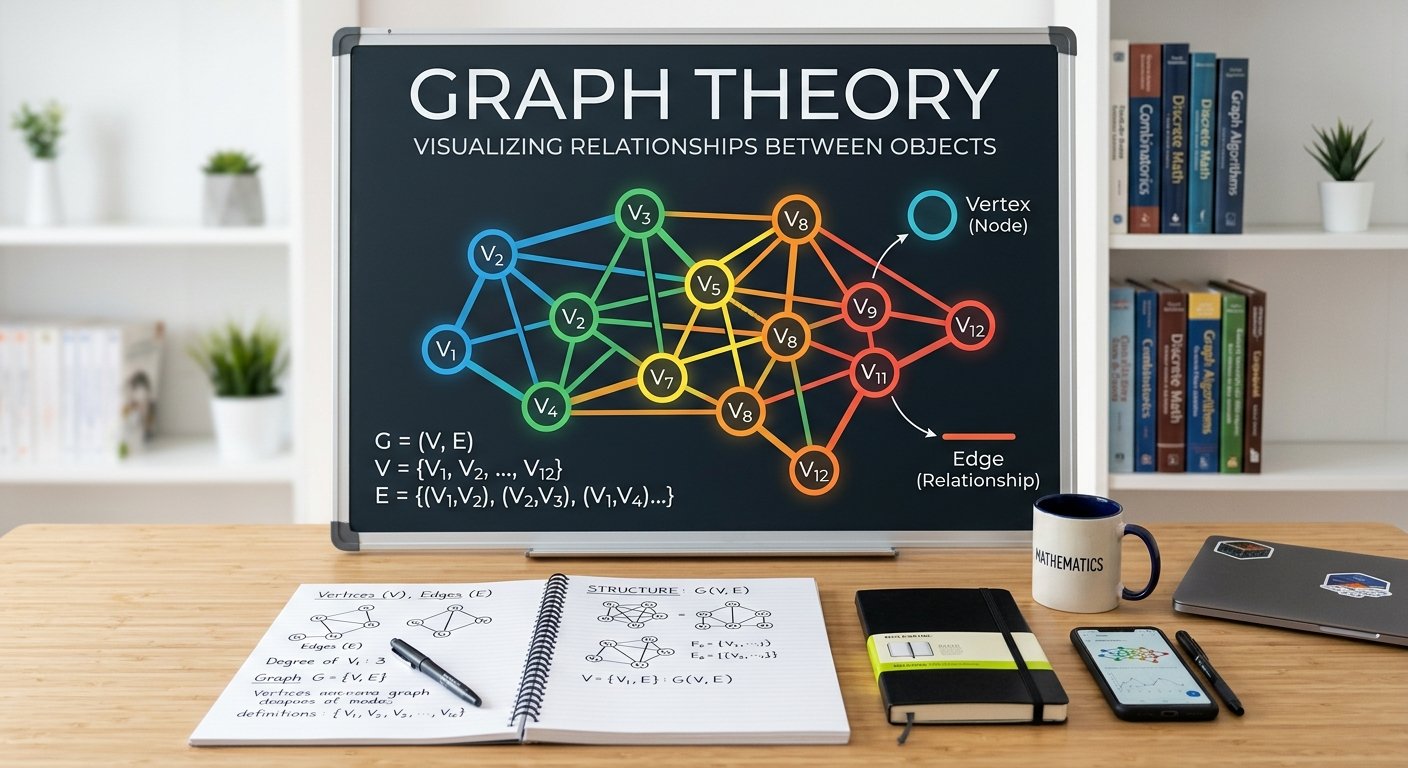
Introduction to Graph Theory
Graph theory is one of the key areas of discrete mathematics, concerned with the relationships and connections between objects. Represents, understands, and analyzes systems in which elements are interconnected using mathematics. These can involve computer networks, transportation networks, social relationships, communication networks and online platforms. While graph theory was developed to study individual elements, it can also be used to analyze the relationships between them and how information, resources, or movement can flow between them. When a graph is made, it is usually a collection of points linked with a line or arrow between each point and the others making it easier to understand complex relationships. The diagrams might look simple, but they could be a representation of a complex system in the real world, and can be the basis for powerful mathematical analysis.
Graph theory is not only mathematically important, but also useful in many practical applications, including the problem of finding connections, of finding a pattern, and of finding an efficient path from one point to another or to exchange information. For instance, in a navigation system, cities are points and roads are connections; in a social networking system, users are points and friendships are connections. Graph theory offers a range of techniques to calculate the shortest possible path, to find critical links and to learn about the interdependencies between parts of a network. Research on graph-based applications shows that graphs have found application in computer science, scientific research, engineering, and social sciences, as they allow them to represent complex relationships in a flexible manner.
So, a knowledge of graph theory is useful to provide a foundation for the study of algorithms, programming, data analysis, artificial intelligence and modern digital technologies.
Fundamental Concepts of Graph Theory
1. Vertices and Edges
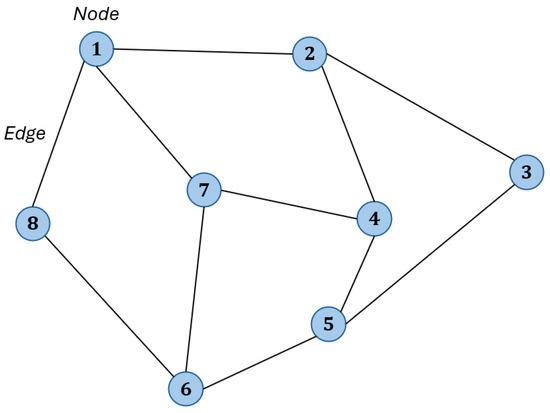
Graphs consist of two basic elements: vertices and edges. A vertex or node is a single object or entity in a system and an edge is a connection between two vertices. In a computer network, for instance, the computers or routers are represented as vertices and the lines of communication between the computers are represented as edges. Likewise, a transportation system can have vertices as bus stops or as intersections in the roads, and edges can be the roads between them. In a graph, the vertices are generally represented as V, and the edges as E, so that a graph can be written as G=(V,E). A graph with five vertices (representing five towns) and edges that connect pairs of towns that have direct road connections. This mathematical model is simple and useful to understand how relationships can be organized and how various components of a system are connected.
Edges may be used to show various types of relationships, depending on the context of the graph. An edge in a social network could represent a friendship, communication or a professional relationship. It can be a wire in an electrical network, or a hyperlink in a Web site. In an undirected graph, the degree of a vertex is the number of edges that it has. A vertex having a high degree could correspond to a particular person in a social network who has a lot of connections, or a key intersection in a transportation network. By analyzing the vertices, the edges, and the degrees of vertices in a network, analysts can discover significant vertices, edges, and understand the structure of a network. These simple concepts can be extended to more complex graph structures and algorithms for real-world computing tasks.
2. Paths and Cycles
Path is a sequence of vertices joined by the edges between them that enable a movement from one vertex to another in the graph. If a road network is made up of Town A to Town B, Town B to Town C and Town C to Town D, then a route from Town A to Town D is a route that passes through Town B and Town C. Paths have significance because many real-world problems require determining if two points can be reached, or the most efficient path between two points. In computer networks, paths are used to define how data can flow from a source device to a destination. They can be used to model possible paths between locations in transportation systems.They can be used to model possible paths between locations in transportation systems. A path can be considered by the number of its edges or the total cost of these edges. This cost may be distance, travel time, monetary cost, or any other measurable cost depending on the application.
A cycle is a path that starts and ends at the same vertex and has passed through other vertices. Road networks, communications networks, and dependency relations between computer programs are examples of systems that exhibit cycles. A circular bus route, for example, might start at the central terminal, go to a number of stops and then back to the central terminal. A computer network cycle can be used as an alternate path around a network when a communication link is not available, but care must be used in managing loops in a computer network. A cycle in a dependency graph is a useful pattern to identify in software development, as it can indicate cycles that hinder the ability to sequence and execute components in a desired order. Graph analysis of paths and cycles provides insights for graph analysts in order to study reachability, find other paths, detect structural issues and create more reliable systems.
3. Connected Graphs
A graph is connected if there is a path between any two vertices. That is, it is possible to walk from any vertex to any other vertex along the graph’s edges. Imagine that there are a number of computers in a network. When each computer is able to communicate with each other computer via one or more intermediate computers, the network can be modeled as a connected graph. If all the links between the groups are severed, then the graph will be disconnected, however, if a group of computers is isolated from the rest, this is not called a disconnect. The graph is considered disconnected if it has several connected components, where each connected component is a set of vertices that are connected to each other. This distinction is important as a system can have several devices that are operating and yet missing communication links between segments of the network.
Connectedness can be used to analyse the reliability and accessibility of systems. Transportation planners can analyze the communities and make sure they can still be reached by the roads that are available; telecommunications engineers can look at how messages can be sent across the network. A graph can also be connected even after removing some of its edges, which can be useful for the analysts to evaluate the resilience of the graph if some of its edges fail. For instance, if there is a network of back-up roads or communications, one of them may be blocked without disrupting the network. Graph theory also can be used to find the edges and vertices that are essential for the network connectivity, whose deletion will make the network partitioned. This information helps with more informed planning of infrastructure, design of the network, and making more informed decisions on where additional connections or backup systems are needed.
4. Directed Graphs
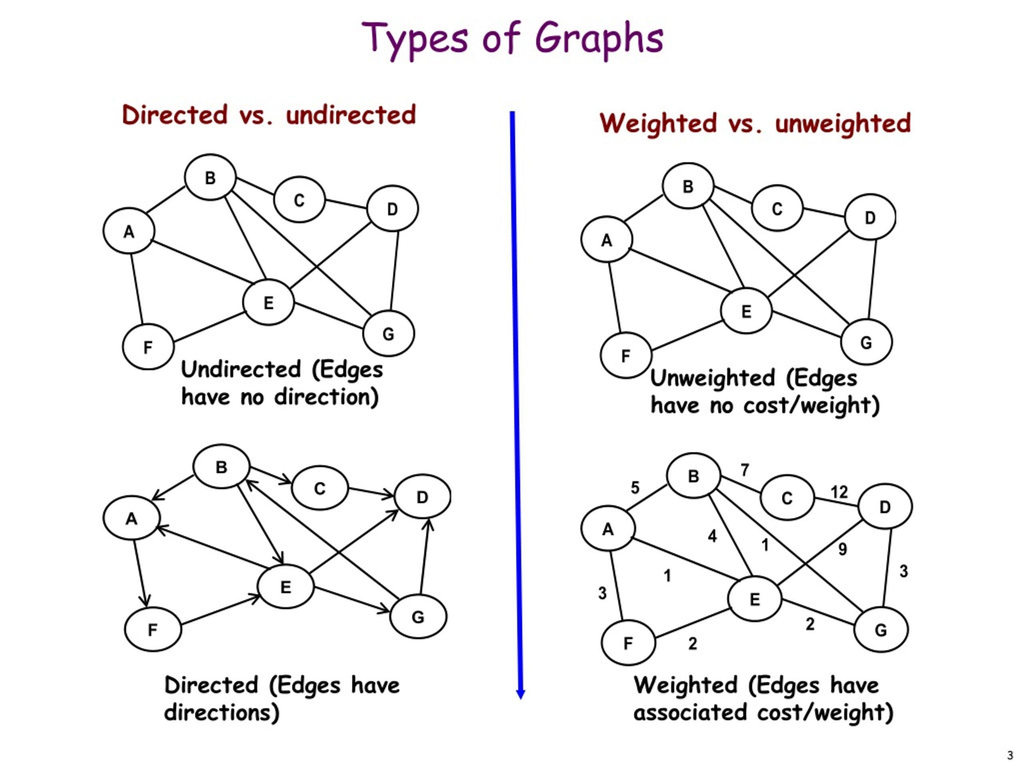
A digraph, or directed graph, is a graph that has directed edges. A directed edge is similar to a directed connection, except that it represents an edge from one vertex to another vertex. The direction of the arrows is a common way to represent directed edges. For instance on a social media site, one user can follow another without the other following the first. Thus, a directed edge is introduced from the follower to the account being followed. Another application of directed graphs is to represent hyperlinks on a website, one-way streets, communication, and sequences of tasks that require previous tasks to be completed. They differ from traditional undirected graphs in which edges typically allow traversal in both directions, as they can be used to model systems in which direction influences what can be done.
Directed graphs can be used in special applications such as dependency analysis, information flow analysis, etc. A task can be dependent on another task in a project management system in that the task must be done before another task can be performed, which forms a direct relationship between the two tasks. A web page with a hyperlink to another page can be shown as an arrow from the first page to the second in a web page network. Likewise, directed graphs can be used to model the flow of information in a communication system, or user interaction with online services. Analysts can look at the incoming and outgoing edges and identify vertices which have lots of connections, and vertices which pass information to lots of other vertices. These properties are fundamental for understanding influence, communication and dependencies in complex systems, and can be the foundation of many algorithms for computation and network analysis.
5. Weighted Graphs
A weighted graph is a graph in which numbers (weights) are placed on the edges of the graph or, in some models of graphs, the vertices. The following values give further information about the relationships being depicted in the graph. In a road network, for instance, the weight might be the distance between two intersections, the time for which you expect the road to be traversed, or the expense of the road you choose to take. The weight of an edge in a computer network can be the delay for a message to pass through the edge, the bandwidth available on an edge, or the cost of sending data through an edge. How to interpret a weight will vary depending on the problem under consideration and will affect the way graph algorithms will assess potential solutions. Weighted graphs are particularly useful when the connections don’t all have the same quality, distance, cost, or importance.
Think of a transport system which links three towns. The road between Town A and Town C may be 20 kilometres in length and the road between Town A and Town B may be 15 kilometres in length, but the road from Town B to Town C may be 25 kilometres in length. For instance, a navigation system can use the distance of the two routes to determine which one is shorter and therefore the more efficient route, with the help of a weighted graph. The path that has the least number of edges does not necessarily have the lowest total weight, as a path that has more edges could have a lower total weight. See the ScienceDirect explanation of weighted graphs for more details. In route planning, network optimization, resource allocation, and scheduling, the concept plays a crucial role in determining the best course of action, particularly when measurable differences between connections are involved.
6. Trees and Other Special Graphs.
A graph that is connected, undirected and does not have any cycles is called a tree. The structure is significant because it helps to link all its vertices together without creating any unnecessary circular links. A tree with nnn vertices has n−1n-1n−1 edges. Trees are used to represent hierarchical relationships, such as the organization of files and folders on a computer, the structure of an organization, and the organization of decisions within a decision tree. A rooted tree is a tree in which one vertex is designated as the root, and other vertices are grouped into parent/child relationships. For instance, a folder can have multiple subfolders with other folders or files. Trees are used for organizing information, searching information, and representing relations that have a distinct hierarchy.
There are other special types of graphs that can be used for specific mathematical and computing problems. A graph in which every two different vertices are joined by an edge is called a complete graph. A bipartite graph consists of two sets of vertices where edges go from one set to the other. It can be used to show a relationship between a student and a course, a customer and a product, or an employee and a job available. In a simple graph, there are no multiple edges or loops between two vertices; a multigraph can have multiple edges or loops between vertices. Selecting a suitable type of graph is important, as this allows the mathematical model to accurately describe the system being modeled. Each type has varying structural characteristics that make it easier to analyse, can be used to support algorithms, and can provide useful information of the relationships within a network.
Common Graph Algorithms and their Implementation.
Graph algorithms are a set of procedures that are systematic in their approach to the solution of problems with graph structures. They can decide if vertices are connected or not, locate routes between locations, identify vital parts of a network, and choose efficient connections. Depending on the graph structure and the requirements of the problem, there are different algorithms to choose from. There are algorithms that just visit the vertices, algorithms that compute the minimum cost, and algorithms that determine an efficient network structure that connects all the vertices. The importance of graph algorithms is that in the real world, networks can have thousands or millions of vertices and edges.
The reason why graph algorithms are important is that networks in the real world can have thousands or millions of vertices and edges, making it impractical to manually analyze them. Computer systems can process relationships systematically and produce useful results by representing the problem as a graph and using an appropriate algorithm. These are important techniques in computer science and are applied in many software programs, networking, logistics, and data analysis applications.
1. Breadth-First Search (BFS)
BFS is a graph traversal technique used to explore vertices layer by layer starting from a given vertex. It starts at the initial vertex and the adjacent vertices are then visited, followed by further vertices. A queue is normally used in BFS to store vertices to be explored. This method can be used to identify a path with the minimum number of edges in an unweighted graph that connects a starting vertex to a destination vertex. For instance, a social networking site might use BFS to find out how many connections he or she needs to make to reach from one user to another; a computer program could use it to find out all the places a user can get to from some starting point. The algorithm can also be used to determine if a graph is connected by determining if any vertex can be reached from a given start vertex.
BFS can be helpful when the ordering of the explorations is important. It can be used in a program to locate the locations around an object, to do a maze walk on a maze which is represented by a graph, or to determine whether there is a vertex in the graph within the specified number of connections. The algorithm could start with a user’s immediate friends, then people who are friends of friends, then friends of friends of friends, etc., in a simple social network. This multilevel approach makes BFS a good algorithm for proximity and reachability analysis. BFS, however, does not necessarily return the cheapest path in a weighted graph; it’s because BFS uses the number of edges to determine the shortest path, not the weight of the edges. If travel distances or travel costs vary, another algorithm might be required. This restriction should be understood so that developers select proper algorithms for solving problems rather than thinking that all algorithms are going to work with all networks.
2. Depth-First Search (DFS)
A depth-first search of a graph proceeds along one branch until it reaches its end, then it goes back to see if there are other ones to explore. Can be done by recursion, or by using an explicit stack to keep track of vertices to explore. DFS is similar to breadth-first search except that in DFS, the depth of the graph is emphasized, rather than the breadth. The method is good for analysing complex structures, finding connected components, cycles and analysing relationships between vertices. For instance, a file management app might be a hierarchical graph of folders and files, and employ a depth-first search strategy to explore the contents of the folders. Likewise, software tools can utilize DFS to find out dependencies among elements of a program or to see whether a directed graph has circular dependencies that might present issues at run time.
DFS is useful when the program should cover the whole graph as opposed to computing the shortest path between two vertices. It can be used to find clusters of connected vertices, to explore potential paths within a network, and to provide the algorithms to sequence tasks based on dependencies. In the context of software analysis, DFS can discover a cycle in a dependency graph, which means that one part of the software depends on another part, which in turn depends on the same part. It can traverse the graph systematically and give details of the graph’s structure in network analysis. While it is simple and simple to implement and is often effective, DFS does not necessarily provide the shortest route from one vertex to another. The main advantage it has is that it follows a systematic approach so that it is a very versatile method for many graph-processing applications.
3. Dijkstra’s Algorithm
The Dijkstra’s algorithm is a shortest path algorithm for determining the minimal cost path from a source vertex to a final one, in a weighted graph having non-negative edge weights. It operates on the principle of keeping the shortest known distance to every vertex and picking the vertex with the smallest tentative distance and repeating this process until the shortest distance is known. Next, the algorithm tests to see if following the path through this vertex would enhance the known distances to its neighbouring vertices. Any better road to find is then changed to the new distance. This process is repeated until the desired destinations are achieved or there are no vertices available to reach. Since Dijkstra’s algorithm allows you to incorporate differences in distance, time, or cost between the connections, it is widely used in route planning and network routing problems, in addition to just counting the number of edges.
A navigation app could use vertices to denote road intersections and weighted edges to represent the road segments. If the weights are travel time, then Dijkstra’s algorithm can calculate a route with the minimum total travel time from the values that are passed in. The calculated path could be on multiple roads instead of the shortest road with the fewest turns or connections. This same idea can be used with communication networks, where weights would be the costs of or delays in transmitting messages. The algorithm, however, assumes non-negative edge weights for its standard correctness guarantees, and it doesn’t take into account the changing traffic conditions unless it is updated by changing the edge weights of the graph. The effectiveness will therefore depend on the appropriate mathematics model and the quality of the data to represent the network.
4. Algorithms for Finding Minimum Spanning Trees
A minimum spanning tree for a connected graph of vertices G with the edges weighted is a spanning tree with the minimum sum of weights of all its edges. Useful where multiple locations are required to be connected in a system without a significant increase in the overall cost of infrastructure. There are two popular Minimum Spanning Tree (MST) algorithms: Kruskal’s algorithm and Prim’s algorithm. Kruskal’s algorithm sorts the edges by weight, and then iterates through them, adding the next edge as long as adding it does not form a cycle. Prim’s algorithm starts at one vertex and continues to append the “lowest weight” edge between the tree and a vertex that has not yet been added. In both methods, the objective is to make an economical network which connects all vertices.
Multiple locations need to be connected, for example in a communication network, electrical infrastructure, etc., and minimum spanning tree algorithms can be applied to this. For instance, a telecommunications company designing a connection between a number of different facilities can model each facility as a vertex, and the potential communication links between the facilities as a weighted edge. If the weights are installation costs, a minimum spanning tree can be used to determine the set of links that provide a path from each facility to every other facility, such that the sum of the weights of the links in the set is as low as possible, provided that the links and the weights are correct. The resulting tree will not necessarily yield the shortest path between any two facilities, and does not automatically result in backup connections for failed links. However, it does offer a good starting point on infrastructure planning if the main objective is to connect all locations economically.
Graphs in the Real World
Applications of graph theory are found in numerous areas of industry as all areas of modern life have relationships and networks. Graph-based models are employed in various fields, such as business, research, engineering, and software development, to analyze relationships, optimize workflow, and uncover patterns in vast datasets. A graph can be used to show the relationships between parts of a system in an easier to follow manner and to make the system easier to understand.
Mathematical concepts can hence be used in various ways in the various problems, even if the objects and connections have other meanings. For instance, a network of roads, a collection of interacting computers, and a social network can all be modeled as a network of vertices and edges—with different meanings assigned to the vertices and edges in each case. This versatility makes graph theory a powerful means of problem solving.
1. Computer Networks
Computer Networks: These are the connections between devices that enable them to share information and resources. Computer, routers, switches and communication links can be represented as vertices and edges in graph theory. A network engineer could examine this representation and see which devices are capable of communicating, find alternate paths to data, and see which connections are of special interest. If there are redundant links in the network, then data can be transmitted through another link if one link fails. Graph algorithms can be used to explore these options and aid network structure decisions. Graph analysis can also help identify connectivity issues, bottlenecks, and connections that, if lost, would cause communication disruptions between critical components of the communication system in large communication systems.
Graph theory also can be used for network routing, in which data needs to be sent from one device in a network to another via other devices. Edge weights can be delays, administrative costs, or other factors that can be used to provide a path selection. Graph algorithms can be used by engineers to assess routes available and to optimise the use of network resources. Practical systems will need to update information and recalculate routes when the graph changes, due to devices joining or leaving the network, connections failing or traffic changing. While graph theory doesn’t solve all networking problems, it provides a mathematical and structured approach to understanding connections and designing effective communication networks.
2. GPS Navigation and Transportation Systems
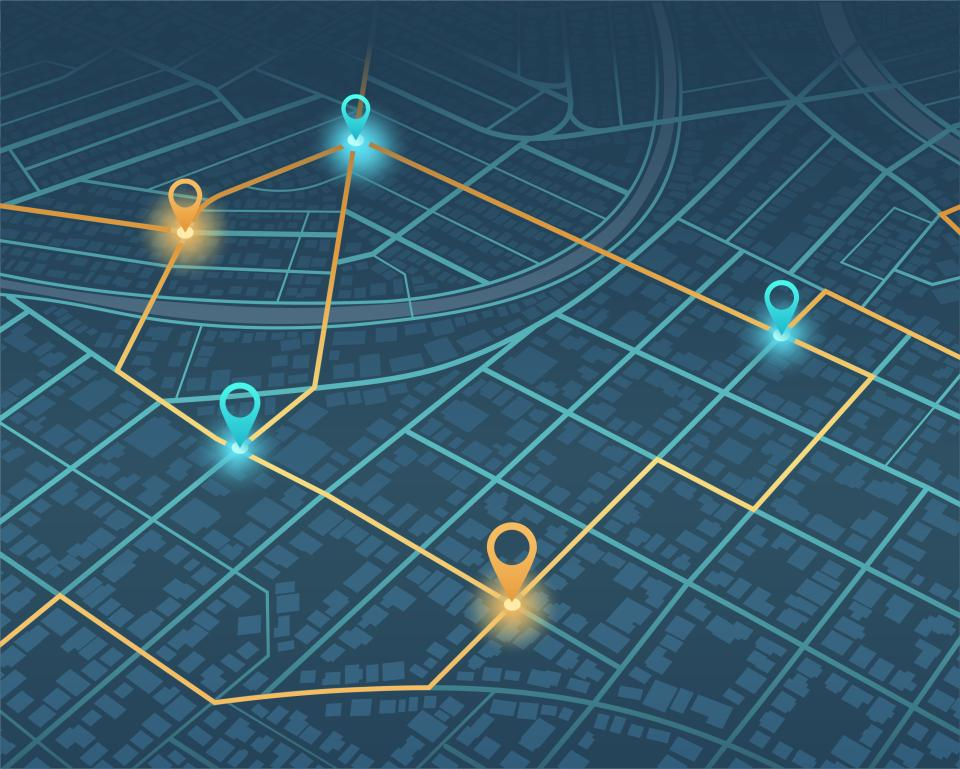
GPS navigation applications use graph-based models to help people travel between locations. In a road network, intersections and other relevant locations can be represented as vertices, while roads are represented as edges. The edges may carry weights for distance, estimated travel time, toll charges, or restrictions on particular types of vehicles. A route-planning algorithm examines these connections to determine a suitable path between the starting point and the destination. This is more complicated than simply choosing the road with the fewest intersections because the fastest route may involve a greater number of roads, and a shorter road may be affected by congestion or restrictions. Graph theory makes it possible to compare routes using clearly defined criteria and systematically identify appropriate alternatives.
Transportation planners can also use graph theory to study bus networks, railway lines, airline connections, and shipping routes. A railway system, for example, can be modelled using stations as vertices and rail connections as edges. Analysis can reveal which stations serve as important transfer points and how disruptions could affect passengers travelling between different regions. In public transport planning, graph models can help evaluate route accessibility and identify locations where additional connections may improve movement through a city. In logistics, companies can analyse networks of warehouses, distribution centres, and delivery destinations to support the planning of transport operations. Real-world decisions must also consider changing schedules, vehicle capacity, operating costs, and demand, but graph theory provides an essential foundation for understanding the network itself.
3. Social Networks
Social networking platforms connect people through relationships such as friendship, following, messaging, and professional association. Graph theory represents each user as a vertex and each relevant relationship as an edge. Depending on the platform, the edges may be directed or undirected. A friendship relationship might be modelled as an undirected connection when it is mutual, while a following relationship is naturally represented as a directed connection because one account can follow another without a reciprocal follow. Analysing these graphs helps platforms identify communities, understand patterns of interaction, and recommend potentially relevant connections. For example, if two users share many mutual connections, the system may determine that suggesting one user to the other is useful, although shared connections alone do not prove that the users know each other.
Graph theory can also help researchers study how information spreads through social networks and how groups form around shared interests. Measures such as vertex degree can identify users with many direct connections, while other graph measures can reveal users who connect otherwise separate communities. Community-detection algorithms seek groups of vertices that are more strongly connected to one another than to the rest of the network. These methods can support research into online communication, collaboration, and information sharing. However, network structure must be interpreted carefully because connections do not necessarily represent trust, influence, or the truth of shared information. Privacy, consent, and responsible data handling are also important considerations when analysing relationships between real people.
4. Web Search Engines
The World Wide Web can be represented as a directed graph in which each webpage is a vertex and each hyperlink is a directed edge. A link from one page to another indicates a navigational connection between those pages. This representation allows search-related systems to analyse the structure of the web, identify relationships between pages, and investigate how information is connected across websites. Some search-ranking approaches use graph-based ideas to estimate the relative importance of webpages by examining the links pointing toward them and the importance of the pages providing those links. A page referenced by several relevant and authoritative pages may receive a different importance score from a page with few meaningful incoming links. Such methods illustrate how graph structure can provide information beyond the text contained on an individual webpage.
Graph theory can also support website crawling, in which automated programs discover pages by following hyperlinks. Starting from a known page, a crawler can traverse the graph to find other reachable pages and collect information for indexing. Because the web contains an enormous number of pages and links, practical systems must manage resource limits, duplicate content, changing URLs, and pages that are inaccessible to crawlers. Graph-based analysis helps organize these relationships and can reveal how websites are structured or how easily users can navigate between pages. Although search engines use many other techniques, including language processing and relevance analysis, graph theory remains a valuable mathematical foundation for understanding connections across the web.
5. Cybersecurity
Cybersecurity involves protecting computer systems, networks, applications, and information from unauthorized access and other digital threats. Graph theory can help security teams represent devices, user accounts, software components, permissions, and communication relationships as a connected structure. For example, a graph may show which user accounts have access to particular systems or which devices communicate with one another. Analysing these connections can help identify unexpected relationships, excessive permissions, or pathways through which a security incident might spread. A graph model can also represent dependencies between software components, allowing security teams to understand how a vulnerable component might affect other parts of a system. These insights can support more systematic security reviews and help teams prioritize areas that require attention.
Graph-based security analysis can also be used to investigate patterns that may indicate suspicious activity. For instance, if several accounts interact with the same unusual set of devices or resources, their relationships may deserve further examination. This does not automatically mean that the accounts are malicious, but graph analysis can help identify patterns that deserve investigation alongside other evidence. Security professionals can also use graphs to examine how a compromised device might be connected to other devices and determine which parts of a network could be affected. Because real systems are large and constantly changing, security analysis often combines graph methods with monitoring tools, statistical techniques, and expert review. Graph theory supports the investigation of relationships, but reliable conclusions require appropriate evidence and careful interpretation.
6. Recommendation Systems
Recommendation systems help users discover products, films, music, books, courses, and other items that may match their interests. Graph theory can represent users and items as different types of vertices, with edges indicating interactions such as purchases, ratings, views, or saved preferences. This approach can be modelled using a bipartite graph when connections are limited to relationships between users and items. For example, a learning platform might represent students as one set of vertices and courses as another, connecting each student to courses they have enrolled in or completed. Analysing the resulting graph can reveal patterns in user preferences and help identify items that may be relevant to people with similar interaction histories.
More advanced recommendation systems can include additional types of relationships, such as connections between products, creators, topics, and categories. A graph may reveal that a user interested in one subject is also connected indirectly to another subject through shared items or related users. These connections can help generate recommendations that go beyond simple popularity rankings. However, recommendation quality depends on the completeness and accuracy of the available data, and systems must take privacy, fairness, and user preferences into account. A recommendation should not be treated as a guaranteed indication of what someone will like. Graph-based approaches are most useful when they help identify meaningful relationships while allowing the system to account for context and the limitations of its data.
7. Artificial Intelligence and Data Analysis
Graph theory is increasingly relevant to artificial intelligence and data analysis because many datasets contain relationships that cannot be adequately represented by isolated records. A graph can connect people, places, products, scientific observations, and other entities, allowing algorithms to examine how their relationships contribute to meaning. For example, a knowledge graph can connect a person to an organization, a location to an event, or a product to its manufacturer. These relationships can help software systems retrieve related information and answer questions that require several connected facts. Graph-based methods are also used in scientific research to examine networks of interacting molecules, relationships between species, and connections among research topics. In these situations, the graph represents not just individual data points but also the relationships that help explain the overall system.
Some artificial intelligence methods, including graph neural networks, are specifically designed to learn from graph-structured data. They use information about vertices and their neighbours to develop representations that can support tasks such as classification, prediction, and relationship analysis. For example, a system may use a graph of related products to estimate which items belong to similar categories, or researchers may use graph-based models to investigate patterns in biological networks. These techniques require appropriate data, careful model design, and evaluation to establish whether their predictions are reliable. Graph theory alone does not make a system intelligent, but it provides mathematical structures that allow machine-learning methods to incorporate relationships into their analysis. As data becomes increasingly interconnected, graph-based approaches offer useful ways to study complex information.
Advantages and Limitations of Graph Theory
Graph theory offers several advantages when solving problems involving complex relationships. One of its greatest strengths is flexibility: the same mathematical framework can represent transportation routes, computer networks, social interactions, and many other systems. Graphs can simplify large problems by separating the objects involved from the connections between them, allowing analysts to focus on the structure that matters. Graph algorithms can automate tasks such as route selection, network exploration, and connection analysis, which would be difficult to perform manually on large datasets. Graph theory also supports optimization by helping researchers identify efficient paths, economical network structures, and important connections. These advantages make it valuable in mathematics, computer science, engineering, logistics, and scientific research, where understanding relationships can lead to better decisions.
Despite these benefits, graph theory also has limitations. A graph is a model of reality rather than a complete representation of every detail in a real-world system. If the vertices, edges, or weights are inaccurate, the results of an algorithm may be misleading. Large graphs can also require substantial computing resources, particularly when they contain millions of vertices and billions of edges. Some graph problems are computationally difficult, meaning that finding an exact solution may require considerable time as the network grows. Furthermore, a mathematically optimal result may not be the best practical decision if the model ignores important factors such as changing conditions, human behaviour, maintenance costs, or legal requirements. Effective graph analysis therefore requires an appropriate model, reliable data, suitable algorithms, and careful interpretation of the results.
Conclusion
Graph theory is one of the most useful areas of discrete mathematics because it provides a systematic way to represent and analyse relationships between objects. Its fundamental concepts, including vertices, edges, paths, cycles, connected graphs, directed graphs, weighted graphs, and trees, form the foundation for understanding how networks are organized and how their elements interact. Graph algorithms such as breadth-first search, depth-first search, Dijkstra’s algorithm, and minimum spanning tree algorithms extend these concepts into practical methods for exploring networks, finding routes, and optimizing connections. By transforming complex relationships into mathematical structures, graph theory helps researchers and developers solve problems that would otherwise be difficult to understand or manage.
The real-world applications of graph theory demonstrate its continuing importance across modern technology and everyday life. Computer networks use graph models to support communication and routing, navigation systems use them to calculate routes, social networks use them to examine relationships, and search engines use them to analyse hyperlinks. Cybersecurity professionals can investigate connections between systems, while recommendation platforms use relationships between users and items to suggest relevant content. Artificial intelligence and data analysis also benefit from graph-based methods that capture relationships within complex datasets. Although successful applications require reliable information and suitable algorithms, graph theory remains a powerful foundation for understanding interconnected systems. As technology continues to develop, its concepts and techniques will remain important tools for solving practical problems in mathematics, computing, engineering, and beyond.