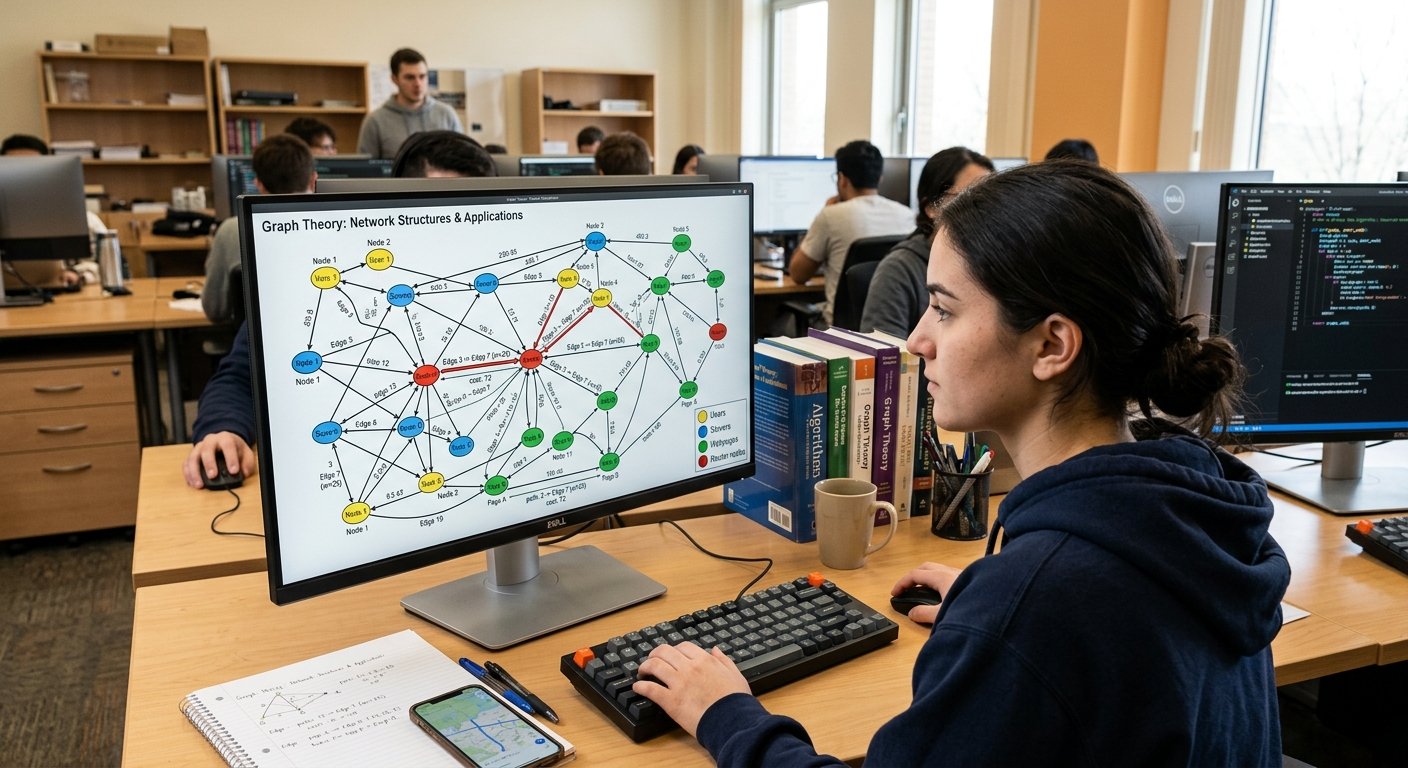
Graph theory is considered one of the most useful fields of discrete structures since it offers a mathematical representation of the relationship and connection between different objects. In computer science, there are numerous problems in which you need to know how things are interconnected, how information flows from one place to another or how the best possible relationship can be chosen among many alternatives. These problems can be more easily modeled and solved using graph theory, which involves using a vertex to represent an object and an edge to represent a relationship between those objects. A graph can be used to model roads between cities, social interactions among users or computers in a network, hyperlinks between web pages, or anything else. This flexibility makes graph theory not only applicable to theoretical mathematics but to other fields as well. Its applications can be found in a variety of technologies that are used daily, such as search engines, navigation systems, recommendation systems, communication systems and social networking applications.
The significance of graph theory in computer science is that it can be used to model complex systems in a simple and structured way. Programmers can represent a whole system as a graph, then apply algorithms to analyze it, instead of considering each one of the relations as a problem independently. For instance, a navigation program can use vertices (nodes) to represent locations and edges (lines) to represent the roads, and the distance or the time of travel for a road may be assigned as the weight. A social network can be a graph where the vertices are people and the edges are friendships or “follows”. A recommendation system can link users to products, movies, books or songs based on their interactions. Upon the representation of a system as a graph, algorithms can be applied to search, compare, optimize and find relationships. This is why graph theory is a crucial concept when talking about how modern computer systems handle connected data.

Vertices and Edges.
Vertices are the two basic elements of a graph, along with edges. A vertex is also known as a node is a single object or entity in a system. Depending on the problem being modeled, a vertex could represent a person, computer, city, website, product, location, or any other identifiable object. Each edge is a relationship or connection between two vertices. For instance, in a social network, individuals might be represented as vertices, and an edge between two individuals could signify their friendship. Likewise, a graph can be used to represent a computer network, where the vertices represent the computers and the edges represent the links between them. The vertices and edges are simple enough that the government and mathematicians can represent some complicated relationships but not have to describe every aspect of the real world system.
The form of the edge relationships varies depending on the type of relationship being modeled. An undirected graph is a graph where an edge is a connection that works in both directions. If two people are connected as friends in a platform, for example, the relationship could be represented as an undirected edge, as both people are connected to each other. In a directed graph, on the other hand, there are directed edges, each of which has a definite direction from one vertex to another. For instance social media followers can be identified as one person can follow another without the other following back. Thus, a directed edge may indicate a “follows” relationship between the entity following the edge and the entity it is following. Directed graphs are particularly useful in applications where there is a clear distinction between source and target, like website links, data flows, transportation pathways and communication processes.
Graphs with Weight and Connected Graphs.
A graph may have extra information on each of its edges, which is called a weighted graph. In a weighted graph, each edge may also contain a number with some significance for the relationship between the two vertices. The value may represent distance, cost, time, capacity, risk or other measurable property. For instance, cities or road intersections can be represented as vertices, and roads as edges. The weight of each road can then be stored as a distance or an estimate of travel time for the road. An algorithm can use these weights to find an efficient path when a user asks for directions. Weighted graphs are therefore especially significant if a system requires connectivity beyond simple connectivity and also requires to decide which of the two links is the better link, cheaper link, shorter link or faster link to an alternative one that is available.
A graph is connected as to whether it is directed or not, and whether the concept of connectivity is defined based on existence of a path or on existence of a chain, depending on the graph. A simple undirected connected graph is a graph that allows a path to be found between any two vertices. One reason for connectivity is that many real-world systems require continuous communication or access between components. For instance, a network of computers is said to be well-connected if there are network paths available that can enable some devices to communicate with other devices. Should some part(s) of the network be disconnected, information may not arrive at the destination. Using graphs, computer scientists can identify disconnected parts, find if any two can communicate with each other, and study the effect of the loss of a connection on the structure. It is helpful in network design, infrastructure planning, and reliability analysis.
Path and Cycles in Graphs.
A path is a sequence of vertices connected by the edges such that one can go from one part of a graph to another. Path is one of the most useful concepts in graph theory as many problems in computer science are described in terms of finding or analyzing paths. A path in a navigation system may be a course of travel from one location to the other. It may refer to the path of devices that data must pass through before arriving at its destination in a computer network. A path in a social network can be a representation of how two individuals are linked via a common friend or others. Possible algorithms would use these paths to find out if a destination is reachable, how many steps it takes or where is the cheapest path.
A cycle is a closed path that starts from the same vertex, and ends at that same vertex. Depending on the system being investigated, cycles may be beneficial or detrimental. Cycles can be a representation of alternative routes that may eventually lead back to the starting point in transportation networks. Computer networks can have more than one path to a certain location and cycles can be used for redundancy. But cycles can also cause problems for algorithms when a program revisits the same vertex without remembering that it has already been visited. For this reason many graph algorithms keep track of visited vertices. Cycling is also relevant in various other contexts, such as dependency management, scheduling, analysis of programming languages and database systems, where a cycle can point to a problem that must be solved.
Trees
A tree is a connected graph which has no cycles. In computer science, trees play a significant role because they are used to represent hierarchical relationships in an organized manner. Unlike a general graph, a tree has a structure in which there is a unique path between any two vertices. An example is a family system, in which the person could have children, the children could have children, and so on. Tree structures can also be used to model computer file systems in which files and subfolders are contained within folders. Other examples are organization structure, decision making process, syntax trees (used by compilers), and database indexes. The tree structure is useful because it has the capability to represent information in a systematic way and yet provide quick search and processing speeds.
Trees are very important data structures in programming, for example in several important data structures used in programming. For example, binary search trees store values in a way that allows efficient searching to be done under certain conditions. An example of another application of binary trees is to represent mathematical expressions, with the operators and operands placed as they appear in a mathematical expression. Another significant tree-based structure, heaps, are used extensively in priority queues and algorithms where the minimum or maximum element from a collection is needed frequently. Tree-based structures show the direct applicability of graph theory to programming. In spite of its simplicity with respect to general graphs, a tree is very useful for organising information, representing hierarchy, for developing efficient algorithms, and for doing searches.
Breadth-First Search
BFS also known as Breadth First Search is a graph traversal algorithm which traverses the vertices of a graph in a level by level manner. BFS first explores adjacent vertices from the given vertex (root), then explores vertices two steps away, and so on. The order of the vertices to be processed is usually kept in a queue. As the algorithm expands from the node, the neighbors not yet visited are placed on the queue and additional nodes are expanded outward. This method can be useful in an unweighted graph, where each edge has the same weight, for finding the shortest path. For instance, in social networks, BFS could be used to find the minimum path length between two users. It can also serve to browse the web, analyze networks and to solve select puzzles and search problems.
The value of BFS stems from the systematic manner it explores. Let’s say a graph models a network of locations, and all the connections between the locations are equally significant. BFS can perform an operation to find out how many connections are required to reach one location from another if needed, it can explore all the locations that are one step away from the application location before going into the locations that are two steps away. This will ensure that if a destination is reached for the first time, then the algorithm has found the shortest path by number of edges. BFS is thus suitable for use in applications where the number of steps is important. But BFS can consume a lot of memory as it can have to maintain numerous vertices concurrently, particularly if the graph comprises a large network of connections. This is a drawback, but it is one of the most significant of the basic graph traversal algorithms due to its predictable behavior.

Depth-First Search
Depth-first search (DFS) is another method for traversing a graph. DFS does not check all the neighbouring vertices first, but goes down as deep as possible on one path and then back up to see another path. Can be done with a recursive call or an explicit stack. Like BFS, DFS keeps track of visited vertices to prevent unnecessary repeated exploration and infinite loops in graphs containing cycles. DFS can be used in a variety of applications, such as finding connectivity, detecting cycles in a graph, exploring possible solutions, analysing dependencies, and processing tree structures. It can easily traverse deeply into a graph, which makes it very useful for problems where the algorithm must explore a branch of a graph thoroughly before looking at other branches.
DFS is also commonly used in more complex graph algorithms. It can be used to find connected components in an undirected graph, for instance, and can be adapted to other applications of directed graphs. DFS is normally taught in computer science education with BFS so that a comparison of the two algorithms can illustrate that different traversal methods can provide different answers to similar problems. BFS has a focus on breadth whereas DFS has a focus on depth; it can be used in minimum-edge-distance problems or for deepening the search for structure of possible routes or dependencies. Neither algorithm is always the better one and it is the graph structure and the problem that the program is solving that dictates which is best.
Graph Theory in Search Engines.
Search engines are a real-life example of graph theory in computer science. The World Wide Web can be considered as a huge directed graph where nodes are web pages and directed links are hyperlinks connecting one page to another. These relationships can be used by search engines to find pages, deduce relationships or establish a relevance ranking for pages based on a query. Crawling systems can follow links between pages, so they can traverse parts of the Web graph. Additionally, by using graph-based analysis, information about the importance or authority of pages can be acquired based on relation between pages. This demonstrates how graph theory can convert a massive data set of independent documents into a network of documents that can be processed by computer programs.
Graph concepts can also be applied to things other than hyperlinks. Search engines must find relationships between pages, topics, entities, and users’ queries, and organize vast quantities of information. Graph-based representations can be used to gain an understanding of connections between concepts or to discover related information. While there are a wide variety of methods that are employed in the creation of modern search engines other than graph algorithms, the concept of employing graph-like structures to represent relationships is still very relevant. The problem of understanding large and complex information environments is therefore an issue that is addressed by graph theory in the context of helping computers understand such information environments. The Web isn’t a bunch of pages, it’s a network, and graph-based thinking is a natural way of thinking about networks that is available in Mathematics.
Application of Graph Theory
An additional obvious example of an application of graph theory is the use of social networks, in which users and relationships are clearly represented by vertices and edges. Vertices can represent a person, and edges can represent friendships, follows, memberships, interactions, etc. These edges can be directed or undirected, depending on the platform. Once users are represented as a graph, algorithms can discover communities, quantify relationships, suggest connections and study how people interact. For instance, a site may suggest that a user connect with another user whose user has many common connections. The analysis of the graph can also be used to provide information that will enable to identify groups of users that interact with each other on a frequent basis, which will be useful for personalization and content organization.
This idea can be expanded to match users to items like movies, books, products, music, or online content, through the use of a recommendation system. The graph could include user vertices, item vertices, and edges that represent user actions like purchases, ratings, views, or likes. These relationships can then be used to determine patterns and recommendations through the use of algorithms. If two or more users have interacted with similar objects, the system may propose additional objects that one user hasn’t seen yet, based on the relationships. The power of graph-based recommendation methods is that they can represent relationships among more than two types of entities. The system can analyze the network of interactions between the users or products, rather than the users or products themselves.
Graph Theory for GPS and Computer Networks
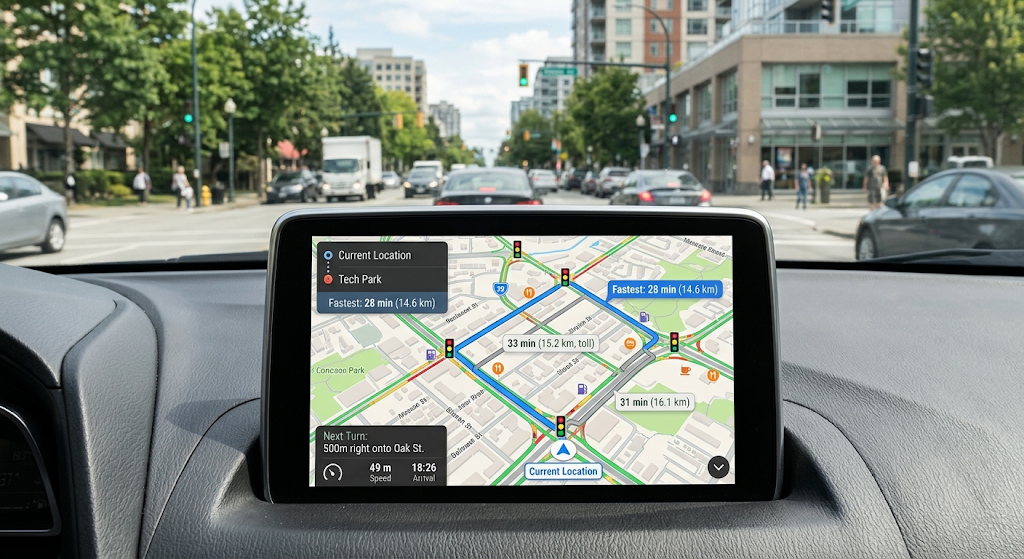
Graphs are an important concept for GPS navigation systems in modelling roads and finding routes. The vertices can be intersections, city or other points and the roads can be the edges. The roads may have different weights due to varying distances, travel time, traffic, and other factors. The route-finding algorithms can then take into account various possible paths, and choose a suitable route depending on the user’s needs. A shortest route could be the one that covers the shortest distance, but another route could be the route that takes the least amount of estimated time. This is the power of the weighted graphs: they will not only tell a computer whether two locations are connected, but they will also tell the computer the cost of traveling between sites.
Graphs can be used to represent computer networks. Communication links can be considered as edges, while devices like computers, routers, and servers can be treated as vertices. The connectivity, potential bottlenecks and alternative routes can be determined from these graphs, and they can be used by network administrators and software systems to analyze them. Thus, graph theory can play a role in enhancing network reliability and efficient data transmission. When important devices are connected to more than one path in a network, information can flow through an alternate path if one link fails. Graph-based methods are still relevant in the design and management of communication infrastructure, in part because of their ability to analyze alternative paths.
Application of Graph Theory
Besides search engines, social networks, navigation and computer networks, there are many other applications of graph theory. Graphs can be used for project management to show tasks and their relationships, allowing an organization to visualize what needs to be done first, in order to proceed with the rest of the project. In software engineering, dependency graphs can be used to represent the relationships between packages, modules, or components. In cybersecurity, the graph structures can be used to better describe the relationships between devices, accounts, permissions, and events. Graphs can be used for biological relationships in biology and medicine, such as relationships between genes, proteins, or other biological entities. In transportation, graphs can be used to represent the paths between stations, airports, ports, etc. These examples illustrate that graph theory can be useful for any problem with complex objects and relationships between them that need to be analyzed systematically.
One of the best features of graphs is their versatility in structure. The same basic mathematical ideas can be translated into very different systems, simply by changing the meaning of the vertices and the meaning of the edges. In one use, a vertex can represent a person and in another use it can represent a city. The meaning of an edge varies according to context: an edge in a friendship network indicates friendship, an edge in a physical space indicates physical proximity, an edge in a communication network indicates communication, an edge in a dependency network indicates dependency, and an edge in a financial network indicates financial interaction. Weights may be used to add other information, like cost or time, and directions can be used to show the direction of information or direction of movement. Graphs can be used in so many ways that when programming students learn graph theory, they don’t learn just one application – they learn a problem solving approach.
Conclusion
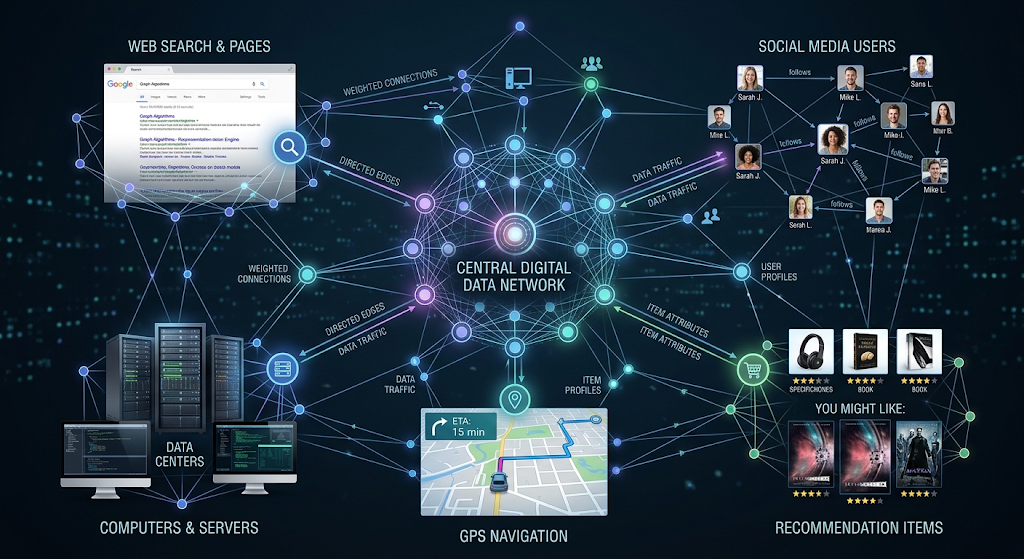
Graph theory is one of the basic subjects of discrete structures which is now widely related with modern computer science. The fundamental concepts of the graph, such as vertices, edges, directed or undirected graphs, weighted graphs, connected graphs, path, cycle, and trees, offer a practical means of expressing relationships and interconnected systems. These structures can be explored using algorithms like breadth-first search and depth-first search, and can be used to solve important computational problems. Graph theory is particularly useful because it is able to relate mathematical concepts to technologies. Graphs are ubiquitous: they are used in GPS navigation, to analyze social networks, to organize search results, to manage computer networks, and to make recommendations.
Knowing about graph theory, then, is not a mere introduction to an abstract mathematical concept for the computer science student. Learn to identify relationships, model complex systems, and choose algorithms to solve problems that are based on relationships. With the constant growth of technology producing more and more interconnected systems, graph-based thinking is probably going to stay relevant. From finding the shortest path to finding relationships to organizing information to detecting patterns to understanding how components interact, graphs are a powerful structure for turning complex relationships into a structure that a computer can analyze. Hence, graph theory is one of the most useful and important fields of discrete structures in computer science.



I truly appreciate your technique of writing a blog. I added it to my bookmark site list and will