
Introduction
Brokerage firms have evolved from a place where people would come to fill out paper orders and speak on the phone to a place where they spend the majority of their time on technology. Cloud computing is the main element of this shift, as it enables flexible provision of computing power, storage, network, databases, and software services that don’t all need to run on privately owned hardware. One of the topics mentioned when talking about cloud computing in today’s brokerage environment is its ability for stretching infrastructure needs as they evolve and providing applications that are needed to be accessible to the customer at all times. It is relevant because an online brokerage could be running many millions of customer accounts, and be receiving, sending and updating so much information on the market at the same time. These capabilities can then be delivered in a connected way, not relying on a single, static physical tech stack, through cloud infrastructure.
How Cloud Computing is Impacting Brokerage Firms
For brokerage companies, cloud computing involves leveraging resources of computing resources that are managed remotely to power technology for digital investment services. These resources can range from virtual servers, database, storage, network systems, application platforms, analytics tools, and security services. The broker can expand or contract resources to meet demand rather than purchase sufficient physical servers to accommodate the maximum possible demand. There is no fixed amount of brokers. The flow of traffic can increase rapidly due to major economic announcements, earnings releases, interest rate changes or sudden market movements, or increase predictably during normal trading. Cloud architecture provides a higher level of flexibility for the firms to be able to react promptly to these changes, but it doesn’t come with guaranteed performance. There is still a lot of work to be finished to ensure that applications, databases, networks, security controls and operating procedures are correctly designed and managed.
Store and Manage Data.
Online brokers create and store vast amounts of information such as trade logs, statements, sales and purchase logs, customer records, tax data, compliance records, application logs, market data and more. Different information can be managed based on its performance, availability, security, and retention needs in cloud storage, which allows for scaling as needed. Highly accessed records can be stored in high performance databases, and older documents, large historical data sets can be stored using more economical storage services. Cloud based databases can also support replication and auto-maintenance, which cuts down on the work that the internal technology teams have to do. But, cloud storage is not a virtual filing cabinet. All brokerage systems must provide the organization of information in order to enable applications to retrieve the correct information within a short time frame, while being able to provide controls on access, Backup, retention and regulatory responsibilities. It is, therefore, essential to have good data architecture to reap the benefits of cloud storage.
Applications Used by Investors
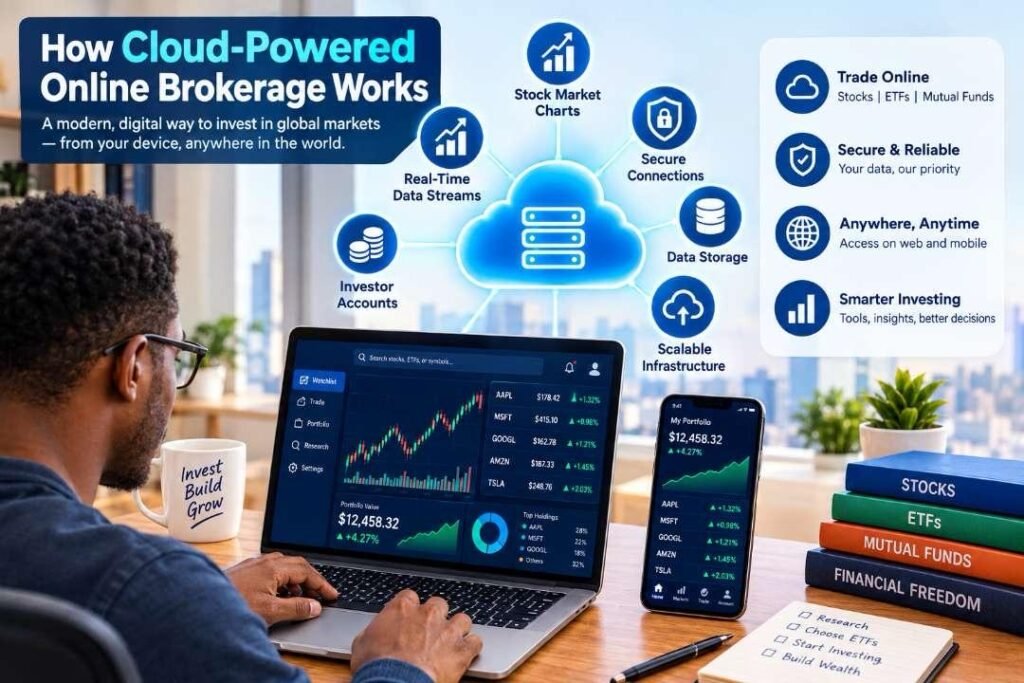
Investors rely on web pages and apps that are built on top of several layers of software that are hidden from view. Allows you to process authentication, portfolio displays, watchlists, order entry, transaction history, alerts, documents and more. Cloud computing can offer the servers and application platforms that can run these functions and distribute workload efficiently. A brokerage may split a big platform into services that are interconnected, enabling authentication, portfolio calculations, market data, order administration and notifications to be actionable as independent services. By distributing the incoming requests among multiple instances of the application, load balancing can minimize the risk of having one application instance being a bottleneck. If there is a surge in use, more application instances can be added when needed. While this may simplify any updates and maintenance, it comes with the caveat that changes to the cloud infrastructure are not always enough to alleviate limitations imposed by inefficient software or limited databases and external systems.
Scalability in Times of Market Upswings.
One of the most crucial advantages of brokerage firms using cloud infrastructure is its scalability. The financial market can go from calm to very frenzied in a matter of minutes. When a major economic announcement, corporate or geopolitical news or sudden change in an investor’s favorite security is made, investors may open applications, refresh quotes, check portfolios, and place buy or sell orders at the same time. Cloud platforms can provision application capacity, databases, network throughput, or other resources to a company based on their needs as their workload grows. Automated scaling can be based on a metric like request volume, processor usage or queue length. The aim is to maintain the critical services’ responsiveness during periods of high demand. The objective is to ensure that critical services remain responsive during periods of high demand. For effective scalability, it is also necessary to do capacity planning and testing, since aspects of a brokerage system, such as market connections and specialized transaction systems, might not be as scalable as general applications.
Handling a Large Volume of Transactions
They have strict processing needs, as one order may be associated with a number of related actions. To validate the order, update positions, communicate information to other systems, record transactions, route the order, validate account information, and authenticate the customer, a brokerage may need to perform a variety of tasks. Many events can be processed with distributed computing resources and systems of message processing in a cloud infrastructure. When there is a sudden surge of workloads, queues can temporarily store them, thereby enabling the services to process the requests in an orderly fashion rather than having to process each request at the same time. Distributed architectures can also enable workloads to be separated so that if one workload increases it won’t crush unrelated workloads. However, there is more than just computing power needed for transaction processing. There are lots of considerations to be made when ordering a sequence, data consistency, latency, monitoring, financial controls and regulatory requirements. Specialized financial systems and procedures are thus used in conjunction with cloud services.
Market Data, Analytics, and Artificial Intelligence
Cloud infrastructure also can be applied when processing massive amounts of data from financial markets. The exchanges, market data providers can generate continuous stream of data that includes prices, trading volumes, quotes, market depth, corporate information, and other signals. These streams can be gathered, transformed, stored and analyzed by a cloud based processing system. Historical market information can be leveraged with customer activity and operational information for analytics, reporting, risk monitoring and product work. For analytical workloads that are not on-going, cloud computing can also offer a significant amount of processing power. Machine learning can aid fraud detection, automate customer service operations, track operations, or look for patterns that seem unusual. Data quality and governance are the key to these capabilities. Accurate and complete information is not reliable because of faster computing, and firms need to have good controls on the gathering, processing, access and storage of information.
Disaster Recovery and Business Continuity
Using a single physical site or a single server to power financial services is not viable, as disruptions such as equipment failures, network issues, software bugs, cyber-attacks and natural disasters can cause a halt to operations. Cloud environments can enable companies to keep their data replicated, data protection solutions and other computing resources at different sites, which can help them with disaster recovery. Select workloads can be moved to another environment if a primary environment becomes unavailable to support those workloads, depending upon the system design and recovery objectives. Backups can also be used to recover information should it be accidentally deleted or corrupted. Disaster recovery is important for brokerages for business continuity reasons as customers are expecting to have access to their accounts when markets are open. That doesn’t mean cloud hosting doesn’t have its share of disaster risk, however. The recovery depends on the frequency of the replications, system configuration, speed of recovery and the fact that the employee has tested the recovery procedure. Along with maintaining infrastructure backups, regular testing is crucial.
Cloud Based Brokerage Systems Cybersecurity.
Security is an important factor as brokerage platforms deal with monetary and personal information. Some of the services that can be offered in the cloud include services for encryption, identity and access management, network segmentation, logging, monitoring, threat detection, and security policies. While these tools can provide protection for applications and data, protection is not a responsibility that is solely the cloud provider’s to take responsibility for – it is shared. The provider might be responsible for obtaining the underlying infrastructure and the brokerage is responsible for setting up the applications, permissions, customer authentication, data access and internal controls. This is particularly relevant, as the compromised credentials can give attackers access to sensitive systems, particularly for strong identity management. However, brokerage firms must also be monitored for any behavior that is out of the ordinary, such as: suspicious logins, suspicious transactions, unauthorized access and more. Cloud security isn’t simply a capability that a company enables. Cloud security, in fact, is not one capability that a company switches on. It is a continuous process related to incident response, technology, people and governance.
Managing Millions of Customers’ Records
A brokerage that has millions of customers doesn’t always have to keep the same physical server or database on which to store all the requests. Cloud architecture can be used to spread requests over several computing resources and caching can minimize the need for the information to be retrieved from the primary database each time. Depending on the application requirements, databases can be deployed by utilizing replication and partitioning strategies for improved availability as well as to manage the increasing workload. These components can be monitored, and if performance is near capacity or is unusual, then the monitoring systems can notify the engineers. The design enables a brokerage system to be a network of machines instead of one machine. It adds some difficulty as well. Many users can be impacted by a small configuration problem and that’s why it’s important to test, change manage, observe, and control deployment. The availability of cloud resources is not the only factor that determines scalability; engineering plays an important role as well.
The Role of Cloud Infrastructure during Extreme Market Activity
While cloud can offer much in terms of resilience during times of extreme market activity, it is not a solution for all operational challenges. Investors can sign in and access the price, consider purchasing and sales, and move money and communicate with customer support at the same time. A resilient architecture can help spread demand over services and expand capacity when it’s possible to do so with automation. Event driven systems may queue requests and monitoring tools aid engineers in knowing which components are being overloaded. Businesses can also take advantage of a traffic management’s ability to keep critical functions secure from less important workloads. Despite all of this, there are a number of factors that can have an impact on availability, including internet connectivity, access to exchanges, third party services, application code, databases, and operational decisions. Adopting the cloud can come with some cost, vendor, data governance, regulatory and system complexity. This means that companies must have a solid architecture, security policies, resilience testing, cost controls and competent technical teams.
While migrating brokerage technology to the cloud may provide significant benefits, companies will still face financial and operational implications of such a change. If applications are generating large amounts of data, or if they need significant processing resources on a constant basis, costs for cloud can add up. Relying on cloud providers can lead to vendor management issues and migrating large legacy systems from one environment to another may be challenging. Data management, regulatory requirements, access, service reliability and handling of sensitive data are also issues to be taken into account by brokerage firms. Other difficulties include complexity. A modern cloud platform could have a lot of components which are inter-connected and which could make it more difficult to troubleshoot if monitoring is lacking. Businesses must have well-defined architecture, cost management, security policies, resilience testing, and knowledgeable technical staff, among other things. Cloud computing is about adding capabilities, rather than replacing good engineering and operational discipline practices.
Conclusion
Cloud computing is an important enabling technology for digital investment services as it enables us to provide scalable computing, flexible storage, application hosting, analytics, resilience and security capabilities within a single technology environment. For brokerage firms, these abilities may enable them to deal with massive customer bases and the constant stream of financial details essential for online investing. It is especially helpful when demand fluctuates quickly as it allows allocating resources to a number of systems, not just one fixed hardware system. Meanwhile, engineering, data governance, security controls, disaster recovery planning, testing and a sense of operational discipline are all critical to the successful adoption of the cloud. Few investors will ever see the infrastructure under a trading application but a lot of the services that investors use on a daily basis are based on cloud systems. Cloud technology will continue to play a powerful role in the infrastructure that will enable investment services to be delivered at scale, as brokerage platforms get increasingly digital and data-rich.
Get more well researched information about Cloud Computing in Brokerage Firms here.