
Introduction to SQL
SQL (Structured Query Language) is one of the most crucial technologies to work with a relational database. A database may have thousands, millions or even billions of records, but storing information is not enough. Applications and professionals also require a reliable method of creating a table, entering information, locating a specific record, editing existing data and deleting information that the application no longer needs. SQL is a standard language that can perform these operations. The concepts and commands are broadly common across different database management systems, although there may be some differences in features and variations.
Today, SQL is utilized in websites, versatile applications, monetary systems, business stages, examination apparatuses, stock administration frameworks, client support administration applications, and significantly more. A knowledge of SQL thus provides an authentic grounding for beginners in how applications communicate with structured data, and how professionals manage information to best effect.
What is SQL and Why is it Important?
SQL is a language used to communicate with relational database management systems. Relational databases store information in tables, which are structured into rows and columns, rather than in one big table. For instance, an online store may have a Customers table with information about customers and their contacts, a Products table with product details, and an Orders table with information about orders and the details of their purchase.
By running commands to SQL that describe what information they want or which operation they want the database to perform, users can interact with these tables. SQL is significant because it gives a consistent way to handle structured information, and doesn’t require the user to seek through files or records. It is used by developers when creating software, by database administrators for managing database environments, by analysts when accessing and analyzing data and by IT administrators when managing systems that rely on secure data storage.
Databases, Tables, Rows, and Columns.
In order to write SQL commands, beginners must know the basic structure of a relational database. A database is a well-structured set of information which is managed by a database management system; A table is a particular structure of the database where related records are stored. The column names specify the information that is stored, for example, the names of the customers, e-mail addresses, age, or date the customer registered. Rows are the individual data records. For instance, if you had a Customers table, it might have an ID field, Name, Email and Country column.
A single row could refer to a single customer; a different row to a different customer. This helps organise and retrieve information due to the fact that every value serves a particular function. Databases may also have relationships between tables and the data may be logically grouped instead of the same data being stored over and over again. SQL gives instructions to create these structures and to control the information that is stored in them.
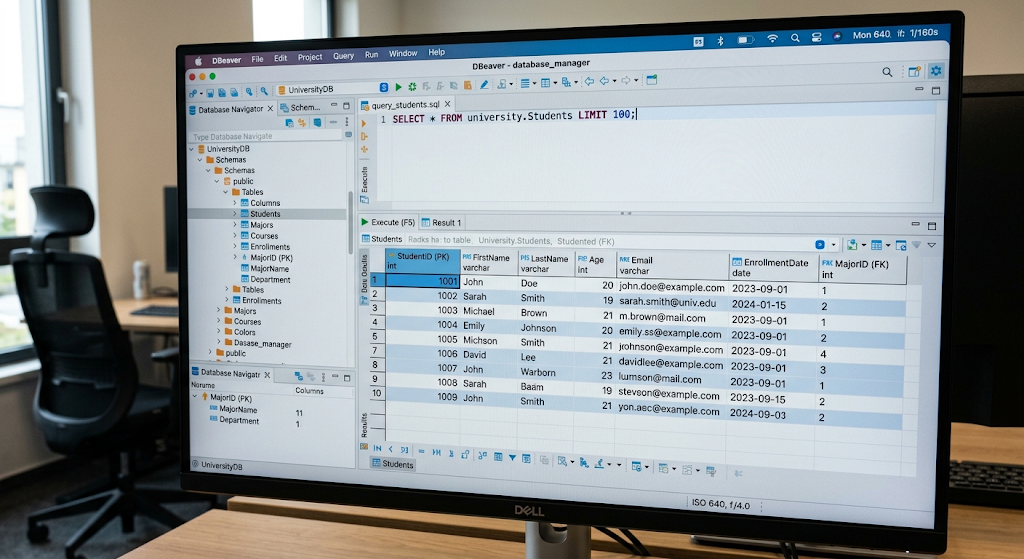
How to Create a Database using CREATE.
The CREATE command is used to create database objects. Creating a database that will hold tables and other objects needed for an application is one of the initial tasks that may be needed for a database project. The syntax may vary from one database to another, but here is a simple example to illustrate the concept:
CREATE DATABASE SchoolDB;
Once the database has been created, a user can choose it for further operations. In systems which allow the USE command, you can select the database as follows:
USE SchoolDB;
The CREATE command can also be used to create tables. A table definition defines the columns of a table and the kind of data each of them will hold. For example:
CREATE TABLE Students (
The identifier of a primary key.Primary key identifier.
FirstName VARCHAR(50),
LastName VARCHAR(50),
Age INT,
Email VARCHAR(100)
);
This statement will result in the Students table to have the following 5 columns. StudentID is an integer and is used as the primary key, that is, it is designed to identify each student uniquely. FirstName is a text data type, LastName is a text data type, Age is an integer, and Email is text that stores an email address. It is important to carefully define the tables, since the structure of the database will affect the accuracy and efficiency of the information that can be stored and later retrieved.
Using INSERT to Add Records
After a table is created the INSERT command can be used to insert records. INSERT specifies the values to insert in the new row. A basic example is:
INSERT INTO Students (StudentID, FirstName, LastName, Age, Email)
VALUES (1, ‘Daniel’, ‘Okafor’, 20, ‘daniel\@example.com’);
Another student can be inserted into the table with another INSERT statement:
VALUES (‘1234’, ‘S. Johnson’, ‘Pinky’, ’62’, ‘pinky.jackson\@fastmail.com’);
VALUES (2, ‘Grace’, ‘Adeyemi’, 21, ‘grace\@example.com’);
INSERT statements are very significant in applications since information is continually being added. An application can make an SQL call to write the appropriate information to a database when a user registers for a service, submits a form, places an order, or creates an account on a website. Usually these operations are performed by an application in a professional system, which is implemented with a database driver, library or framework, but never by customers typing the SQL. Developers should still know about INSERT, since it will help them understand what will happen when the application adds a new record to the database, and how values will be associated with specific columns.

Where we find the first SELECT
SELECT is one of the most commonly used SQL commands as it fetches data out of a database. The simplest query will ask for all the columns of a table:
SELECT \* FROM Students;
The asterisk means that the query should return all available columns. But it may be more suitable to choose only the data that an application needs:
SELECT FirstName, LastName, Email
FROM Students;
The WHERE clause can also be used to filter records in SQL. For example:
Select the FirstName and LastName fields.Choose the FirstName and LastName fields.
FROM Students
WHERE Age >= 21;
Use this query to find students that are 21 years old or older. Conditions, expressions, functions, sorting, grouping, and relationships between tables are just a few of the powerful features that can be used with SELECT. Data analysts can use SELECT to look around a business’ data, and developers can use it to get a record for an application to show. The SELECT statement can also be used by database administrators to inspect the contents of a database or to find specific records. Learning to write accurate SELECT statements is therefore an important aspect of getting comfortable with SQL.
Sorting Results using ORDER BY
Records in the database may not be returned in a specific order. SQL has the ORDER BY clause to specify a particular order. Students then could be divided into groups, by last name, for example:
SELECT FirstName, LastName, Age
FROM Students
Order by LastName Asc;
ASC stands for ascending (ascending order). SQL also provides for DESC, which is used for descending order:
Select FirstName, LastName, Age
FROM Students
ORDER BY Age DESC;
The second query shows older students first then younger students. An ORDER BY clause may be helpful in applications displaying lists, reports, rankings, transaction histories or search results. Can also sort by multiple columns. For example, an application could sort records in the order of country, then last name. The knowledge of ORDER BY assists newbies to grasp that getting information and showing it off are two different matters. Even if the information is correct in the database, the order of the results returned by the query may be different, allowing applications and reports to use this information better for their needs.
Using GROUP BY to Group Data
GROUP BY is used to group information, especially in the presence of aggregate functions like COUNT, SUM, AVG, MIN, and MAX. Suppose, for instance, there is an Orders table with data about purchases. The business would be interested in the number of orders placed by each customer. A query could use:
SELECT CustomerID, COUNT(\*) AS TotalOrders
FROM Orders
GROUP BY CustomerID;
This query groups the CustomerID and counts how many orders each group contains instead of returning each individual order. The GROUP BY clause is very useful for reporting and data analysis, because it can be used to summarize large amounts of information. A company might ask similar questions to find out how many sales they have made per product, how much is the average salary per department, how many customers are there per country, or how many transactions are there per month. For starters, it is important to realize that GROUP BY does not sort data. ORDER BY determines the ordering of the returned records, and GROUP BY groups the records into logical groups to enable aggregation on the groups.

Using JOIN to Connect up Tables.
The ability to separate related data into tables and link them together as needed is one of the most powerful aspects of relational databases. SQL uses JOIN to join information from various tables. For instance, if there’s an Orders table with a CustomerID field, and a Customers table with the customer’s name, then there’s a corresponding foreign key. The two tables can be related with an INNER JOIN:
SELECT Customers.FirstName, Customers.LastName, Orders.OrderID
FROM Customers
INNER JOIN Orders
ON Customers.CustomerID = Orders.CustomerID;
The ON condition provides SQL with information on how the records in the two tables are related. JOIN operations minimize the need to store the same data in several tables. The Customer information may be stored in a Customers table, and a Customer ID field might be used to refer to the Customer information in an Orders table. There are other varieties of joins, such as LEFT JOIN, RIGHT JOIN, and FULL OUTER JOIN, but these may be unavailable or may have different syntax in various database systems. Often one of the most crucial concepts for beginners is learning how to JOIN. Most of the time, databases aren’t just a single table with all the data in it, they are a collection of tables that are connected together.

Updating Existing Data with UPDATE.
Occasionally, data must be modified once it has been saved. The UPDATE command is used to update records. One example of using an UPDATE statement is when the student’s email address changes:
UPDATE Students
SET Email = ‘newemail\@example.com’
WHERE StudentID = 1;
WHERE is a very key clause as it determines the record(s) that will be modified. An UPDATE statement can change many or all of the records in a table if there’s no condition. This statement, for instance, would change the email address of each student:
UPDATE Students
SET Email = ‘newemail\@example.com’;
This can be a conscious effort in some cases, but it can also cause major data issues if it is done inadvertently. It is therefore important to test and pay attention to the conditions before making changes to information in a professional database. Common safeguards in use among developers and database administrators to minimize the chances of making unwanted changes include transactions, backups, permissions, and more.
Deleting Records with DELETE
DELETE deletes records from a table. For instance, a particular student can be excluded by:
DELETE FROM Students
WHERE StudentID = 2;
Where, like UPDATE, plays a critical role. The next command would delete all of the records in the Students table:
DELETE FROM Students;
The table would not be deleted, but its content would be taken away. This is why SQL needs to be used sparingly and in a careful manner, particularly in a production environment where sensitive business or customer data exists. Additional techniques may be utilized in some applications, such as soft delete, where a record is not deleted but made inactive. This will depend on the needs of the application, the data retention requirements, and the design of the database. To learn to be careful when performing UPDATE or DELETE operations, beginners should get into the habit of looking carefully at their conditions.
Using ALTER to change Table Structures
Database needs may vary from year to year. If a table is adequate at the time an application is first created, it may need more information over time. The ALTER command is used to change the structure of a database. In this case, the database administrator could add a Phone column to the Students table:
ALTER TABLE Students
ADD Phone VARCHAR(20);
The syntax of ALTER TABLE will be different in different database management systems, and some database systems offer more facilities to alter or remove columns, constraints, indexes, and other database objects. ALTER is useful because databases may change in structure as software applications are developed. A business could add a new customer field, an organization could add a new department identifier, or an application could request further data about transactions. Database changes should be carefully planned as changing a table that has a lot of data in it may have an impact on the applications, performance, constraints, and existing queries.
SQL and Database Management Systems
SQL is a language; systems like MySQL, PostgreSQL, Microsoft SQL Server, Oracle Database and SQLite offer environments that implement SQL and also offer additional database functionality. While some of the basic SQL commands are the same, they can vary in syntax, functionality, configuration and available functions. The learning of SQL would provide knowledge to the novices which is transferable, but it is also crucial to know the specific database system in a project.
A developer utilizing PostgreSQL might find features not found in SQLite, and a Microsoft SQL Server database administrator might find features and tools available in his or her environment that would not be found in PostgreSQL. The concepts are still important because SELECT, INSERT, UPDATE, DELETE, CREATE, ALTER, JOIN, GROUP BY, ORDER BY are the foundation for most relational database activities.
Importance of Understanding and Utilizing SQL Skills
DBMSs are still relevant today because most software builds rely on structured data. Even though some database operations are abstracted in higher-level interfaces, software developers must know how to access and manipulate data in them. SQL is a language used by database administrators to create and manipulate structures, to identify issues and troubleshoot, to restrict access, to monitor systems, and to maintain databases. SQL enables data analysts to query, filter, join, aggregate, and analyze data to generate reports or perform additional analysis.
An IT professional could be called upon to support a business application, troubleshoot a system or investigate issues related to data using SQL. Working with SQL also teaches some useful technical thinking skills – people have to communicate exactly what they want to know, and how they want the records to be connected, or manipulated. This skill is, therefore, not just about being able to recall commands. The ability to edit, modify, filter, group data and use tables, relationships, conditions is a building block applicable to numerous database-driven technologies.
SQL Guide for Beginners.
For those new to SQL, it can be helpful to start with simple databases and progressively build up their skills level by tackling increasingly complex queries. Create easy basic tables and some records go in them, and then use SELECT to pull them out. Once you’ve grasped basic retrieval, go over WHERE conditions, ORDER BY sorting, UPDATE operations, and DELETE operations before moving on to JOIN and GROUP BY.
You should also understand the working of various data types and their importance, as well as constraints, foreign keys, and indexes. Always review the WHERE clause, and if applicable, test the SELECT statement to make sure you know what records you are updating or deleting when running UPDATE and DELETE statements. Beginners should also not presume that SQL syntax is the same for all database systems. When learning a new platform, it helps to work with the platform itself while mastering the concepts and understanding differences between the platforms.
Conclusion
SQL is a usable method for organizing information, storing it in relational databases, retrieving it, modifying it, and managing it. CREATE and ALTER are used to define the structure of a database, and INSERT is used to add a record to it. SELECT is used to retrieve records from a database. UPDATE and DELETE can be used to modify or delete existing data, ORDER BY affects how the results are sorted, GROUP BY can be used to summarize data, and JOIN is used to join together data from related tables.
These are the basic commands in understanding the working of the database-driven applications. Database management systems might interpret SQL in a variety of ways and have their own extra attributes, but the core concepts are heavily practical. Learning SQL is not just about memorizing SQL statements – it is about understanding the way structured information is structured and how accurate queries can be used to interact with this information. This base can be applied to other aspects of information technology, such as software development, database administration, data analysis, and others.