
A programming language gives the developer a set of mechanisms to control the flow of instructions and the structure of logic in a program. A computer would not be capable of following anything more complicated than a list of instructions without having these mechanisms. Control structures affect executions, number of executions and conditions of executions. Functions and related concepts, on the other hand, provide a way for programmers to structure code into meaningful and reusable programs.
These features, combined, are some of the most significant programming basics. The underlying concepts are the same, regardless of the language, whether it’s Python, Java, JavaScript, C, C++, C, Ruby, Go and more. The concepts of sequence, selection, iteration, recursion, procedures, functions, parameters, return values, and scope, therefore, can be used in the transfer of knowledge across programming languages and development environments.
The Concept of Control Structures in Programming
A control structure is a way to dictate the order of statements or blocks of statements to be executed. The simplest programs run instructions one by one from the beginning to the end of the program, in a predictable sequence. Useful software, however, must make decisions, perform similar operations repeatedly, react to variable data, and at times even return to a previous stage of a computation. These behaviors are governed by control structures.
There are three basic types: sequence, selection and iteration; recursion is another very useful way to control repeated or self-referential computation. The concepts are expressed in a very similar way in different programming languages, but the syntax varies. Understanding these concepts enables the programmer to understand the way that individual statements operate and how a complete program makes decisions and controls the flow of its execution.
Sequences: Doing Instructions in Order
The simplest type of control structure is sequence, the basic flow of a program from one line to the next, in the usual order. Usually, statements are executed in order when there is no change in flow caused by a condition, loop, function call, exception or other control mechanism. A program could prompt a user for a name, save the name in a variable, print a message, and make a note of something.
All operations are dependent upon one another such that one operation must be finished before the next can start. Sequences are especially significant as more complex control structures are engineered around them. When a program has a complicated condition or loop, the statements within the condition or loop are normally executed in order and not necessarily in reverse sequence which the condition or loop may imply.
Selection: Making Decisions
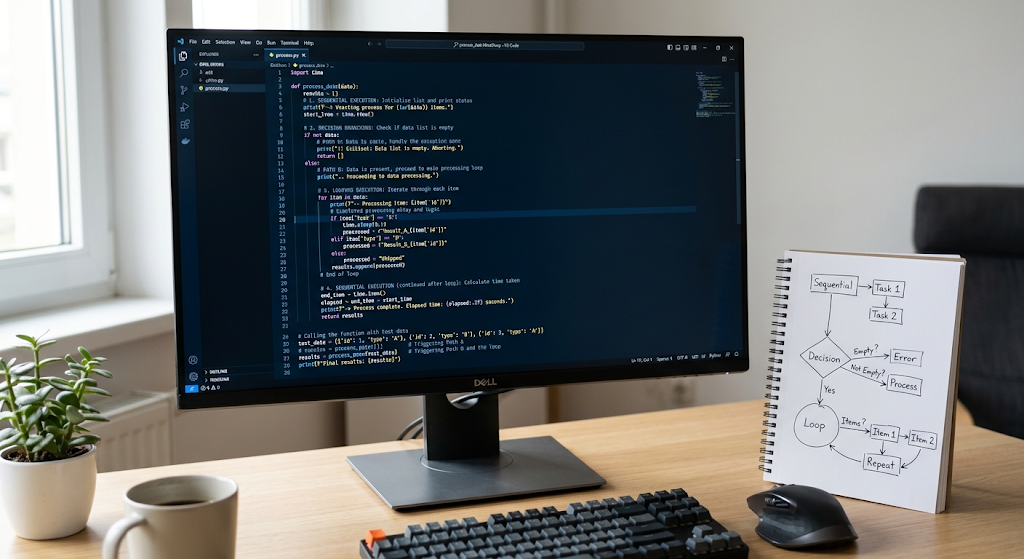
Selection is a programming construct that enables the selection between two or more alternatives depending on a certain condition. The most common selection structure is the if block, which can only be executed when a certain condition is true. Else in a program can follow an alternative path and else if (or similar constructs) can be used to check multiple conditions.
Many languages also have a switch or match construct to select from among a set of behaviors according to the value or pattern of an expression. Selection is necessary because many programs in the real-world don’t use the same instructions for all inputs. A banking app might behave differently when processing a valid transaction as it does when processing an invalid transaction, and a web page may show different information if a user is logged in or not.
The Purpose of Selection in a Real Program
Selection structures enable software to act in an intelligent manner in response to information and not in a repetitive manner when the same instructions are executed each time. Suppose there is a program that determines if a student passes an exam. It needs to compare the student’s outcome to some pre-established criterion and determine a response. Likewise, an online store can decide if a product is in stock before accepting an order, and a security system can decide if a user has the proper permissions to view sensitive information before showing it to them.
The examples show that selection relates program logic to the real world. The developers often use logical operators like AND, OR, NOT in combination. With expanding applications, a well structured selection logic is critical to maintain the program’s understandability, maintainability, and predictability.
To Repeat Operations Efficiently
Iteration enables a program to execute a group of instructions over and over for a specified number of times without the programmer having to explicitly write these instructions for each iteration. Loops are the most common way to implement iteration. Languages usually have for, while and do-while loops, though there can be variations in syntax. A for loop is often convenient when a programmer knows or can calculate the number of times it will be repeated, and a while loop is often used when a programmer wants the loop to repeat while a condition is true.
Iteration comes in very handy when processing a collection of data. A loop can perform the same operation on each item in a list of hundreds or thousands of items without having to write separate statements to do this. This results in shorter, more standardized programs, and simplifies program changes.
Iteration Is Used in a Variety of Ways
Iteration is used in software development projects because when many computing tasks repeat, iteration is a natural occurrence. A program can repeat steps through a list of customer records, read each character in a string, perform some action on each item in a shopping cart, or ask for input and repeat until the input is good. Iteration is also an essential part of many algorithms. Recurrent execution is important for searching, sorting, data processing, simulation and numerical calculations.
Any developer should however carefully plan the loop conditions to ensure that the loop doesn’t end before it should or become too large to terminate. A good loop should always have a definite purpose, a condition that can become false at some time, and proper processing of the data it is to use. Knowing these concepts can prevent programmers from making predictable mistakes and produce predictable programs.
Reusable Blocks of Logic and Program Organization
Larger programs will have the same instructions repeated many times throughout the program, thus increasing the duplication and making maintenance more difficult. This is where a lot of the reusable blocks of logic are really useful. Programmers can define a procedure or function that contains a set of instructions to perform a specific action and then call the procedure or function whenever the action is needed, rather than implementing the same action in many places.
This has the added benefit of making the organization more effective as each reusable unit can have a clear purpose and responsibility. This also implies that if something needs to be changed in a specific operation, the programmer can often modify one copy of the same code instead of having to find it among several copies of the same code. Reusable logic is thus closely related to modular programming, maintainability, testing, readability, and breaking down large apps into smaller, more understandable units.
Recursion: A Function Calling Itself
This section defines a function that calls itself.Recursion: A function calling itself.
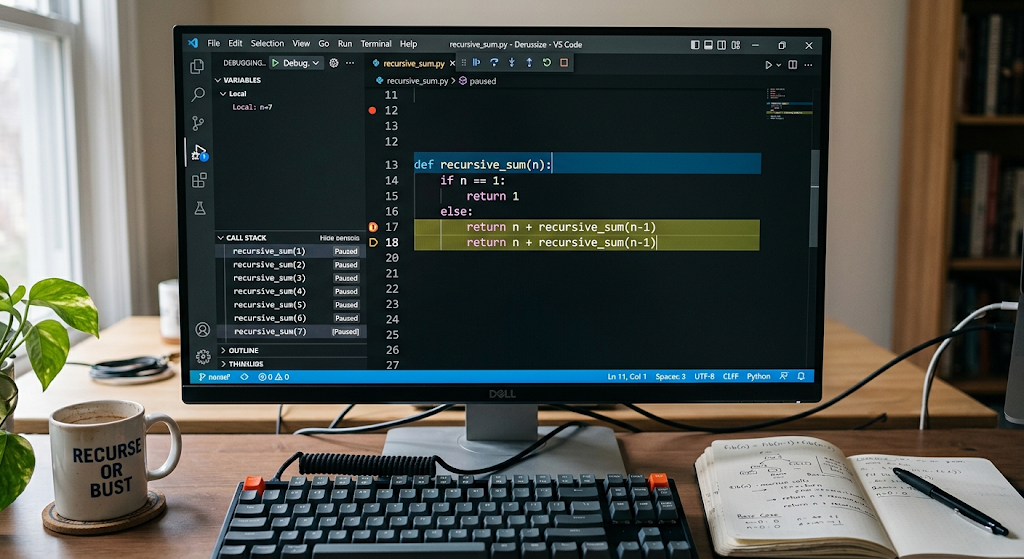
Recursion: When a function calls itself, either explicitly or implicitly, to solve a problem. Typically, there are two aspects to a recursive solution: a stopping condition, which is known as the base case; and a solvable condition, which is known as the recursive case. If there is no base case to terminate the recursion, it can also continue endlessly, leading to a program crash. Problems that are hierarchically or self-similarly structured are especially suitable for recursion. These can include traversing directories, processing trees, exploring specific graphs and solving mathematical problems that can be broken down into smaller problems. While many recursive problems can be solved using iteration, in some cases, the solution generated by recursion will be more similar to the problem’s structure.
Procedures and Functions
Groups of instruction that can be executed when required are called procedures and functions. Terminology varies between programming languages. The distinction between procedures and functions is made in some languages, with the former generally used to perform actions, and the latter to produce a value, and in other languages a nearly complete one is made, with nearly all callable units being functions.
The key point here is that the developer can create a block of behavior and call it anywhere in a program. For instance, a program might include a function that calculates a total price and/or a procedure that displays a menu. This is because software is easier to understand if the responsibility for each part of it is clearly defined. It also facilitates testing since individual functions can be tested in isolation from the larger application.

Parameters: Passing Information to Functions
This is a section in the Java station that provides information to a function.
Parameters are used to pass information to functions and procedures that are called from other functions or procedures. A named variable that is known when the function is defined; the value that is passed when the function is called is usually called an argument. For instance, one function to calculate the area of a rectangle may take width and height arguments. Areas for a number of different rectangles could then be computed using the same function, but without unnecessary implementations. Some programming languages have a variety of mechanisms for passing parameters, such as positional, named, optional, default, and variable-length argument lists. A key point to understanding parameters is that they help keep functions general, and not specific to a particular data set. This helps to foster flexibility and to develop truly reusable elements of the program.
Returning Values and Results
Return value: information returned by a function and returned to a calling program. For instance, a function that adds up the total cost of a purchase might return the total calculated amount to enable another section of the program to use this amount or display it or store it. Functions can be used as a computational unit whose output can be used as an input to another function using return values.
Not all procedures or functions need to return a value that carries a meaning; some are used to do an action, like displaying information, modifying an object, writing data or recording an event. Languages vary in the way they represent a function that does not return any value; but the general concept is that a callable unit can return the result, perform an operation, or both, as it is designed.
Scope: Determining Where Variables Exist
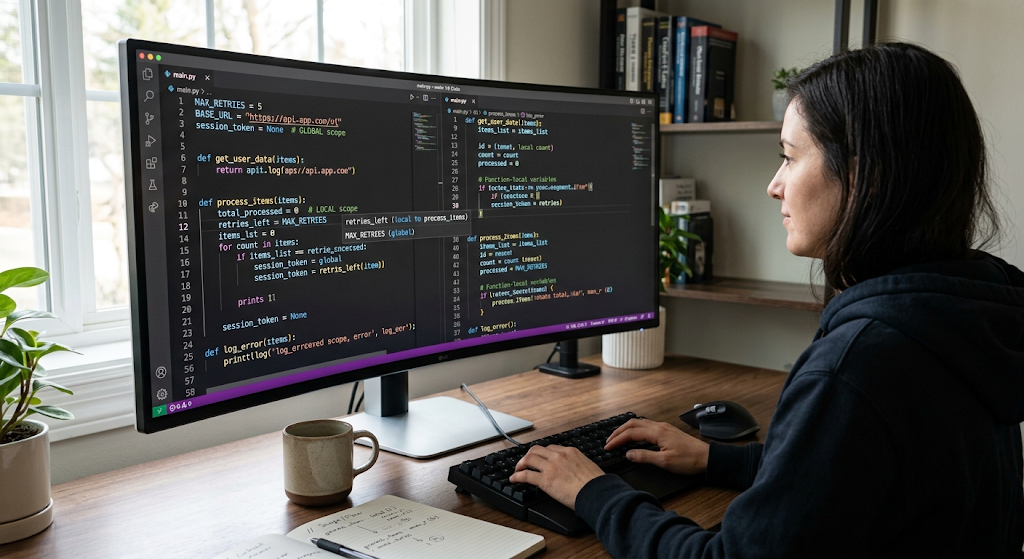
Scope refers to the area of a program that a variable, function, or identifier can be used in. It’s a significant concept because programs often have numerous variables of various purposes and lifetimes. A variable with a local scope (declared within a function) can only be used within the function, a variable with a global scope (declared at a broader level) can be used over a wider range of the program. Different languages have different scope rules, but the scope rules include local, global, block, and module or namespace scope. Limiting access to variables can minimize unintended interaction among the various components of a program. In general, a temporary variable in one function is not likely to be available to all the other functions. A good usage of scope helps the developer to organize the data and avoid unnecessary dependency.
How Control Structures and Functions Work Together
Control structures and functions don’t stand alone. They co-operate in making practically functional software. Sequences, selections, and iterations can be placed within a function and a loop can call a function repeatedly to process a different item. A conditional statement can decide on which function to call, and a function can return a value that affects following decisions. Recursion involves repeated computation (repeated function calls), also known as a recursive procedure, which is a function that calls itself until it eventually reaches a base case.
Parameters are used to pass information into these functions, and return values to the calling code. Each part of the program has only the information specified by scope available to it. It is more useful to know how these things relate than to learn about individual syntax rules; programming languages can represent the same idea in various ways.
Example of Combining the Fundamental Principles
Let’s look at a simple application that receives a list of customer orders. It can start by executing a set of instructions that will load the order information and prepare the process environment. It can then iterate through each order, looking at each one in turn. An order can be considered valid, pending or needing further attention inside the loop thanks to a selection structure. A function can be used to get the total value of each of the valid orders, the price and quantity are used as parameters; the return value of a function can be used for a running total.
The formatting or display of the result can be performed in a separate function. Local variables can be used to store temporary results in the right context. Recursion may be another approach to traversing an application that requires a hierarchical structure, like categories and subcategories. This example demonstrates the interaction of several basic programming concepts in one real scenario.
Importance Across Different Programming Languages
Control structures and functions can be expressed in many different ways in a variety of programming languages, but the concept is the same. Many languages, like Java, C, C++ and JavaScript, use braces to define many blocks, whereas Python typically does this with indentation. In some languages, functions are used to a great extent, and in object-oriented languages functions are also part of classes and objects. Functional programming can consider functions as values to be passed among functions and procedural programming can focus on procedures and explicit control flow.
However, those differences shouldn’t be too significant, because a programmer who knows sequence, selection, iteration, recursion, parameters, return values, and scope can move his/her knowledge from one language to the next. The syntax still needs to be learnt, but the concepts are still helpful even if the language or programming paradigm is different.
Common Mistakes to Steer Clear Of
There are some common mistakes to steer clear of.
Beginners have difficulty understanding the use of control structures and functions if their behavior is not understood. Common errors include writing if statements that don’t ever get false, looping forever, failing to return a value from a function, passing into a function an argument that is not correct, or trying to access a variable outside of its realm of permission. In recursive functions, if the base cases are not defined or if the recursive call does not make the problem easier to solve, it can cause issues. There’s another problem though: writing too many functions that try to do a lot of unrelated things. A good general rule of programming is to have clear responsibilities, meaningful names, manageable functions, and straightforward control flow. It can be used to test individual functions and investigate various input conditions, thus helping to identify early on any errors and facilitating the debugging and maintenance of larger programs.
Conclusion
Control structures and functions are used to control program execution and organise software into manageable units. Selects produces condition based program decisions and Sequence sets an order of operations. Iteration can be used for doing repeated work efficiently, and recursion can be used to solve problems by repeated function calls that break the problem down to a base case. Parameters are used to pass information to a procedure or function and values are used to pass results back from a procedure or function.
Limits access to identifiers and reduces unwarranted interaction among various sections of a program. These principles provide a practical means for programmers to develop organized, reusable, and maintainable programs. The knowledge gained from them can be used as a solid basis for algorithms, data structures, object-oriented programming, functional programming, and other advanced software-development concepts.