
Programming is a method used to give directions to a computer to perform tasks, solve problems, process information and respond to users. When beginners first see code that they don’t recognize, it may appear to be difficult, but in essence, programming is simply a way for a programmer to describe a solution to a problem using a programming language and for the computer to execute the instructions in a sequence of steps. All applications, websites, mobile apps, games, and software programs start with instructions that are written by people.
Those instructions are then translated or processed into a series of instructions that the computer’s hardware can understand. It’s easier to get the mystery out of programming by understanding this journey. Beginners need not think of code as a jumble of strange symbols – it is a method of giving a machine instructions to perform a series of actions.

Writing of Codes by Programmers
A programmer is writing code, which is a sequence of instructions that he or she hopes to have the computer execute to achieve a specific task. Typing random commands in a text editor is not a typical way to start the process. Suppose that a computer programmer is making an easy calculator. First, one might think that the program should accept numbers, perform mathematical calculations on them, and then display the results. The programmer then selects a programming language and writes such requirements in terms of the language rules and commands. The instructions produced are known as source code, as they are the original code created by humans. Programmers can read source code, but it is still subject to the exact rules of the programming language. The computer must be able to interpret the program and to translate the program into instructions it can follow.
An important thing to remember about programming and human-written code is that the programmer’s instructions are the basis for what the computer will do later. Rather, a formal programming language is used containing words, symbols, structures, and rules that are used by the programmer. The rules enable software to interpret the meaning of each instruction precisely. After the code is written, another stage of the program is to verify, translate or interpret the written instructions. The code can be compiled prior to execution, interpreted on the fly during program execution, or some mixture of the two, depending on the programming language and development environment. This is the change that links human thoughts with machine operations.
How to Read Source Code and Syntax
The text that is readable by humans is called source code. It has the instructions, calculations, decisions, data definitions, functions, etc. that tell a program what to do. Typically, programmers write program code in a text editor or an integrated development environment, which is also known as an IDE. It can be as short as a few lines in a simple program or as long as thousands of lines or millions of lines in thousands or millions of files in a professional software.
Yet the underlying purpose of source code remains the same: it implements the program’s structure, operation and logic using a programming language that is governed by certain rules. There are many different languages including Python, Java, JavaScript, C++, and C; each of these languages have different syntax and features, but each gives the programmer a structured way to describe operations that ultimately the computer can execute.
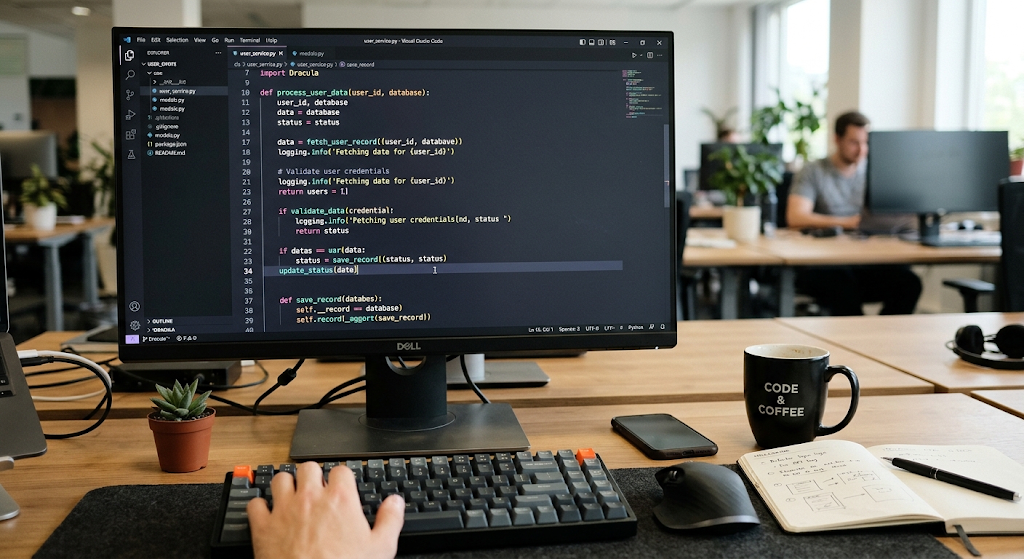
Why Syntax Matters
Syntax means to the rules that govern the way instructions have to be written in a programming language. Languages, such as the English language, employ grammar to ensure that sentences are structured correctly; programming languages employ syntax to ensure that code is properly formed. A program may fail to run before it can even do what it is supposed to do if one symbol is missing, a keyword is misspelled, a bracket is missing, and so on, or if it is indented incorrectly.
Syntax is thus one of the first concepts that should be understood when programming. But, having the right syntax does not mean it will run right. There is a way to write code that follows 100% of the rules of a programming language and still get the wrong answer. As programmers start to write more sophisticated and larger programs this distinction between syntactic correctness and logical correctness is important.
Algorithms: Planning Before Coding
An algorithm is a sequence of instructions that can be followed to solve problems and/or perform tasks. When programmers start to write source code, they usually consider the steps they need to take to get the desired result. For a program that must find the maximum number in a list, you might think to use a function.You might be tempted to use a function for a program that must find the greatest number in a list. The programmer has to determine what the program should be doing with the values, how to compare them, how to remember the largest so far, and how the program should report the answer. That process can be represented as an algorithm prior to being turned into the syntax of a specific programming language. Algorithms are significant because they bring into focus the solution itself not the actual instructions that are used to solve it. A good algorithm can then be written in various programming languages with similar logic and desired result.

Algorithms can be quite basic or much more complex, such as in the field of artificial intelligence, cyber security, search engines, data analysis and financial technology. It can be helpful to consider an algorithm as a recipe for solving a problem, especially for beginners. A recipe defines the ingredients, the order of operations and a specific output. A computer algorithm follows the same rule but the instructions do not allow the computer to make assumptions as it follows them. A programmer, if he does not specify an important step, will never be able to deduce the missing information from common sense and insert it into the program. For this reason, programmers spend lots of time examining a problem and thinking about a logical answer to it before or during writing the source code.
The Compilers: What They Do to the Code.
A compiler is a software program that converts a program written in some programming language into another program that can be executed by another program or by the computer. Traditional compilation models involve a programmer creating a source code, and then using a compiler to compile that code. The compiler will check the syntax and other errors and will translate valid instructions into a lower level program representation, in this process. The output will be either machine code or some other intermediate code, depending on the language and compiler. Machine code are instructions which are coded in a form that can be directly executed by the processor of a computer. That is, compilation is a vital connection between the “readable instructions” written by programmers and the “low-level operations” which are performed by computer hardware.
Compilation also offers the chance for a compiler to detect errors prior to running a program. A compiler can detect an error and refuse to successfully compile the program if a programmer does not use a variable properly or does not follow the rules of the language. Modern compilers can also transform programs to more efficiently use resources while still producing the same program functionality. Each language and development system implements it differently, but essentially the idea is that the source code is somehow transformed into a form that can be run. The crucial thing for beginners to understand is that the computer is not simply reading a page of source code and executing it directly as processor operations, but rather reading the source code and translating it into the processor’s operations.

Interpreters and How They Work
An interpreter is a program that receives instructions from source code and then translates and executes them, typically while the program is running, without first converting the program to a form of traditional machine code. This is because the behaviour may vary between programming languages and modern implementations (for many languages, there are hybrid ways of doing things that involve compilation, interpretation, intermediate representations or virtual machines). The principle is very useful for novices, however: an interpreter is able to instruct a computer using the instructions of the programming language, and perform operations as the person requests. Programming languages with interpreted executions include Python and JavaScript, but most of the newer implementations of these languages use advanced techniques and the definition of “compiled” versus “interpreted” is not as clear-cut as it seems.
The distinction between compilation and interpretation is thus more a distinction in the way the program instructions are used to be processed than a distinction of two totally different programming branches. Modern software systems may use several techniques, or one or the other, but a compiled program is translated before it is run, and an interpreted environment is executed on a line-by-line basis. A language can do, for instance, what is called intermediate representation conversion, then execution and further optimization of that representation by a runtime system. These approaches exist due to the goals of programming languages and computer systems related to portability, development speed, performance, memory usage and flexibility. This will help new programmers to not come to think of the idea that all programming languages go from source to processor instructions in exactly one simple way.
The Role of Variables in Programming
Variables provide a way for programs to store and work with information while they are running. A variable may hold any value (e.g., a number, a name, a sentence, a date, a measurement, another value) that the program requires. For instance, a program may store the score of a student in a variable, and then use that value to determine if a certain condition occurs or to compute an average. The values in variables are variable and can change during the operation of a program, making the programs flexible. When a programmer does not need to write individual instructions for each possible value, he or she can write general instructions that are executed for variables. How variables are defined and how they are used varies by language, especially with respect to their types and the need for them to be declared.
Variables can also be used to structure information and ensure that the program is easier to understand. As programs get larger, it’s more important for a meaningful variable name to communicate what is being represented. There are many variables that can be used in programs at once, and each one can have a specific function in a portion of the program. Some variables can hold intermediate results, others can hold information that stays there for a much longer time. When a program runs on a computer, these values are stored in the computer’s memory. If a variable is changed in an instruction, the computer does operations that change the data. Variables make one of the basic links between the logic of source code and the data a computer manipulates itself.
Functions and Reusable Instructions
The other crucial building block of programming is the function. A function is a part of a program that is named to perform a specific task. A programmer can write a set of instructions once within a function, and call the function at any point in the program where they need the instructions. For instance, if we have a program to calculate a sales tax, there may be a function in the program that performs the calculation. The function could then be called from other parts of the program as needed to perform a tax calculation. Functions take in values, manipulate the values and then return values. This approach helps to keep programs more structured and decreases duplication. It also enables programmers to break down complex problems into smaller parts that are easier to program, test, comprehend and maintain.
Functions are especially useful in large software developments. Each function of a professional application can be hundreds of thousands or millions of functions that work together to offer different features. One function may check information from the user, another may access information, and another may present the information. Programmers can make changes to a specific part of an application without affecting the rest of the system. Functions also promote code reuse; that is, a well-designed piece of logic can be reused in several places. This helps keep the code maintainable and can save developers from making mistakes by repeatedly developing the same operation. Knowledge of functions gives the beginning programmer insight that programming is not just a list of commands; it is a way of structuring groups of similar operations into meaningful components.
Program Execution and Runtime Environments
A runtime environment is the context under which a program runs as it is executing. Delivers services, libraries, resources and supporting systems that are necessary for the program to work. The runtime can consist of various components such as a virtual machine, standard libraries, memory management systems, security mechanisms, and more, depending on the programming language and platform. The program does not run alone when a programmer starts up an application. It relies on operating systems, hardware, libraries and runtime components to access memory, files, networks, input devices, displays, and other resources. The runtime environment thus makes a significant contribution to the execution of a program’s instructions into actions that the user can observe and participate in.
The program is executed when the proper system loads and runs the program. The program then executes the instructions in it; it checks conditions, makes calculations, calls functions, fetches data, and reacts to inputs. The processor performs low level operations and the memory stores information used during the operation. The program may ask the operating system or other software to give it information from a file, a database, or a network service by using the operating system or other software. The way it works is that the instructions in source code are translated into a sequence of operations that are carried out inside a computing system, depending on the application. The outcome could be a message displayed on a monitor, a calculation returned to the user, a file produced, or information transmitted over a network.
From Source Code to Computer Operations
The process of getting from source code to the operations of a computer can be seen as a chain of related steps. A programmer recognizes a problem, and writes an algorithm to solve it. The algorithm is then written into the syntax and features of a specific programming language, thus defining a program in source code. The code is then checked for errors and compiled, interpreted, run in a virtual machine or all three. The obtained instructions are then interpreted in a suitable runtime environment. When execution occurs, variables contain data, functions execute specific operations and the program interacts with the operating system and hardware when resources are needed. Finally, the processor executes low-level instructions to operate on the data stored in the computer and control its operations. While contemporary programming systems may make this procedure sophisticated, each phase is there to link human instructions with actions carried out by machines.
This is how programming works, and why it takes logical thinking and attention to detail. There are electrical circuits that are not directly commanded by a programmer every time a line of Python, Java, JavaScript, C++ or other languages is written. Rather, they are encoding instructions in a series of software programs that in the end link the instructions to the operation of the machines. The layers allow programmers to work with variables, functions, objects, conditions, algorithms and other concepts rather than with the individual operations of the processors themselves. Meanwhile, when a programmer is coding, the knowledge of the underlying process will assist him or her in trouble shooting. Errors can be caused by incorrect syntax, poor logic, bad variable value, missing dependency, runtime issues or interaction with the operating system. Understanding of the stages is a help to understanding these problems.

Why Understanding Program Execution Matters
Learning the workings of a program provides a much better basis for a novice programmer than to learn programming commands. Once students realise that an algorithm is a solution, source code is a way to express a solution, syntax is a way to write source code, and compilers or interpreters act as a machine for executing source code, programming makes more sense. Variables are then interpreted as containers for moving information, as reusable operations, and as runtime environments as systems that enable programs to run. The idea is common to many programming languages, although specifics of the syntax and implementation may vary. There you will have a number of basic concepts that as soon as you get them, you will be able to learn a particular language as it is simply learning a new method to express common programming concepts instead of memorizing an entirely different set of rules.
Finally, programming is a process of human problem solving and machine execution of a program. Programmers start with a goal and concepts; turn those concepts into an algorithm; write the concepts as source code; and execute the concepts as a result of having them processed by a software tool. On execution, the computer executes the instructions contained within it by means of a processor, memory, operating system, runtime environment and so on. This translates into the software experience the user will have, ranging from basic mathematical calculations to sophisticated websites, mobile apps, AI systems, games, and business platforms. There’s no one special moment where suddenly coding transforms into a working app. Rather, programming is a sequence of electronics-related processes that are carefully interwoven. After learning about chains, computer programming becomes less mysterious and more comprehensible to the beginning programmer, as a practical way to convert logical concepts into working programs.