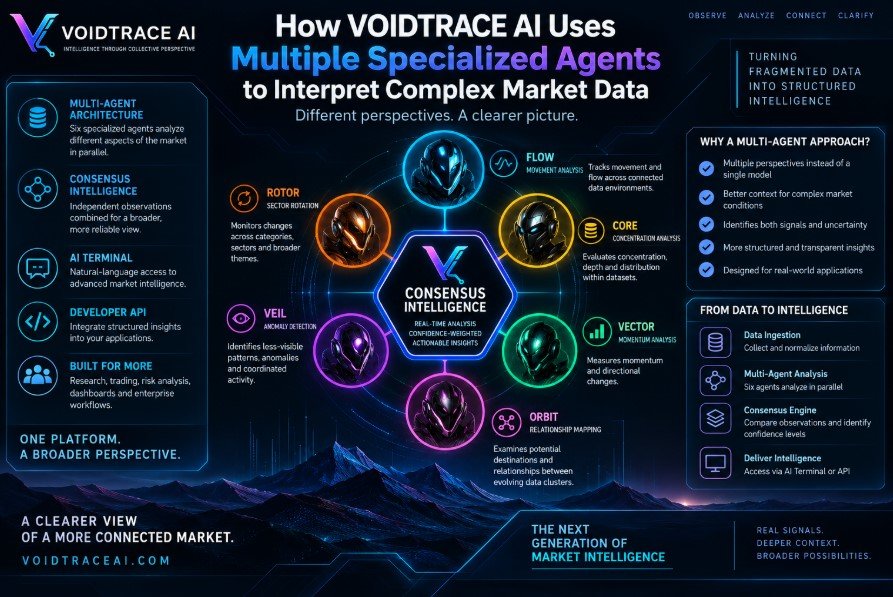
Following its September 4 public rollout, VOIDTRACE AI explains why its architecture separates data analysis across six specialized agents instead of relying on a single general-purpose model
September 2026 — Artificial intelligence systems are increasingly being used to summarize large volumes of information, but complex analytical environments can present a different challenge.
One model may be asked to identify momentum, detect anomalies, evaluate concentration, track movement and compare categories simultaneously.
VOIDTRACE AI is taking a different approach.
Following the September 4 rollout of its wider ecosystem, the project is continuing development of a multi-agent architecture in which individual analytical responsibilities are distributed between six specialized agents.
Why Specialization Matters
Each VOIDTRACE AI agent is designed to examine a different characteristic of incoming information.
FLOW observes movement.
CORE focuses on concentration and distribution.
VECTOR examines momentum.
ORBIT evaluates potential destinations and relationships.
VEIL looks for hidden or less-visible patterns.
ROTOR monitors changes between categories and themes.
The premise is similar to using several specialists instead of asking one analyst to evaluate every dimension of a complex environment simultaneously.
Multiple Observations Feed One Consensus Layer
The architecture does not treat each agent’s result as the final answer.
Instead, observations can be passed into a shared consensus layer.
Consider an environment where VECTOR identifies rising momentum while FLOW detects increasing movement and CORE observes improving concentration.
Those signals collectively provide different context from momentum appearing on its own.
Likewise, if one agent identifies a change while the remaining agents provide little confirmation, the system can preserve that disagreement.
The goal is to create structured intelligence that reflects both signals and uncertainty.
Moving From Raw Information to Structured Output
The system is designed around a sequence:
Data → Processing → Specialized Agents → Consensus → Structured Intelligence
The resulting information can then be delivered to users through the VOIDTRACE AI Terminal or to software applications through developer infrastructure.
This separates data processing from the interface used to consume the results.
Natural-Language Interaction Through the AI Terminal
The VOIDTRACE AI Terminal is intended to allow direct users to interact with the underlying architecture through natural-language questions.
A researcher might want a written explanation.
A developer might require structured machine-readable output.
An organization might want the same information delivered into an existing dashboard.
VOIDTRACE AI is developing the platform so the same underlying intelligence architecture can potentially support each of those workflows.
Public Rollout Continues After September 4
The project’s September 4 rollout also included the launch of the $VOIDE presale, introducing the ecosystem token alongside the broader platform.
VOIDTRACE AI said the next development phase will continue to emphasize the intelligence architecture, Terminal experience and developer integration.
Additional information is available at VoidTraceAI.com.
About VOIDTRACE AI
VOIDTRACE AI is developing a multi-agent artificial intelligence environment built around specialized analytical agents, consensus-based interpretation, natural-language interaction and developer-facing infrastructure.
Disclaimer: This article is provided for informational and educational purposes only. Platform features described may remain under development and may change over time.