The entrance of a commercial building has to handle more than people coming and going. It needs to work reliably during busy periods, provide a practical experience for visitors, support accessibility, and fit the security and operational needs of the property.
That is why automatic sliding doors have become a practical option for many commercial entrances.
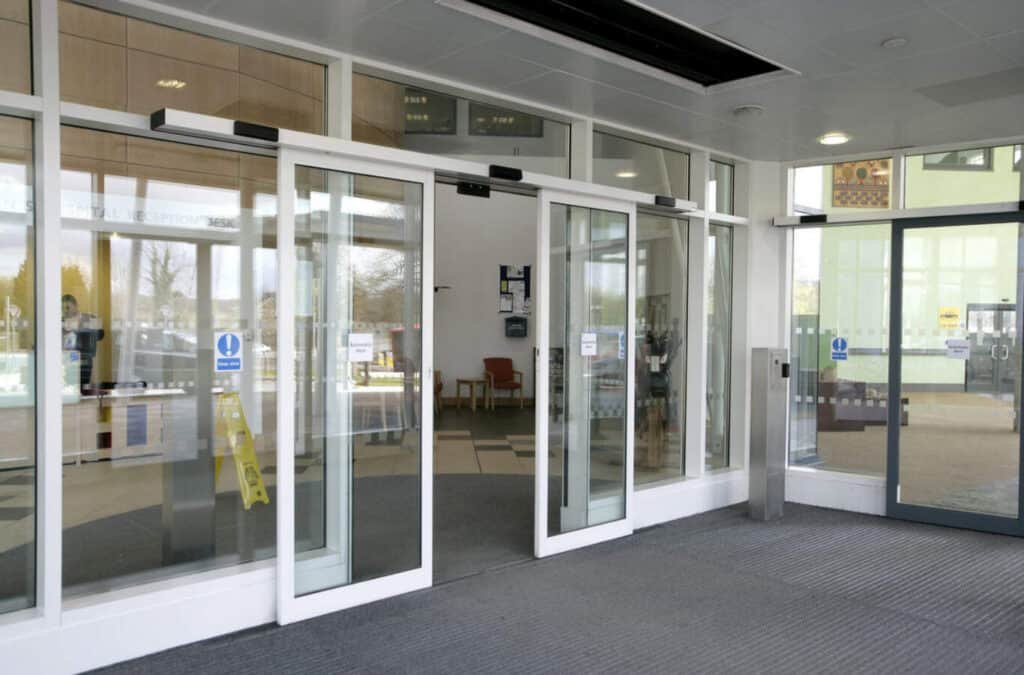
Unlike a traditional hinged door, an automatic sliding door opens by moving its panels along a track rather than swinging into the entrance area. Depending on the system, activation can be provided by sensors, push buttons, access control, or other approved devices.
For businesses considering automatic sliding doors NJ, the decision should not be based solely on appearance. The building layout, pedestrian traffic, accessibility requirements, available space, safety features, maintenance needs, and intended use all matter.
New Jersey also regulates commercial construction through its Uniform Construction Code. The state adopted the 2024 editions of several model codes effective August 17, 2026, so businesses planning a new installation or major alteration should verify which code provisions apply to their particular project and permit timeline.
Here are the practical benefits commercial property owners should consider.
1. Easier Entry for Customers and Visitors
One of the most obvious benefits of automatic sliding doors is that people do not have to physically pull or push the door open.
That can make a difference in everyday situations.
A customer may be carrying shopping bags. A hotel guest may have luggage. A visitor to a medical facility may be using a walker. An employee may be moving supplies between areas.
With a properly installed automatic sliding system, the door can open when the appropriate activation device detects a person or receives a signal.
This removes one physical step from the entry process.
For businesses with a steady stream of visitors, that small improvement can make the entrance feel easier to use throughout the day.
2. Better Support for Accessible Entrances
Accessibility is one of the most important considerations when planning a commercial entrance.
The Americans with Disabilities Act does not generally require every business to install automatic doors. It does, however, establish accessibility requirements for covered facilities and accessible routes.
The ADA Standards address automatic and power-assisted doors specifically. Full-powered automatic doors are required to comply with the applicable ANSI/BHMA standard incorporated by the ADA Standards.
The standards also address clear opening width, maneuvering clearance, thresholds, controls, and emergency operation.
For automatic doors that form part of an accessible means of egress and do not have standby power, the ADA Standards include requirements concerning maneuvering clearance or standby power, with specific provisions for emergency operation.
This means an automatic sliding door should not be selected simply because it appears accessible.
The entire entrance needs to be evaluated.
Door dimensions, approach areas, activation controls, thresholds, surrounding routes, emergency operation, and other elements can affect whether an entrance meets applicable requirements.
For a commercial project in New Jersey, businesses should have the proposed installation reviewed against the applicable federal and state requirements.
3. Automatic Sliding Doors Work Well in High-Traffic Areas
Busy entrances can become inefficient when every person has to manually operate a door.
Think about a supermarket during a busy afternoon or a medical building during appointment hours.
People may be entering and leaving continuously.
Automatic sliding doors can help keep that movement more orderly because the door opens and closes as people approach and pass through the entrance.
This can be particularly useful for:
- Retail stores
- Shopping centers
- Supermarkets
- Medical offices
- Hospitals
- Hotels
- Office buildings
- Banks
- Restaurants
- Public facilities
The benefit is not that an automatic door magically makes a building faster.
Rather, it removes a repeated manual action from an entrance that may be used hundreds or thousands of times over the course of normal business operations.
4. Sliding Doors Do Not Require Swing Clearance
This is one of the most useful design advantages of a sliding door.
A conventional hinged door needs space for the door leaf to swing open.
A sliding door moves laterally, so the entrance does not require the same type of swing arc.
That can be valuable in commercial properties where space is limited.
For example, a business may have:
- A narrow lobby
- Retail displays near the entrance
- A busy corridor
- A restricted vestibule
- Heavy pedestrian traffic
- Equipment positioned near the doorway
Because the panels move along a track, the door can provide an opening without occupying the same floor area as a swinging door during operation.
However, sliding doors still require appropriate space for their panels, operators, sensors, and other components. The building layout should therefore be evaluated before selecting a particular configuration.
5. They Can Help Manage Pedestrian Flow
Commercial entrances rarely have people approaching from only one direction.
People arrive, leave, pause, enter with groups, and sometimes turn around before reaching the doorway.
Automatic sliding systems can be configured to respond to pedestrian traffic using appropriate activation and safety sensors.
That can make the entrance more predictable for people approaching from different directions.
In a busy facility, this can be particularly useful because visitors do not have to stop, reach for a handle, pull the door, and then move through the opening.
Instead, the entrance can operate as part of the building’s overall pedestrian flow.
The result depends heavily on correct installation and system configuration. An improperly positioned sensor or poorly adjusted operator can create problems rather than solve them.
6. They Can Make Hands-Free Entry Possible
Hands-free access is useful in more commercial settings than many business owners initially consider.
A grocery customer carrying bags may not have a free hand.
A warehouse employee may be transporting materials.
A hotel guest may be pulling luggage.
A healthcare worker may need to move equipment.
In these situations, eliminating the need to physically operate the door can make movement through the entrance easier.
Automatic sliding doors can therefore be valuable where people frequently carry objects through an entrance.
This is one reason they are common in environments where pedestrian traffic and material movement happen throughout the day.
7. Automatic Doors Can Work With Access Control
Automatic operation does not mean that every person must automatically be allowed through the door.
Depending on the system, an automatic sliding entrance can be combined with access-control equipment.
This can be useful for commercial properties with different access requirements.
For example, a building might have:
- A public entrance during business hours
- A controlled employee entrance
- Restricted areas beyond the lobby
- After-hours access
- Card-reader access
- Keypad-controlled areas
- Security monitoring
The automatic door and access-control system can be designed as part of the same entrance strategy.
The specific integration depends on the door operator, locking hardware, access-control equipment, building layout, and security requirements.
This is particularly important for businesses that want convenience without giving up control over who can enter restricted areas.
8. They Can Improve the Appearance of a Commercial Entrance
The entrance contributes to a visitor’s first impression of a business.
Glass automatic sliding doors are commonly used in modern commercial buildings because they provide a relatively open appearance and allow visitors to see into the lobby or retail area before entering.
They can work well with:
- Glass storefronts
- Modern office buildings
- Retail entrances
- Hotel lobbies
- Medical facilities
- Shopping centers
- Corporate buildings
Appearance should not be the primary reason to install an automatic door, but it can be part of the overall design decision.
A commercial entrance should ideally balance appearance with safety, accessibility, durability, security, and expected traffic.
9. They Can Help Keep the Entrance More Organized
Manual doors depend on users to open and close them.
Someone may hold the door open for another person. Another visitor may leave it open longer than necessary. A busy group may approach while the door is still moving.
Automatic doors control the opening and closing cycle through the door operator and activation system.
That can provide more consistent operation.
This does not mean an automatic door will always close immediately or that it will eliminate all air movement through the entrance.
The actual operating cycle depends on the equipment, settings, traffic, environmental conditions, and applicable safety requirements.
The advantage is greater control over the door’s normal operating sequence.
10. Automatic Sliding Doors Can Be Used in Different Commercial Settings
Automatic sliding doors are not limited to one type of business.
Their configuration and capabilities can make them suitable for a wide range of commercial applications.
Retail Stores
Retail entrances can experience significant pedestrian traffic throughout the day.
Automatic sliding doors can make it easier for customers carrying bags, shopping carts, or other merchandise to move through the entrance.
Medical Facilities
Healthcare facilities often have visitors and employees moving equipment, supplies, and personal belongings.
An entrance that does not require manual operation can be useful in these environments.
Hotels
Hotel guests often arrive with luggage.
An automatic entrance can make moving from the exterior into the lobby easier, particularly during busy check-in periods.
Office Buildings
A commercial office building may benefit from automatic entry when the lobby receives a steady flow of employees, visitors, vendors, and deliveries.
Access-control integration can also be considered for areas where entry needs to be restricted.
Shopping Centers
Shopping centers and other high-volume commercial properties can use automatic entrances to manage significant pedestrian traffic.
The specific door design should be based on expected traffic levels and the physical characteristics of the entrance.
11. Safety Should Be Built Into the Installation
Automatic sliding doors need appropriate safety equipment and installation.
The purpose of industry standards for power-operated pedestrian doors includes reducing the likelihood of user injury or entrapment.
ANSI/BHMA A156.10 covers power-operated pedestrian doors and includes requirements intended to address safe operation.
That makes professional installation important.
An automatic sliding door involves more than the glass panels themselves.
The complete system can include:
- Door operator
- Activation sensors
- Safety sensors
- Tracks
- Rollers
- Control equipment
- Breakout mechanisms where required
- Locks
- Glass and framing
- Electrical components
Each component needs to work correctly with the others.
Businesses should also establish an appropriate maintenance schedule after installation.
12. Maintenance Can Protect Long-Term Performance
Automatic doors contain more mechanical and electronic components than basic manual doors.
That means maintenance should be part of the ownership plan.
Regular inspections can help identify problems with components such as sensors, tracks, rollers, operators, locks, or other hardware before they become larger operational issues.
The exact maintenance schedule depends on the door type, manufacturer, traffic volume, environmental conditions, and applicable standards.
High-traffic entrances naturally place more demands on the equipment.
A commercial property should therefore consider expected usage when discussing the door system and maintenance requirements with the installer.
13. They Can Be a Practical Choice for New Jersey Businesses
Businesses considering automatic sliding doors NJ installations should think about both the door system and the regulatory environment.
New Jersey’s Uniform Construction Code governs construction work throughout the state and is enforced through the applicable state and local code officials.
The state adopted new 2024 model-code editions effective August 17, 2026. Because code requirements can depend on the type of project, occupancy, alteration, and permit circumstances, a business should not rely on a generic online door checklist when planning an installation.
Instead, confirm the requirements that apply to the specific property.
This is especially important when replacing an existing entrance, changing the doorway configuration, modifying an accessible route, or integrating the door with other building systems.
Automatic Sliding Doors vs Traditional Swinging Doors
It is useful to compare the two systems based on actual business requirements rather than assuming one is always better.
| Consideration | Automatic Sliding Doors | Traditional Swinging Doors |
| High pedestrian traffic | Generally well suited | Can require more manual interaction |
| Hands-free operation | Available with appropriate activation | Not normally available |
| Swing clearance | No traditional door swing arc | Requires space for swing |
| Accessibility | Can simplify operation when properly designed | Can also be accessible when properly designed |
| Access control | Can integrate depending on system | Can integrate with appropriate hardware |
| Installation complexity | Generally higher | Generally simpler |
| Components | Operator, sensors and additional hardware | Fewer powered components |
| Maintenance | Requires attention to powered and mechanical components | Primarily mechanical hardware |
| Commercial appearance | Often suited to glass and modern storefront designs | Available in many styles and materials |
| High-volume entrances | Often a strong application | Depends on door design and traffic |
The right choice depends on the building rather than the label attached to the door.
What Should You Consider Before Installing Automatic Sliding Doors?
Before ordering an automatic sliding system, evaluate the entrance from several angles.
Pedestrian Volume
Estimate how many people use the entrance during normal and peak periods.
A door designed for a small office may not be appropriate for a high-volume retail entrance.
Available Space
Measure the entrance and surrounding walls.
Sliding doors need space for the panels and operating equipment. The available layout will influence which configuration is practical.
Accessibility
Review the complete accessible route rather than focusing only on the door.
The approach, clear opening, thresholds, controls, maneuvering areas, and emergency operation can all matter.
Security
Determine whether the entrance needs access control, electronic locking, monitoring, or after-hours restrictions.
Safety
Confirm that the proposed equipment includes appropriate activation and safety features and is installed according to the applicable standards.
Maintenance
Ask about recommended maintenance intervals, replacement components, service availability, and expected operating conditions.
Building Codes
For a New Jersey commercial project, verify the applicable Uniform Construction Code requirements and permit process before work begins.
Are Automatic Sliding Doors Worth It for Commercial Buildings?
For the right building, they can be.
The strongest case for automatic sliding doors usually comes from a combination of high pedestrian traffic, accessibility considerations, limited swing space, hands-free entry needs, and the desire for a controlled entrance experience.
A low-traffic business with a simple entrance may not receive the same practical benefit.
That is why businesses should avoid choosing a door solely because it looks modern or because another property uses the same system.
The entrance should be evaluated based on how people actually use it.
The equipment should then be selected to match those conditions.
Improve Your Commercial Entrance With Alpha Doors & Security
If you are researching automatic sliding doors NJ for a commercial property, the next step is to evaluate the existing entrance and determine which door configuration fits your building.
Alpha Doors & Security can be considered when exploring commercial door and security solutions in New Jersey. Before moving ahead, discuss pedestrian traffic, available space, accessibility, security, safety, maintenance, and applicable code requirements with a qualified door professional.
A commercial automatic sliding door should be more than an attractive upgrade. It should be properly matched to the building, installed with appropriate safety measures, and maintained so it can continue serving the people who use the property every day.