Introduction
Instruction set architectures (ISAs) are used to specify the way that software interacts with computer hardware. In computer architecture, two main techniques in instruction set design are Reduced Instruction Set Computer (RISC) and Complex Instruction Set Computer (CISC). Both architectures embody different approaches to CPU design, which impact a variety of aspects of processor performance and efficiency, device applications and functionality, and software compatibility. For computer science students, electronics engineers and anyone applying for technical exams or processor-related jobs it is important to know the difference between RISC and CISC.
Different architectures were developed to address different computing problems, RISC and CISC. RISC has a smaller number of simple instructions that takes less time to execute, whereas CISC has a larger number of complex instructions that can perform more than one operation. These ways diverge in the speed of instruction, the complexity of the processor, energy usage and the kinds of devices that each architecture is typically used in.
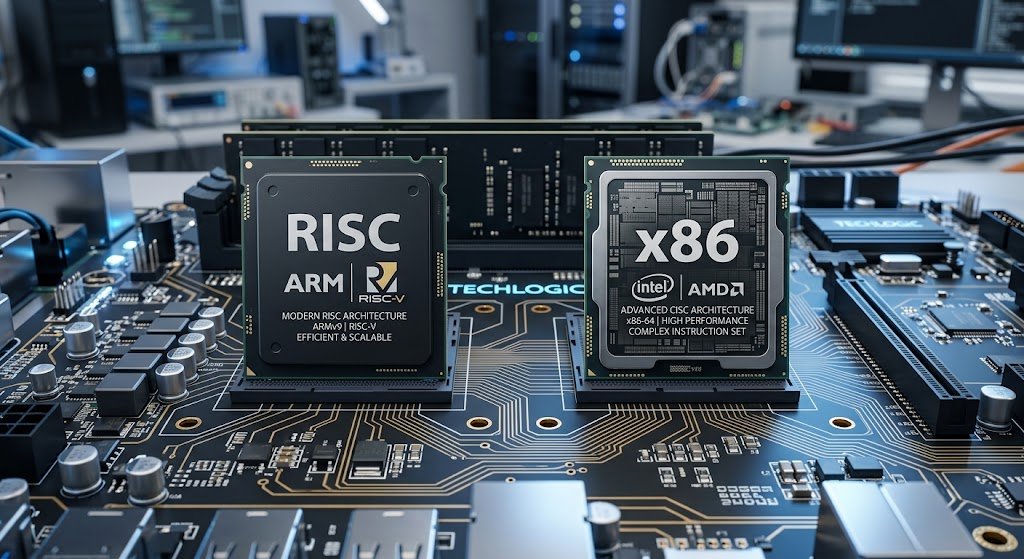
In the modern context of computing, this is becoming more interesting due to the fact that traditional boundaries are now less rigid. There are for instance ARM processors on the rise in smartphones and embedded devices, and x86 processors in desktop and laptop computers are still popular. Meanwhile, open-source architectures like RISC-V are attracting interest due to their flexibility and customization. To understand why ARM/RISC-V vs x86 processors are used in different computing contexts, it is helpful to have a detailed understanding of ARM vs RISC-V.
The RISC Architecture
A design strategy for processors that makes use of a small set of simple instructions is known as RISC (Reduced Instruction Set Computer). The basic premise of RISC is that a CPU that supports a few simple instructions, but can execute them very quickly, can be far more efficient than one that supports many complicated instructions. Each instruction is supposed to do a simple operation — this way, the processor does several simple instructions to get a complicated one done.
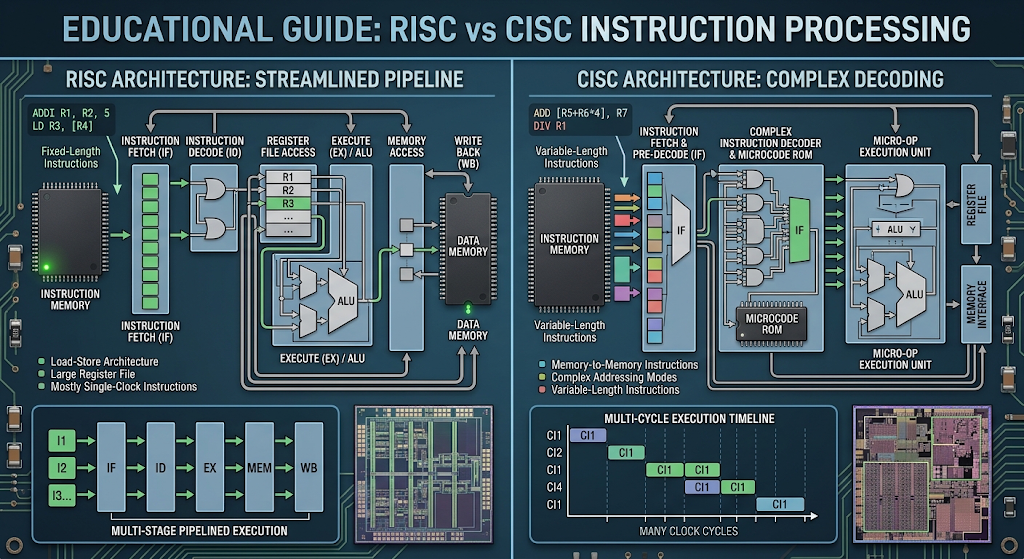
The RISC design philosophy leans towards simplicity, efficiency and predictable execution. The typical RISC processors have fixed length instructions, with instructions typically the same length. This helps to simplify the process of instruction decoding and lets the processor pipeline run more efficiently. Instructions are easier to read and the hardware architecture of the CPU needs fewer transistors to decode instructions allowing for more transistors to be used for additional registers, better caches and more advanced execution units.
The load/store design model is a second significant attribute of RISC. Only certain instructions have access to memory in RISC, and arithmetic and logical operations typically use data that is stored in the registers. This saves the complexity of memory access and also optimizes the processing. Armand, RISC-V, MIPS and PowerPC are examples of RISC based architectures.
Advantages of CISC Architecture?
The Complex Instruction Set Computer (CISC) is a type of processor architecture that has a vast number of instructions that execute complex operations. The aim of CISC is to use an instruction to execute several tasks so as to decrease the number of instructions needed to execute a program. A CISC processor can have a single instruction that performs several operations, rather than having to perform several simple operations.
The CISC approach evolved at a time when memory cost was high and memory was limited. Programming efficiency and memory saving were achieved by minimizing the number of instructions in a program. CISC processors feature a large number of addressing modes, varying instruction lengths and dedicated instructions for special functions.
Companies like Intel and AMD have made their x86 chips popular for many desktop computers, laptops and servers, and they have been around for decades, with plenty of software support. In fact, while complex instructions are translated into simpler micro-operations in the processor itself, the CISC instruction set is kept in order to support existing software.
Differences between the RISC and CISC architecture
Instruction Set Size
The biggest difference between RISC and CISC is the size of their instruction sets. A smaller instruction set with fewer instructions, each of which was designed to execute a simple operation, was used in RISC processors. This makes the processor simpler and provides more uniformity of instruction execution.
CISC processors have hundreds of instructions in their instruction sets, many of which are specialized instructions. These instructions can be used to simulate more complex instructions, thereby decreasing the number of instructions that can be used in a program. But with a large instruction set, the design of the processor becomes more complex and more sophisticated decoding is needed.
Instruction Length
Another key distinction between the two types of architectures, RISC and CISC, is the instruction length. The instructions in RISC processors usually are fixed-length, that is, each instruction is the same length. Many ARM processors have instructions which are the same length, so they can be decoded quickly and operate efficiently in a pipeline.
Most processors with CISC instructions have variable word lengths. In x86 architecture, instructions may be as little as a few bytes or upwards to a lot of bytes depending on their complexity. Variable length instructions offer flexibility, but also make the decoding of instructions more difficult since the processor has to locate both the starting and ending position of instructions.
Performance of the execution and execution speed
The RISC processors are engineered to be simple and fast. RISC processors can deliver high performance, with fewer clock cycles and lower hardware complexity, due to its short and typically complete instructions. The regular instruction format can also facilitate the optimization of pipelines.
Advanced features like out-of-order execution, branch prediction, and instruction-level parallelism make it possible to achieve good performance with CISC processors. Today’s x86 processors are very capable, and offer greater performance in many processing applications, such as desktop and server workloads than do many RISC processors. Modern processors solve this problem by translating the instructions into simpler operations in their internal architecture; this is the reason they support CISC instructions.
While architecture is an important factor, the performance of a processor is affected by other factors such as processor design, clock speed, cache size, manufacturing technology, OS optimisation, workload type, etc. Thus one should not draw the conclusion that RISC is always faster or CISC is always slower.
Examples of RISC and CISC Processors
ARM Architecture
ARM is a notable success in the world of RISC. ARM processors were initially designed for energy-efficient embedded computing, and are favored due to their power-saving capabilities and high performance efficiency. In the present-day, ARM chips are found in smart phones, tablets, smart watches, embedded systems, automotive electronics and more.
The ARM processors are heavily used in mobile operating systems like Android and iOS. Companies create custom ARM chips to make the performance and battery life as effective as possible. For instance, the A-series and M-series processors powered by ARM architecture are capable of delivering performance while being energy efficient, Apple’s of course.
The success of ARM shows the merits of RISC in power and thermal management-sensitive applications.
RISC-V Architecture
RISC-V is an open-source RISC (reduced instruction set computer) architecture that has become popular in recent years. Unlike proprietary architectures, RISC-V is licensed to allow for researchers, companies and developers to design their own processors without paying license fees.
Educational Projects, Embedded Systems, Research Applications, Specialized Computing Solutions are all using RISC-V. It is flexible enough to enable organisations to develop processors that are specialised for certain functions, such as AI applications, the Internet of Things, and low-power systems.
RISC-V is also a move towards processor development becoming more open, and offers an alternative to the traditional ARM and x86 architectures.
x86 Architecture
The best-known CISC is x86. Originally made by Intel, x86 processors became the standard of personal computers and servers. Intel and AMD are companies making x86 compatible processors utilized by millions of desktops, laptops and enterprise systems.
There are a number of benefits to x86, with software compatibility being the largest. There are many decades of applications, operating systems, and enterprise tools that have been built for x86. Many computing environments are hard to replace with x86 because of this large ecosystem.
Today’s x86 processors are CISC machines with sophisticated internal features that enable them to deliver high performance and backward compatibility.
The Power Consumption of RISC versus CISC
One of the best features of RISC architecture is that it is power efficient. RISC processors have fewer hardware resources for decoding instructions, and they have simpler instructions, which makes them more energy efficient. This makes them perfect for battery-operated gadgets like smart phones, tablet computers, and wearable gadgets.
Mobile devices need processors that have powerful performance, but remain cool and don’t drain the battery rapidly. ARM processors are an example of how RISC principles can be used to achieve some balance between speed and energy efficiency.
It is common that the CISC processors are more complex due to the larger instruction sets and advanced decoding systems that they support. This complexity can lead to high power consumption, particularly in high-performance processors like CPUs for desktop and server systems.
But modern x86 processors have made a great improvement, owing to better manufacturing and power management options. Features such as dynamic frequency scaling and efficient cores allow modern CISC processors to provide better energy efficiency than earlier generations.
Pros and Cons of RISC Architecture
Advantages of RISC
The main advantages of RISC are: Simple instruction set makes processor design easier and makes it more efficient to execute. Fixed length instruction makes it faster to decode and improves the pipeline performance. Typically, a RISC processor includes fewer transistors to process instructions, potentially saving on power consumption and production complexity.
Scalability is an additional benefit. RISC is an architecture that can be scaled to a wide variety of applications, ranging from an air-quality sensor or embedded controller to a laptop processor. ARM’s RISC designs have proved to be very successful in mobile computing, where low energy consumption is crucial.
Disadvantages of RISC
The worst thing about RISC is that programs can be larger on it than on a CISC system if they run the same task. Increasing the number of instructions may add to the program space and require more memory and compiler optimizations.
The efficient development of software for RISC processors can also necessitate care in optimizing; the programmer and compiler must deal with several simple instructions, rather than complex hardware instructions.
Pros and Cons of CISC Architecture
There are some advantages and disadvantages of CISC Architecture.
Advantages of CISC
The key benefit of CISC architecture is that powerful instructions execute the software efficiently. One complex instruction may be able to perform multiple simple instructions, which can decrease program size. Another advantage of CISC processors is their software compatibility, particularly with x86 systems.
Compatibility is a big factor in x86’s staying power for enterprise and desktop clients. Users can run the old applications without any major changes since the modern x86 processors have been able to run the old instruction sets.
Disadvantages of CISC
The design of CISC processors is more complex: They need advanced systems of instruction decoding. It can be difficult to support multiple instructions, which can lead to an increase in processor size, cost and power consumption.
Another drawback of many CISC processors is that the length of the instruction varies, causing pipeline design to be more complex. Most of these problems are overcome by modern processors, but the complexity is still a disadvantage compared to simpler RISC designs.
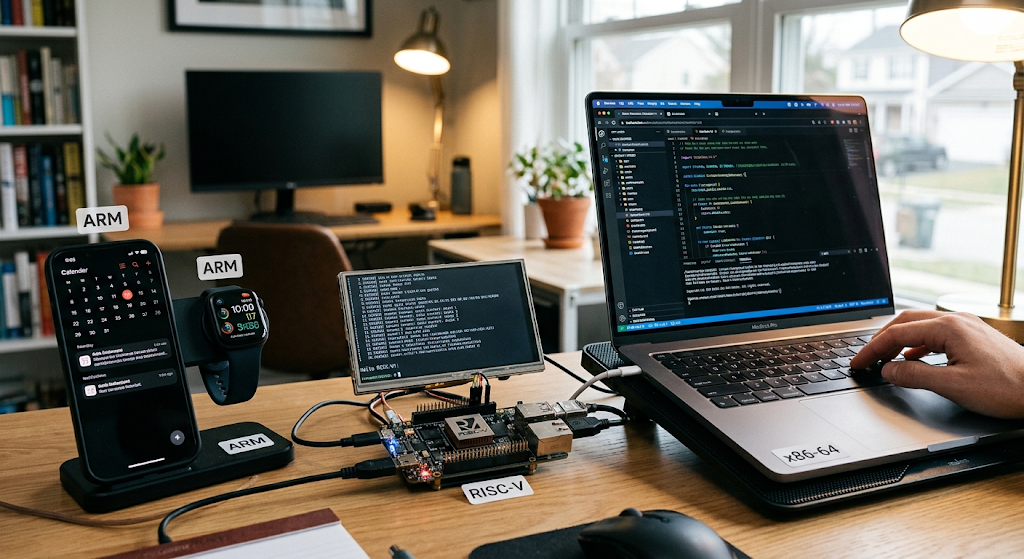
RISC/CISC distinction in Mobile and Desktop Computing
Mobile Devices
RISC based processors, particularly ARM, are widely used in mobile devices. Power efficiency, heat dissipation and excellent battery life are all essential features of a successful smartphone, which can be achieved through RISC architecture.
The ARM processors are sufficient for heavy usage applications like gaming, AI processing, video editing and multitasking, while using minimal amounts of energy.
Desktop and Laptop Computers
Most desktop and traditional laptops have traditionally used x86 CISC processors from Intel and AMD. They are still in use as they are very efficient, have a large software support, and can be used for professional applications.
But desktop processors powered by ARM chips are getting a run for their money these days. Recent x86-RISC comparisons show that recent RISC chips are competitive with x86 systems, where they once were not.
RISC vs. CISC Architecture: Which is Better?
There is no general winner between RISC and CISC as each type is aimed at different objectives. The RISC is very efficient for applications where efficiency, simplicity and power consumption are important. This makes it perfect for use in mobile phones, embedded devices and energy efficient applications.
CISC continues to be useful in situations where software compatibility and high computing power becomes a factor, as well as where existing ecosystems exist. x86 processors persist in powering desktop computers, servers and enterprise systems.
Both architectures will make an appearance in the future of computing. ARM is steadily continuing its expansion to laptops and servers, RISC-V is becoming popular as it is open sourced, and x86 is still a very strong platform for traditional computing workloads.
Conclusion
There are two different processor design approaches: RISC and CISC. The RISC processor is designed for simple instructions, efficient execution and low power consumption, whereas the CISC processor is designed for powerful instructions, software compatibility and flexibility. The advantages of RISC architecture are evident in ARM and RISC-V, particularly for mobile and niche computing, while x86 remains the dominant architecture for desktops and servers.
The key difference to note is that RISC has a small number of simple instructions that are fixed in format whereas CISC has a larger number of complex instructions that have variable formats for use in exams and technical interviews. But today’s processors have moved beyond such simple definitions, and are made up of a complex mixture of advanced technology to deliver high performance and efficiency. Knowing both architectures will give a good foundation in computer organization, processor design, and future of computing technology.