Introduction
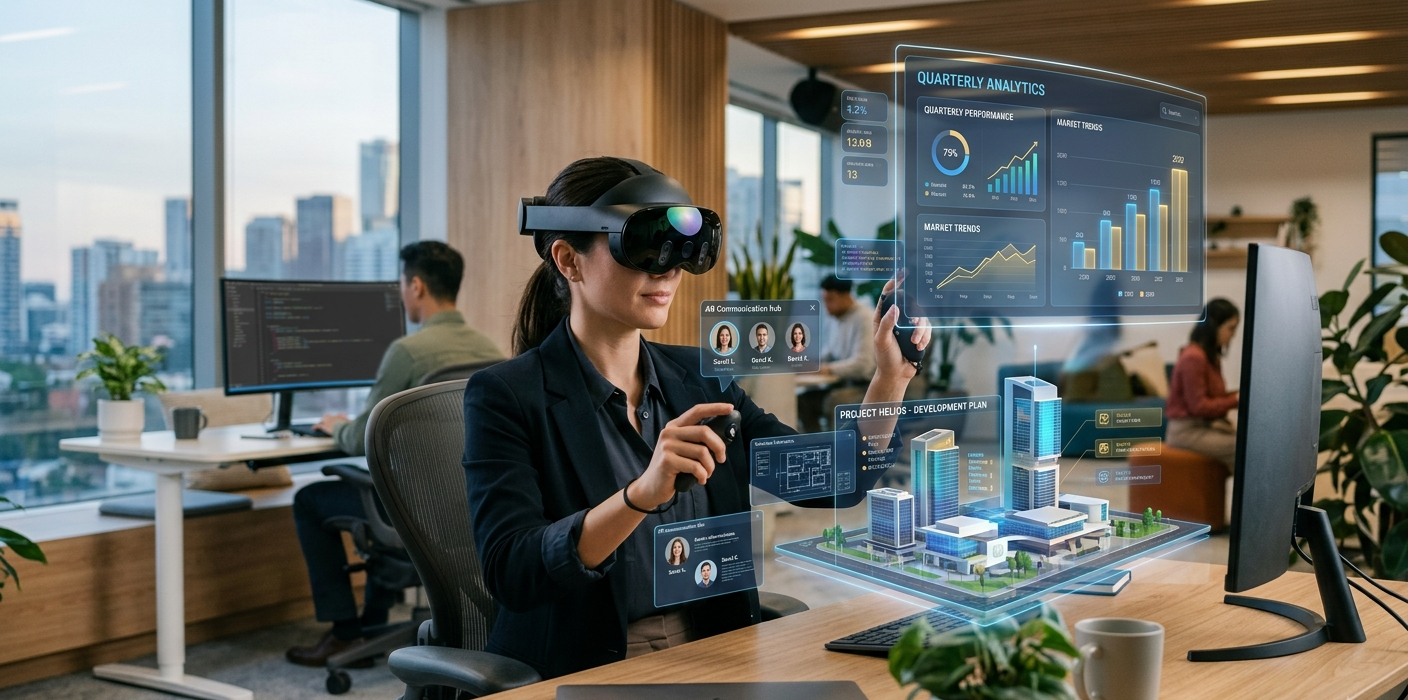
The landscape of human interaction with information, entertainment, work, and learning has been transformed over the years by technology. Every generation of technology has led to a new way to connect the physical and digital world, from the invention of the computer to the development of the smartphone and cloud technology. The next step in this evolution is Extended Reality (XR), which integrates real-world settings with smartphone-generated content to create a fully immersive experience. XR is not one technology but rather is a term that encompasses Augmented Reality (AR), Virtual Reality (VR), and Mixed Reality (MR). These technologies are all creating a new way for humans to interact with digital information that is more natural, more visual and more engaging.
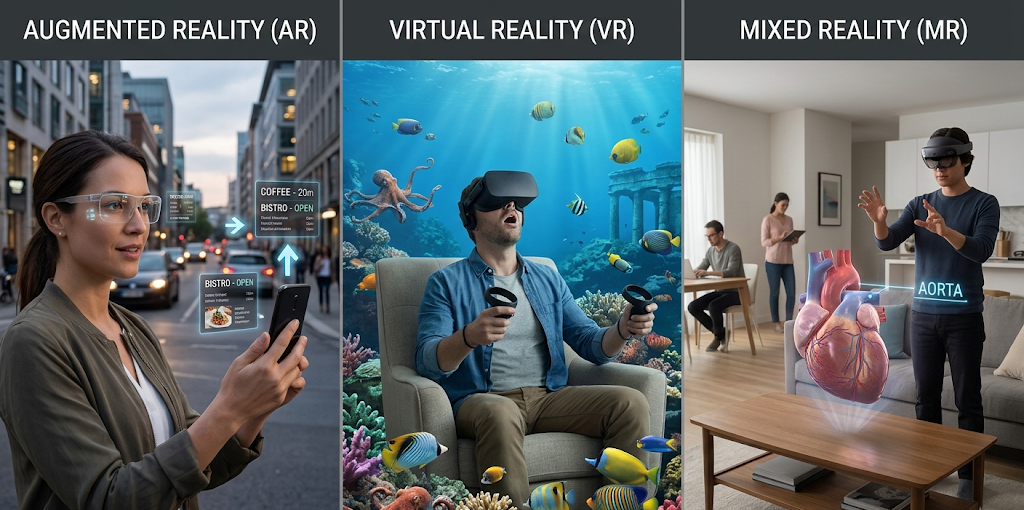
Extended reality is the term used to refer to the spectrum of extended reality that exists across the continuum of technologies between the real world and digital world. On the first end of this spectrum is Augmented Reality: augmenting the real world with digital elements. Virtual Reality is the other side of the coin, which builds a totally simulated environment that takes the place of the user’s surroundings. Mixed Reality is about fusing these two experiences together, enabling digital objects to interact with the real world. Concurrently, with its continued evolution, XR is increasingly proving itself to be an essential educational, healthcare, engineering, entertainment, business collaboration and much else again tool.
What is Extended Reality (XR)?
Extended Reality (XR) is a group of technologies used to merge digital content into people’s perception. XR is different from a computer screen that shows information in a flat format, it creates an immersive experience for the user, who can interact with digital objects in three-dimensional spaces. They are realized with the help of hardware, software, sensors, artificial intelligence, computer vision, and high-quality graphics technologies.
XR systems are designed to interpret the surrounding context of a user and react to their actions through the use of headsets, smart glasses, controllers, cameras, and motion sensors. For instance, an XR device could be used to pinpoint a person’s location, identify the surrounding objects, and render a digital display that feels like it is fused with the real world. This capability opens the door to more engaged learning, simulations of real-world scenarios, creative design thinking, and enhanced collaboration at a distance.
Advancements in computing power and accessibility of devices have helped to fuel the growth of XR. Some of the first XR technologies were used by researchers or large companies, but today, XR devices are becoming available to consumers, schools, and small businesses. As the costs go down, and as experiences increase, XR will be seen as a more regular way of interacting with digital things.
Three Main Types of Extended Reality
Augmented Reality (AR)
Augmented Reality (AR) is a technology that merges a virtual or digital object with the people, places, and things of the real world. With AR, users can visualize their environment and watch superimposed digital information, like images, animation, text, 3D models, and interactiveness. The majority of AR experiences are meant to enhance the comprehension and engagement with the environment.
One of the most frequently encountered examples of AR is applications that superimpose digital objects in a real environment using the camera of a smartphone. Navigation apps can overlay directions on top of the streets, people can view interactive 3D models of furniture in their homes in shopping applications, and educational apps can bring interactive 3D models of planets, animals, or human anatomy to life. Such experiences will help increase the usefulness of the information; users will be able to view digital content within the context of the real world.
The AR devices are smartphones, tablets and specific smart glasses. Companies are creating AR goggles that enable users to retrieve information without needing to hold a device. These glasses can be used to give workplace instructions, show notifications, help with maintenance jobs, and be used in various professions. As AR hardware continues to grow in sophistication, the technology will become more portable, robust and popular.
Virtual Reality (VR)
Virtual Reality is the technology that enables the user to experience a completely virtual environment (VRE) where the world around them is simulated by the computer. Wearing a VR headset puts them in a virtual environment that allows them to see and interact with virtual objects, and live through situations that wouldn’t be possible in real life. VR is a different experience than AR, which brings the digital into the real world.
VR headsets are equipped with displays, motion tracking sensors, and controllers, which give users an immersive experience. Some popular VR headsets are gaming, professional training or enterprise VR headsets for businesses. Users can explore virtual environments, navigate through virtual spaces, and interact with virtual objects, experiencing a sense of presence.
While gaming is one of the most well-known uses, VR has revolutionized so much more. VR is used in business for training staff in simulated environments without potential hazards. For instance, pilots can simulate flight procedures, medical students can learn from simulations and engineers can virtually view machines before they are built. The following are examples of uses of VR for the enhancement of learning, safety and efficiency.
Mixed Reality (MR)
Mixed Reality is a blend of Augmented Reality and Virtual Reality – digitally created objects can exist and interact with the real world. Virtual objects are not just superimposed on the real environment in MR experiences, but can react to the real environment and seem to be in the user’s space.
Advanced sensors and cameras are used to enable MR devices to learn about the world around the user. This enables digital objects to “see” the surfaces, react to movement and affect physical space. For instance, a designer can set up a virtual model of a building on a real table, and then move around and modify the building as if it were real. Engineers could view digital machines and work together with other engineers to view the same machine.
Mixed Reality is particularly useful for the professional sector, allowing participants to collaborate, visualize and solve problems. MR can be used by architects, manufacturers, healthcare professionals and researchers to better understand complex information. In the future, MR technology could be one of the most significant means of linking digital information to real-world activities as the technology evolves.
Experience with XR Devices and Hardware
Specialized hardware is essential for XR development in order to enable users to experience digital environments naturally. XR devices are made of head-mounted displays, smart glasses, handheld devices, motion controllers and tracking systems. There are different types of hardware, each offering a specific degree of immersion and interaction.
VR headsets are one of the most popular types of XR devices as they offer full immersion. These feature high-resolution screens, speakers and head and body motion detectors. These features enable virtual exploration of an environment with realistic movement. AR devices like smart glasses, mobile apps, and more are designed to be used for the augmentation of information, and not to outright replace the physical environment.
MR devices are generally more technologically advanced since they need to grasp both digital and physical spaces. The devices feature cameras, depth sensors, and AI to map the environment around them and build realistic interactions between virtual objects and real-world spaces. With the rapid advancement of miniaturization, speed and cost reduction of hardware, XR experiences will be more accessible to the general public in the future.
Applications of XR in real world
The use of XR in Education and Learning
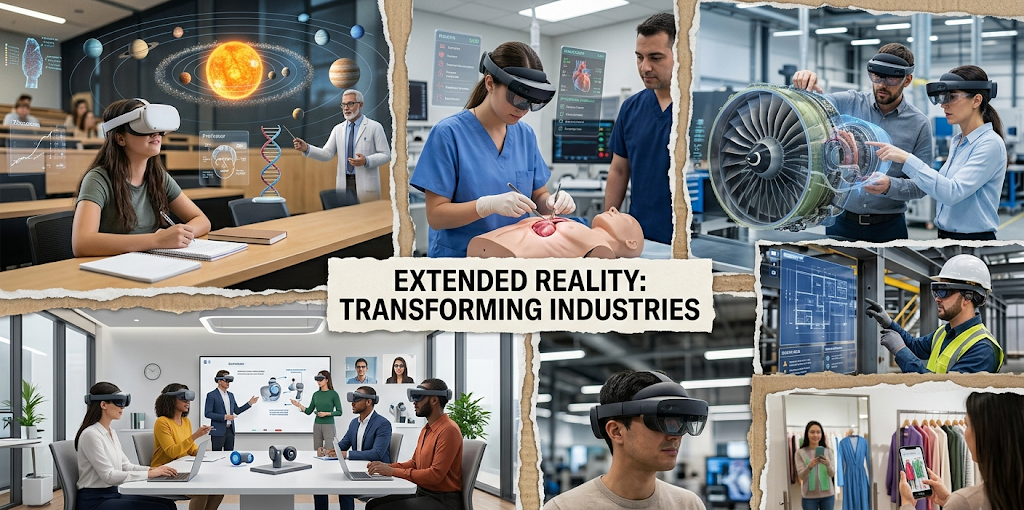
XR has the potential to make a big difference in education. While traditional learning approaches rely on textbooks, lectures, and static images, XR enables students to immerse themselves in concepts and experiences. Instead of simply reading about historical events, students can experience virtual historical locations. Rather than examine illustrations of scientific ideas, they can manipulate real, three-dimensional models.
XR can be utilized to produce interesting lessons that accommodate various learning styles for teachers. Medical students can practise procedures, science students can visit virtual laboratories and geography students can look at environments around the world. These experiences enable students to learn more interactively and help to gain an understanding of complex topics.
XR in Business Training and Professional Development
XR is also being used in employee education across a range of businesses as it allows individuals to gain real-world experience without real-world dangers. Aviation, manufacturing, health care, and construction are all sectors that are utilizing XR for training for difficult situations.
For instance, staff can train to use machinery, deal with emergencies or undertake technical tasks within a virtual environment. This can be done to enhance safety and cut training costs for companies. Additionally, XR allows remote teams to work together in shared virtual environments, making it relevant for today’s work environments.
XR in Entertainment and Gaming
One of the first industries to adopt XR technology has been entertainment. VR gaming offers players the opportunity to experience a virtual environment, with the ability to interact with characters and engage in digital adventures. AR games have also brought innovative concepts for bringing outdoor spaces into the digital world.
In addition to the gaming space, XR is altering the way movies are made, concerts are performed, and one tours the world and socializes. Virtual events enable audiences to experience events from around the globe and museums and cultural institutions can develop virtual exhibitions that are accessible to more people.
Collaborating and working remotely with XR
The trend towards remote work has brought a greater demand for effective digital communication tools. While traditional video meetings offer the ability to interact and collaborate, XR can open up the opportunity for virtual workspaces to be shared, facilitating more natural collaboration.
Employees can meet in virtual offices, view 3D designs and engage with digital documents simultaneously with XR collaboration platforms. This technology can make distance working more interesting by providing a sense of presence between team members who are working remotely.
The Future of Extended Reality
As technology advances and other industries find uses for the technology, extended Reality is anticipated to continue evolving. The use of artificial intelligence, increased network speed, enhanced displays, and better sensors will make XR experiences more realistic and accessible.
XR could be an everyday part of the learning experience, work, entertainment, and communication of the future. The students are able to go to immersive classrooms, businesses to operate in virtual environments, and persons to interact with digital information by means of lightweight wearable devices.
But privacy, accessibility, cost, and responsible use of technology will be key challenges with XR’s growth. Businesses and developers must make sure that their XR products are developed in an ethical manner and benefit various user groups.
Conclusion
Extended Reality is a significant paradigm shift in the relationship between humans and technology. XR is the fusion of Augmented Reality and Virtual Reality with Mixed Reality, opening up new learning, working, designing and experiencing opportunities. These technologies are no longer confined to entertainment, but are rapidly becoming powerful tools to address practical problems in various sectors.
As businesses and creators begin to recognize that immersive technology will shape the future of digital experiences, so should students.XR is more and more important for students, creators and businesses. XR is an emerging technology that will undoubtedly impact how users interact with technology, but it will also transform the way people interact with information, with one another, and with their environment.